Greg’s Cable Map

Greg's Cable Map

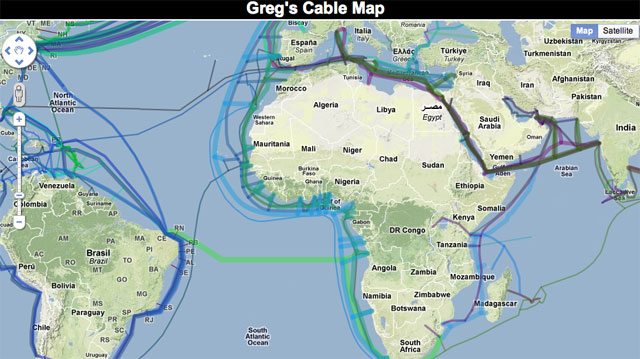
There’s a fascinating interactive map of the world’s undersea communications cables here. It’s also a pretty good guesstimation guide as to where there are, or are likely to be, NSA or subordinate agencies’ (and other non-affiliated intelligence services’) field stations that funnel the data flowing through such cables through computer systems that analyse traffic and content data.

(via Gizmondo)

Will the Global South overtake the North in transparency?

At a time when liberal democracies in the Global North seem increasingly paranoid and cutting down both on personal freedoms and government accountability, could nations from the Global South seize the moment to become the new pace-setters on open government?

There are plenty of good examples from Latin American, but it’s in Africa that the real changes are occurring. Yes, that’s the same Africa often stereotyped as the home of endless war, corruption, military coups and dictators. Kenya, in fact, which the pessimists were portraying as being on the brink of collapse and authoritarianism after election violence a few years ago. But now, Kenya is pushing forward with massive changes in the way its government operates with an increasing tendency towards open information and other accountability initiatives, as a Guardian story is reporting.

Cynics will argue that this is just pandering to a new urban middle class, with only 26% of Kenyans having home Internet access. However, like many countries in Africa, the communications revolution us predominantly mobile and almost 65% of Kenyans have mobile telephones and will be able to access mobile versions of the new sites.

Increasing ‘popularity’ of drones

National Public Radio (NPR)  in the US broadcast an interesting short piece on the spread of drones or Unmanned Aerial Vehicles (UAVs). Drones of all sizes are now increasingly used by national and local states – I think ‘popular’ is the wrong word as most people have no idea that they are so widespread or even that they are likely to be operating at all. There’s also a longer piece by Barbara Ehrenreich on the more general issue of robotic warfare on the Guardian’s Comment is Free site today.

According to my sources in the UK, they have just started flying Reaper drones out of RAF Northolt over London, in preparation for the 2012 London Olympics.

Globalization

At the other end of the scale from my last post on miniaturization, I came across this extraordinarily forthright editorial in a Portuguese newspaper, lambasting the international financial ratings agencies, Moody’s, Standard & Poor and Fitch Ratings and calling them ‘You Bastards’. I happened to have been just writing about these bodies for my next book and a chapter on ‘Globalization and Surveillance’, in the forthcoming International Handbook of Surveillance Studies. Why I am writing about these organisations? Let me quote from my draft chapter:

“this process most certainly is surveillance as conventionally understood within Surveillance Studies and it is perhaps the single most important form of surveillance operating in the world today at the global level. The reason lies in the outcomes of such profiles and ratings. If individual credit-scoring (re)produces comparative (dis)advantage and embeds poverty and class distinctions, then credit-scoring at the global scale can condemn whole national populations to economic marginality and set an inescapably negative context for individual and collective life chances. This is especially the case for those sections of national populations whose jobs, incomes and livelihoods are still tied into the national economy, as opposed to members of the increasingly footloose transnational ruling class. These ratings systems so affect economic decision-making that even minor changes to the credit scores of governments can effectively undermine national government policy, making states that have any substantial international debt – and that is almost every state in the world – ultimately responsible not to their electorates but to the demands of the rules of competition in finance capitalism.”

The problem is, of course, that people and governments only really notice these organisations, let alone complain about them or fight back against them, when their nation-state is downgraded in the ratings. The surveillance power of these bodies needs to be challenged by those who are not (yet) negatively affected if there is to be any change. And you never know, that might yet happen, as apparently the European Commission is considering how it might control these agencies.

Miniaturization

I am doing a bit of work on the ‘vanishing of surveillance’ right now – looking at the decreasing size of sensors, the hiding of surveillance platforms through biomimetics, and so on.

So I was very interested in news reported on Boing Boing today about a pinhead-sized camera with no conventional lens etc. that is mainly designed for applications that do not require detail. The inventors are talking about medical applications, but once again, the agency funding this is DARPA, the US Defense Department’s research organisation.

Security systems and trust

Sometimes, little local stories give us the best insight into what living in a surveillance society is really like. This one is from a school in Virginia, USA. According to the local newspaper (via BoingBoing) a middle school student was suspended from school for opening the main door for a women who they knew who was unable to press the entry button because they had their hands full. The reason given by the school auhtorities is that the school has a secure entry system, in which people are supposed to press the entry button, look into a camera, and request entry. The student was suspended on the grounds that they were all supposed to know the rules, and that these rules were potentially of vital importance.

However this security-bureaucratic reasoning misses the key point that the child knew the adult concerned. Whilst security and surveillance systems are at least in part designed to respond to a supposed decline in social trust and an inceased ‘threat’ (which is very poorly supported by evidence anyway), there is good reason to suppose that placing what were previously matters of social negotiation into the hands of such ‘systems’, ‘rules’ and ‘technology’ further damages social trust.

Many questions then arise: what is this school, through this action and these systems, teaching kids about society? That security comes above all else? That no-one can be trusted? And that individual decision-making or social interaction is better replaced by impersonal systems? Surely, if education is the basis of the future of society, then what should be taught are the opposite lessons. This kind of subordination to systems is a form of training, of disciplinary control, not learning and education.


Corporate Privacy Redux

The Supreme Court of the USA has unanimously decided (pdf) that “corporations do not have “personal privacy” for the purposes of exemption 7(C) [of The Freedom of Information Act].”

This is a welcome decision which should set back further efforts by corporate bodies to claim ‘human rights’ as a justification for avoiding their responsibilities under laws mandating transparency and accountability.

Marc Rotenberg points us to a welcome for this decision from Senator Patrick Leahy of Vermont.

Good news all round for once.

UK consultation on CCTV: a weak brew?

The UK government has released a consultation document on a ‘Code of practice relating to surveillance cameras’ (CCTV). The closing date for comments in May 25th.

I will go through the document in more detail but there are several initial things to note here:

1. I am interested first of all in the fact that the camera systems are refered to as ‘surveillance cameras’ rather than ‘security cameras’ or ‘safety cameras’ as in many situations I have encountered around the world.

2. This is merely a step toward a state code of practice. The government had promised to ‘regulate’ CCTV, and what many people might have legitimately expected from such a promise was legislation, in other word a statutory footing for surveillance cameras and legal controls. A code of practice is very much at the weak and volunteeristic end of ‘regulation’ if it is regulation at all. The proposed Code itself is really quite weak and presaged on “gradually raising standards to a common level.” with nothing that is mandatory.

3. The document proposes another ‘Commissioner’ to govern surveillance cameras, a ‘Surveillance Camera Commissioner’. This government, despite its avowed attempt to reverse the proliferation of Quangos, seems to want to create another one. One would think that this would naturally fall under the remit of the Information Commissioner, but it appears that the Tory attacks on the ICO (which have been going on in newspapers like The Times for some years and have now spread to other libertarian groups) have been having some effect. Does Britain need another Commissioner in the area of information, surveillance and privacy? I don’t think so. I think we need to clarify the roles of existing Commissioners, and reduce their number – provide adequate budgets and better guidance and division of labour. I suggested a few weeks ago that splitting the ICO into a Surveillance and Privacy Commissioner (which would incorporate the data protection function and absorb all the existing micro-commissions like Surveillance, Interception of Telecommunications and now this new proposed Surveillance Camera Commissioner) and a separate Freedom of Information Commissioner, would be the best solution.

4. The consultation document acknowledges that camera surveillance has increased too rapidly in Britain and has eroded privacy and been overly intrusive. That’s a start. However it also hedges this quite strongly by saying that the government does not intend to limit law enforcement’s abilities. I am not sure the two things are compatible – but I will have to examine the proposals in more detail.

5. The document acknowledges that “CCTV does not always provide the benefits expected of it” but explains this as largely down to technical and operation reasons rather than anything more fundamentally problematic. This is not necessarily justified by evidence or particularly insightful.

6. The document acknowledges that Automatic Number Plate (Licence Plate) Recogntion (ANPR / ALPR) is largely unregulated too and that it connects to all kinds of databases, yet proposes little more than auditable data trails.

7. The document mentions both flying drone cameras / Unmanned Aerial Vehicles (UAVs) and helmet-mounted cameras, but assumes mistakenly that these are ‘niche and novel’. If this can still be said to be true, it will not be for much longer, and the document is overly dismissive of the immediacy of this issue.

8. The document is way too cautious and has the fingerprints of a ‘Sir Humphrey’ bureaucratic avoidance of anything that might ‘frighten the horses’, motivated as it claims to be by “the wish to avoid imposing unreasonable or impracticable bureaucratic or financial burdens on organisations” and recommending “an incremental approach.” It is too late for incrementalism, about 20 years too late in fact.

At first glance, the consultation document appears to be a rather weak brew rather than the strong medicine that is required.

On the Internet, no-one knows you’re a dog

So the (now rather old) joke goes. In fact, this joke is now often seen as an example of how people early on in the history of the Internet misunderstood it. People, the argument goes, are just people on the Net, pretty much the same way they are in real life. No technological determinism here, no siree.

However there is increasing evidence that this new ‘common knowledge’ is dead wrong, but it isn’t necessarily individual ‘dogs’ pretending to be humans online, it is whole organised packs (don’t worry, I won’t take this metaphor any further). Various sources have been reporting the development call by the US military for software development to create artificial posters on Internet forums, chatrooms, and news sites. The US state it seems has woken up to the possibilities of what is often called ‘astroturfing’, the creation of fake grassroots movements, with fake members.

George Monbiot, a leading British investigative journalist with The Guardian newspaper knows about astroturfing more than most. He frequently writes about climate change denialists, and the comments under his stories are always filled with pseudonymous critics who seem to pop up every time the word ‘climate’ is mentioned and their responses often appear to be scripted and organised. He’s been digging deeper, and while his investigations are still ongoing, he has provided a useful summary of recent development here.

As well as the corporate interests (tobacco, oil, pharma etc.) it’s also worth pointing out that other states are far ahead of the US on this. China notoriously has its so-called ’50-Cent Party’, students and others who are recruited by the state and paid by the message to counter any anti-Chinese or pro-Tibetan, pro-Taiwan or pro-Uighur sentiment. Their early efforts were laughably obvious, but are becoming more and more subtle. Israel is open in its backing of such ‘online armies’, and advocates the use of a particular software tool, called Megaphone, which enables its users to respond quickly and widely to any reports or discussion seem as against the interests of the Israeli state.

Anonymity is also used by these organised groups as a form of individual intimidation through other ‘open’ channels, especially of those who lack the resources and sometimes the low cunning to be able to respond effectively. One is Freedom of Information legislation. In the area of climate change denial, we saw this with the systematic and organised petitioning of the University of East Anglia’s Climate Research Unit, in which FoI requests were really a form of harassment. More recently, as I have just heard from Chris Parsons, two professors from Ottawa, Errol Mendes and Amir Attaran, seen as ‘liberal’ and critical of the Canadian government, have similarly found themselves the subject of a huge upsurge in FoI requests, many of which seem to be deliberately requesting very intimate information. This would appear to be Freedom of Information as intimidation.

There are several responses one could have to this. One would be to withdraw from more public and open forms of interaction, to batten down the hatches, retreat into extreme forms of privacy. This would be a mistake: it really would, as some of the more alarmist reports have proposed, mean the death of Web2.0. The other would be to take the Anonymous route, to ferret out the spies and the fakes. This could be done with better forum and comment software, but would mean a lot of hacking effort and knowledge. How is a chatroom supposed to go up against the power of states and corporations? The real risk with this, as with more low-tech forms of ‘exposure’, is that we help create a culture of suspicion in which moles and spies are everywhere, and genuine political interaction is chilled. It may be coincidental, but it is not unrelated, that we are seeing a growing attention being called to this kind of thing just as we have seen the power of social media in the uprisings across the Arab world. In this area at least privacy is not the answer, a more radical political openness and transparency may well be required to facilitate the kind of social trust that can keep Web2.0 growing and changing in a positive direction.

Helping robots find their way in the city

Many approaches to developing cities as automated environments, whether this be for robotics, for augmented reality or ubiquitous computing tend to take as their premise the addition of items, generally computing devices, to the environment. Thus, for example, RFID chips can be embedded in buildings and objects which could (and indeed in some cases, already do) communicate with each other and with mobile devices to form networks to enable all kinds of location-based services, mobile commerce and of course, surveillance.

But for robots in the city, such a complex network of communication is not strictly necessary. Cities already contain many relatively stable points by which such artificial entities can orient themselves, however not all of them are obvious. One recent Japanese paper, mentioned in Boing Boing, advocates the use of manhole covers, which tend to be static, metallic, quite distinctive and relatively long-lasting – all useful qualities in establishing location. The shape of manhole covers could be recorded and used as location-finding data with no need for embedded chips and the like.

It isn’t mentioned in the article, but I wonder whether such data could also be used for other inhabitants of the city with limited sensory capabilities: impaired humans? Could one equip people with devices that read the same data and use this to help sensorially-impaired people to navigate the city more effectively? On the less positive side, I also wonder whether such data would prove to be highly desirable information for use in urban warfare…