
RIPA to be limited

The UK Home Office is finally publishing plans to reform the Regulation of Investigatory Powers Act (RIPA) which defined in law the surveillance powers open to hundreds of government bodies. You can see what I have previously said about the consultation here. The consultation on RIPA actually had 7 major questions. The Home Office has now responded to all the opinions offered during the consultation. In more detail, this is what was said:

1.    Taking into account the reasons for requiring the use of covert investigatory techniques under RIPA set out for each public authority, should any of them nevertheless be removed from the RIPA framework?

Response: basically, none should be removed. Although the Home Office noted that many respondents had objections, they didn’t feel they added up. Indeed this section also seems to include extensions of the powers (or clarifications that act effectively as extensions) for example the ability of the Child Maintenance and Enforcement Commission (the replacement for the Child Support Agency), to have access to telecommunications data to investigate fathers required to pay child support. These extensions may be warranted or not, but they show the tendency for what Gary Marx long ago called ‘surveillance creep’ to occur – the saving of telecommunications data has increased since RIPA was proposed and now RIPA will be used to allow new agencies access to this data.

They also note that they will not be returning any of these investigatory functions to the police. This is interesting because later they use the reason of non-interference in law-enforcement for denying elected councillors detailed oversight. So this confirms a trend to less and less accountable law enforcement.

2. If any public authorities should be removed from the RIPA framework, what, if any, alternative tools should they be given to enable them to do their jobs?

Response: given the previous response, it is not surprising that no real change is proposed here. The Home Office in fact insists that more emphasis should be placed on overt surveillance by local authorities (like CCTV) in order to reduce the need to resort to RIPA’s covert surveillance!

3.    What more should we do to reduce bureaucracy for the police so they can use RIPA more easily to protect the public against criminals?

This wasn’t a question that I ever noticed critics of RIPA asking. Some agencies seem to have objected to the amount of paperwork around RIPA and The Home Office “agrees that it is in no-one’s interests for documentation to be unnecessarily time-consuming” and they, for once, insist on a proper auditable trail that can help protect privacy. They say in any case, applications are already down massively.

There is an interesting note that suggests the increasing use of RIPA for counter-terrorism activities which is left rather open – “the Government is facilitating the work of police collaborative units, such as the regional counter-terrorist units… This means officers seeking to use techniques under RIPA will be able to apply to authorising officers in different forces, where the Chief Officers have made a collaboration agreement that permits this”, in other words that RIPA might be used for massive, blanket undercover surveillance operations. Now that certain wasn’t what the government has recently claimed it was intended for – although of course, as anyone with any kind of memory will recall, it was exactly the justification used for passing it.

4.    Should the rank at which local authorities authorise the use of covert investigatory techniques be raised to senior executive?

Response: The media reports thus far have focused on the plan to limit the authorisation of such practices to council chief executives and directors – a recommendation made by the House of Lords Constitution Committee – what the Home Office actually recommends is to restrict the decision to a rather wider set: ‘Director, Head of Service, Service Manager or equivalent’. So, no junior officers any more, which is good, but not necessarily senior managers only. They also recommend having a compliance officer designated, which is good if they genuinely work on active and ethical compliance rather than thinking of excuses in retrospect.

5. Should elected councillors be given a role in overseeing the way local authorities use covert investigatory techniques?

Response: yes they should, but it should be ‘strategic’ and limited to once a year setting of policy and strategy with quarterly oversight meetings. They argue, as I mentioned earlier, that non-interference in law-enforcement is a good reason for keeping elected officials away from the details… Councillors in the UK have been increasingly hamstrung in the way that they can oversee their supposed bureaucracy, even to the point where they have been fined and suspended for criticising their own officers. Some real control would be welcome (after all, that is what the purpose of local democracy should be).

6. Are the Government’s other proposed changes in the Consolidating Orders appropriate?

Response: the Home Office basically rejected all the respondents’ comments on the proposals.

7.    Do the revised Codes of Practice provide sufficient clarity on when it is necessary and proportionate to use techniques regulated in RIPA?

Response: the codes of practice will be made clearer. No more guidance will be given. The Guardian says that the proposals will ‘ban’ the use of RIPA for ‘minor matters’ but I can’t really see that they do this, and the points of such codes is usually to avoid recourse to the law by encouraging a voluntary self-regulation; it is how CCTV is largely – and incredibly ineffectively – regulated in the UK too.
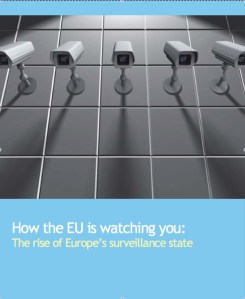
Europe’s Surveillance State

EU_surveillance
The Open Europe report

I have just got hold of a new report by UK-eurosceptic think-tank, Open Europe, called How the EU is Watching You: the Rise of Europe’s Surveillance State, which whilst it isn’t as startling as the NeoConPanopticon report from the Trilateral Institute and Statewatch, does some to collect some useful information together in one place. Crucially the report points out the same thing as Will Webster and I did in our paper in JCER a couple of months ago, that this isn’t just a case of ‘European’ bad practice being imposed on the UK, but just as much UK bad practice being exported and generalised throughout Europe.

One interesting footnote is how the discourse of opposition and analysis is changing. A few years ago, and still in academia, the idea of the ‘surveillance society’ was the dominant way of describing the situation, but now there is once again an increasing focus on the ‘surveillance state’ or the ‘database state’.  This is partly, I think because there are an increasing number of right-libertarian and anti-state or small-state groupings openly opposing increasing surveillance – for example, the new Big Brother Watch in the UK, and they tend to emphasise the state’s role (or in this case, the role of an organisation they regard as an unaccountable superstate). This also reflects the growing opposition from the UK in particular. This is particularly interesting because in the past, the idea of the ‘surveillance state’ was mainly a historical term to do with the development of repressive political policing, especially that involved in colonial counter-insurgency – see, for example, Alfred McCoy’s new book, Policing America’s Empire, on the role of the US occupation of the Philippines in the co-evolution of US and Filipino state surveillance practices – or in the totalitarian regimes of the former Eastern Bloc.

The landscape today is much less obviously one of state control. Indeed one could see these developments as a result of the retreat of the power of the individual state and an attempted reconfiguration of state-power of a new kind at a supranational level. And, this power is crucially dependent, as it has been since the end of WW2 on the private sector. The military-industrial complex is now a security-industrial complex and security is no longer anywhere near being simply state business.

The Biggest Database in the World

James Bamford has a superb review of the new book by Matthew Aid about the US National Security Agency (NSA) in the New York Review of Books this month. What seems to be causing a stir around the intelligence research (and computing) community is the reference to a report by the MITRE corporation into a the information needs of the NSA in relation to new central NSA data repository being constructed in the deserts of Utah. The report, which is being rather speculative, says that IF the trend for increasing numbers of sensors collecting all kinds of information continues, then the kind of storage capacity required would be in the range of yottabytes by 2015 – as CrunchGear blog points out: there are “a thousand gigabytes in a terabyte, a thousand terabytes in a petabyte, a thousand petabytes in an exabyte, a thousand exabytes in a zettabyte, and a thousand zettabytes in a yottabyte. In other words, a yottabyte is 1,000,000,000,000,000GB.” However CrunchGear misses the ‘ifs’ in the report as some of the comments on the story point out. There is no doubt however, that the NSA will have some technical capabilities that are way beyond what the ordinary commercial market currently provides and it’s probably useless to speculate just how far beyond. Perhaps more important in any case, are the technologies and techniques required to sort such a huge amount of information into usable data and to create meaningful categories and profiles from it – that is where the cutting edge is. The size of storage units is not really even that interesting… The other interesting thing here is the hint of competition within US intelligence that never seems to stop: just a few months back, the FBI was revealed to have its Investigative Data Warehouse (IDW) plan. Data Warehouses or repositories seem to be the current fashion in intelligence: whilst the whole rest of the world moves more towards ‘cloud computing’ and more open systems, they collect it all and lock it down.

Information-rich animals

Iris scanning has been proposed for horse by a company called Global Animal Management (GAM) Inc. As bloodstock is a huge and lucrative business – feeding everything from the private obsessions of the super-rich through the horseracing industry to the dreams of teenage horse-enthusiasts – it is not surprising to see such investment in biometrics. Racehorses were, after all, the first living creatures to be regularly microchipped. Vets seem sceptical about the idea, but surely members of the medical profession would be more enthusiastic about non-invasive replacements for invasive identification techniques like RFID?

Ironically, support for the scepticism comes form GAM’s own website, where a very interesting short video shows just how comprehensive the surveillance of animals through RFID chips has become. RFID chips do not just identify, they carry whole life-cycle information on origins, movements, health and disease and legal compliances. And because of the chips this information is carried with the animal not simply associated with it via a distant database as the result of an occasional scan. The system creates what GAM calls ‘information-rich animals’, which presumably is what makes GAM – and it hopes, its customers – cash-rich too…

(thanks to Aaron Martin, whose reading now seems to include Horse and Hound magazine…)

Canadian Internet Snooping Law

I’ve noted before that there seems to be a concerted push around the world by governments to introduce comprehensive new telecoms surveillance laws that force telecommunications and Internet Service Providers (ISPs) to record, store, and provide access to and/or share with state intelligence agencies, the traffic and/or communications data of their customers (in other words, users like us). What is noticeably here is that there is a particular logic that appears in the arguments of governments who are attempting to persuade their parliaments or people of the need for such laws. This logic that is firstly, circular and self-referential, in that it makes reference to the fact that other governments have passed such laws as if this in itself provides some compelling reason for the law to be passed in their own country. The second part of this is a king of competitive disadvantage arguments that flows from the first argument: if ‘we’ don’t have this law, then somehow we are falling behind in a never openly discussed intelligence-capability race that will hit national technological innovation too.

The media often seem oblivious to what seems obvious, and hence the story on the CTV news site today with reference to Canada’s currently proposed communications law that would allow the Canadian Security and Intelligence Service (CSIS) warrantless access to such the data from Internet and telecoms providers. They consider it to be ‘unexpected’ that the parliamentary Security Intelligence Review Committee has come out in support of the bill. Looking at the reasons why though, they are exactly what one would expect if one has been following the debates around the world and contain exactly the logics I have outlined. The story notes that the committee “points out that governments in the United States and Europe have already passed laws requiring co-operation between security agencies and online service providers” (without, incidentally, pointing out that these remain enormously controversial, or that other governments have abandoned some of their attempts) and later that “intelligence technology… requires continued access to new talent and innovative research.” However they won’t go into details as it is a “very sensitive matter.”

And absent from this debate as usual is the fact that this is not just a question of ‘national security’ if you set up these systems, you feed the US National Security Agency too. Canadian intelligence is still bound by agreements made after WW2, particularly the CANUSA agreement on Signals Intelligence (SIGINT), later incorporated into the UKUSA structure. And as we all know, right now, the USA does not always have the same strategic interests as Canada (the issue of arctic sovereignty is just one example). If this bill is passed, it’s a license for US spies, not just Canadian ones.

UK police still adding innocent people’s DNA to database


Research in the UK has shown that police forces in Britain are continuing to add the DNA – and incidentally the fingerprints, although this is never mentioned – of innocent people to the DNA database despite the European Court of Human Rights ruling that it was illegal (and the government’s promise to accept the ruling). According to The Guardian newspaper today, 90,000 innocent people have been added to the National DNA database (NDNAD) since a the court ruling and the Association of Chief Police Officers (ACPO) – incidentally, a private organisation – is still telling chief constables to continue with this collection. On the other hand the process of removing individual profiles has been painfully slow: only 611 DNA profiles of innocent people have been removed, and all as a result of individual challenges in court. It seems that the police are determined to drag their feet as long as possible and, in fact, break the law quite openly. Hardly a good example…

Controlling Robotic Weapons

I’m delighted to be informed by Professor Noel Sharkey that I have been invited to become the first member of the Advisory Board of the International Campaign for Robotic Arms Control (ICRAC). ICRAC aims to help prevent the unfettered spread of automated weapons systems and to produce an international convention or some other kind of binding agreement to control their use. I’ve been tracking the develeopment of robotic surveillance (and killing) systems for quite a while now and I think this campaign is absolutely essential. This piece recently in The Times of London goes into some of the issues quite well. There is a lot of work to do here to persuade governments to control what many militaries think will be ‘essential’ to warfare in this coming century, but I think that the landmines campaign is a good example of what can be done here – but this time before robotic weapons become too common.

Bizarre happenings in Rio de Janeiro

My collaborator, Paola Barreto Leblanc writes to me “Something really bizarre happened this week. In a public street in Rio’s center CCTVs from some buildings and a Bank – private circuits – caught a criminal action led by police officers [Policia Militar – PM, or Military Police, in fact]. Instead of helping a victim of an attack they rob the robbers!” The news story is available on youtube:

The thing that adds an extra layer of particularly bleak humour to this nasty event is that the name of the PM officer involved is capitão Bizarro (Captain Bizarre)… however, the really sad fact about the whole incident is that the victim was prominent social justice activist and founder of the internationally-renowned favela music group AfroReggae, Evandro João da Silva. He did a lot more good for the city and for the improvement of the lives of the urban poor than any gang-members or police officers ever did and he will be sorely missed. The PM chief, Mário Sérgio Duarte, who we interviewed back in April, is once again in the papers and on TV, apologizing. I noted at the time that Colonel Duarte seemed ‘profoundly indifferent’ to CCTV – I wonder if he will change his mind now and in what direction…

As Paola also writes to me, the nexus of CCTV in Rio is an intensely confusing one, mixing drug-gangs, corrupt police, the media, who like anywhere else seem to be living off the images from CCTV cameras without much in the way of respect for the victims. We are now starting to work together on a paper on these developments.

Would Canadians be “safer with a camera on every corner”?

I haven’t got very involved with Canadian debates on surveillance yet (but don’t worry, I will!). However a comment piece in Thursday’s Globe and Mail, which demanded that Canadian cities install ubiquitous video surveillance, prompted me to pen an immediate letter, which was signed by both Professor David Lyon and myself. It was published today, slightly edited – the full version is below. (They also decided to edit out our respective titles, which makes me look senior to Professor Lyon. Oops.)

“Marcus Gee writes that “We’d be safer with a camera on every corner” (Comment, May 22nd, p.15). If only this were true. However it simply is not the case.

Mr Gee quotes the UK as an example of where video surveillance is effective, but this is not supported by the crime figures in the UK or by academic research. The most comprehensive evaluation of all studies done of the effects of CCTV on crime (by the Campbell Collaboration, 2009) concluded that it had little or not effect on the occurrence of violent crimes like the disgraceful murder of Christopher Skinner, which prompted Mr Gee to write. Even the limited British police assessment of CCTV conducted by the Association of Chief Police Officers (ACPO) in 2008, admitted this was the case.

It is easy to demand that ‘something must be done’ as a response to any particular incident of violent crime, and CCTV is the currently fashionable ‘something.’ But let us get beyond the superficial and look at the evidence. Then we could have a proper debate about CCTV.”

US Predator drones in Pakistan

Although the US military has been operated its Predator Unmanned Aerial Vehicles (UAVs) (both surveillance and weaponized versions) in both Pakistan and Afghanistan for some time now, the Pakistan government is now for the first time reported to be accepting their use as an official part of its own military’s operations in the South Waziristan region. This is the area where it has long been known that some of the most important Taliban and Al-Qaeda groups have been ‘hiding’  – but hiding in pretty much plain sight. More on military drones here and here.