
The New North American Perimeter

Canadians have been angered to discover recently that a deal to create a new US-Canada perimeter security initiative has been going on behind their backs. This plan has been some time in the making, as we uncovered during our current research on border security. In particular, alliances of major corporations and US and Canadian government organisations have been planning together in the Security and Prosperity Partnership (SPP) and the North American Competitiveness Council (NACC) – who back in 2007 produced a document, Building a Secure and Competitive North Anerica (pdf), that seems to prefigure exactly what this ‘new’ soon to be announced plan will contain.

And already the state public relations machines have rumbled into place to prevent dissent. The government clearly has nothing but contempt for the Canadian Charter rights that this deal will damage (most notably those around information and privacy). And there seems to be no doubt that this deal will further embed US security priorities in Canadian-US relations, and effectively add an inner core of security to the economic layer of NAFTA (excluding Mexico, of course… no doubt the perimeter will continue exclude them, even while we exploit their cheap labour and resources). Indeed the ‘success’ of NAFTA (read: the success of NAFTA for business elites) is one of the reasons given for supporting this so-far unseen plan by five former Canadian ambassadors to Washington in an Opinion piece in the Globe and Mail today.

This first volley from the big guns seems to have come straight from the Ottawa PR stategy. There are references to ‘common sense’ and the ‘reassertion of sovereignty’ and attacks on ‘bellyaching’ and ‘knee-jerk anti-Americanism’. Indeed it is worth quoting the final paragraph in full because it is a masterpiece of old-fashioned continentalist propaganda combined with post-9/11 fear-stoking:

“Knee-jerk anti-Americanism is an indulgence without purpose in today’s interconnected, interdependent world. Our future economic prosperity relies on an efficient border, and we should welcome any agreement that smoothes the way for jobs and growth while toughening up our borders to security threats against both our countries.”

In this worldview, asserting sovereignty means giving it up, ‘interconnected and interdependent’ means allied with the USA rather than all the other multiplicity of friendships Canada had carefully crafted around the world prior to the Harper era, and security threats to the USA are seen as one and the same as those to Canada. In other words, we should hitch our wagon more firmly to Washington and prevent any return to that ‘indulgent’ Canadian emphasis on global security, peace-building, human development and human rights – you know, the values that once gained Canada respect around the world.

It’s quite eye-opening in a way to see former representatives of the Canadian state to the USA openly acting as US assets in Canada, clearly trying to educate the Canadian public in how to think and how to behave towards their rulers (sorry, slip of the tongue, of course I meant ‘neighbours’), and trying to preempt and predefine reaction to a plan that we haven’t even seen yet not least because people like this seem to think that Canadians don’t deserve to have a say in something that amounts to nothing less than the future sovereignty of their country.

(thanks to Harrison Smith for the NACC document and David Lyon for pointing out the Opinion piece)
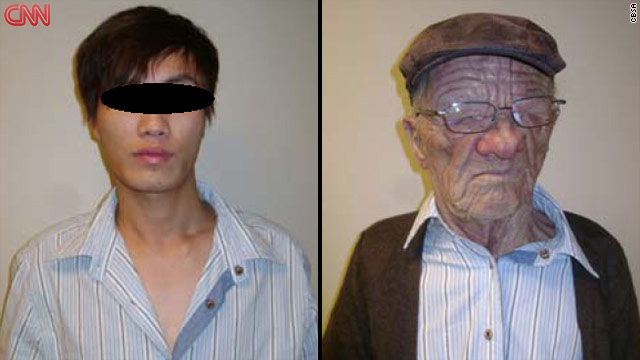
Disguised man allowed to board flight to Canada

An effective disguise (CNN)

CNN has an exclusive today on a young Chinese man who boarded an Air Canada flight from Hong Kong disguised as an old white man. During the flight he removed the mask and then claimed asylum on landing in Canada.

No-one outside of the man concerned and the Canadian Border Security Agency knows much more about this right now. The disguise looks pretty impressive. And he had a boarding pass for a man of the correct age and origins. Of course some people will try to spin this as a ‘security threat’ story, or make it about terrorism. But really this says far more about the desperation of those trying to claim asylum faced with the rather kafkaesque logic of such systems, which tend to assume that claimants can use legal means to escape from situations where their life might be in danger…

Not everything is about the (still relatively small) risk of terrorism and nor should we overreact or organise or always try to reorganise our societies on the basis of that risk. Canada has a historically-deserved reputation as a humane refuge for those in need. This should be defended.

Surveillance, Coercion, Privacy and the Census

There’s been a huge furore here in Canada about the current government’s decision to abolish the long-form census. I’ve been following the debate more interested in what the proponents and opponents have been saying about privacy and surveillance rather than intervening. But it’s about time I got off the fence, so here’s my two cents’ worth. It may come out as an op-ed piece in one of the papers soon, I don’t know…

Sense about the Census:

Why the Long-form Census debate really matters.

The debate about the scrapping of the long-form census is in danger of being unhelpfully polarized. The result can only benefit the current government to the long-term detriment of the Canadian people. On the one hand, some of those campaigning for the reinstatement of the survey have dismissed issues of surveillance and privacy. On the other hand, supporters of its abolition have referred to ‘privacy’ and ‘coercion’ as if these words in themselves were reason enough to cut the survey. But the whole way in which privacy has been discussed is a red herring. We need to reaffirm a commitment to privacy alongside other collective social values not in opposition to them. We need privacy and we need the census.

First, coercion. The long-form census is undoubtedly a form of coercive state surveillance. One only has to glance at the recent history of state data collection and its role in discrimination and mass-murder to see that that one can be far too blasé about the possibility of states misusing statistics. Examples abound from the Holocaust to the genocide in Rwanda, and there is no reason to suppose that this could never happen again. In fact technology makes discrimination easier and more comprehensive: with sophisticated data-mining techniques, inferences can be made about individuals and groups from disparate and seemingly harmless personal data.

However, just because censuses have the potential for abuse, this does not make them wrong. Surveillance forms the basis of modern societies, good and bad, and coercion is all around us from the time we are children told by our parents not to play on the stairs. Coercion can be caring, protect us and improves our lives. The long-form census would have to be shown to be unfairly coercive, or not have enough beneficial policy outcomes to justify any coercion. This, the government has failed to do, whereas the campaign for the restoration of the survey has highlighted numerous examples of improvements in communities across Canada resulting from long-form census data.

Now to privacy. The campaign to restore the long-form census has seen frequent instances of the argument, ‘nothing to hide, nothing to fear’. This is one of the most glib arguments about privacy and surveillance, not only because of the potential abuse of state data collection but also because it assumes so much about what people should want to keep private. Another common argument is that privacy is irrelevant because ‘everyone gives away their personal information on Facebook anyway’. But the fact that some people chose to share parts of their lives with selected others does not imply that any infringement of privacy is acceptable. Privacy depends on context. Social networking or marketing trends do not mean that ‘anything goes’ with personal data.

In making these arguments, campaigners end up unwittingly bolstering a government strategy that relies not only on the evocation of ‘coercion’ but on pitting individual privacy against collective social goals. Yet, the government’s position is misleading. Privacy is not simply an individual right but also a collective social value. And further, just because the data is collected from individuals by the state, does not mean that the state infringes on privacy. It depends on whether the data is stored without consent in a way that identifies individuals or is used in a way negatively impacts upon them.

However, Statistics Canada have demonstrated a commitment to privacy within the census process. The long-form census data is not used to identify or target individuals. It is aggregated and used for wider community purposes. As Statistics Canada say quite on their website: “No data that could identify an individual, business or organization, are published without the knowledge or consent of the individual, business or organization.” The census returns are confidential and Statistics Canada employees are the only people who will ever have access to the raw returns, and they are bound by The Statistics Act. All this was confirmed by the Office of the Privacy Commissioner of Canada, who found the 2006 census fully compliant with privacy law.

So both privacy and coercion are red herrings. The conduct of the long-form census has demonstrated a commitment to privacy alongside other collective social values in support of individuals and the wider community. This moderate, sensible and profoundly Canadian position is now under threat. That is why this debate matters.

Support Peter Watts

I’ve been snowed under teaching recently and haven’t been posting much. One thing has really got my goat though and I think it needs wider attention. Those of you who read boingboing will already know, but the SF author, Peter Watts (who wrote the excellent novel of really alien contact, Blindsight) has been convicted of obstructing US border guards and could spend up to two years in prison. This is despite the fact that the border guards lied about the whole incident (they claimed he had tried to choke an officer, when in fact they were assaulting him, a fact admitted in court). He basically got convicted for challenged the guards and getting out of his car to ask what was going on. As Cory Doctorow comments on BoingBoing, this is not about security, this is not about safety, and it is not even about crime as we would recognise it, it is about authority and the massive increase in humourless abuse that has increased so much in recent years, particularly on the US border*. Peter Watts was convicted essentially of not responding fast enough and questioning commands. He’s now posted more on his own blog, including some comments from some of the jury, who couldn’t quite believe the outcome…

Anyone who thinks ‘nothing to hide, nothing to fear’ or truly believes that it couldn’t happen to you, read this a be concerned. Show your support for Peter too. Write to your congressmen if you are in the USA, or Members of Parliament in Canada, write to Ministers and Secretaries of State. Make a fuss. Write to Peter too and tell him you support him.

*And sure, there’s a context, but it seems to me that the post-9/11 situation is used as an excuse by rather too many guards to exercise a petty brutality on anyone who does not conform to their perception of normality. That critical point where liberty comes up against security is just as much about interpersonal encounters like this as it is about grand policy.

Fortress Toronto for G20 summit

There is an interesting article yesterday in the Toronto Star that does a good job of describing what will happen when the G20 arrives in town in June this year.

Of course, it will be accompanied by all the security and surveillance that these days comes as part and parcel of these ‘mega-events‘ (see also: here and here) whether they be sporting, economic or political – with the added hyper-security around world leaders. Rather like the peripatetic monarch’s court that used to be a feature of high mediaeval European societies, the travelling circus of global governance brings with it, its own security norms, creating locked-down ‘islands’ within cities, temporarily removing the rights and liberties of residents, and moving out and on those people seen to be ‘out-of place’ (the homeless, street vendors, protestors and so on). In many cases, ordinary people are suddenly potential troublemakers, and residents are harassed in advance by intelligence services who check profiles, backgrounds, political affiliations and so on. Business within the zone are usually negatively affected – even if the case is made, as it normally is, that there will be some nebulous ‘economic benefit’, which (oh, so conveniently) happens to cover the costs of security. The events are often also ‘test-beds’ for new technologies of surveillance and security – last year at the Pittsburgh G20 summit, we saw the use of sonic weapons on protestors for example.

Why do cities put up with this? Well, it’s all about inter-urban competition. For urban authorities these mega-events reinforce the global status of the city, or allow it to climb the ever-incrasing numbers of rankings of ‘world cities’ of ‘global cities’.  Toronto, like so many other cities in the second or third rank of global cities, is obsessed with appearing to be world class, and the local government will put up with almost any kind of inconvenience to its citizens that is seen to benefit the city’s global status.

I’ll be keeping an eye on developments, but if I was a Toronto resident, and if I could, I’d just leave town for a couple of weeks before and during the event…

Security and the Economy (again)

The whole body scanners issue has once again brought to the fore the question of the relationship of security and the economy (see here, here and here). This is a more complex question than the political economy which argues that security companies benefit, therefore there are economic interests behind every surveillance surge than occurs. Of course, some companies, scanner makers, Rapiscan and L3 in particular in this case, make a lot of money form their patented systems: each one of the 44 L3 Scanners that Canadian airports are installing costs around $250,000 CAN (125,000 Euro), which adds up to a hefty income to L3. And of course there are connections to the revolving door of US Homeland Security governance at least: Michael Chertoff, the former Head of HOmeland Security from 2005-9 was making the case for scanners immediately after the December 25th thighbomber’s failed attempt, yet he neglected to mention his role as consultant to Rapiscan, which was awarded millions of dollars of contracts under his watch.

However, there are other interests here, notably the aviation industry, airlines and airports, not to mention those of travelers. The Toronto Globe and Mail today reports how airlines in Canada are increasingly concerned that already growing security levies from government (to provide security) will only spiral with every new measure introduced. The airlines expect the government to bear the costs. The government has merely said that it will try to ensure that costs passed on are minimised. However someone has to pay, somewhere along the line. If airlines (or their passengers) are not paying, then tax-payers are and it’s debatable whether ultimately, subsidising the security costs of international travelers is really what taxes should be for when times are hard. Of course no government wants this to come down to a ‘security versus the economy’ argument, but that has to be discussed, alongside the still largely unaddressed issues of privacy and other individual and collective liberties.

Vancouver Olympic surveillance legacies

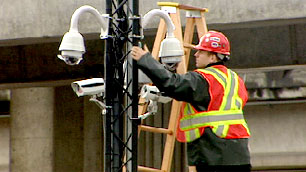
A city worker installs video surveillance cameras outside GM Place in downtown Vancouver. (CBC)

As the CCTV cameras are going up, Vancouverites are starting to become more concerned now about what the legacy of increased security and surveillance will be after the Olympics. Although the initial promises were that the cameras would be taken down afterwards, with the money that has been put into building a swish new control room, it seems unlikely that the authorities will want to ‘waste’ this investment. As we warned in our Vancouver Statement in November, it seems as if the Games have become a globe-trotting Trojan horse for the video surveillance industry.

Canadians should be concerned about camera surveillance

A new report by the Surveillance Camera Awareness Network (SCAN) at Queen’s University shows that Canadians believe surveillance cameras promote safety, but their perceptions don’t match the actual evidence. The first of its kind in Canada, A Report on Camera Surveillance in Canada will be used as background to help structure new federal surveillance legislation.

“There is little or no evidence that surveillance deters crime,” says David Lyon, coordinator of the report and director of the school’s new Surveillance Studies Centre. “Media such as TV police shows and crime stoppers promote the perception that cameras are more important than they really are.”

The report looks at the rapid growth of surveillance in Canadian society based on studies about:

  • The lack of Canadian legislation addressing public camera surveillance
  • Camera surveillance as big business
  • An exploration of camera operators
  • Research on public opinions about camera surveillance
  • Camera surveillance as one of the legacies of hosting the Olympic Games
  • Camera surveillance in Ottawa taxicabs
  • Camera surveillance in shopping malls

“The public should be concerned,” adds Professor Lyon. “Surveillance technology is constantly changing. Closed-circuit television does not accurately describe it anymore; now surveillance footage is increasingly digitized and free to flow online. What stops are in place to prevent it from falling into the wrong hands? We need to question the social ethics of surveillance footage as well as establish legal limits on how the footage can be used.”

(The Surveillance Camera Awareness Network at the Queen’s Surveillance Centre completed the report with funding from the Office of the Privacy Commissioner and the Social Sciences and Humanities Research Council of Canada. The report is the topic of a surveillance workshop on January 15 and 16, 2010 at Queen’s University).

Press Release from Queen’s University.

Contact: Jeff Drake
jeff.drake@queensu.ca
613-533-2877
Queen’s University

After the Thighbomber: Virtual Strip Searches at every airport?

The botched attempt to bomb a flight into the US by a the son of a wealthy Nigerian family, using explosive components strapped to his thigh, has led to an immediate techno-economic consequence, which is to speed up the process of installing terahertz wave or other body scanners in major airports, which if nothing else will provide a guaranteed income stream to Rapiscan and Qinetiq, who make these kinds of machines. Schipol in Amsterdam, where  announced they would be extending their body scanning operation and the British government almost immediately followed by saying that major British airports would be rolling out body scanning within weeks. Now, Canada is to do the same.

But, will this make a real difference or is it just more symbolic security? The scanners certainly ‘work’ in the sense that they do provide pretty good images of what is under the clothes of passengers (see below). However, interpreting what is seen is still no easy task and will the scanners will certainly not replace physical searches, but will add yet another extra layer of surveillant sorting and therefore delay. And there are questions over the effectiveness of the scanners in particular areas of the body. The Toronto Sun reports that trials at Kelowna Airport in British Columbia “left blind spots over the head and feet”, so these machines are certainly not the ‘silver bullet’.

Then of course, there are the privacy issues. I don’t have any particular problem with the technology, provided it is restricted to airports and doesn’t start to get used in other, more everyday, social settings (which given the rapid development of this technology is by no means certain). However, as I noted the last time I wrote about this, there will be many religious, gender-based and personal reasons for objecting to their use. The other question of course is whether, every time some lone lunatic tries something like this – that was, let us not forget, poorly planned and ineffective, and which should have been prevented by other conventional intelligence operations working properly – it makes sense to jump and harden security (or at least be seen to harden security) for everyone travelling internationally. Doing this just plays into the hands of terrorists as it disrupts the ordinary workings of an open society.

Body Scan Image (US TSA)

Olympic surveillance legacies

David Loukidelis, the Information and Privacy Commissioner of British Columbia, speaking today at The Surveillance Games workshop, has made it quite clear that his office does not want the Winter Games to leave a legacy of securitization in the city or indeed, fear (as the Assistant Federal Privacy Commissioner, Chantal Bernier, put it), in the consciousness of its residents. In particular he argued that the 600 (yes, 600) cameras that are being installed at the Olympic venues and beyond should not be allowed to remain after the games. I hope that his office is able to deliver on this view, but I doubt that it will. As Kevin Haggerty and Phil Boyle have noted, security architecture is now an actual deliverable of the Olympics, and as many other researchers have shown, such architecture, including in particular CCTV but also adjusted local or national laws on the thematic and spatial limits of protest and freedom of expression (which, as Michael Vonn of the BCCLA and Chris Shaw, a leading anti-games activist, are describing at this very moment in the conference, are themselves often illegal and unconstitutional) tends not only to persist but to act as a kind of Trojan Horse for an expanded surveillance. And as Vonn’s group has also shown – the city is building a permanent CCTV control centre as part of the security architecture for the Games, and you don’t do that for cameras that are going to be removed.