Security systems and trust

Sometimes, little local stories give us the best insight into what living in a surveillance society is really like. This one is from a school in Virginia, USA. According to the local newspaper (via BoingBoing) a middle school student was suspended from school for opening the main door for a women who they knew who was unable to press the entry button because they had their hands full. The reason given by the school auhtorities is that the school has a secure entry system, in which people are supposed to press the entry button, look into a camera, and request entry. The student was suspended on the grounds that they were all supposed to know the rules, and that these rules were potentially of vital importance.

However this security-bureaucratic reasoning misses the key point that the child knew the adult concerned. Whilst security and surveillance systems are at least in part designed to respond to a supposed decline in social trust and an inceased ‘threat’ (which is very poorly supported by evidence anyway), there is good reason to suppose that placing what were previously matters of social negotiation into the hands of such ‘systems’, ‘rules’ and ‘technology’ further damages social trust.

Many questions then arise: what is this school, through this action and these systems, teaching kids about society? That security comes above all else? That no-one can be trusted? And that individual decision-making or social interaction is better replaced by impersonal systems? Surely, if education is the basis of the future of society, then what should be taught are the opposite lessons. This kind of subordination to systems is a form of training, of disciplinary control, not learning and education.


Corporate Privacy Redux

The Supreme Court of the USA has unanimously decided (pdf) that “corporations do not have “personal privacy” for the purposes of exemption 7(C) [of The Freedom of Information Act].”

This is a welcome decision which should set back further efforts by corporate bodies to claim ‘human rights’ as a justification for avoiding their responsibilities under laws mandating transparency and accountability.

Marc Rotenberg points us to a welcome for this decision from Senator Patrick Leahy of Vermont.

Good news all round for once.

‘Turning Off’ the Internet

Boing Boing contributors have been doing a fascinating job of documenting the place of the Internet and social media in the ongoing turmoil spreading across Arabic countries. Until recently the focus had been on the use of social media tools by activists, but in the last few days, the empire has struck back. In particular the Egyptian state has effectively ‘turned off’ the Internet, cutting Net access and communications between Egypt and the rest of the world.

What’s particularly interesting is that the rulers of western ‘democracies’ seem to want similar powers. I’ve been writing about the growing movement amongst states to develop powers to split or close the Internet entirely for some time (see here, here and here, for example). Most recently, I reported on French efforts to develop Internet censorship power in wide-ranging circumstances, and as Sean Bonner on BB points out, a bill was introduced into Congress last year by, it’s that man again, Joe Liebermann, to give the USA government even greater powers to cut off civilian access to the Net entirely in the event of a ‘cyber-emergency’.

This is not a drill, people, this is happening…

US border project cancelled… or is it just mutating?

Neoconopticon is reporting that the Secure Border Initiative (SBI) project is to be shelved and replaced with off-the shelf surveillance equipment (UAVs etc.).

The project which was based on contracts with Boeing and Raytheon, had been in trouble for some time. I reported back in 2009 how Boeing had basically wasted most of the money on the Mexican border projects on systems that didn’t work. Neoconopticon gives the figure of $3.7Bn for the project, but in fact estimated costs for the longer-term maintenance just of the Mexican fence component had spiralled to over $10Bn.

The original source for this news, Defence Industry Daily, has a good timeline.

I am left wondering however about whether this cancellation might have anything to do with the discussions that were recently revealed on the North American Perimeter project, which I blogged back in December last year. A complete North American perimeter might reduce the pressure to add further security to the US-Canadian border at least, and Canadian government funds and people could be leveraged by the US, as they were during the Cold War with the DEW Line and BMEWS. A summit on the issue between US President, Barack Obama, and Canadian Prime Minister, Stephen Harper, had been scheduled for January and was recently pushed back into February, which has given time for the decision on the cancellation of the SBI.

This could all be coincidence, but it is certainly interesting timing…

Corporate Privacy?

I’ve been arguing a lot recently that individual privacy, state secrecy and corporate confidentiality should be regarded as clearly separate things. Keeping this separation is important precisely because it stops organisations which we should expect to be open to inspection and accountable to us, from using ‘privacy’ as an excuse for avoiding such inspection. Philosophically, the distinction should be clear, but legally it may not be so obvious. One problem however lies in the nature of the whole notion of ‘incorporation’, which in its very language already assigns certain individual human attributes to organisations. And corporations are very much aware of this.

Marc Rotenberg points me to a very interesting legal test case in which the Electronic Privacy Information Center (EPIC) in the USA is currently involved. This case originally started when in 2008 the Federal Communications Commission ruled that corporations could not use ‘privacy’ as a reason to reject Freedom of Information requests. In 2009, a court overruled this decision. And now the FCC, ironically aided by EPIC, an organisation which frequently finds itself challenging rather than supporting the state on such issues, is seeking to have this ruling overturned in the Supreme Court.

This strikes me as a vital case, not just for the USA, for other jurisdictions where corporations will be observing the outcome and seeking to bring similar challenges if they can. If privacy, and indeed any other fundamental human right, is to mean anything it can neither be granted to companies who find it simply a convenient cover for a desire for confidentiality, nor to states who seek to maintain secrecy. Clearly there is information possessed by corporations and by states that might have elements that could be damaging to personal privacy. Private individuals acting in a corporate or state capacity may perhaps in some clearly delineated circumstances have the right not to be personally identified, even more so for individuals from outside the organisation concerned, but the ‘what’ of the information should still not, by association with an individual expressing a desire for privacy or anonymity, acquire the protection of privacy.

Two Weeks to Go for Bill C-32

Many people will still not be aware of the imminence of a new bill on copyright for Canada. Everything you need to know (and more) is on Michael Geist’s excellent site. The key thing is that, like most such bills around the world, this bill is still skewed towards industry perspectives and does not place much importance on the rights on the ordinary citizen or resident of Canada, in particular in the areas of ‘digital locks’ that prevent fair use of digital materials, and the lack of provision for copying across form factors for personal use. You have until the end of January to make your views heard.

The New North American Perimeter

Canadians have been angered to discover recently that a deal to create a new US-Canada perimeter security initiative has been going on behind their backs. This plan has been some time in the making, as we uncovered during our current research on border security. In particular, alliances of major corporations and US and Canadian government organisations have been planning together in the Security and Prosperity Partnership (SPP) and the North American Competitiveness Council (NACC) – who back in 2007 produced a document, Building a Secure and Competitive North Anerica (pdf), that seems to prefigure exactly what this ‘new’ soon to be announced plan will contain.

And already the state public relations machines have rumbled into place to prevent dissent. The government clearly has nothing but contempt for the Canadian Charter rights that this deal will damage (most notably those around information and privacy). And there seems to be no doubt that this deal will further embed US security priorities in Canadian-US relations, and effectively add an inner core of security to the economic layer of NAFTA (excluding Mexico, of course… no doubt the perimeter will continue exclude them, even while we exploit their cheap labour and resources). Indeed the ‘success’ of NAFTA (read: the success of NAFTA for business elites) is one of the reasons given for supporting this so-far unseen plan by five former Canadian ambassadors to Washington in an Opinion piece in the Globe and Mail today.

This first volley from the big guns seems to have come straight from the Ottawa PR stategy. There are references to ‘common sense’ and the ‘reassertion of sovereignty’ and attacks on ‘bellyaching’ and ‘knee-jerk anti-Americanism’. Indeed it is worth quoting the final paragraph in full because it is a masterpiece of old-fashioned continentalist propaganda combined with post-9/11 fear-stoking:

“Knee-jerk anti-Americanism is an indulgence without purpose in today’s interconnected, interdependent world. Our future economic prosperity relies on an efficient border, and we should welcome any agreement that smoothes the way for jobs and growth while toughening up our borders to security threats against both our countries.”

In this worldview, asserting sovereignty means giving it up, ‘interconnected and interdependent’ means allied with the USA rather than all the other multiplicity of friendships Canada had carefully crafted around the world prior to the Harper era, and security threats to the USA are seen as one and the same as those to Canada. In other words, we should hitch our wagon more firmly to Washington and prevent any return to that ‘indulgent’ Canadian emphasis on global security, peace-building, human development and human rights – you know, the values that once gained Canada respect around the world.

It’s quite eye-opening in a way to see former representatives of the Canadian state to the USA openly acting as US assets in Canada, clearly trying to educate the Canadian public in how to think and how to behave towards their rulers (sorry, slip of the tongue, of course I meant ‘neighbours’), and trying to preempt and predefine reaction to a plan that we haven’t even seen yet not least because people like this seem to think that Canadians don’t deserve to have a say in something that amounts to nothing less than the future sovereignty of their country.

(thanks to Harrison Smith for the NACC document and David Lyon for pointing out the Opinion piece)

Robot Warfare

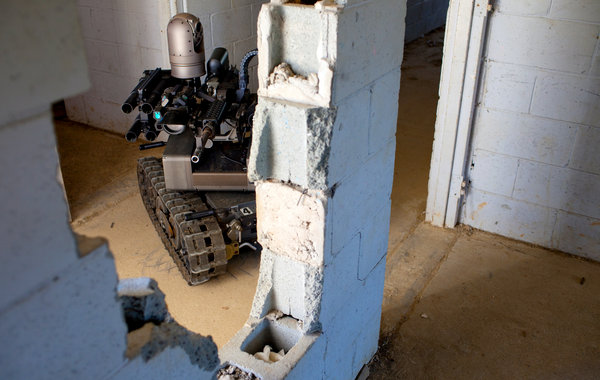
MAARS ground robot (NYT)

The New York Times recently had a good article on the development of robot warfare, covering surveillance drones, and actual warfighting machines, inspired, it seems, by a visit to the annual ‘Robotics Rodeo‘ held by the US military at Fort Benning in Georgia every October. These things are only going to get more common and more sophisticated… never mind that they kill plenty of civilians, they keep ‘our boys’ out of harm’s way, eh?

Latest round of Wikileaks shows nothing new, but changes everything

The ongoing Wikileaks revelations have been fascinating, but the latest round, those of US diplomatic cables, are perhaps the least revealing thus far. Basically, there’s a lot of the usual personal opinion and gossip that one would expect and the unsurprising revelations that the US gathers information on its allies as well as its enemies. The only really challenging insight is that Saudi Arabia want Iran dealt with far more urgently, it seems, than Israel. But then, even that is hardly unexpected given the religious and political gulf between those two states.

The more important thing for the longer-term is the process going on here, the fact that nation-states, even powerful ones, no longer seem to be able to have complete control over the information that they generate. Potentially, this is not about international relations at all or about any one particular nation-state, but potentially challenges the asymmetrical relationship between all nation-states the their peoples. Of course, there are already right-wing US politicians scrambling to label Wikileaks as a terrorist organisation, which just shows how corrupted the use of the idea of ‘terrorism’ has become, but below this, it demonstrates the very real fear of losing control amongst the political elite. The problem is that, with the current wave of nationalism sweeping the USA, such desperate sentiments play well to the gallery…

Growing Movement Against Body Scanners in the USA

Two of the major pilots’ unions in the USA are advising their members not to submit to body scans. There have also been a number of cases of people refusing to cooperate with the new (and so far unofficial) more intense TSA ‘pat-downs’ (including ‘testicular cupping’ for men…) for those who decide not to be scanned. Geek website, Boing Boing, has been documenting the growing movement against body scanning, including T-shirts, no-fly days and the like, however it seems rather optimistic to suggest, as they do, that the action of the unions will hasten the inevitable end of the scanners following some talk that they do not detect internal objects in the body and earlier demonstrations that they may not even be that good at finding some external objects. In fact, it seems more likely that not only will they eventually become mandatory sooner rather than later, but that the technical limitations of the current scanners will prompt their replacement by more advanced models that are now already being tested, which do detect internal foreign objects.

Well, I will soon have up close and personal experience of just what is going on when I fly to San Francisco tomorrow… wish me luck!