
Bruce Schneier has a nice little piece which is saying similar things to what I’ve been saying over the last couple of years on the subject of ‘crowdsourcing’ or opening closed-circuits of surveillance. He critiques the Internet Eyes scheme and Texas Border Watch and others. This is also the subject of the paper, ‘Opening Surveillance?’ that Aaron Martin of LSE and I presented at the S&S conference in London in April, and which will hopefully be coming out in the journal’s conference special early next year…
Category: Americas
Disguised man allowed to board flight to Canada
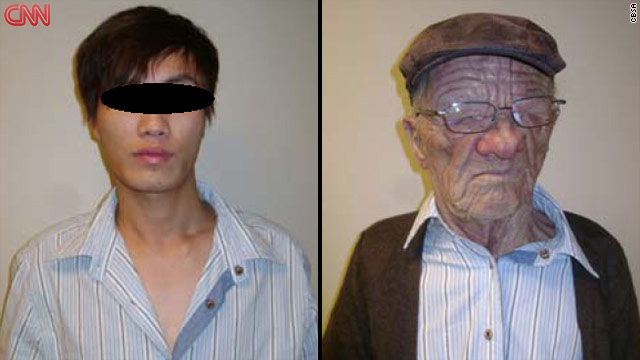
CNN has an exclusive today on a young Chinese man who boarded an Air Canada flight from Hong Kong disguised as an old white man. During the flight he removed the mask and then claimed asylum on landing in Canada.
No-one outside of the man concerned and the Canadian Border Security Agency knows much more about this right now. The disguise looks pretty impressive. And he had a boarding pass for a man of the correct age and origins. Of course some people will try to spin this as a ‘security threat’ story, or make it about terrorism. But really this says far more about the desperation of those trying to claim asylum faced with the rather kafkaesque logic of such systems, which tend to assume that claimants can use legal means to escape from situations where their life might be in danger…
Not everything is about the (still relatively small) risk of terrorism and nor should we overreact or organise or always try to reorganise our societies on the basis of that risk. Canada has a historically-deserved reputation as a humane refuge for those in need. This should be defended.
US subversion in Norway
Norway has long been a close ally of the USA. Outside of the EU, but inside NATO, it provided bases and consistent support for the USA during the Cold War, unsurprisingly seeing neighbouring USSR as a serious threat to its interests. Yet… those days would seem to be long gone, at least as far as the US is concerned, if a story recently revealed is to be believed.
According to the Dagbladet newspaper, Norway’s TV2 News reported that 15-20 Norwegians, including ex-police, had been recruited by the US Embassy over 10 years to form a secret group, the Surveillance Detection Unit (SDU) that would apparently monitor terrorist threats in Norway. The group operated from a building near the embassy, and collected information on hundreds of Norwegian citizens, whose details were added to a database called SIMAS (Security Incident Management Analysis System).
This was all done apparently without the Norwegian government’s consent, although according to the report, the US Embassy has admitted carrying out the program. The question is – is this standard US practice, or simple a ‘rogue’ embassy group of bored spooks getting above themselves? The answer is that it is almost undoubtedly the former. SIMAS is the US diplomatic service’s global database. According to a Privacy Impact Assessment (!) submitted by the State Department on the system:
“Security Incident Management and Analysis System (SIMAS) is a worldwide Bureau of Diplomatic Security (DS) web-based application, which serves as a repository for all suspicious activity and crime reporting from U.S. Diplomatic Missions abroad (all U.S. embassies and consulates). Department of State personnel, including Diplomatic Security personnel, regional security officers, and cleared foreign nationals, enter Suspicious Activity Reports (SARs) into SIMAS as a central repository for all physical security incidents overseas. SIMAS Reports typically contain a detailed narrative description of the suspicious activity prompting the report, available suspicious person(s) and vehicle descriptors, and other identification data as may be available (e.g. photographs). Reports also indicate date, time and location of suspicious activity, and may include amplifying comments from relevant Bureau offices.”
The data entered into the system on individuals include:
“Citizenship Status and Information (source-documents)
- DSP-11 (Passport Application)
- OF-156 (VISA application)
Biometric Information (source-observation and photography)
- Gender
- Race
- Height
- Weight
- Eye Color
- Skin Tone
- Hair Color
- Hair Style
- Images
- Age or Estimated Age
- Body Type (Build)
- Scars, Marks, & Tattoos
Other (source-personal interview by authorities)
- Name
- Address
- DOB
- Telephone Number
- Father’s Name
- Mother’s Name”
It is supposed to be limited to “suspicious or potentially threatening incidents gathered from observations in the vicinity of a post” in order to protect the embassy, however it seems that far more was going on in the case uncovered in Norway, and it would not be surprising if the SDU was operating as a cover for a range of other intelligence activities.
Update: the Norwegian government is now complaining to the US government about this, saying that it breaks Norwegian privacy laws. But, but… they did a PIA! Surely everything is okay now? Oh, and the US claim that “Norwegian authorities had been informed in advance about the surveillance activities.” Hey, this means someone is lying to us! Surely not… 😉
New Orleans Ditches Surveillance Cameras
For a while now, I have been wondering how long it would be before the combination of cost and manifest ineffectiveness made urban authorities consider removing CCTV schemes. I had thought, given its long history of public space video surveillance, was that it might be Britain where this was most like to happen. What I didn’t expect was that one of the first big examples would be from the USA, which since 2001 has been going through the kind of expansion of CCTV seen in Britain in the 1990s.
But, surprise, surprise, here is New Orleans’ Mayor, Mitch Landrieu, arguing that a mere 6 indictments in 7 years (which is the success rate of New Orleans’ video surveillance system) is not enough to justify the costs and intrusion of CCTV:
“Most of us can agree that based on the way that they were installed, based on the way that they operated and the way that they were not maintained, that they were not a good investment.”
Woah! What was that? Public space CCTV doesn’t work? Who knew?
Well actually, it isn’t just New Orleans and its particular unmaintained and faulty system. Most urban authorities already know this. Police forced already know this. I would argue that much the same could be said for those in London, which has an far, far more intensive network in public spaces, yet the police themselves admit that only 3% of street robberies are solved with the help of CCTV. The difference is that now some of them are admitting what they have known for some time. The problem is that the public still largely believe that they ‘work’ (whatever that means anyway). And ironically this means in New Orleans that the cameras are staying up, even if they are turned off (as in fact many all over the world are anyway, and many more are not actually being watched by anyone)…
Meanwhile, in the rest of the USA, Homeland Security and stimulus plan-funded Justice Department CCTV systems continue to proliferate.
(Thanks to Aaron Martin for finding this story!)
US military crowdsourcing communications
Marketing site, Brandchannel, reports on a US Army program, the Joint Tactical Radio System (JTRS or ‘Jitters’), which they say is going to crowdsource video surveillance on the battlefield. Actually, if you watch the embedded video piece from the US Army itself, you’ll see that the program is much more fundamental than this, it is about integrating different radio systems and trying to make the best use of scarce EM bandwidth in order to allow all kinds of more efficient communications – which would of course include video surveillance data or any other kind of data sent over wireless.
However, all is not what Brandchannel thinks. According to Global Security, the JTRS program was already in trouble back in 2005 and rumours of its demise continued to circulate – Wired’s Danger Room reported on this back in 2007. It is still in existence but has been scaled back, the contractors have switched and the costs have risen to more than $1Bn.
The latest bit of boosterism, and claims from the JTRS people that the system will include the ability for troops to access surveillance images from military UAVs and could be in place by 2014, comes therefore in this context, and also in the context of the hacking of US military surveillance drones by insurgents using cheap Russian TV downloading software. One of the really interesting things about this is how the context of military expertise is changing: one of the key justifications for all this is the concept that US troops will already be familiar with handheld devices and streaming video etc. Network-centric warfare turns out to be no different from kids using their iPhones to watch movies… if, of course, it ever actually works.
Rio de Janeiro to continue in hardline direction
The Brazilian presidential elections may be only at the half-way stage – with Lula’s hand-picked successor, Dilma Rousseff, not quite securing the 50% she needed to avoid a run-off, largely due to a late surge by the radical Green Party candidate, Maria Silva – but the results of the elections for Rio de Janeiro’s Governor were much clearer. The incumbent, Sergio Cabral, was easily re-elected with just over 66% of the vote. Second was, once again, a Green Party candidate, Fernando Gabeira, with almost 21%, followed by a slew of minor candidates.
Cabral was expected to win as he is supported by the growing middle classes who have done well due to the economic bouyancy of Rio in the last few years. However, it is by no means clear that this result will do much good for the poorest in society. Cabral, along with the Mayor Eduardo Paes, favours a hardline approach to the favelas and their inhabitants, favouring a law-enforcement and crime-control approach to a social one – what Paes calls the choque de ordem. In this sense he is out of step with the national government, however for the middle class of Rio reading their copies of O Globo behind the doors of their secured apartments, the favelas represent not an unfair city which is still unable to close the massive gap between the rich, growing ever richer, and the poor, but a spectre of criminal disorder and a source of fear
The upcoming mega-events, particularly the FIFA World Cup, 2014, and the Olympics in 2016, have only strengthened the feeling amongst the privileged that Rio must simply crack down on violence rather than dealing with the underlying problems (poverty and the international drugs and small arms trades) that fuel the violence. What this means in practice is ‘out of sight, out of mind’: walling off favelas, installing surveillance cameras, stopping the illegal street vending that gives many in the favelas some small hope of a livelihood, and demolishing high-profile new construction.
*For more on my work in Brazil and in Rio de Janeiro, see the entries from January to April last year…
The Tools of Personal Surveillance
There’s always something interesting on BoingBoing, and it was via that site that I came across this story in Salon magazine about one woman’s decision to track down the man who had robbed her. Now, most of the commentary about this has focussed on her commitment and determination and the usual stuff about how the police let criminals prospers etc. However, what interested me was the techniques and technologies that she was able to employ to find this guy: basically not only did she use a whole lot of techniques and technologies that not so long ago would have been the preserve of the intelligence services, police or private investigators, but also the thief in question was also an inveterate social networker and was about as careless with his online personae as most of us are. Of course, what it also shows is that it takes an awful lot of effort to do this, and this kind of obsessive hunt takes over lives, so it would not be a practical option: individual surveillance is not a substitute for the power of the state. It’s a fascinating read…
Bigger than Brazil
So says a new IMS report on the surveillance market in Latin America, according to industry site, Surveillance Park.
Brazil’s emergence as an economic power means that there is increasing demand for surveillance both in individual applications and for larger infrastructure projects like the 2014 World Cup and 2016 Olympic Games. But Brazil already has what the report terms “an established eco-system of suppliers” so, in the face of this strong competition, foreign surveillance companies are advised to look elsewhere, particularly Argentina, Chile and Mexico, whose surveillance markets should provide “long-term double digit growth.
The city where the cameras never sleep… New York, New York
The Gothamist blog has a brief report on the massive upgrading and expansion of the video surveillance system in the New York public transit system. Like Chicago, which I’ve mentioned several times here, the cameras in New York are really just collection devices to feed an evolving suite of video analytic software, that can track suspects or vehicles in real-time or search through old footage to find multiple occurences of particular distinctive objects or people.
The other notable thing is that the new camera system is just completely overlaying the old – in other words there is no attempt to connect the older cameras which are not compatible and have far poorer image quality. As cameras and software gets cheaper, this option looks like being the one many urban authorities will pursue, so cities like London, which pioneered widespread video surveillance, but which, with their disconnected mosaic of incompatible systems, have started to look increasingly ineffective and out-of-date, could deal with this not by expensive and unreliable fixes but simply by sticking in an entirely new integrated algorithmic system on top of or alongside the old ones. Technological fallibility and incompatibility can no longer be relied on as protections for the privacy rights of citizens in public spaces.
Chipping Pre-School Kids in the USA
ACLU is reporting that nursery schools kids in Richmond, California are being issued with jerseys embedded with RFID chips. GPS-enabled and/or RFID-chipped clothing has been available for a while now, and there have also been (pre-)schools in other countries that have issued tracking devices to kids, notably in Yokohama in Japan, but this appears to be the first time in the USA. RFID is a very simple, insecure technology, and this type of initiative gives a false sense of security and is about at once raising and appeasing social anxiety and parental paranoia about the incredibly rare instances of child kidnapping. ACLU note correctly that this is just likely to make stalking and kidnapping easier as harder, but really all this does is enable the school to know where the jersey is – like left on the back of a bus, swapped with a friend or thrown in a ditch. It’s more pointless security theater, but at a more intimate level than the kind we are used to at airports and public buildings.
 ubisurv