
Support Peter Watts

I’ve been snowed under teaching recently and haven’t been posting much. One thing has really got my goat though and I think it needs wider attention. Those of you who read boingboing will already know, but the SF author, Peter Watts (who wrote the excellent novel of really alien contact, Blindsight) has been convicted of obstructing US border guards and could spend up to two years in prison. This is despite the fact that the border guards lied about the whole incident (they claimed he had tried to choke an officer, when in fact they were assaulting him, a fact admitted in court). He basically got convicted for challenged the guards and getting out of his car to ask what was going on. As Cory Doctorow comments on BoingBoing, this is not about security, this is not about safety, and it is not even about crime as we would recognise it, it is about authority and the massive increase in humourless abuse that has increased so much in recent years, particularly on the US border*. Peter Watts was convicted essentially of not responding fast enough and questioning commands. He’s now posted more on his own blog, including some comments from some of the jury, who couldn’t quite believe the outcome…

Anyone who thinks ‘nothing to hide, nothing to fear’ or truly believes that it couldn’t happen to you, read this a be concerned. Show your support for Peter too. Write to your congressmen if you are in the USA, or Members of Parliament in Canada, write to Ministers and Secretaries of State. Make a fuss. Write to Peter too and tell him you support him.

*And sure, there’s a context, but it seems to me that the post-9/11 situation is used as an excuse by rather too many guards to exercise a petty brutality on anyone who does not conform to their perception of normality. That critical point where liberty comes up against security is just as much about interpersonal encounters like this as it is about grand policy.

Mapping drone strikes

Via Boingboing, an analysis and map of US UAV drone strikes on the tribal regions of Pakistan from 2004. Some good stuff from NewAmerica. What is particularly interested, if not unpredictable, is the way that weaponized UAVs have in the course of just a few years become a ‘normal’ part of the US war machine, with deaths from drone strikes possibly doubling from 2008-9. We can’t be sure of the exact numbers.

Closing the Internet

A lot of my current thinking is based around the dynamic of opening / closing. I’ve been considering the way in which elements of state power, and in particular the military and intelligence agencies, regard openness per se as a threat. Now, Wired’s Threat Level blog (just about my favourite reading right now), has an excellent take on the response to what has been termed (in a deliberately mixed-up phrase) the ‘open-source insurgency’. This  is the way in which the ex-head of US intelligence, now working for ‘contractor’*, Booz Allen Hamilton, Michael McConnell. is promoting the re-engineering of the Internet. This is necessary, it is argued, because the current openness of the Net means that terrorists and criminals can flourish. This re-engineering would make attribution, geo-location, intelligence analysis and impact assessment — who did it, from where, why and what was the result — more manageable”. In other words to close the Internet. remove everything that is innovative and democratic about it, and make it easier for agencies like the NSA to monitor it.

Along with a whole raft of measures like extending ‘lawful access’ regimes, introducing corporate-biased copyright and anti-peer-2-peer legislation, censorship and Net filtering, this is an attack on what the Internet has become and to turn it into something simply for consumption – something, in other words, more like television. But there is another layer here too – the US military, I suspect, still has a nostalgic longing for when the Internet was its private domain. It’s a long way from its origins, and now perhaps the military want it back. But it isn’t theirs anymore, it’s ours and we need to fight for it.

* or, more accurately, arm’s length consulting agency of the US state.

Fortress Toronto for G20 summit

There is an interesting article yesterday in the Toronto Star that does a good job of describing what will happen when the G20 arrives in town in June this year.

Of course, it will be accompanied by all the security and surveillance that these days comes as part and parcel of these ‘mega-events‘ (see also: here and here) whether they be sporting, economic or political – with the added hyper-security around world leaders. Rather like the peripatetic monarch’s court that used to be a feature of high mediaeval European societies, the travelling circus of global governance brings with it, its own security norms, creating locked-down ‘islands’ within cities, temporarily removing the rights and liberties of residents, and moving out and on those people seen to be ‘out-of place’ (the homeless, street vendors, protestors and so on). In many cases, ordinary people are suddenly potential troublemakers, and residents are harassed in advance by intelligence services who check profiles, backgrounds, political affiliations and so on. Business within the zone are usually negatively affected – even if the case is made, as it normally is, that there will be some nebulous ‘economic benefit’, which (oh, so conveniently) happens to cover the costs of security. The events are often also ‘test-beds’ for new technologies of surveillance and security – last year at the Pittsburgh G20 summit, we saw the use of sonic weapons on protestors for example.

Why do cities put up with this? Well, it’s all about inter-urban competition. For urban authorities these mega-events reinforce the global status of the city, or allow it to climb the ever-incrasing numbers of rankings of ‘world cities’ of ‘global cities’.  Toronto, like so many other cities in the second or third rank of global cities, is obsessed with appearing to be world class, and the local government will put up with almost any kind of inconvenience to its citizens that is seen to benefit the city’s global status.

I’ll be keeping an eye on developments, but if I was a Toronto resident, and if I could, I’d just leave town for a couple of weeks before and during the event…

US school spies on kids at school… and at home

There’s a really disturbing story on Boingboing concerning a US school in a wealthy suburb that issued laptops to students whose webcams could be covertly switched on by school administrators, wherever the kids were. As if this wasn’t bad enough, the school saw nothing wrong in using these cameras to spy on kids at home, and even issuing a disciplinary notice to one child who was apparently deemed to be guilty of ‘improper behaviour.’ Not surprisingly the school is now subject to a class action lawsuit.

School surveillance is a particularly under-studied issue, although recently, there has been the excellent new book edited by Torin Monahan and there will be a double issue of Surveillance & Society on surveillance and children coming out in March / April. It seems that because children either do not have adult rights (or their rights are not seen as important in the same way), states, school authorities and individual Heads and Administrators have all taken the opportunity to experiment with ever more  intrusive surveillance measures. Many of these were once justified with reference to concerns over truancy and attendance, or security and violence (the metal detectors in many urban US high schools, for example), and then there was health (used to justify the automated monitoring of what kids ate at meal times). But increasingly more petty and market-based issues have emerged: corporate data-collection and compliance with minor rules and regulations. All seemingly without any regard for the developing sense of autonomy, privacy or sociality of children.

Of course, the increasing use of surveillance in schools also serves an educative function in a surveillance society: essentially it indoctrinates children as to what is the ‘new normal’, what should be their expectations of privacy (and other rights) in a world increasingly organised on the principles of surveillance. However it’s good to see the lawsuit in this case and that some things still have the power to raise people from their apathy. But this is a school in a wealthy area with educated parents who understand and have access to the law – what would be the outcome in a school in a marginalized area?

European Parliament blocks EU-US data-sharing agreement

In a rare burst of sanity and concern for the rights of EU citizens, the European Parliament has exercised one of its very limited range of powers and blocked an agreement to continue the ability of the US government to access the Swift international bank transfer system. The parliament argued that the agreement, the descendent of a secret arrangement discovered in 2006, which came about in the aftermath of 9/11, paid insufficient attention to privacy. They are right. It doesn’t pay any attention to the safeguarding of citizens’ information rights, it merely confirms the terms of the undemocratic original agreement, one of a surge of such arrangements that were rushed through in the wake of the attacks when no-one was likely to pay much attention to things like human rights. Now, however, in an slightly less charged atmosphere, the Parliament has been able to demand that such rights should be respected in any transparent and accountable agreement. No-one is arguing that data should not be shared where there is a case for it to be shared, but this should not be at the expense of the rights and freedoms of which we are supposedly exemplars.

Pentagon seeks bids for 3D-surveillance system

DARPA are seeking bids for a high resolution three-dimensional battlefield surveillance system. The so-called Fine Detail Optical Surveillance (FDOS) program is looking to develop “a fundamentally new optical ISR capability that can provide ultra high-resolution 3D images for rapid, in-field identification of a diverse set of targets… for use in an active battlefield or hostile environments with designs tailored to allow for soldier portable applications as well as UAV integration.”

As Wired maagazine points out, the Pentagon are already deep into a virtual 3D surveillance scheme, the evily-named Gorgon Stare, that involves 12 cameras attached to Reaper drones, and DARPA already have another development programme called Autonomous Real-time Ground Ubiquitous Surveillance – Imaging System (ARGUS-IS), which involves “a 1.8 Gigapixels video sensor”. There’s more details here.

Artist's Impression of the ARGUS system (Wired)

There’s no getting away from it: semi-autonomous robots and unmanned aerial vehicles are the new silver bullet for both military and civil uses, both in surveillance and warfighting itself. It’s about time more researchers and activitists paid this some greater attention…

The drone surge

The Huffington Post has a really interesting article on the current and future use of drones (whether they be UAVs, MAVs or other things) by the US military. Judging from the early comments, it seems there are some people also think these things are great because ‘they keep US soldiers safe’ – unfortunately they don’t seem to do the same for the villagers of the impoverished countries where they are deployed. As the International Campiagn for Robotic Arms Control (ICRAC) is arguing, there needs to be an international treaty or convention to regulate the use of such machines when they are used as or part of weapons systems, but beyond that, these systems, out of theline of vision of the general public, in terms of their policy development and often their physical deployment, are seen as ‘the future of surveillance’ within many nations too – as was revealed in Britain just the other day. The military-industrial complex is now the security-industrial complex and there is a decreasing gap between military tech and its civilian counterparts…

Security and the Economy (again)

The whole body scanners issue has once again brought to the fore the question of the relationship of security and the economy (see here, here and here). This is a more complex question than the political economy which argues that security companies benefit, therefore there are economic interests behind every surveillance surge than occurs. Of course, some companies, scanner makers, Rapiscan and L3 in particular in this case, make a lot of money form their patented systems: each one of the 44 L3 Scanners that Canadian airports are installing costs around $250,000 CAN (125,000 Euro), which adds up to a hefty income to L3. And of course there are connections to the revolving door of US Homeland Security governance at least: Michael Chertoff, the former Head of HOmeland Security from 2005-9 was making the case for scanners immediately after the December 25th thighbomber’s failed attempt, yet he neglected to mention his role as consultant to Rapiscan, which was awarded millions of dollars of contracts under his watch.

However, there are other interests here, notably the aviation industry, airlines and airports, not to mention those of travelers. The Toronto Globe and Mail today reports how airlines in Canada are increasingly concerned that already growing security levies from government (to provide security) will only spiral with every new measure introduced. The airlines expect the government to bear the costs. The government has merely said that it will try to ensure that costs passed on are minimised. However someone has to pay, somewhere along the line. If airlines (or their passengers) are not paying, then tax-payers are and it’s debatable whether ultimately, subsidising the security costs of international travelers is really what taxes should be for when times are hard. Of course no government wants this to come down to a ‘security versus the economy’ argument, but that has to be discussed, alongside the still largely unaddressed issues of privacy and other individual and collective liberties.

Vancouver Olympic surveillance legacies

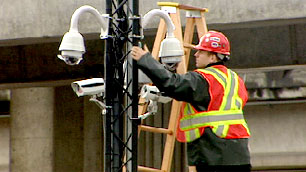
A city worker installs video surveillance cameras outside GM Place in downtown Vancouver. (CBC)

As the CCTV cameras are going up, Vancouverites are starting to become more concerned now about what the legacy of increased security and surveillance will be after the Olympics. Although the initial promises were that the cameras would be taken down afterwards, with the money that has been put into building a swish new control room, it seems unlikely that the authorities will want to ‘waste’ this investment. As we warned in our Vancouver Statement in November, it seems as if the Games have become a globe-trotting Trojan horse for the video surveillance industry.