Governments will find it harder and harder to stand up to this kind of pressure from the growing security economy – all the companies grown fat on the War on Terror
Two recent stories of the cancellation of airborne surveillance programs should remind us that the route to a surveillance society is not an inevitable technological trajectory.
You don't see that very often! An airborne DEA surveillance plane (Photo by Schweizer Aircraft/MCT).
One is a classic tale of secret budgets disguising incompetence and disorganisation rather than efficient espionage. The US Drugs Enforcement Agency (DEA) has ended an experimental air surveillance program, following almost total equipment failure. The planes, in short, didn’t fly, or didn’t fly much. Almost $15 million US down the drain, and no accountability because this was an ultra-secret, need-to-know, maximum deniability, ‘black earmark’ project…
The other is a more courageous story of a government finally standing up to the pressure or its larger ‘allies’, and the fear-mongering PR of arms companies. In this case, the Australian government has withdrawn from the BAMS Global Hawk Unmanned Aerial Vehicle (UAV) program. It has cost the country $15 Million AUS, but this will save almost $1 Billion AUS. It also puts a small dent in the massive expansion of UAVs, now being used everywhere from the skies of Afghanistan to the streets of Liverpool. This decision did not make the military-industrial complex very happy and the story in The Australian shows clear evidence of corporate PR spin at work – the emotional blackmail of claiming that this decision could cost Australian lives in the event of more bushfires (or in other stories, it would leave Australia open to terrorism).
Global Hawk (USAF)
Even in a recession, governments will find it harder and harder to stand up to this kind of public pressure from the growing security economy – all the companies grown fat on the War on Terror that have the ear of the military and are backed by US-led consortia. It is to their credit that the Australian government has not given in – as for the US DEA, well, that is the opposite lesson – secrecy and the assumption of necessity can lead to massively wasteful state procurement and an absence of real security. The question is whether either lesson will prompt wider leaning…
I am sure there will be arguments about the violation of airspace, which will not be trivial as the ongoing diplomatic and increasingly military row over US surveillance vessels off China is showing…
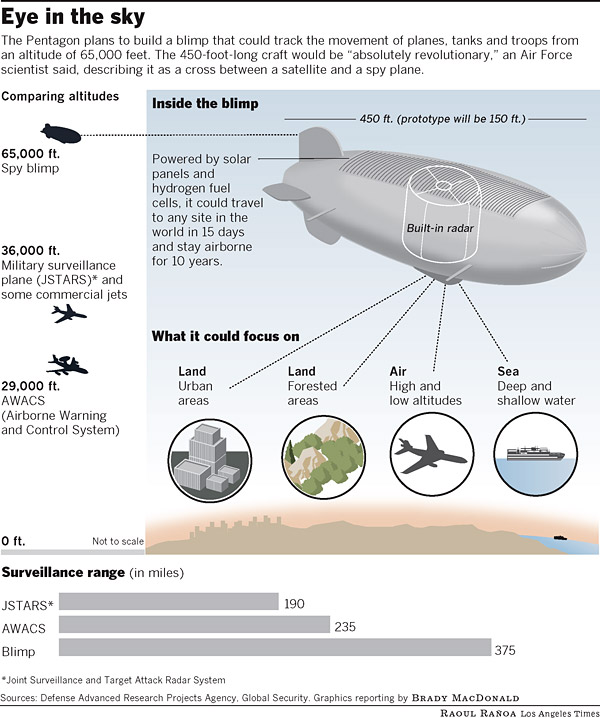
Unmanned aerial vehicles (UAVs) are one of the fastest-developing areas of surveillance technology. A new plan revealed by the US Department of Defense combines old and new tech with a plan, first revealed by the Los Angeles Times, for an pilotless surveillance airship called ISIS (Integrated Sensor Is the Structure) that will fly right at 65,000 feet (about 20km) high, right at the edge of ‘airspace’. The point of the airship is to provide the kind of constant watch that a geostationary satellite provides, but at a much lower level so that for more detailed pictures of the precise movements of vehicles, objects and people could be observed.
Well, as usual, the reports only seem to to be concerned about how great this would be for US military tactics, and are not interested in the law, politics and ethics of such devices. For example, I am sure there will be arguments about the violation of airspace, which will not be trivial as the ongoing diplomatic and increasingly military row over US surveillance vessels off China is showing. And of course there are issues around the violation of human rights by such intrusive technology: international violations are very hard to deal with, however. And this will only be the beginning. The new Obama administration has promised more investment in intelligence and surveillance and less in warfighting. That sounds good in some ways, but of course just poses new problems and new issues for those of us concerned with ongoing US attempts to cover the whole world with surveillance for the benefit of its strategic aims.
As a result of an annual report on datamining sent to the US Congress by the Office of the Director of National Intelligence, a research project, Video Analysis and Content Extraction (VACE), has been revealed. The program is aiming to produce an computer system that will be able to search and analyse video images, especially “surveillance-camera data from countries other than the United States” to identify “well-established patterns of clearly suspicious behavior.”
Conducted by the Office of Incisive Analysis, part of the Intelligence Advanced Research Projects Activity (IARPA), the program has apparently been running since 2001,and is merely one of several post-9/11 research projects aiming to create advanced dataveillance systems to analyse data from global sources. How the USA would obtain the information is not specified…
One could spend a long time listing all the DARPA and IARPA projects that are running, many of which are speculative and come to nothing. The report also mentions the curious Project Reynard that I have mentioned before, which aims to analyse the behaviours of avatars in online gaming environments with the aim of detecting ‘suspicious behaviours’. Reynard is apparently achieving some successful results, but we have no real idea at what stage VACE is, and the report only states that some elements are being tested with real world data. This implies that there is nowhere near a complete system. Nevertheless the mentality behind these projects is worrying. It is hardly the first time that the USA has tried to create what Paul Edwards called a ‘closed world’ and these utopian projects which effectively try to know the whole world in some way (like ECHELON, or the FBI’s proposed Server in the Sky) are an ongoing US state obsession.
It is the particular idea that ‘suspicious patterns of behaviour’ can be identified through constant surveillance and automated analysis, that our behaviour and indeed thoughts are no longer our own business. Because it is thoughts and anticipating action that is the ultimate goal. One can see this, at a finer grain, of programs like Project Hostile Intent, a Department of Homeland Security initiative to analyse ‘microexpressions’, supposedly preconscious facial movements. The EU is not immune from such incredibly intrusive proposals: so-called ‘spy in the cabin’ cameras and microphones in the back of every seat have been proposed by the EU-funded SAFEE project, which is supported by a large consortium of security corporations. The European Commission has already hinted that it might try to ‘require’ airlines to use the system when developed.
No doubt too, because of the close (and largely secret and unaccountable) co-operation of the EU and USA on security issues, all the images and recordings would find their way into these proposes databases and their inhuman agents would check them over to make sure we are all passive, good humans with correct behaviours, expressions and thoughts, whether we are in the real or the virtual world…
Personal surveillance is only going to get harder to regulate as things like ‘smart dust’ and micro-UAVs come down in price and are more easily available…
CBS News in the USA is reporting on the rise of stalking and in particular the use of more powerful, smaller and cheaper surveillance devices: embedded hidden cameras, GPS trackers and so on. They discuss in particular the case of Michael Strahan, a sportsman who seems to be obsessed with keeping watch on family and friends. But the bigger pictures is that stalking is something that apparently affects around 3.4 million US citizens. That’s more than one in a hundred, an astonishing figure if it’s anywhere near ‘right’.
Stalking and personal surveillance are an integral part of the culture of any state in which order in ensured through surveillance. We are creating unhealthy societies in which personal relationships between people are increasingly characterised by the same fear and distrust as states have of their people.
Don’t trust your spouse? Get their mobile phone registered with a tracking service, and put a GPS tag on their car…
and so on.
Smart Dust chips (Dust Networks)
This is only going to get harder to regulate as things like ‘smart dust’ and micro-UAVs come down in price and are more easily available. And already surveillance equipment like head-mounted cameras for cyclists, is marketed as ‘toys’… regulation is only half the answer. The other half has to be in working out how to shift away from this mistrustful, fearful, risk-obsessed culture. Part of this has to be down to government: the more that surveillance is part of every solution they come up with to any problem, the worse the social malaise will become.
The Electronic Frontier Foundation (EFF) and the Open Society Initiative have created the very useful ‘Surveillance Self-Defense’ (SSD) site. Although the SSD is aimed at US citizens and the legal aspects are therefore more relevant to those living in the States, the general advice and information on risk management and defensive technologies is all worth reading for anyone who uses a computer anywhere in the world.
Essentially this is a kind of care and maintenance of your ‘data double’ concept, which is one response to the growth of surveillance. Of course no-one should think that this kind of ‘personal information economy’ approach is enough and the EFF certainly don’t. There is in any case a general effect that could emerge from this kind of action should large numbers of people start taking the advice of EFF: mass surveillance effectively becomes more difficult, more expensive and less worthwhile. However, things like SSD cannot be a substitute for political action to curb the powers of state and private sector to monitor us and reduce individual liberties and dignity.
In one of those fortuitous instances of synchronicity, there are two stories today that illustrate some of both the commonalities and the differences between state surveillance practices and regulation in the UK and the USA.
In the UK, The Guardian has revealed that the Surveillance Commissioner (a separate office to the Information Commissioner) has been very critical behind the scenes, as the Lords Committee was in public, of the uses to which the Regulation of Investigatory Powers Act (2000) (RIPA) has been put, not this time by local government, but by national ministries like the Department for Environment, Food and Rural Affairs (DEFRA) and agencies, including Ofcom (the broaadcast and communications regulator) and the Charities Commission. DEFRA came in for a particular telling-off over its spying on fishermen. The chief commissioner, Sir Christopher Rose found generalised lax practice, a lack of proper justification for and proportionality in the used of RIPA, and little training or accountability. In short, RIPA is being used because the powers exist not because there is any pressing justification to use surveillance in this manner – the used of surveillance has expanded because it is available.
It is very interesting that The Guardian had to discover all this through Freedom of Information Act (FOIA) requests, and that the Surveillance Commissioner had not put all of this in the public domain as a matter of course. It highlights for me, once again, the clear difference in attitude and regulatory practice between him and the open, accountable, and active Information Commissioner’s Office (ICO). It confirms my view that we would be much better off if the Surveillance Commissioner’s work was absorbed into the ICO.
In the USA, it is to lawyers that people immediately turn if some bad practice is suspected on behalf of the government. The Los Angeles Times reports that on Friday, the US government lost the case it had been bringing to try to stop an Islamic charity based in Oregon from suing them over what they claim were illegal wiretapping operations targeted at them. The case stems from the Bush administration’s attempts to bypass what were already very weak regulations governing the surveillance of American citizens which were introduced in the Foreign Intelligence Surveillance Act (1978) (FISA) and recently amended in the Protect America Act (2007). Requests are supposed to go to the Foreign Intelligence Surveillance Court (FISC) which meets in secret and does not have to publish its rulings and so far as we know, has never turned down a request – so it is somewhat mystifying except as a matter of speed and convenience that the Bush administration did bypass the court.
Now the Obama administration is (shamefully) defending the actions of his predecessor. This is not entirely surprising. Intelligence is one area of continuity between governments: it is what Peter Gill called the ‘secret state’, a core that remains constant regardless of changes of administration. Nixon and Bush were both stupid enough to get caught, but the NSA, CIA and FBI are continually looking for different ways to get around domestic regulations on surveillance. Political devices like the UKUSA agreement served this purpose for many years – whereby Canadian and British intelligence services would collect SIGINT on Americans and supply it to the NSA and vice-versa. But GCHQ and others just don’t have the capabilities to carry out the amount of monitoring that now goes on. It’s been the reality for many years now that the NSA in particular does spy on Americans. Again, they have the capabilities so those capabilities are used.
Of course, unlike in the UK, we are talking about the threat of terrorism not anglers catching one-too-many fish; that really does say something about the petty bureaucracy that characterises the UK! However RIPA was also justified originally with reference to terrorism and serious and organised crime. Anyway, the ruling in the Oregon case clearly states that state secrets privilege was not enough to justify warrantless surveillance of suspects, whatever they had allegedly done. It seems that at least is one point of hope that the USA and the UK have in common. Let’s see where these situations now lead in each country…
The latest city to fall for the current wave of government enthusiasm for surveillance that is sweeping the USA is, unfortunately, the city of Austin… Sorry Austin – unless you people do something about this, you are off my list of cool cities…
Austin, Texas… lone island of sanity and liberalism in a less-than-liberal state. With its laid-back attitude, massive urban bat population, superb music scene and reputation for weirdness, it must for some time have been a candidate for coolest city in the States.
Austin... no longer cool
Well no longer. The latest city to fall for the current wave of government enthusiasm for surveillance that is sweeping the USA is, unfortunately, the city of Austin, whose authorities have voted to install a CCTV system. The local newspaper, The Daily Texan, jauntily informs us that the city has voted to sacrifice privacy for security: that does not sound like the attitude of a confident, hip place. Sorry Austin – unless you people do something about this, you are off my list of cool cities!
Seriously, though: Austin is not a city with an especially high crime rate, nor has it seen any massive recent increase in crime – even if CCTV was any good at reducing crime, which we know from the multiple assessments done in the UK and elsewhere that it isn’t. Yet Police Chief Art Acevedo is quoted as praising CCTV in the UK, specifically in London. Perhaps he has been reading too much of the hype and hasn’t read the British government’s own assessments of CCTV (conducted under the auspices of the Home Office)?
So why the sudden urge to install cameras? Could it be because of the lure of federal funding from the Department of Homeland Security? It could be. Austin has acquired $350,000 to install cameras, and what set of city fathers turns down cash (whatever it is for)? That was one of the main lessons of the expansion of CCTV in Britain in the 1990s and of course cities are now paying the long-term price of their enthusiasm as they struggle to find the money to monitor and maintain their camera systems. Chief Acevedo seems to have no worries about this though – this techno-evangelist is already talking about automation and computer recognition systems. He really sounds like a guy who has started to believe the sales pitches at all those law enforcement technology trade fairs…
…despite Britain’s reputation as a surveillance society… the USA is now eclipsing the UK. The post-9/11 surveillance surge has seen to that.
Back in the USA again. Chicago has been featuring a lot this week for its CCTV system. Newspapers generally offered glowing assessments of its capabilities based around homey anecdotes of pretty harmless incidents ‘solved’ by CCTV – in this case the stories, for example those in the Chicago Sun-Times and the New York Times, featured a theft from a Salvation Army kettle, which sounds like it is straight from a Mayoral press release. It is depressingly poor journalism and once again, all very reminiscent of the situation in the UK in the 1990s before academic and even government assessments dampened the enthusiasm for CCTV. There’s also a depressing naivety (and factual incorrectness) about the insistence from the authorities and from some ‘experts’ that these cameras have nothing to do with human rights like privacy as they are all in public spaces.
But there is one very important difference. Chicago, with massive investment from the Department for Homeland Security, has gone much further than most UK cities, not only in coverage but also in capabilities. First of all, Daley and police-chief Orozco have promised that “We’re going to grow the system until we eventually cover one end of the city to the other” in other words they do want, as the Chicago Sun-Times subheading claims, ” a camera on every street corner.”
The particular innovation that the city is pushing here is the linking up of the law-enforcement aspects with emergency services through something called Computer-Aided Dispatch (CAD). This is system that uses a live Geographic Information System to match camera location to reported incident location, so that when an incident is called in via 911, the nearest cameras can immediately turn to picture the scene. This is part of what Chicago calls ‘Operation Virtual Shield’, a fibre-optic cable system which links the cameras with other biological and chemical weapons-detection system in a “homeland security grid.’’
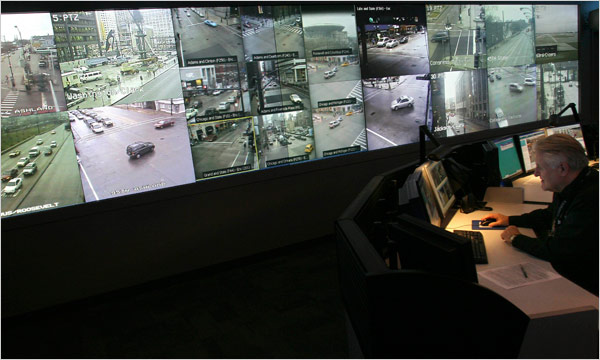
The Chicago control room (New York Times)
As part of the work we did for our latest book, Jon Coaffee Pete Rogers and I visited and analysed several different cities in the UK to assess their emergency-response and surveillance systems. While most had intentions to use the cameras for more active emergency-response purposes and particular local police were starting to try to install override systems for the multiple local camera systems that exist in the UK in the case of citywide emergencies (like a mass evacuation). And in particular, Manchester (whose high-tech control room looks like the Chicago one as seen in the NYT (picture above) and also often features in media PR for CCTV) has gone further down the Chicago route than most. But they still don’t come close. Britain’s systems are fragmented, ageing, generally not integrated with other functions and certainly don’t link to other kinds of sensors. Britain has introduced some stupid authoritarianism like the infamous ‘shouting cameras’ mostly as part of the Respect (sic) Zones initiative. But despite Britain’s reputation as a surveillance society I suspect that in terms of advanced integrated cameras systems, the USA is now eclipsing the UK. The post-9/11 surveillance surge has seen to that.
There’s two other points worth noting here. The first is that Chicago is bidding for the Olympics in 2016. I can almost hear multiple researchers in surveillance studies around the world, releasing a collective ‘of course!’. Mega-events like the Olympics, the World Cup – there will be a fantastic conference on this theme in November this year in Vancouver – or other non-sporting ones like world summits or the G-8 conference are often the trigger for the introduction of repressive measures and new surveillance systems. This was true in Japan (where state CCTV was first introduced because of the soccer World Cup in 2002), in South Africa (for various major world summits), and in Athens for the Olympics in 2004. Mayor Daley wants the city to be 100% free from the possibility of terrorist attack. Laving aside the actual impossibility of that desire, how far will he go to get there?
Well, the last Olympic venue, Beijing, might give some indication. For it is actually the plans in authoritarian, non-democratic China that seem most similar to what is going on in Chicago. Even the names have an eerie reminiscence: China’s Golden Shield, Chicago’s Virtual Shield. That is trivial, however the substance is not. The Chinese government, as Naomi Klein has written, is installing massive and comprehensive camera systems in every major city in China. It is also, of course, linking this system into its infamous Internet monitoring operation, with the ultimate aim of being able to track individuals in real and virtual space. Of course, the US, like most other nations is now trying to control Internet use too and the NSA already keeps massive data banks of communications traffic information as well as doing real-time monitoring as recent revelations have, once again, shown. But, it’s different in the USA isn’t it? The USA wouldn’t link up all these systems, would it? The Land of the Free? The home of democracy? I wouldn’t bet against it…
Largely unnoticed in commentary on US President Obama’s fiscal stimulus plan has been the $4Bn for the Justice Department. Now there are various very worthy programs nominated for funding including quite a large chunk to combat violence against women, but also a lot of cash washing around for rather more vague aims, in particular the $2Bn (i.e.: half the cash injection) for the Edward Byrne Justice Assistance Grant (JAG) program “to fund grants for state and local programs that combat crime”.
The JAG program has already providing funding for many cities to install cameras as part of ‘demonstration programs’, as well as covert surveillance capabilities. However $2Bn is a massive increase in funding and will allow some rather more ambitious schemes to be funded. With the current popularity of CCTV cameras as a catch-all solution in the USA (regardless of negative assessments of their effectiveness elsewhere – see ACLU’s recent convenient US-focused summary), could one side-effect of the stimulus package be a massive ‘surveillance surge’ in the USA? After all, this is exactly what happened in the UK in the 1990s when central state funding through the ‘City Challenge’ program sparked a mania for installing city-centre CCTV systems – see the editorial and the articles by Will Webster, Pete Fussey and Roy Coleman in the special issue of Surveillance & Society on CCTV.
Those concerned with civil liberties and the intensifying push for videosurveillance in the USA should keep a careful eye on applications to the JAG program.
It is hard to say anything about Facebook that hasn’t been said elsewhere. Of course, the decision to reverse its attempt to change its terms, which would have made it nigh on impossible for members to remove material they had posted, is a good one. Effectively what it would have done is made Facebook the owner of all personal data posted on the site.
The campaign against it was of course organised through Facebook groups! That in itself should have been enough to persuade Facebook’s young owners of the power and passion generated by the system they had created. But I don’t think they really do understand it, or indeed very much about the implications of what they are doing at all. I mentioned their youth. Last time Facebook got into trouble, it was because of comments made by their ‘Marketing Director’ (age: 24) at Davos, which were (apparently erroneously) taken by the press to indicate that Facebook was going to sell personal data.
Now, I know that it’s not cool and probably won’t make me popular to knock youth at a time where youth is everything (despite the fact that the word is ageing) – Fast Company last month had snowboarder Shaun White as its cover star in a story full of fawning admiration about how rich he had become by telling big companies about the youth market. But at least White seems to have his head screwed on – maybe it’s a class thing? Facebook’s owners on the other hand need to grow up a bit. They need to learn a bit more about the value of some rather old-fashioned fundamental rights, particularly privacy, and strop treating the system they have created as the personal spare-time sophomore project as which it began. I think that they just didn’t appreciate how people would view their proposals.
There is a serious issue here. Privacy is something that you only start to truly truly understand as you get older. Partly this is because your mistakes and your secrets get more serious and more potentially damaging as you get older! But, as I have said before, most of those are nobody’s business but your own and no-one benefits from forced transparency – honesty and conscience are also profoundly personal matters. It has been argued that the ‘youthfulness’ of the Net has encouraged a general carelessness with privacy. I am not sure that is entirely true, as Facebook users have shown – they care. But it’s the careless and – let’s face it – privileged youth of many of these new entrepreneurs, the fast companies, which is more concerning. Most are not success stories from the wrong side of the tracks, who have learned ‘the hard way’.
The threat of legal action from EPIC, which was preparing to take them to the Federal Trade Commission might have concentrated minds in this regard. Maybe it was just the threat itself – EPIC have a strong record in these kinds of cases and have taken down Microsoft and Doubleclick. However I would like to think that the arrogance and energy of youth might be tempered with a bit more maturity and consideration in the future. If only, as I’ve said before, because Facebook is no longer a fresh young company in Web 2.0 terms and could easily be eclipsed by the next big thing. Perhaps they can hire someone more ‘real’ like Shaun White to tell them how privacy rights and user control of information would be like, totally rad, dude…
Woah man, I am so stoked about privacy... (Shaun White, not actually advising Facebook on privacy, pictured for Fast Company)
On a more serious note, EPIC put a lot of time and money into protecting privacy in the USA and they do a damn good job, and in cases like that of Facebook they are having a positive affect the world over, so give them some money!




 This is only going to get harder to regulate as things like

 ubisurv