Surveillance and the ‘Open-source Insurgency’

Hierarchical, national and corporate bodies are profoundly afraid of the openness, apparent lack of interest in conventional goals and absence of obvious leadership or deference that is represented by the new collaborative networks like Open-source. They are not ‘under control’. The answer for the military-industrial complex is a consistent one, and as usual it combines strategic military and economic goals. This answer is surveillance.

The US military-industrial complex is always trying to identify new threats to bolster its budgets. There was a minor outcry a few years ago when US military powerpoint slides on strategy seemed to indicate that it regarded international civil society organisations, including the Red Cross, as a potential source of such threat. Then came 9/11 and the war on terror and for a while it didn’t need these phantom menaces as there were real global enemies, and fortunately for the military-industrial complex, it seemed that those enemies might be infinitely expandable and malleable into what was briefly termed the ‘long war’.

But the war on terror isn’t what it was. So there seems to be some effort to resurrect previous threats. One of these is ‘the war on drugs’ now rebranded as ‘narco-terrorism’ or ‘narco-insurgency’. And the particular focus of the concern is closer to the United States: Mexico. Writing in the self-proclaimed ‘capitalist tool’, Forbes magazine, Reihan Salaam argued that Mexico’s ongoing struggle with drug-related violence was a major threat which could ‘blind-side’ the USA. Now, Republicans like Salaam are struggling to find anything important to say when its obvious what the major global problems are, and the US electorate has decided that the Republicans aren’t the people to solve them. He is of course correct that there is a serious situation in Mexico – and indeed elsewhere in Latin-America: the drug-trafficking gangs are also the major problem for the Brazilian government in any attempt to include their excluded favela communities. However, he makes no mention of the other underlying cause of destabilization in the USA’s southern neighbour – the way in which NAFTA has transformed Mexico into a subordinate economic role to the USA as source of cheap production facilities and cheap labour, all the while being told that its people are not wanted in the USA. The EU has its critics, but at least its building of free-trade has been accompanied by a far greater degree of free movement of people and reciprocal political rights. Nor is there any reference to the consumption of cocaine and crack in the USA that is driving the trade (as the first comment on the article notes).

Instead Salaam tries to analyze the Mexican situation using a recent strategic theory, and one which is profoundly worrying in its implications. In an essay in the New York Times in October 2005, John Robb argued that the Iraq war had turned into what he termed an ‘open-source’ insurgency, “a resilient network made up of small, autonomous groups”. He argued that those resisting the US occupation and other armed groups were like open-source software developers in that “the insurgents have subordinated their individual goals to the common goal of the movement”. (Never mind once again, that there is an obvious underlying common goal – that of getting rid of an occupying foreign power!).

Now of course, in many ways this was just a restatement of the whole post-Cold War, network-centric warfare hypothesis. There are also echoes back to the kind of language which has been used to describe ‘eastern’ or ‘foreign’ peoples for centuries – the British in India being unable to tell ‘them’ apart, the faceless and numberless ‘yellow peril’, the ‘godless communists’ who subordinated their individual will to the collective, and the ‘clash of civilizations’. It’s the hive-mind, the fear of humans who don’t appear to act ‘like us’. Without the overt racism of course: this is Orientalism 2.0, the politically-correct version!

However the addition of the label ‘open-source’ is no accident. Hierarchical, national and corporate bodies are profoundly afraid of the openness, apparent lack of interest in conventional goals (profit, advancement, etc.), and absence of obvious leadership or deference that is represented by the new collaborative networks like Open-source. They are not ‘under control’.

So how to bring them ‘under control’? John Robb’s first (and rather refreshing) answer was that in many ways you probably can’t and that in Iraq, the US should have probably ‘let them win’. But this is an unpopular response for the uneconstructed military-industrial complex. For them the first answer is a consistent one, and as usual it combines strategic military and economic goals. This answer is surveillance. For the Internet, we have seen, and continue to see, attempts in multiple countries to attack the basis of what makes the Internet creative and free, in the name of all kinds of ‘risks’ (mainly terrorism, identity crime, pirating and paedophilia). Of course these risks are no greater on the Internet than in the material world, but the Internet is still for many people, and many politicians in particular, a vast, unknown terrain which they do not understand: ‘here be dragons’ as the old maps used to have it of any such ‘terra incognita’.

For countries afflicted by the new ‘open-source insurgency’, the answer is the same. The Defense Industry Daily today starts off its story on Mexico with the apparently uncontentious statement that “Mexico needs surveillance.” It then lists with the usual kind of techno-pornographic relish of these publications, all the mainly Israeli UAVs and surveillance craft that the Mexican state is buying. We are supposed to cheer. We are supposed to think that this is evidence of Mexico’s growing maturity. Soon Mexico will be monitored and ‘under control’. No evidence of whether surveillance ‘works’ (even in military terms) troubles these kinds of stories. That is taken as self-evident. And certainly there is no question of whether this could in any way be the wrong approach, or even a counterproductive strategy. As the Brazilian parliamentarian to whom I was talking yesterday said, about the favelas, the only answer to both crime (because, let’s not forget that’s what ‘narco-terrorism’ really is) and the poverty on which it feeds, is in the long-term (and that means starting now not later): sanitation, schools, hospitals, transport, jobs – in other words providing the poor with access to the same society that the wealthier enjoy. Extending intensive high-tech military surveillance across the global south is not only a complete failure to address these underlying issues, it also diverts much-needed money away from social priorities. It is the wrong answer to the wrong question… except for the defense industry.

China calls for better international regulation of space

…it is the USA that effectively controls earth orbit. However many other emerging economies see no reason why this should be the case….

Following last week’s collision between an obsolete Russian military satellite and an US Iridium communications satellite, there has been a lot of discussion about the management of orbital space (or, more accurately, the lack of it). Orbital positions are managed by the International Telecommunications Union (ITU), but the effective control of orbital space is a matter of power projection – i.e.: which country can maintain a stronger and more pervasive presence in space. With the Russian program almost defunct, and European satellites limited in number, it is the USA that effectively controls earth orbit. However many other emerging economies see no reason why this should be the case. India now has a regular launch program and in particular China is massively expanding its space presence, even making noises about its ability to destroy satellites if necessary.

China seems now to be using this incident to sound out other countries and the international scientific community about a more coherent and comprehensive international management of orbital space. In an article published on the official English-language news site, Chinadaily, various senior Chinese scientists and People’s Daily journalists are quoted in favour of “establishing a system for the promotion of space safety is an important method of space traffic management”, through “long-term cooperation from the international community”, and perhaps even a “space traffic law”, although it is acknowledged that this is “still a very remote concept”.

The one organisation that is not going to like this at all is the US military. USSTRATCOM has absorbed the space power doctrine developed in the 1990s by USSPACECOM, which argued effectively that orbital space should be part of US military plans for ‘Full-Spectrum Dominance’ (FSD) and that international projects like the International Space Station would be tolerated only insofar as they could be ‘leveraged’ to US advantage. The US military wants to maintain the ‘ultimate high ground’ that dominance of earth orbit gives them, for communications, for surveillance, for weapons targeting. They are not even very keen on the EU Galileo project, the new and more technically-advanced rival to GPS (which is a US military system).

Just as with the discussion about internationalising management of the Internet and moving it beyond US government control, any suggestions of a more comprehensive international management of space are likely to be resisted even at the expense of logic and reason. The Chinese know this very well, and are being rather cleverly provocative. They are however, right.

UK and USA have actively undermined international law

A major new report by the independent International Commission of Jurists has concluded that the actions taken by the many countries, but in particular the USA and the UK, since 9/11 in the name of fighting terrorism add up to “a serious threat to the integrity of the international human rights legal framework.” Acording to the BBC, the eminent jurists have been ‘shocked’ by the “excessive or abusive counter-terrorism measures in a wide range of countries around the world,” including detention without trial, torture (and of course the massive extension of surveillance powers). The report, entitled Assessing Damage, Urging Action is available for download here.

CCTV watches (and catches) the watchman

surveillance can be a weapon of the weak and perhaps right wrongs committed by representatives of the state…

Sometimes surveillance ends up rebounding on those who are usually on the other side of the camera. Videos from citizens can hold violent officers to account, as in the Rodney King incident. But occasionally, CCTV cameras themselves will catch a violent cop out, as is alleged to have happened in New York in the case of Officer David London’s arrest of Robert Morgenthau, a Iraq-war veteran suffering from PTSD. According to the New York Times, video footage from a CCTV system in the building where the arrest occurred shows Officer London repeatedly beating and kicking Mr Morgenthau.

Ironically, London’s lawyer claims that “oftentimes the videotape is the beginning of the story, not the end.” This isn’t usually the attitude that the police have to CCTV footage of a crime!

Now of course, this kind of thing is also sightly uncomfortable for anti-CCTV activists too. In some ways, it shows CCTV failing of course (it didn’t deter Officer London from assaulting Mr Morgenthau), but it also shows that surveillance, and not particularly countersurveillance or sousveillance just surveillance, can be a weapon of the weak and perhaps right wrongs committed by representatives of the state. We shouldn’t forget that surveillance, whether we object to it generally or in particular cases, is not always about repression; it often has caring intent and can result in the right thing being done.

Hip Hop Cops

Alchemist album from 2003

An interesting article entitled ‘Watching Rap’ by Eric Nielson on police surveillance of hip-hop artists in the USA. It’s worth a read and has some nice analysis of the response in rap lyrics, which is a pleasant change from the concentration on mainstream film and fiction that you tend to get in Surveillance Studies. However, it is unfortunately illustrated with a lot of rather irrelevent cliched images of CCTV cameras, Banksy etc. and is rather lacking in a deeper political context. It is not as if rappers are the first group of popular cultural figures, or the first African Americans to be put under surveillance by the US state: he should perhaps have looked back at least to the Black Panthers and the FBI’s COINTELPRO program of the 1960s. This isn’t just a cultural connection: Nielson starts off with the rumours around the shooting of Tupac Shakur, whose mother was, of course, deeply involved in the Panthers… but a very worthwhile piece nevertheless.

US No-Fly List is a big fat waste of money

I can’t say I am remotely surprised, but in the journal, Homeland Security Affairs, Marcus Holmes has written a comprehensive demolition of the claim that the US federal government’s No-Fly List is an efficient security policy. He isn’t concerned with civil liberties – ACLU has done that elsewhere – nor with effectiveness – Bruce Schneier nailed that one a while back. He simply demonstrates, using elementary Cost-Benefit Analysis that the policy is a big fat waste of money. The article isn’t complicated to understand, so the best thing I can suggest is that you just go read it… (and thanks to Bruce Schneier and Boingboing.net for posting on this one).

More CCTV stories: from Jerusalem to Cambridge

CCTV cameras are seen as the answer to anything and everything. It’s not much more than a form of magical thinking.

Two contrasting CCTV stories today.

On the one hand, we have a seemingly typical story of civic authorities wanting to install cameras, right down to the lazy, cliched, headline: ‘Smile, you’re on surveillance camera’ – how many times have we seen variations on that one? The cameras are proposed to arrest a decline in custom at a busy city market except… that the city is Jerusalem, and the market is the Mahane Yehuda market, a favoured target for suicide bombers. Now, I am not entirely sure how cameras will stop a determined suicide bomber, who by definition isn’t really that bothered about being seen committing a crime, but this is just an extreme case of underlying causes being missed. There are the usual civil rights concerns raised, and the effectiveness of cameras questioned. But suicide bombing isn’t just some unavoidable fact of life, it’s directly related to the ongoing repression by Israel of the Palestinian territories… a clear case of sticking plaster for a mortal wound if ever I saw one.

Here as in many cases, CCTV cameras are seen as the answer to anything and everything. It’s not much more than a form of magical thinking.

On the other hand, we see the town of Cambridge, Massachusetts, voting against allowing Homeland Security cameras to be used. It’s another extreme case of course. You could hardy find a more comfortable and safe middle-class town with a higher concentration of liberal intellectuals – they even had a former head of ACLU speaking at the meeting. It must be positively terrifying to be a city councilor in the face of informed opposition like that. Of course the story is replete with all kinds of ironies, not least the city representative who argues that the city voted against it only because there hasn’t been enough public participation!

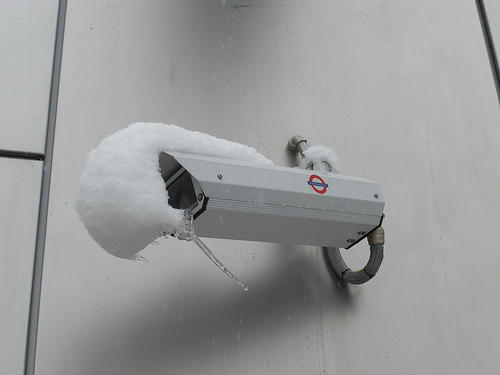
However, as the article also notes, the cameras are already installed, they just aren’t switched on. Perhaps, like this snowbound camera photographed yesterday in London, their ‘magic’ will work anyway and everyone will be happy…

They can see through snow, you know. London CCTV camera (by Almost Wiity on boingboing)
They can see through snow, you know. London CCTV camera (by Almost Witty on boingboing.net)

ACLU calls for release of Bush security info

The American Civil Liberties Union (ACLU) is calling for President Obama´s administration to release secret files that would shed light on the previous US government´s security and surveillance policies, including the now use of torture and warrantless surveillance. It´s a good move of course, but as I´ve previously remarked, the NSA and others have been doing this for almost 50 years, either directly or indirectly through UKUSA allies, warrants or no warrants, so what makes anyone think that they only started doing this under Bush or will stop if such information is released? As intelligence researcher, Loch K. Johnson, remarked about the Church Committee hearings in the 1970s, one thing they showed was that, when it came to illegal intelligence activities, the office of the President was an irrelevancy. Bush was probably even more irrelevant than most. Still, sunlight is the best disinfectant… but if Obama can change the internal culture of US intelligence, he will truly have performed a miracle.

Keep quiet or get labelled a terrorist…

BoingBoing brings this piece from the Daily Kos to my attention. It’s a disturbing story of what has happened on a number of occasions to people who annoy flight attendants and end up being labeled as terrorists. These ridiculous rulings have been severely debilitating – in the most extreme case, one woman lost access to her children, and in a Kafkaesque twist was unable to argue the case because she could not reach the custody hearing (in Hawai’i) because she was banned from flying!

These rulings have all occurred through extreme interpretations of the provisions of the US PATRIOT Act. However both this tendency for laws to extend their reach is not unique to the USA, indeed Britain may be far more culpable in this regard but in its mundane, bureaucratic way. Examples include the way that the Harassment Act, designed to protect people from stalkers, has become a tool of corporations against protestors, and the Regulation of Investigatory Powers Act (RIPA), which has enabled local authorities to employ intensive surveillance of individuals for such heinous acts as recycling wrongly.

The other issue here is once again, one of responsibilization, the enabling of ordinary people in minor positions of responsibility, or none, to use powers that would previously have been reserved to law enforcement officials or the court system. In the USA, it is flight attendants, whose role has increased markedly as post-9/11 provisions have ratcheted up expectations of passenger behaviour, but in Britain, the New Labour administration has enabled hundreds of bureaucrats to issue fines without any court process through the Regulatory Enforcement and Sanction Act, passed last year.

Basically, there are more and more people who, on a whim and with little or no evidence, can make life extremely difficult if you don’t conform to increasingly tight behavioural norms based on pre-established categories – ‘acting like a terrorist‘ being just one. Some of these norms we may even agree with – no-one likes rudeness – but what is happening is a process of desocialization and the replacement of what used to be matters of civility by narrow protocols.

Virtual surveillance fail

this Open-Circuit TV (OCTV) is also about ´responsibilizing´citizens, trying to turn ordinary people into civic spies. Luckily, whilst people love to watch, they generally refuse to behave as agents of surveillance

The US-Mexican border has been a pretty good barometer of the levels of paranoia, waste and stupidity around immigration and surveillance for quite some time now. Now the El Paso Times of Texas reports on the stupendous failure of one massive initiative that was supposed to spread the burden of watching the border by installing webcams (and associated infrastructure) for US citizens to watch online and report anything suspicious.

Around $2 Million US was sunk into the program, yet it had few tangible outcomes. The figures, released under the Texas Public Information Act show that despite 1,894,288 hits on the website, there have been just 3 arrests out of a projected 1200, and only 8 incidents reported in total out of a projected 50,000.

What made me laugh was the comment from the office of Governor Rick Perry, who initiated the scheme, that the only problem was the way in which the scheme´s success had been assessed – there is a quote from a spokesperson that is a classic of government evasion: apparently, ¨the progress reports need to be adjusted to come in line with the strategy¨!

The only sensible comment on the whole debacle comes from Scott Stewart, a surveillance and security expert from Stratfor, who notes as all surveillance experts already know, that cameras are not that effective at deterring or stopping crime, and blames our naive faith in technological solutions that ¨can provide us with a false sense of security¨.

This isn´t just about whether cameras work though.

Of course there are wider issues about the fairness of US relations with Mexico which, under NAFTA, effectively mean that the US uses Mexico as a source of cheap labour and land for manufacturing and the free flow of goods, but does not permit the free flow of people. However for studies of surveillance, it is also about whether encouraging virtual voyeurism is either socially desirable or effective in reducing crime. In terms of effectiveness, of course Bruce Schneier has been arguing for quite a while that most security schemes are inefficient and counterproductive and there was an excellent paper by John Mueller of Ohio State University exploding the statistical myths around security measures in the War on Terror.

But this Open-Circuit Television (OCTV) – not the the usual Closed-Circuit Television (CCTV) we are used to in malls and big cities – is also about ´responsibilizing´citizens, trying to turn ordinary people into civic spies. Luckily, whilst people love to watch, they generally refuse to behave as states would want and do not willingly become agents of surveillance – as this scheme and the experiment in the London borough of Shoreditch with such participatory surveillance schemes, which was similarly successful amongst viewers but achieved no measurable result and was shelved, show.

Note: Hille Koskela of the University of Helsinki, who works mainly on webcams, has been following the Texas border watch scheme and will be presenting a paper on it at our Surveillance, Security and Social Control in Latin America sumposium here in Curitiba in March… I look forward to hearing her analysis.