
In a rare burst of sanity and concern for the rights of EU citizens, the European Parliament has exercised one of its very limited range of powers and blocked an agreement to continue the ability of the US government to access the Swift international bank transfer system. The parliament argued that the agreement, the descendent of a secret arrangement discovered in 2006, which came about in the aftermath of 9/11, paid insufficient attention to privacy. They are right. It doesn’t pay any attention to the safeguarding of citizens’ information rights, it merely confirms the terms of the undemocratic original agreement, one of a surge of such arrangements that were rushed through in the wake of the attacks when no-one was likely to pay much attention to things like human rights. Now, however, in an slightly less charged atmosphere, the Parliament has been able to demand that such rights should be respected in any transparent and accountable agreement. No-one is arguing that data should not be shared where there is a case for it to be shared, but this should not be at the expense of the rights and freedoms of which we are supposedly exemplars.
Category: antiterrorism
Surveillance fraud
Add together a climate of fear, a trust in surveillance and security technology and a massively profitable industry, you get a perfect climate for fraud. Now, one of the most outrageous frauds in the area of surveillance and security has just been exposed courtesy of ex-magician and sceptic James Randi, and the BBC’s Newsnight team. A British manufacturer owned by Jim McCormick, based in Somerset, UK, has sold around $85 million US worth of their ADE-651 ‘explosives detector’ to the Iraqi government, and it is now in common use throughout the Middle East at checkpoints and borders. Yet the ADE-651 has no technical capabilities to detect anything. It is just a lump of plastic with a hinged metal rod sticking out of it, and contains only a basic commercial anti-theft tag – and is very similar to several previous fake bomb detectors.
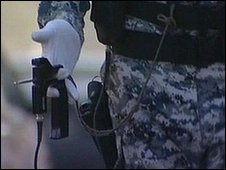
Mr McCormick has stated that the device is based on ‘dowsing’ principles (which have no known scientific basis). This device may have resulted already in many needless deaths, and yet some people still seem to put their trust in it, including a senior Iraqi military commander, Major General Jehad al-Jabiri, who is quoted as saying “whether it’s magic or scientific, what I care about is it detects bombs.” Or perhaps he cares more about his kick-back…
Security and the Economy (again)
The whole body scanners issue has once again brought to the fore the question of the relationship of security and the economy (see here, here and here). This is a more complex question than the political economy which argues that security companies benefit, therefore there are economic interests behind every surveillance surge than occurs. Of course, some companies, scanner makers, Rapiscan and L3 in particular in this case, make a lot of money form their patented systems: each one of the 44 L3 Scanners that Canadian airports are installing costs around $250,000 CAN (125,000 Euro), which adds up to a hefty income to L3. And of course there are connections to the revolving door of US Homeland Security governance at least: Michael Chertoff, the former Head of HOmeland Security from 2005-9 was making the case for scanners immediately after the December 25th thighbomber’s failed attempt, yet he neglected to mention his role as consultant to Rapiscan, which was awarded millions of dollars of contracts under his watch.
However, there are other interests here, notably the aviation industry, airlines and airports, not to mention those of travelers. The Toronto Globe and Mail today reports how airlines in Canada are increasingly concerned that already growing security levies from government (to provide security) will only spiral with every new measure introduced. The airlines expect the government to bear the costs. The government has merely said that it will try to ensure that costs passed on are minimised. However someone has to pay, somewhere along the line. If airlines (or their passengers) are not paying, then tax-payers are and it’s debatable whether ultimately, subsidising the security costs of international travelers is really what taxes should be for when times are hard. Of course no government wants this to come down to a ‘security versus the economy’ argument, but that has to be discussed, alongside the still largely unaddressed issues of privacy and other individual and collective liberties.
What now for the UK’s anti-terrorism laws?
On the 12th of January, the European Court of Human Rights (ECHR) ruled in the case of Gillan and Quinton v. the United Kingdom, that UK police powers to randomly stop and search people under Sections 44-47 of The Terrorism Act (2000) were unlawful. This is the third recent ruling by the ECHR against the current direction of the UK’s security policies (after the ruling in S. and Marper v. the UK, against the police retaining DNA profiles and fingerprints from people not convicted of any offence). It also follows the furore over the London Metropolitan Police’s interpretation of Sections 43, 44 and 58s of The Terrorism Act in relation to public photography.* The case was brought by two people, Pennie Quinton a journalist who was on her way to cover a demonstration against an arms fair in London in September 2003,, and Kevin Gillan, who was cycling past.
Section 44 allows the police to stop and search anyone on the basis of a ‘reasonable suspicion’ that they may be in posssession of information or items that may be useful in committing an act of terrorism. The case in the ECHR was on several principles, most of which were rejected, but most importantly the Court found that arbitrary stop and search dis violate Article 8 of the European Convention, on the right to privacy. This was because “the use of the coercive powers conferred by the legislation to require an individual to submit to a detailed search of his person, his clothing and his personal belongings amounts to a clear interference with the right to respect for private life”.
Furthermore the UK government once again argued, as it did equally unsuccessfully in the case of Peck v. UK back in 2003, that Article 8 did not apply as there was no right privacy in public places. This argument, the Court not only rejected but actually argued that the publicness of the stop and search made the violation of privacy worse:
“Although the search is undertaken in a public place, this does not mean that Article 8 is inapplicable. Indeed, in the Court’s view, the public nature of the search may, in certain cases, compound the seriousness of the interference because of an element of humiliation and embarrassment. Items such as bags, wallets, notebooks and diaries may, moreover, contain personal information which the owner may feel uncomfortable about having exposed to the view of his companions or the wider public.”
This was a well-thought out ruling which made the arguments pretty clear. However the response of the UK government, as in the DNA case, leaves a lot to be desired. In fact, it has basically said, “make me”! The government intends to ignore the ruling in everyday practice, as it did with Peck, and will continue to allow police to carry out such searches whilst it appeals the case. This also means that there will be no disciplinary action against any officer who follows this policy, despite its now being unlawful.
*This of course is by no means over either, and there will be a mass photography action, “I’m a Photographer Not a Terrorist!”, on January 23rd at 12 Noon, Trafalgar Square in London.
After the Thighbomber: Virtual Strip Searches at every airport?
The botched attempt to bomb a flight into the US by a the son of a wealthy Nigerian family, using explosive components strapped to his thigh, has led to an immediate techno-economic consequence, which is to speed up the process of installing terahertz wave or other body scanners in major airports, which if nothing else will provide a guaranteed income stream to Rapiscan and Qinetiq, who make these kinds of machines. Schipol in Amsterdam, where announced they would be extending their body scanning operation and the British government almost immediately followed by saying that major British airports would be rolling out body scanning within weeks. Now, Canada is to do the same.
But, will this make a real difference or is it just more symbolic security? The scanners certainly ‘work’ in the sense that they do provide pretty good images of what is under the clothes of passengers (see below). However, interpreting what is seen is still no easy task and will the scanners will certainly not replace physical searches, but will add yet another extra layer of surveillant sorting and therefore delay. And there are questions over the effectiveness of the scanners in particular areas of the body. The Toronto Sun reports that trials at Kelowna Airport in British Columbia “left blind spots over the head and feet”, so these machines are certainly not the ‘silver bullet’.
Then of course, there are the privacy issues. I don’t have any particular problem with the technology, provided it is restricted to airports and doesn’t start to get used in other, more everyday, social settings (which given the rapid development of this technology is by no means certain). However, as I noted the last time I wrote about this, there will be many religious, gender-based and personal reasons for objecting to their use. The other question of course is whether, every time some lone lunatic tries something like this – that was, let us not forget, poorly planned and ineffective, and which should have been prevented by other conventional intelligence operations working properly – it makes sense to jump and harden security (or at least be seen to harden security) for everyone travelling internationally. Doing this just plays into the hands of terrorists as it disrupts the ordinary workings of an open society.

British cops still haven’t got the message about photography
There is a disturbing film and story on The Guardian site which shows two London Police Community Support Officers (PCSOs) hassling an Italian art student, Simona Bonomo, largely, it seems to me, because she wasn’t submissive towards them and stood up for herself. This comes several months after the Home Office issued new guidelines, yet it looks like photography and filming is still being treated as if it is inherently suspicious – as Marc Vallée points out.
The additional issue is that PCSOs are not even proper trained police officers in the first place, yet they increasingly seem to be under the impression that they can make the kind of judgements that senior police officers should be making. There need to be some changes to UK law here (amongst many of course!) – one to replace Section 44 of the Terrorism Act, since it seems clear that it can’t be interpreted appropriately, and secondly, the powers of PCSOs need to more carefully delineated and restricted.
For those involved in photography, video or film-making, in the UK or nearby, there will be a mass photography action, “I’m a Photographer Not a Terrorist!”, on January 23rd at 12 Noon, Trafalgar Square in London.
Everyday prejudices mean Canadians end up on watchlists
Another great audit report from the Office of the Privacy Commissioner here in Canada, investigating the Financial Transactions and Reports Analysis Centre of Canada (Fintrac) has just been released. Fintrac, created in 2001 in the Proceeds of Crime (Money Laundering) and Terrorist Financing Act and now with even more extended powers, operates a databases which is supposed to contain details of those suspected of supporting terrorism or money laundering (often on behalf of major criminal and terrorist groups).
However, there is a good story in The Globe and Mail today which leads on the most worrying aspect identified by the audit, which is that in many cases, the Fintrac database is massively overreliant on unsubstantiated suspicions from low-level functionaries in banks, insurance firms and credit agencies. Some of these ‘suspicions’ were clearly simple prejudice as they appeared to be based entirely on ethnicity. Part of the problem is that there are no clear guidelines as to what constitutes a reasonable suspicion in the legislation.
But being put on the database can have serious consequences, firstly because of the potential penalties involved (up to $2m CAN fines and 5-years imprisonment) and secondly, because the information in the Fintrac database can be accessed by Canadian Security Intelligence Service (CSIS), the Royal Canadian Mounted Police (the RCMP – Canada’s FBI) or shared with overseas police and intelligence services. In the latter case, as we already know, mounting errors can result in innocent people being subject to ever more harsh treatment including being excluded from countries, placed on no-fly lists or even the UN1267 ‘known terrorists and affiliates’ list, as well as, in the worst cases, opening them up to extraordinary rendition, imprisonment and torture.
Jennifer Stoddart, the current Privacy Commissioner, has a well-deserved reputation getting positive changes made, so let’s hope she can persuade Fintrac to get this sorted out pretty soon.
UK state spy program targets innocent
The headline may not come as any surprise but a damning report has been released on a key strand of the British government’s counterterrrorism strategy, Preventing Violent Extremism (or just ‘Prevent’). £140m (around $200m US) has been allocated to this program but much of it seems to have been devoted not to combatting nascent Islamic extremism (which is the stated aim) but MI5 simply collecting masses of information on entirely innocent British Muslims – information that will be kept until they are 100 years old! Part of this is because of the tenuous nature of the strategy in the first place: how would one define or identify those who are not terrorists but might become so? Will it be, as in cases reported by The Guardian, the student who attends a lecture on the conditions in Gaza or Muslim men with mental health problems? And much of this depends on teachers and lecturers reporting students. Therefore the program would seem inevitably to encourage suspicion and distrust, as Arun Kundnani writes and as the general tone of left and civil liberties critique has reinforced. But opposition has come from all sides: Pauline Neville-Jones, the Conservative shadow security minister, but also former chair of the Joint Intelligence Committee and political director of the Foreign Office, has also condemned the whole approach of New Labour, which she argues is rooted in the identification of discrete ‘communities’ who share similar characteristics. This can of course be the basis of a form of multiculturalism, but at times of increased security and suspicion it seems all to easy for it to morph into what is effectively racial profiling…
UN 1267 and kafkaesque justice
I have just come back from a talk by Abousfian Abdelrazik, a Canadian citizen of Sudanese origin who has just in June returned to Canada after six years in Sudan. He wasn’t there by choice but because he was arrested by the Sudanese intelligence services (NISS) – who have been frequently condemned by Amnesty International and the United Nations High Commissioner for Human Rights – imprisoned and tortured and then prevented from returning by the Canadian government, until a Federal Court Judge, Russel Zinn, ruled in his favour. He has never been charged with any offence let alone convicted, and it has been made clear on a number of occasions that there is no evidence against him. Furthermore he alleges (and Judge Zinn agreed) that the Canadian Secret Intelligence Service (CSIS) was involved almost every step of the way, including harassing him and his family, and participating in his interrogation in the Sudan – CSIS is, of course, as unacountable as most of the intelligence agencies of supposedly democratic western states. You can read more about the case here.
Now he’s back, but he is effectively a persona non grata, as since 2006, at the request of the US government, he has been on The Consolidated List established and maintained by the 1267 Committee with respect to Al-Qaida, Usama bin Laden, and the Taliban and other individuals, groups, undertakings and entities associated with them (the ‘UN 1267 List’). This list, established by UN Resolution 1267, and administered by the permanent members of the Security Council (not the General Assembly or other more accountable UN organisations), goes much further than the US ‘No-Fly List’. It is supposedly a list of the most dangerous Al-Qaeda and Taliban members and affiliates and no signatory state is allowed to provide those listed with any financial or material assistance, including services, employment, healthcare and so on. You would think that this extraordinary (and so far as we know, indefinite) punishment would require equally extraordinary proof, but the situation is the opposite: there is no public evidence or accountability offered. It is theoretically possible to get off the list, but appeal is only to the UN 1267 List committee itself, seems to work on the principle of ‘prove that you are not a terrorist’ – an all but impossible task for anyone – and no reason for refusal is published or given to the appellant.
But the list itself is entirely public. On the website, you can find Abdelrazik, listed under ‘Individuals associated with Al-Qaeda’ – and let’s make it clear, no evidence has been offered to suggest that he is in any way associated with that terrorist organisation or its affiliates. The entries are telling in that they are basically a series of ‘known aliases’ of various degrees of apparent strength of evidence (which of course is not provided). Each group of aliases could really be anyone or any number of people for two main reasons. Firstly, there is the acknowledged lack of expertise of western intelligence agencies in Arabic and Muslim countries – just as a random example, see this article from earlier this year which makes clear that the CIA is still massively deficient in all foreign language skills. The second is the fact that any information they do have was in many cases either paid for or obtained by forced confessions through intimidation and torture, which as everyone knows, provides nothing of value and is counterproductive in a wider political sense (in addition to being wrong, of course). And to add another layer of bleak irony, some of this unreliable information is obtained from the very organisations (like NISS) condemned by the UN for their appalling human rights records! Yet a web of certainty and indefinite punitive restriction is being spun around these dubious data.
Judge Zinn in his judgement, compared the situation to that of The Trial by Franz Kafka, and it’s hard to imagine a more apt word for it than kafkaesque. He not only decried the Canadian government’s attitude to this individual case as flawed (as have been the actions of almost all the major western nations in this area), but he argued that the UN 1267 list as a whole was “a denial of basic legal remedies and untenable under the principles of international human rights” and – I would add – morally indefensible.
New York City expanding surveillance infrastructure
The New York Times reports that $24M US has been assigned from the Department of Homeland Security to expand the city’s CCTV camera system from downtown to midtown Manhattan (the area between 30th and 60th Streets). This of course is justified by Mayor Bloomberg on the grounds of security, with a large number of iconic buildings in the midtown area. However, it bears repeating that firstly, the 9/11 attacks did not come from the streets, and secondly, London already had a comprehensive CCTV system at the time of the 7/7 attacks and whilst they provided lots of pictures for the news media afterwards, they did not in any way prevent the attacks, and it is difficult to see how such a system could prevent any determined attacker. It may make people feel safer, at least temporarily, however even at that symbolic level, there’s likely to be as many people who feel uneasy about the idea of constant monitoring or the loss of privacy (although from my experience of the UK, the actual monitoring is far from constant or comprehensive, and most people also get used to that too). But, whatever the people of New York do feel – and there will many different reactions – they shouldn’t get the impression that they are getting actual ‘security’ (whatever that is) here. This isn’t a message many people like to hear, it seems, least of all those in government…
 ubisurv