Towards Open-Circuit Television

The era of Closed-Circuit Television (CCTV) surveillance may be coming to an end. Surprised? Unfortunately, this does not mean that we are likely to see less surveillance, and cameras being torn down any time soon – quite the contrary. Instead a number of developments are pointing the way to the emergence of more Open-Circuit Television (OCTV) surveillance. These developments include technological ones, like wireless networking, the move to store data via ‘cloud’ computing, participatory locative computing technologies like CityWare, and the increasing affordability and availability of personal surveillance devices (for example, these plug and play mini-cameras unveiled at DemoFall 09). However they also include changes in the way that video surveillance is monitored and by whom.

Back in 2007, a pilot scheme in Shoreditch in London, which enabled residents to watch CCTV cameras on a special TV channel, was canned. However the project had proved to be incredibly popular amongst residents. Now The Daily Telegraph reports that an entrepreneur in Devon, Tony Morgan has set up a company, Internet Eyes, which is marketing what is calls an ‘event notification system’. They plan to broadcast surveillance footage from paying customers on the Internet, with the idea that the public will work as monitors. They won’t just be doing this for nothing however: the whole thing is set up like a game, where ‘players’ gain points for spotting suspected crimes (three if it is an actual crime) and lost points for false alarms. To back this up, there are monthly prizes (paid for out of the subscriptions of the organisations whose cameras are being monitored) of up to 1000 GBP (about $1600 US). Their website claims that a provisional launch is scheduled for November.

Mark Andrejevic has been arguing, most recently in iSpy, that those who watch Reality TV are engaging in a form of labour, now we see the idea transferred directly to video surveillance in ‘real reality’ (a phrase which will make Bill Bogard laugh, at least – he’s been arguing that simulation and surveillance are increasingly interconnected, for years). This idea might seem absurd, indeed ‘unreal’ but it is an unsurprising outcome of the culture of voyeurism that has been engendered by that combination of ever-present CCTV on the streets and Reality TV shows that came together so neatly in Britain from the early 1990s. It certainly raises a shudder too, at the thought of idiots and racists with time on their hands using this kind of things to reinforce prejudices and create trouble.

But is it really so bad? At the moment, UK residents are asked to trust in the ‘professionalism’ of an almost entirely self-regulating private security industry or the police. Neither have a particularly good record on race-relations for a start. Why is it intrinsically worse, if there are to be cameras at all (which I am certainly not arguing that there should be) to have cameras that are entirely open to public scrutiny? Is this any different from watching public webcams? Wouldn’t it actually be an improvement if this went further? If say, the CCTV cameras in police stations were open to public view? Would it make others, including the powerful, more accountable like a kind of institutionalised sousveillance?

In Ken Macleod‘s recent novel, The Execution Channel, the title refers to an anonymous but pervasive broadcast that shows the insides of torture chambers and prison cells, which functions as a device of moral conscience (at least for literary purposes) but also a Ballardian commentary on the pervasive blandness of what used to be the most outrageous atrocity. Accountability is in the end as far from this project as it is from Internet Eyes. Set up like a game, it will be treated like a game. It strips out any consequence or content from reality and leaves just the surfaces. What is ‘seen’ is simply the most superficial – and seen by the most suspicious. Participatory internet surveillance is Unreality TV. In any case, I don’t think it will either be successful in terms of crime-control (other such participatory surveillance schemes, like that on the Texas-Mexico border, have so-far proved to be failures) or useful in social terms, and may also be illegal without significant safeguards and controls anyway.

And there is nothing to stop multiple people signing up with multiple aliases and just messing the system up… not that I’d suggest anything like that, of course.

(Thank-you to Aaron Martin for badgering me with multiple posts pointing in this direction! Sometimes it just takes a little time to think about what is going on here…)

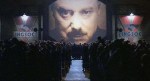
Nineteen Eighty-Four in Spain

Tim Robbins and The Actors’ Gang are putting on a fascinating-looking adaptation of George Orwell’s Nineteen Eighty-Four in Barcelona. The production deliberately ties in with contemporary concerns about surveillance in the city, and in Spain and beyond. This production has already toured the USA, and you can find out more about it here.

Of course, this is far from the first adaptation of Orwell’s novel. Earlier this year, which is the 5oth anniversary of the publication of this seminal work, the UK’s National Media Museum put on a special version with John Hurt playing Winston Smith as he did in the 1984 cinema version, directed by Michael Radford (with its chilly soundtrack by The Eurythmics, which many regard as inappropriate but I really like!). The best version I have seen was done by Northern Stage in my old home city of Newcastle. This was a violent, uncompromising version (see this review in The Guardian) mixing live cinema and theatre. There was also the much earlier 1956 film directed by Michael Anderson and starring Edmond O’Brien, which shared with the climate in which the novel was written, the air of post-war ruin and privation (or at least its memory). Of course, one could regard Terry Gilliam’s Brazil as a riff off Nineteen Eighty-Four – but he’s never a director for a straight version!

(thanks to Aaron Martin for pointing me in the direction of the Barcelona production…)

Surveillance in Science Fiction

There have been waves of interest in surveillance in fiction, and we are going through another one now, and not just in SF – I am currently writing a piece now on surveillance in post-9/11 fiction (which includes Doctorow, Stross, Macleod and other SF writers), and a discussion of this recently started on a listserv. I posted a quick message, which I will reprint here, as the first part of a catalogue of relevant novels in the genre.

Here’s my incomplete list of essentials in surveillance SF in roughly chronological order, which will be added to in future. The problem here is that SF abounds with dystopias of social control, and separating out the ones which say something interesting about surveillance is difficult…

Yevgeny Zamyatin – We which is pretty much the basis for George Lucas’s film THX-1138, so far as I can see, although it is not acknowledged. It was also read by Orwell, although for a long time he claimed not to have read it!
Aldous Huxley – Brave New World. Seems far more pertinent than Orwell in many ways, especially in terms of how control is best achieved by giving people what they want…
George Orwell – Nineteen Eighty-Four is of course as chilling and brilliantly-written as ever…
Philip K. Dick – A Scanner Darkly (and indeed most of PKD’s fiction – he is perhaps the best writer ever on paranoia and surveillance from the pulp of Eye in the Sky to more developed works like Ubik – I have a piece out this year in the Review of International American Studies on Dick and surveillance)
Bob Shaw – Other Days, Other Eyes – a superbly poetic technology called ‘slow glass’ forms the basis of this fix-up novel (made from three short stories with a cliched plot spun around it – the original stories are better and more suggestive)
John Brunner – Not just the proto-cyberpunk, The Shockwave Rider, it’s very worth reading the other three of his amazing four dystopic novels of the early 70s Stand on Zanzibar, The Jagged Orbit and The Sheep Look Up
David Brin – Earth. A quite frankly ludicrous pulp plot and Brin can’t write dialogue or characters, but a lot of great surveillance stuff in it that forms the background to his non-fiction, Transparent Society – his other novels have a similar interest in surveillance, if you can put up with his writing!
Paul J. McAuley – Whole Wide World – so far as I know, still the only SF novel to engage successfully with the UK’s CCTV system. It is also beautifully written and a cracking crime novel too. He is perhaps Britain’s most underrated writer… I have a partly-piece written about this, which I have never published!
Arthur C. Clarke and Stephen Baxter – The Light of Other Days. Clarke’s idea written up by the much younger Baxter, this steals a short-story title from Bob Shaw and much of the plot from Isaac Asimov (see below), but then takes it a bit further. Still utter pulp though…
Charles Stross – Glasshouse. This is set on what is supposedly a ‘panoptic’ prison in space, except it turns out it isn’t as panoptic as it is supposed to be…
Cory Doctorow – Little Brother. A teen novel, but the only deliberately written fictional manual for resistance to contemporary surveillance.

Surveillance is also pretty much omnipresent in cyberpunk novels (Gibson, Sterling et al.) but it is not really foregrounded in any of them, although one could mention Islands in the Net by Bruce Sterling as being a good example.

It’s also worth remembering that SF is and has been since the 1930s, a genre that is based primarily in the short-story, not the novel, and there are hundreds of interesting short stories on this theme, of hugely varying quality. Some are classics, like Isaac Asimov’s ‘The Dead Past’ or Bob Shaw’s ‘The Light of Other Days’ (see above – there is an interesting sub-genre of works in which surveillance tech emerges out of efforts to see into the past) or Frederik Pohl’s The Tunnel Under the World’ or Damon Knight’s ‘I See You.’

J.G.Ballard is dead

Anticipating academics like Baudrillard and Marc Auge by some years, he saw the future in what Nairn called subtopia: suburbs, industrial ruins, traffic islands, gated communities. He once said that the airport departure lounge was the apotheosis of western civlisation and its ultimate destination.

There’s only one piece of news that matters today: J.G. Ballard is dead.

Along with fellow ‘new wave’ science fiction writers like Brian Aldiss and Michael Moorcock, Ballard revolutionised the way British people saw ourselves, our present and our futures. He recognised that the real danger to society was not some distant dystopia, but a current and ongoing nightmare of consumer-driven ennui, a lethargic cultureless space of casual selfishness and lost ideals. Anticipating academics like Baudrillard and Marc Auge by some years, he saw the future in what Nairn called ‘subtopia’: suburbs, industrial ruins, traffic islands, gated communities. He once said that the airport departure lounge was the apotheosis of western civilisation and its ultimate destination.

Some of the obits would give you the impression that Ballard disliked being classified as a science fiction writer. But it is probably truer to say that mainstream critics disliked having to heap praise on a man who was so obviously writing science fiction, a genre that attracts nothing but disdain by many rather ignorant commentators. What he did might now be classed as ‘slipstream’ or put in the same box as the great experimental mid-century European writers like Italo Calvino. Anything but SF. Those critics did not, and still do not, realise that science fiction, as Ballard himself put it, was the most authentic literature of the Twentieth Century. What Ballard disliked was being classified by people who understood what he was doing less than him, who perceived what was happening less insightfully than he did.

That said, Ballard was not a traditional British writer of what Brian Stableford called ‘scientific romance.’ Like many writers who grew up during the mid-century, he was instead informed by the experience of war, in his case being a child in China during the Japanese invasion and occupation. However, like Aldiss, he also drew on the legacy of experimental political / artistic movements like surrealism. His early disaster novels, The Drowned World (1962), The Drought (1965), The Crystal World (1966) and so on, demonstrate this quite clearly, although the high point of his modern fantasy is probably the quite wonderful The Unlimited Dream Company of 1979 in which his native Shepperton is transformed into feathery tropical colours by the arrival of a birdman.

He could be quite terrifyingly acute about the moral vacuum in contemporary consumer capitalism. Before Bauman and Baudrillard were producing their sociological and semiotic takes, in the more optimistic climes generated by MacLuhan’s ‘global village’, Ballard was writing The Atrocity Exhibition (1969), Crash (1973), Concrete Island (1974) and High Rise(1975), four of the most uncompromising, bleak portrayals of the decline of western civilisation in any language or any genre. Although the mood of these novels was shared by other contemporary ‘new wave’ SF writers like Samuel Delaney (Dhalgren), Philip K. Dick (A Scanner Darkly), Brian Aldiss (Barefoot in the Head) and John Brunner (The Sheep Look Up), nothing quite so tellingly vicious and dark was produced by mainstream writers until some thirty years later when Cormac McCarthy wrote The Road.

At the same time however, for most of his career, Ballard’s imagination was never dominated by a single approach. His conceptions and his writing were often beautiful and elegiac, especially in his short-stories, a form central to the development of SF but over which he showed a uniquely total mastery. The collections that became Vermilion Sands (1971) and Memories of the Space Age (1988) have an atmosphere of decline, abandonment and loss of memory, that is at once frightening and liberating. The amnesiac astronauts who inhabit the ruins of Cape Canaveral are all of us, lost, looking for roots in the remains of life, yet somehow living a dream from which they cannot, and would not, want to wake.

Ballard’s later writing did become more mainstream and more accessible, both less acute in many ways and more obviously reflective of now: the world, in other words, gradually caught up with him. Thus novels like Cocaine Nights (1996), Super-Cannes (2000), and Kingdom Come(2006), are no longer SF, partly by design, but partly because we have arrived. The departure lounge is all around us. With all the paranoia, the obsession with security and surveillance, the petty micro-authoritarianism, the gated, golf-playing, consumer utopias, we live in Ballard’s world now; in what Mike Davis and Daniel Bertrand Monk recently termed the ‘evil paradises’ of neo-liberalism.

For me, Ballard reached a high point of his craft in this vein with 1988’s Running Wild, his taut, economically-written novella of a middle-class spree-killing in a private estate, a work which drew on the reality of the Hungerford Massacre, one of Britain’s worst spree killings. In the 1980s, he gradually became more intensely self-reflective and his best works were autobiographical: Empire of the Sun (1984), The Kindness of Women (1991) and most recently, Miracles of Life (2006). It was also welcome, in 1996 to see his selected essays published as A User’s Guide to the Millennium – the title was not in any way egotistical. Ballard was probably the only person alive who could justifiably claim to be able to have written such a thing. Ballard could have been Britain’s Philip K. Dick but whereas Dick was driven wild-eyed and ragged in the effort to understand what he saw and was as out-of-control as his words, Ballard remained clear-sighted, level-headed and produced disciplined, considered prose.

He will be much missed.

J.G. Ballard (1930-2009) – writer, thinker, intellectual freedom-fighter.