More on CCTV in Japan

The slightly left-leaning Asahi Shimbun newspaper had a pretty balanced if uninspiring editorial this week on the spread of CCTV cameras in Japan. The English translation is available here.

The most important thing in the editorial is the recommendation of national laws for CCTV. This would be better than in the UK for example, where there still isn’t any national regulation of CCTV except for the Data Protection Act. The paper’s suggestions are:

  • transparent operational procedures with ‘rigorous conditions’ for the sharing of images
  • third party oversight for police cameras and a ‘help desk where people can complain about being caught on tape’

This is a start, but only a start, and the second one would probably prove completely unworkable especially if cameras become more widespread. It would be rather better for some kind of permission system to operate, where cameras were seen as an exceptional response to a proven need. The paper is already accepting the normality of CCTV cameras in public spaces regardless of the evidence of their effectiveness- which it acknowledges is equivocal (in fact it’s generally much worse than that in the UK) or indeed the wider social impacts.

Japan to introduce resident-monitored CCTV

One of the most interesting developments in recent years has been the way in which the state has attempted to adapt Japan’s traditional culture of responsibilized local community organisations (chounaikai) for the new surveillance society (kanshi shakai, in Japanese). Cynics may well argue that what is called here bohan machizukuri (or community safety development – or sometimes the similar anzen anshin machizukuri) is simply a way in which the government can attempt to save money whilst pretending to be tough on what is always claimed to be a worsening crime rate. It is also true to say that this is also a further perversion of the machizukuri (bottom-up community development) idea that came out of local environmental movements of the 1960s.

Nevertheless, the Japan Times reported that the Keisatsuchou (National Police Agency or NPA) appears to be pushing forward with plans to extend its rather small number of CCTV cameras* into 15 residential areas starting January 2010 (two of which, Higashiyamato and Musashimurayama, are suburbs of Tokyo, and I’ll be visiting these whilst I am here) at the cost of 597 Million Yen (around £3.85 Million or $6.3 Million US). There’s always an underlying fear that is played on when such systems are installed, and in this case it is a classic: the threat to children. The small camera systems(around 25 cameras in size) will be installed on streets that are commonly used by kids going to and from school.

The fact that the schemes are focused on child safety would certainly be one of the reasons why the use of local volunteer committees to watch the cameras and manage the data from local civic facilities like community centres, has been put forward. It could also be in response to opposition from some local residents to what they see as the imposition of unwanted state invasion of their privacy, although according to the Japan Times, the police say it “will help residents to secure safety by themselves.” Their big problem is that there do not appear to be many volunteers yet!

There are many questions here. One mystery is that in Japan most school runs already have several, often elderly, volunteers who look out for children in person,in a more genuinely machizukuri form of bohan machizukuri so why the more expensive cameras? Another massive question is the one around privacy and data protection. How will volunteers be expected to act as official data controllers, especially in such a sensitive area as surveillance of children in public space? Finally, what will the effect be on trust and community relations to have one set of people in the community monitoring others? How will they be held accountable?

These, and many other questions will be just some of the things occupying my time here for the next two months…

*There are just 363 NPA cameras in Japan, however there are more owned by local municipal authorities, particularly in Tokyo, and thousands more operated by private companies and shoutenkai (shopkeepers’ associations).

India joins the battle for orbital space

Artist's impression of RISAT-2

India has launched its first major military surveillance satellite, RISAT-2, a platform for high-resolution Synthetic Aperture Radar (SAR), which puts it up there with the kind of things that the USA were launching over 10 years ago. Of course although, as The Times of India comment shows, being part of the club of orbital space powers is a consideration, the main motivations are most immediately, dealing with the threat of Pakistani Islamic extremists, and in the long term, regional competition with China, which has its own active satellite launch (and satellite-killing) program. One thing which about which the paper is entirely correct is that Indian high tech is more advanced than China’s and this home-grown satellite marks a small but significant shift in global surveillance power towards India. Whether, for a country still struggling with massive poverty and inequality, it is what anyone ‘needs’ or is any more than an expensive strategic symbol is another question.

They want us to trust them…

Maybe what Jacqui Smith needs is a dose of ‘Chinese democracy’ to go with her Chinese-style attitude to security and surveillance…

In the last fortnight there have been interesting developments that have reminded us, as if we needed reminding, that those who want to infringe on the liberty of others need to be absolutely squeaky-clean themselves or risk severe censure, and that those who introduce systems which encourage suspicion and spying should not be surprised if people no longer trust them and start to investigate their activities.

The first of course was the saga of Jacqui Smith’s apartment. The basic facts are that the UK Home Secretary has been claiming £24,000 (around $35,000 US) per year in allowances for an apartment that she does not actually live in. The particular irony (and we love a bit of irony in Britain!) was that she has been reported by a neighbour – in other words she was a victim of the kind of suspicious, back-stabbing, trust-no-one society that she has been encouraging. Of course she should resign if she had any intelligence or integrity, but we already know to the cost of our civil liberties that she does not.

Funnily enough, it is to China we go to another example and one with, it seems, a rather more accountable outcome. This is almost the second time in a row that I have unfavourably compared a western country to China – this is getting rather disturbing particularly as I am no friend of the Chinese state, being a long-term Free Tibet supporter. However, Variety (of all places) is reporting that Yu Bing, who is director of the internet monitoring department of Beijing’s Public Security Bureau, and therefore a major figure in the infamous Golden Shield, and surveillance of journalists, bloggers and net democracy activists (as well as those just trying to access unapproved content), has been arrested for taking bribes from a contractor.

Admittedly it is a lot more than the sums in the Jacqui Smith case (40M Yuan, or about $5.8M US), and corruption is endemic within the Chinese state at all levels, but it does show a rather different attitude to the establishment towards top officials who fail to live up to the standards we expect of them. Maybe what Jacqui Smith needs is a dose of ‘Chinese democracy’ to go with her Chinese-style attitude to security and surveillance?

China calls for better international regulation of space

…it is the USA that effectively controls earth orbit. However many other emerging economies see no reason why this should be the case….

Following last week’s collision between an obsolete Russian military satellite and an US Iridium communications satellite, there has been a lot of discussion about the management of orbital space (or, more accurately, the lack of it). Orbital positions are managed by the International Telecommunications Union (ITU), but the effective control of orbital space is a matter of power projection – i.e.: which country can maintain a stronger and more pervasive presence in space. With the Russian program almost defunct, and European satellites limited in number, it is the USA that effectively controls earth orbit. However many other emerging economies see no reason why this should be the case. India now has a regular launch program and in particular China is massively expanding its space presence, even making noises about its ability to destroy satellites if necessary.

China seems now to be using this incident to sound out other countries and the international scientific community about a more coherent and comprehensive international management of orbital space. In an article published on the official English-language news site, Chinadaily, various senior Chinese scientists and People’s Daily journalists are quoted in favour of “establishing a system for the promotion of space safety is an important method of space traffic management”, through “long-term cooperation from the international community”, and perhaps even a “space traffic law”, although it is acknowledged that this is “still a very remote concept”.

The one organisation that is not going to like this at all is the US military. USSTRATCOM has absorbed the space power doctrine developed in the 1990s by USSPACECOM, which argued effectively that orbital space should be part of US military plans for ‘Full-Spectrum Dominance’ (FSD) and that international projects like the International Space Station would be tolerated only insofar as they could be ‘leveraged’ to US advantage. The US military wants to maintain the ‘ultimate high ground’ that dominance of earth orbit gives them, for communications, for surveillance, for weapons targeting. They are not even very keen on the EU Galileo project, the new and more technically-advanced rival to GPS (which is a US military system).

Just as with the discussion about internationalising management of the Internet and moving it beyond US government control, any suggestions of a more comprehensive international management of space are likely to be resisted even at the expense of logic and reason. The Chinese know this very well, and are being rather cleverly provocative. They are however, right.

Quiet in the Library! Controlling the Internet

For many supposedly liberal politicians and bureaucrats the Internet is just a library of information, and we all know that libraries must be quiet and orderly, used responsibly and under the supervision of trained librarians…

Just a quick one: Boing Boing covered the story of an Australian EFF information rights campaigner, Geordie Guy, who has received a death threat from supporters of the government´s plan to control the Internet – just like so many other states around the world.

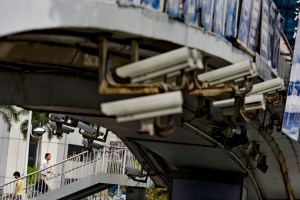
Surveillance cameras in Dajuyuan, Shenzhen (Rolling Stone)

It is no accident that the EFF campaign in Australia makes reference to their government´s plan as a ‘great wall’.  The first government to do this was, of course, China with its jīndùn gōngchéng (‘Golden Shield’) system which was exposed by Greg Walton.

As Naomi Klein´s more recent investigations have shown, it seems that western governments and companies are not only deeply involved with supplying equipment and expertise to China´s new surveillance state, but also see the development of the combined physical and virtual surveillance infrastructure being built by the authoritarian Chinese government as some kind of model for their own supposedly more liberal nations.

The Internet seems to worry all sorts of otherwise level-headed and well-meaning people. I was invited to speak at a recent conference in Finland on security in the Baltic states, and I got into a small argument with the rapporteur of one of the working groups, who said that one of their conclusions was that ‘we’ must stamp out hate-speech on the Internet. I asked the rapporteur how they would intend to do this without destroying the structures which enabled the creativity and freedom of the Net, and the response was that stamping out hate-speech was too important and just must be done. I suspect this is how a lot of supposedly liberal politicians and bureaucrats are thinking. For them the Internet is just a library of information, and we all know that libraries must be quiet and orderly, used responsibly and under the supervision of trained librarians. If enforcing order destroys everything that makes the Internet so revolutionary and so important, so what? Order must be maintained. There must be quiet in the library!