Surveillant Landscapes

There is a fascinating little piece on Bldg Blog about ‘security geotextiles’ and other actual and speculative surveillance systems that are built in to, underlie or encompass whole landscapes. The argument seems to support what I have been writing and speaking about recently on ‘vanishing surveillance’ (I’ll be speaking about it again in Copenhagen a the first Negotiating (In)visibilities conference in February): the way in which, as surveillance spreads and becomes more intense, moving towards ubiquitous, pervasive or ambient surveillance, that its material manifestations have a tendency to disappear.

There is a standards kind of alarmism that the piece starts with and the assumption that such things are malevolent does strike one as an initial impression, perhaps not surprising given that the piece is inspired by yet another security tech developement – this time a concealed perimeter surveillance system from Israeli firm, GMax. Perhaps if it had begun with urban ubiquitous sensory systems in a universal design context, it might have taken a very different direction. However, what’s particularly interesting about the piece is that it doesn’t stop there, but highlights the possibilities for resistance and subversion using the very same ubiquitous technologies.

But whether hegemonic or subversive, the overall trajectory that post outlines of a move towards a machine-readable world, indeed a world reconfigured for machines, is pretty much indisputable…

A buried and ultimately invisible magnetic passive perimeter security system, from Israeli security company, G-Max.

(Thanks to Torin Monahan for alerting me to this)

Will 2012 be the year of the drone?

My first post of 2012 – and, yes, my New’s Year’s Resolution is to blog regularly again – is not about a new subject. Unmanned Aerial Vehicles (UAVs) or drones, are already on their way to being a standard tool of national security and increasingly of policing too. However, given decreasing price of small Micro-Unmanned Aerial Vehicles (MAVs), it was also inevitable that NGOs, activist and citizen groups and even individuals, would soon start to operate them as a form of sousveillance or counter-surveillance, or simply as surveillance.

Some Occupy protestors in Europe and the USA had already made use of commercially available MAVs to broadcast footage of protest. And, the BBC reports today that the Sea Shepherd Conservation Society, the radical direct action anti-whaling group, will this year use an Osprey drone aircraft to monitor Japanese whaling fleets operating in the southern oceans. Sea Shepherd has always been technically adventurous (and PR savvy), operating radar-invisible speedboats and even a submarine in the past.

But it all suggests that drones have made the leap from military to policing to civil use with remarkable speed, and I suggest that in 2012 we will see the proliferation of MAVs operated by non-government users. Let’s just see how fast governments now try to outlaw drones in response…

Sea Shepherd activists test their drone


Robot Warfare

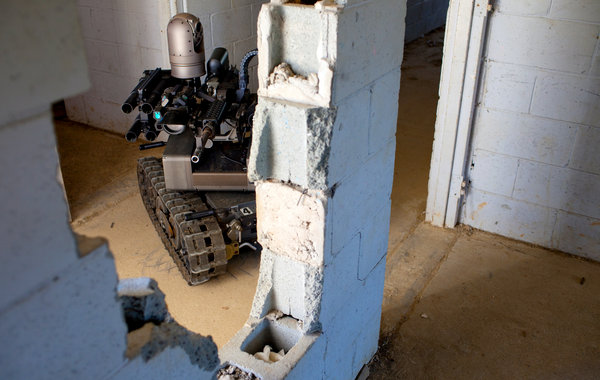
MAARS ground robot (NYT)

The New York Times recently had a good article on the development of robot warfare, covering surveillance drones, and actual warfighting machines, inspired, it seems, by a visit to the annual ‘Robotics Rodeo‘ held by the US military at Fort Benning in Georgia every October. These things are only going to get more common and more sophisticated… never mind that they kill plenty of civilians, they keep ‘our boys’ out of harm’s way, eh?

Border Security Market estimated at $16Bn

A marketing consultancy has estimated that the global border security market, including Unmanned Aerial Vehicles (UAVS), Unmanned Ground Vehicles (UGVs) and perimeter surveillance is due to hit $15.8bn in 2010. Without any sense of irony whatsoever, the company calls the border security market “one of the most exciting emerging markets within the global defence and security marketplace.”

They ask questions like:

“Which regional border security marketplaces offer the most significant growth opportunities? What are the prospects for European and North American defence and security companies seeking business opportunities in the Middle East? How is spending on different types of border security technology likely to be affected as government budgets come under intense pressure? What is the status of the Secure Border Initiative Network (SBInet) or ‘virtual fence’ along the US-Mexico border? To what extent is public opinion driving government policy on border security? What effect is the economic downturn having on illegal immigration?”

To know their answers to these questions though, you’ll have to pay £1499.00 (or $2,418.00 US)! Clearly they believe that the market for reports on border security is also pretty ‘exciting’…

Manchester Surveillance Blimp Axed

The axed Manchester Police drone (Guardian)

Police in Manchester, UK, have axed a tethered surveillance balloon that cost them 80,000 GBP (around $130,000 US). The supposedly covert balloon – if a large white blimp with ‘POLICE’ written on the side in big blue letters can be called ‘covert’ – had been intended to be used for monitoring of public order at large-scale events. However it was a victim of a more conventional Manchester problem – bad weather. Apparently it did not function very well in wet and windy weather. One would have thought that this might have occurred to the police of a notoriously wet and windy town…

This might seem like a victory for anti-surveillance forces, but of course, this will only increase the pressure for more versatile and weather-proof aerial surveillance, i.e. the micro-UAVs (or camera drones) that several other forces have already purchased, not to mention the more expensive powered high-level surveillance airships of the kind specified in the secret South-Coast Partnership report on drone surveillance.

Drone Britain

Despite the supposed anti-surveillance tendencies of the new coalition government in Britain, one kind of surveillance would seem to be expanding, as it is almost everywhere in the world: that of surveillance Unmanned Aerial Vehicles (UAVs), Micro-unmanned Aerial Vehicles (MAVs) or flying drone cameras. There are so many previous stories on this blog about drones you’d be better off searching than me providing links here!

The Guardian reported on Friday that a growing number of different agencies are either ordering drones or have plans to do so, including he Serious Organised Crime Agency (SOCA), four police forces (Merseyside, Essex, Staffordshire and the British Transport Police), the Environment Agency, and even some Fire Services (West Midlands and South Wales). This follows the story in January that there was what seemed to be an evolving secret national strategy for drones.

So far, their use has been limited not by ethical concerns but by the requirements of the Civil Aviation Authority (CAA) which insists that they must be “licensed when flown within 50 metres of a person, property or structure.” This remains its position, but it will be interesting to see how stringent are the licensing requirements as drones increase in number and whether the expansion in UAV use is in any way affected by the government’s stated policy aim to bring CCTV under stricter regulation.

(thanks to Charles Raab for this)

Mapping drone strikes

Via Boingboing, an analysis and map of US UAV drone strikes on the tribal regions of Pakistan from 2004. Some good stuff from NewAmerica. What is particularly interested, if not unpredictable, is the way that weaponized UAVs have in the course of just a few years become a ‘normal’ part of the US war machine, with deaths from drone strikes possibly doubling from 2008-9. We can’t be sure of the exact numbers.

Does the expansion of surveillance make assassination harder? Not in a world of UAVs…

Following the killing of Mahmood Al-Mabhouh is Dubai, allegedly by Israeli Mossad agents, some people are starting to ask whether political assassination is being made more difficult by the proliferation of everyday surveillance. The Washington Post argues that it is, and they give three other cases, including that of Alexandr Litvinenko in London in 2006. But there’s a number of reasons to think that this is a superficial argument.

However the obvious thing about all of these is that they were successful assassinations. They were not prevented by any surveillance technologies. In the Dubai case, the much-trumpeted new international passport regime did not uncover a relatively simple set  of photo-swaps – and anyone who has talked to airport security will know how slapdash most ID checks really are. Litvinenko is as dead as Georgi Markov, famously killed by the Bulgarian secret service with a poisoned-tipped umbrella in London in 1978, and we still don’t really have a clear idea of what was actually going on in the Markov case despite some high-profile charges being laid.

Another thing is that there are several kinds of assassination: the first are those that are meant to be clearly noticed, so as to send a message to the followers or group associated with the deceased. Surveillance technologies, and particularly CCTV,  help such causes by providing readily viewable pictures that contribute to a media PR-campaign that is as important as the killing itself. Mossad in this case, if it was Mossad, were hiding in plain sight – they weren’t really trying to do this in total secrecy. And, let’s not forget many of the operatives who carry out these kinds of actions are considered disposable and replaceable.

The second kind are those where the killers simply don’t care one way or the other what anyone else knows or thinks (as in most of the missile attacks by Israel on the compounds of Hamas leaders within Gaza or the 2002 killing of Qaed Senyan al-Harthi by a remote-controlled USAF drone in the Yemen). The third kind are those that are not meant to be seen as a killing, but are disguised as accidents – in most of those cases, we will never know: conspiracy theories swirl around many such suspicious events, and this fog of unknowing only helps further disguise those probably quite small number of truly fake accidents and discredits their investigation. One could argue that such secret killings may be affected by widespread surveillance, but those involved in such cases are far more careful and more likely to use methods to leverage or get around conventional surveillance techniques.

Then of course, there is the fact that the techniques of assassination are becoming more high-tech and powerful too. The use of remote-control drones as in the al-Harthi case is now commonplace for the US military in Afghanistan and Pakistan, indeed the CIA chief, Leon Panetta, last year described UAVs as “the only game in town for stopping Al-Qaeda.” And now there are many more nations equipping themselves with UAVs – which, of course, can be both surveillance devices and weapons platforms. Just the other day, Israel announced the world’s largest drone – the Eltan from Heron Industries, which can apparently fly for 20 hours non-stop. India has already agreed to buy drones from the same company. And, even local police forces in many cities are now investing in micro-UAVs (MAVs): there’s plenty of potential for such devices to be weaponized – and modelled after (or disguised as) birds or animals too.

Finally, assassinations were not that common anyway, so it’s hard to see any statistically significant downward trends. If anything, if one considers many of the uses of drones and precision-targeted missile strikes on the leaders of terrorist and rebel groups as ‘assassinations’, then they may be increasing in number rather than declining, albeit more confined to those with wealth and resources…

(Thanks to Aaron Martin for pointing me to The Washington Post article)

Pentagon seeks bids for 3D-surveillance system

DARPA are seeking bids for a high resolution three-dimensional battlefield surveillance system. The so-called Fine Detail Optical Surveillance (FDOS) program is looking to develop “a fundamentally new optical ISR capability that can provide ultra high-resolution 3D images for rapid, in-field identification of a diverse set of targets… for use in an active battlefield or hostile environments with designs tailored to allow for soldier portable applications as well as UAV integration.”

As Wired maagazine points out, the Pentagon are already deep into a virtual 3D surveillance scheme, the evily-named Gorgon Stare, that involves 12 cameras attached to Reaper drones, and DARPA already have another development programme called Autonomous Real-time Ground Ubiquitous Surveillance – Imaging System (ARGUS-IS), which involves “a 1.8 Gigapixels video sensor”. There’s more details here.

Artist's Impression of the ARGUS system (Wired)

There’s no getting away from it: semi-autonomous robots and unmanned aerial vehicles are the new silver bullet for both military and civil uses, both in surveillance and warfighting itself. It’s about time more researchers and activitists paid this some greater attention…

The drone surge

The Huffington Post has a really interesting article on the current and future use of drones (whether they be UAVs, MAVs or other things) by the US military. Judging from the early comments, it seems there are some people also think these things are great because ‘they keep US soldiers safe’ – unfortunately they don’t seem to do the same for the villagers of the impoverished countries where they are deployed. As the International Campiagn for Robotic Arms Control (ICRAC) is arguing, there needs to be an international treaty or convention to regulate the use of such machines when they are used as or part of weapons systems, but beyond that, these systems, out of theline of vision of the general public, in terms of their policy development and often their physical deployment, are seen as ‘the future of surveillance’ within many nations too – as was revealed in Britain just the other day. The military-industrial complex is now the security-industrial complex and there is a decreasing gap between military tech and its civilian counterparts…