Iraqi resistance hacks US drones

According to the Wall Street Journal, US surveillance drones (you know, the future of military surveillance…) have allegedly been hacked by Iranian-backed Shi’ite forces in Iraq, using $26 off-the-shelf Russian software called Skygrabber – and they may have been compromised in Afghanistan too.

It is, as my informant, Aaron Martin, points out, amazing that the military surveillance systems of the world’s most resourced and technologically-developed military could be hacked so easily and for so long without notice. It also makes me wonder how many other networked surveillance systems would be vulnerable or are being hacked using the same or similar systems. If for example, organised criminal gangs could access the video surveillance systems of major cities, this would further call into question the effectiveness of these systems. Or alternatively, of course, it could point the way to a more accountable, open-access kind of surveillance – as Aaron and I are exploring in a paper we are currently writing.

New UAVs in Afghanistan

The USAF continues to use the Afghanistan / Pakistan conflict as a test bed for new military surveillance technologies and robotic weapons. The latest thing is apparently the RQ-170, codenamed Sentinel, which is a radar-evading UAV or drone aircraft.

This picture of the aircraft was apparently shot near Kandahar…

The Sentinel (source unknown)

It seems that as this conflict drags on, more and more of these things will get wheeled out. Its only purpose seems to have become to field test all these black-project developed technologies that the US security-industrial complex has been churning out. It wasn’t that long after the Predator drone emerged that we saw a weaponized version. It is unclear whether there is any such version of the Sentinel yet, but no doubt there will be soon enough. The increasing reliance on remote-controlled and robotic weapons seems to be a new article of faith amongst the world’s wealthier militaries.

Controlling Robotic Weapons

I’m delighted to be informed by Professor Noel Sharkey that I have been invited to become the first member of the Advisory Board of the International Campaign for Robotic Arms Control (ICRAC). ICRAC aims to help prevent the unfettered spread of automated weapons systems and to produce an international convention or some other kind of binding agreement to control their use. I’ve been tracking the develeopment of robotic surveillance (and killing) systems for quite a while now and I think this campaign is absolutely essential. This piece recently in The Times of London goes into some of the issues quite well. There is a lot of work to do here to persuade governments to control what many militaries think will be ‘essential’ to warfare in this coming century, but I think that the landmines campaign is a good example of what can be done here – but this time before robotic weapons become too common.

MAVs

Torin Monahan sent me this interesting video from the US Air Force showing ideas on Micro-Aerial Vehicles (MAVs) – nature-mimicking drones or independent robots that are intended to ‘enhance the capability of the future war-fighter’…

I’ve called for a convention on the use of robotic weapons and Professor Noel Sharkey and a couple of colleagues have now set up the International Committee for Robot Arms Control (ICRAC) – this video just illustrates why they need to be controlled as soon as possible before these kinds of things are widespread.

India plans ‘world class’ electronic surveillance for Commonwealth Games

The Times of India reports on the Indian government’s plans to implement comprehensive surveillance for the 2010 Commonwealth Games. One aim seems to be to create the kind of ‘island security’ with which we have become so familiar at these kinds of mega-events: vehicle check-points with automatic license-plate recording and recognition; x-ray machines and other scanners for vehicles (and perhaps people too). They will also massively expand CCTV systems and not just in the actual Games area, but throughout the city of Delhi.There are also, as usual plans to use more experimental surveillance and control techniques (as with the use of sub-lethal sonic weapons in Pittsburgh the other day), in this case a drone surveillance airship,” capable of taking and transmitting high-density visual images of the entire city.”

However, this is not just about the temporary security of the games. As with many other such mega-events, the Indian government appears to be planning to use the Delhi games as a kind of Trojan Horse for the rolling out of similar and more permanent measures in big cities across the country. The Times article claims that the Ministry of Home Affairs intends to expand the measures and “soon the same model is planned to be replicated across the country,” and in particular on use of airships, “similar airships would be launched in other big and vulnerable cities like Mumbai, Bangalore, Kolkata and Chennai.” And there will be an infrastructure too, apparently “the IB [Intelligence Bureau] is silently working to create a command center to monitor all-India intelligence and surveillance.”

Of course the threat of ‘terror groups’ is the justification, and there’s no doubt there is a threat to Indian cities from such groups, particularly those based in Pakistan. However, the Indian public shouldn’t assume that anything done in the name of ‘anti-terrorism’ will: 1. actually work (in the sense of preventing terrorism); or 2. be used for those purposes anyway. This same trend happened  in the UK during the early 1990s, when the threat of the Provisional IRA was the justification, and before most people in Britain had even noticed, a massive (and it seems ever-expanding) patchwork of CCTV camera systems had been created, which were joined by further repressive measures even before 9/11. And did this massive number of cameras stop London being attacked by terrorists? No, it didn’t.  7/7 still happened. But of course we had lots of good pictures after the event for the media… and they are very expensive and don’t even do much to stop regular crime, as a recent meta-study has shown. What would be more effective would be peace and co-operation with Pakistan, a move away from both chauvinistic Hindu and Muslim nationalisms and extremisms which only generate resentment and hatred, and old-fashioned targeted intelligence work on those very few people who are actually planning terrorism – not mass surveillance and the gradual erosion of civil liberties of the entire population based on state fears that some of them might be guilty.

Finally, this is about globalization. The whole way this is promoted by the Indian government is as if there is some international competition to install as much CCTV and security as possible. But the global spread of the surveillance standards and expectations of the rich western elite is a self-fulfilling logic that benefits only the massive global security-industrial complex.

Moon protest highlights wider border surveillance issues

The mass mooning of the US balloon camera owned by Sierra Nevada Corporation went ahead, but the irony was that the system had already been disabled by the weather. Apparently a large thunderstorm cause a gash in the fabric of the balloon last week which, if nothing else, should prove rather more effective than the protest in making sure that the US government does not invest in it.

However the wider issue of the US surveillance of the border with Canada remains (not mention that of the Mexican border, already a major concern) and whilst this particular technology and the appropriately ridiculous protest, has attracted most attention in the media, let’s not forget that camera towers have been erected and the USA is flying UAVs along the border. Surely President Obama should realise that the paranoid policies of his predecessor do nothing apart from damage relationships (and trade) with a close neighbour?

Time for an international convention on robotic weapons

The estimable Professor Noel Sharkey is calling today for a debate on the use of robotic weapon systems, like the UAVs that I have been covering sporadically. He’s right of course, but we need to go much further and much faster. With increasing numbers of counties turning to remote-controlled weapon systems, and the potential deployment of more independent or even ‘intelligent’ robots in war, hat we need is an international convention which will limit the development and use of automated weapon systems, with clear guidelines on what lines are not to be crossed. In the case of atomic, biological and chemical weapons these kinds of conventions have had mixed success, but we have had very few clear examples of the use of such weapons in international conflicts.

US borders with Canada strengthened

There has been a lot of interest in the US border with Mexico in recent years, and rightly so. However, what not so many people have noticed is that the closing of the closing of the USA is taking place along the world’s largest land border between two countries, the border between the USA and Canada.

Unmanned Aerial Vehicles (UAVs) already patrol the airspace (and at a low enough level that private flights have had to be restricted, thereby doing two security jobs with one technology). However, the most recent announcement concerned the installation of video surveillance towers to monitor waterways. This is all on the basis of very little information about whether this is either cost-effective or necessary; according to the AP article, the Border Patrol themselves admit this: “What we don’t know is how often that vulnerability is exploited […] if, in fact, there’s a lot more going on than we thought, then this technology will help us identify it and it will help us respond and apprehend those people in ways that we haven’t before.” So essentially, this is surveillance to see whether surveillance is necessary – it seems we are now in a surveillance double-bind, so you no longer need a strong reason to install cameras; they are their own justification and may be justified in retrospect whatever does or does not happen. If nothing is seen, they will be said to be a deterrent, if something is detected then they will be proclaimed as showing the need for surveillance!

The technology employed against those tricky Canucks will be provided by the same supplier, Boeing, that has been so criticised for its failures on the Mexican border (and there have been plenty of failures down there). It seems that even when it comes to the trump card of security, which normally wins hands-down, the congressional pork-barrel remains the joker in the pack. Now, the Canadians and local firms along the US border have already been complaining about the post-9/11 restrictions that have begun to stifle cross-border trade on which many of those communities depend. In a recession, such considerations might be thought to count for something, but it seems that the mighty Boeing’s profits matter more…

Flying into trouble?

Governments will find it harder and harder to stand up to this kind of pressure from the growing security economy – all the companies grown fat on the War on Terror

Two recent stories of the cancellation of airborne surveillance programs should remind us that the route to a surveillance society is not an inevitable technological trajectory.

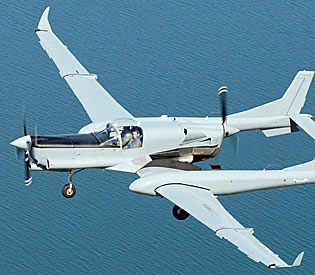
You don't see that very often! An airborne DEA surveillance plane (Photo by Schweizer Aircraft/MCT).

One is a classic tale of secret budgets disguising incompetence and disorganisation rather than efficient espionage. The US Drugs Enforcement Agency (DEA) has ended an experimental air surveillance program, following almost total equipment failure. The planes, in short, didn’t fly, or didn’t fly much. Almost $15 million US down the drain, and no accountability because this was an ultra-secret, need-to-know, maximum deniability, ‘black earmark’ project…

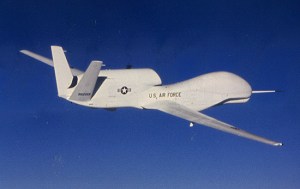
The other is a more courageous story of a government finally standing up to the pressure or its larger ‘allies’, and the fear-mongering PR of arms companies. In this case, the Australian government has withdrawn from the BAMS Global Hawk Unmanned Aerial Vehicle (UAV) program. It has cost the country $15 Million AUS, but this will save almost $1 Billion AUS. It also puts a small dent in the massive expansion of UAVs, now being used everywhere from the skies of Afghanistan to the streets of Liverpool. This decision did not make the military-industrial complex very happy and the story in The Australian shows clear evidence of corporate PR spin at work – the emotional blackmail of claiming that this decision could cost Australian lives in the event of more bushfires (or in other stories, it would leave Australia open to terrorism).

Global Hawk (USAF)
Global Hawk (USAF)

Even in a recession, governments will find it harder and harder to stand up to this kind of public pressure from the growing security economy – all the companies grown fat on the War on Terror that have the ear of the military and are backed by US-led consortia. It is to their credit that the Australian government has not given in – as for the US DEA, well, that is the opposite lesson – secrecy and the assumption of necessity can lead to massively wasteful state procurement and an absence of real security. The question is whether either lesson will prompt wider leaning…

US plans surveillance drone airship

I am sure there will be arguments about the violation of airspace, which will not be trivial as the ongoing diplomatic and increasingly military row over US surveillance vessels off China is showing…

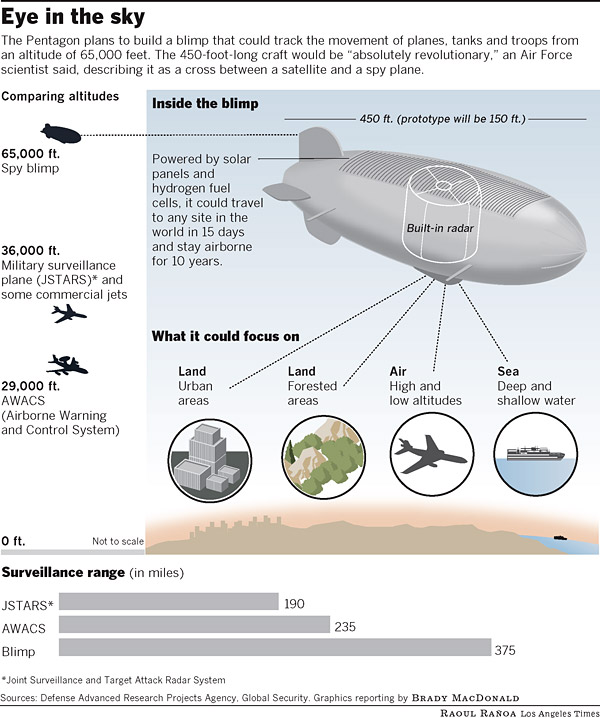
Unmanned aerial vehicles (UAVs) are one of the fastest-developing areas of surveillance technology. A new plan revealed by the US Department of Defense combines old and new tech with a plan, first revealed by the Los Angeles Times, for an pilotless surveillance airship called ISIS (Integrated Sensor Is the Structure) that will fly right at 65,000 feet (about 20km) high, right at the edge of ‘airspace’. The point of the airship is to provide the kind of constant watch that a geostationary satellite provides, but at a much lower level so that for more detailed pictures of the precise movements of vehicles, objects and people could be observed.

airship

Well, as usual, the reports only seem to to be concerned about how great this would be for US military tactics, and are not interested in the law, politics and ethics of such devices. For example, I am sure there will be arguments about the violation of airspace, which will not be trivial as the ongoing diplomatic and increasingly military row over US surveillance vessels off China is showing. And of course there are issues around the violation of human rights by such intrusive technology: international violations are very hard to deal with, however. And this will only be the beginning. The new Obama administration has promised more investment in intelligence and surveillance and less in warfighting. That sounds good in some ways, but of course just poses new problems and new issues for those of us concerned with ongoing US attempts to cover the whole world with surveillance for the benefit of its strategic aims.