The Royal Canadian Mounted Police (RCMP) are investing more in micro-UAVs, in particular little remote-control surveillance helicopter drones, according to the National Post today. The new drones will be the quad rotor AeroVironment Qube model, one of the most popular small drones used by police worldwide.
According to the police themselves, they will limit the use of the drones to “accident reconstruction, search-and-rescue operations, major crime scenes and situations involving emergency response teams”, however as the article also notes, they don’t actually have a formal policy on the use of UAVs, and as with other controversial purchases by Canadian police, for example the LRAD accoustic weapons in Toronto and Vancouver, this highlights how little oversight there is of what technologies police can purchase.
It is increasingly seeming like UAVs will continue to form the core of Obama’s military strategy, and it seems no coincidence that he has nominated John Brennan, described as the ‘architect’ of his drone policy, to be the new head of the Central Intelligence Agency.
Meanwhile, Canada is more likely to have widespread use of drones by police and the private sector before it gets any military models. It was reported just at the end of last year that the Canadian military drone program is now not likely to be in operation until 2017 and the cost has gone up to over $1Bn (Can). This doesn’t seem to have attracted anything like the attention that has been given to the ingoing farago surrounding the Canadian government’s attempt to purchase US Lockheed F-35 fighter jets, although admittedly that is no estimated as being something in the region of 50 times as expensive…
(Thanks to Chris Prince for keeping me updated on this!)
In one of my only posts last year, around this time, I argued that 2012 would be in the ‘year of the drone’ – and it certainly lived up to that. But we’re still only just beginning. This is already the decade of the drone. Unmanned Aerial Vehicles (UAVs) are going to be everywhere in the coming few years (and of course not just in international disputes – I am writing about the spread of domestic surveillance drones for a major report on Surveillance in Canada that we’re producing right now).
Media outlets are reporting that the dispute over maritime territory between China and Japan is ramping up through the use of UAVs. At the moment both countries rely heavily on conventional naval or fisheries surveillance vessels, which are limited in terms of speed of deployment and numbers. However, surveillance drones could enable a more consistent presence over the disputed islands (and more importantly the sea around them, whose fisheries and below seabed mineral resources are the real underlying issue here).
However, there are big differences in the politics and the political economy of each state’s strategic trajectory here. Japan is relying on its longstanding ‘alliance’ with the USA, and is likely to purchase US-made Northrop-Grumman Global Hawks, further emphasizing the military dependency Japan still has on the USA. China, on the other hand, is speeding up development of its own UAVs, in multiple different models. US industry sources seem more worried by alleged breaches of intellectual property rights in the drones’ design than by strategic issues – but of course, China has almost certainly had access to both hardware and software from downed US drones, which is all part of what some analysts are terming a ‘drone race’ with the USA.
and the Chinese version (Chengdu Aircraft Co.)
But this isn’t just about surveillance. Like the USA’s models, many of China’s UAVs are armed or can be weaponized very easily, and again like the USA, China has also been looking to export markets – most recently, Pakistan has been discussing the purchase of several armed drones from China, following the distinct lack of success in its own UAV development program.
The Global Hawks that Japan is buying are not armed, but this doesn’t mean that Japan is acting less aggressively here or will not in future used armed drones. Despite the post-WW2 US-imposed but popular ‘pacifist’ constitution of the country, the recent return to power of rightist PM Shinzo Abe might will mean both more heated rhetoric over territorial claims and attempts to increase the of the country’s self-defence forces: a review of Japanese military spending – with a view to increasing it – was announced just yesterday.
Drones would seem to be a politically popular choice in this regard as they do not involve putting Japanese lives at risk, or at least not directly; however the longer term outcomes any drone war in East Asia would not likely favour a Japan whose regional economic and political power is influence declining relative to China’s.
There is a fascinating little piece on Bldg Blog about ‘security geotextiles’ and other actual and speculative surveillance systems that are built in to, underlie or encompass whole landscapes. The argument seems to support what I have been writing and speaking about recently on ‘vanishing surveillance’ (I’ll be speaking about it again in Copenhagen a the first Negotiating (In)visibilities conference in February): the way in which, as surveillance spreads and becomes more intense, moving towards ubiquitous, pervasive or ambient surveillance, that its material manifestations have a tendency to disappear.
There is a standards kind of alarmism that the piece starts with and the assumption that such things are malevolent does strike one as an initial impression, perhaps not surprising given that the piece is inspired by yet another security tech developement – this time a concealed perimeter surveillance system from Israeli firm, GMax. Perhaps if it had begun with urban ubiquitous sensory systems in a universal design context, it might have taken a very different direction. However, what’s particularly interesting about the piece is that it doesn’t stop there, but highlights the possibilities for resistance and subversion using the very same ubiquitous technologies.
But whether hegemonic or subversive, the overall trajectory that post outlines of a move towards a machine-readable world, indeed a world reconfigured for machines, is pretty much indisputable…
A buried and ultimately invisible magnetic passive perimeter security system, from Israeli security company, G-Max.
My first post of 2012 – and, yes, my New’s Year’s Resolution is to blog regularly again – is not about a new subject. Unmanned Aerial Vehicles (UAVs) or drones, are already on their way to being a standard tool of national security and increasingly of policing too. However, given decreasing price of small Micro-Unmanned Aerial Vehicles (MAVs), it was also inevitable that NGOs, activist and citizen groups and even individuals, would soon start to operate them as a form of sousveillance or counter-surveillance, or simply as surveillance.
Some Occupy protestors in Europe and the USA had already made use of commercially available MAVs to broadcast footage of protest. And, the BBC reports today that the Sea Shepherd Conservation Society, the radical direct action anti-whaling group, will this year use an Osprey drone aircraft to monitor Japanese whaling fleets operating in the southern oceans. Sea Shepherd has always been technically adventurous (and PR savvy), operating radar-invisible speedboats and even a submarine in the past.
But it all suggests that drones have made the leap from military to policing to civil use with remarkable speed, and I suggest that in 2012 we will see the proliferation of MAVs operated by non-government users. Let’s just see how fast governments now try to outlaw drones in response…
Sometimes, little local stories give us the best insight into what living in a surveillance society is really like. This one is from a school in Virginia, USA. According to the local newspaper (via BoingBoing) a middle school student was suspended from school for opening the main door for a women who they knew who was unable to press the entry button because they had their hands full. The reason given by the school auhtorities is that the school has a secure entry system, in which people are supposed to press the entry button, look into a camera, and request entry. The student was suspended on the grounds that they were all supposed to know the rules, and that these rules were potentially of vital importance.
However this security-bureaucratic reasoning misses the key point that the child knew the adult concerned. Whilst security and surveillance systems are at least in part designed to respond to a supposed decline in social trust and an inceased ‘threat’ (which is very poorly supported by evidence anyway), there is good reason to suppose that placing what were previously matters of social negotiation into the hands of such ‘systems’, ‘rules’ and ‘technology’ further damages social trust.
Many questions then arise: what is this school, through this action and these systems, teaching kids about society? That security comes above all else? That no-one can be trusted? And that individual decision-making or social interaction is better replaced by impersonal systems? Surely, if education is the basis of the future of society, then what should be taught are the opposite lessons. This kind of subordination to systems is a form of training, of disciplinary control, not learning and education.
Many approaches to developing cities as automated environments, whether this be for robotics, for augmented reality or ubiquitous computing tend to take as their premise the addition of items, generally computing devices, to the environment. Thus, for example, RFID chips can be embedded in buildings and objects which could (and indeed in some cases, already do) communicate with each other and with mobile devices to form networks to enable all kinds of location-based services, mobile commerce and of course, surveillance.
But for robots in the city, such a complex network of communication is not strictly necessary. Cities already contain many relatively stable points by which such artificial entities can orient themselves, however not all of them are obvious. One recent Japanese paper, mentioned in Boing Boing, advocates the use of manhole covers, which tend to be static, metallic, quite distinctive and relatively long-lasting – all useful qualities in establishing location. The shape of manhole covers could be recorded and used as location-finding data with no need for embedded chips and the like.
It isn’t mentioned in the article, but I wonder whether such data could also be used for other inhabitants of the city with limited sensory capabilities: impaired humans? Could one equip people with devices that read the same data and use this to help sensorially-impaired people to navigate the city more effectively? On the less positive side, I also wonder whether such data would prove to be highly desirable information for use in urban warfare…
Video analytics is the thing right now. With so much video information and the limits of human operators, what to do with all that footage? There are numerous answers mostly involving forms of algorithmic movement recognition. From the masses of press releases that come my way every day, I notice one Israeli company (Israel being one of the world leaders in security technology), BriefCam, is marketing a new automated system that not only recognises objects of interest but then condenses hours of video which feature the object of interest into a matter of minutes featuring all the salient points from the whole time, at once. Or according to their own website:
“BriefCam VS Online receives real-time feed from the DVR/NVR and processes data to produce a database that can be called on to create a video summary presentation, on demand.”
I’ve seen the technology at work, but one thing starts to concern me imediately is what is lost by way of this combined footage. Check the video here for example.
The blurb claims that it is ‘easy’ for operators to see something unexpected, yet this is not a ‘real’ image, or in fact it is a hyperreal image, multiple images partly overlaid on what is assumed to be a standardized background. Of course, given the original footage remains available contextual evidence can be sought. However, I do wonder what kind of decisions will result from fast-moving combined footage pre-selected to present to a human viewer… and of course, what exactly it is that the system is programed to recognise and how. It seems that operators of video surveillance systems will increasingly be watching is not reality, but combined, edited highlights, a part-simulated recreation. Jean Baudrillard would be having a quiet chuckle if he could see this…
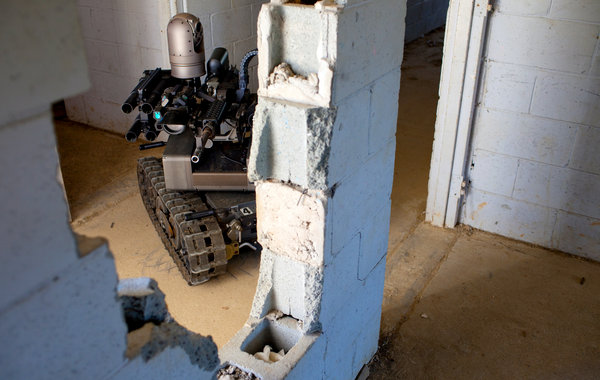
The New York Times recently had a good article on the development of robot warfare, covering surveillance drones, and actual warfighting machines, inspired, it seems, by a visit to the annual ‘Robotics Rodeo‘ held by the US military at Fort Benning in Georgia every October. These things are only going to get more common and more sophisticated… never mind that they kill plenty of civilians, they keep ‘our boys’ out of harm’s way, eh?
A marketing consultancy has estimated that the global border security market, including Unmanned Aerial Vehicles (UAVS), Unmanned Ground Vehicles (UGVs) and perimeter surveillance is due to hit $15.8bn in 2010. Without any sense of irony whatsoever, the company calls the border security market “one of the most exciting emerging markets within the global defence and security marketplace.”
They ask questions like:
“Which regional border security marketplaces offer the most significant growth opportunities? What are the prospects for European and North American defence and security companies seeking business opportunities in the Middle East? How is spending on different types of border security technology likely to be affected as government budgets come under intense pressure? What is the status of the Secure Border Initiative Network (SBInet) or ‘virtual fence’ along the US-Mexico border? To what extent is public opinion driving government policy on border security? What effect is the economic downturn having on illegal immigration?”
To know their answers to these questions though, you’ll have to pay £1499.00 (or $2,418.00 US)! Clearly they believe that the market for reports on border security is also pretty ‘exciting’…



 ubisurv