The mundane costs of independent drones

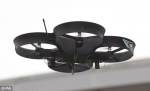
It’s been an aim of developers for quite a while to develop more independently functioning surveillance drones that can fly around and recharge themselves in some way – whether it’s solar gliders in the stratosphere or, at street level, biomimetic bird-like micro-UAVs that can ‘perch’ and draw power from electricity cables. This was one of the original aims of the DARPA call that led to the creation of that beautiful marvel of engineering / dystopian nightmare surveillance tool, the Nano Hummingbird. If you are an engineer, this is certainly convenient and probably looks a lot like a ‘free lunch’ – there is certainly no mention of any possible costs or downsides in this piece on engineering.com. But as we all should know, there is no such thing as free lunch.

Firstly and most importantly, there’s the question of whether societies want either identifiable or camouflaged surveillance devices flying around us at all times. A mobile surveillance device essentially becomes even more independent and less limited by its construction if it can ‘feed’ itself. And while the US Federal Aviation Authority in particular has just recently put a bar on commercial drone delivery services (PDF), it certainly hasn’t prohibited other kinds of drone use, and many other national regulatory bodies are yet to decide on what to do, while drone manufacturers are pushing hard for less ‘bureaucratic’ licensing and fewer controls.

The second objection is less fundamental but perhaps more effective at igniting opposition to such devices. It might be that any single device would draw minute amounts of power from cables, but what happens if (or when) there are thousands, even millions, of these devices – flying, crawling, creeping, rolling, slithering – and all hungry for electricity? I would suggest that, just like the cumulative effect of millions of computers and mobile phones, this would be substantial and unlike the claims made for smartphones, this would be additional rather than replacing less efficient devices. And this is not including the energy use of the huge server farms that provide the big data infrastructure for all of these things. So, who pays for this? Essentially we do: increased energy demand means higher bills and especially when the power is being drawn in an unaccountable way as with a biomimetic bird on a wire. And unlike the more voluntary decision to use a phone because of its benefits to us, paying for our own surveillance in this way would seem to be less obviously ‘for our own good’ and certainly has the potential to incite the ire of ‘ordinary middle-class homeowners’ (that holy grail of political marketing) and not just the usual small-government libertarian right or pro-privacy and anti-surveillance left.

 

Surveillant Landscapes

There is a fascinating little piece on Bldg Blog about ‘security geotextiles’ and other actual and speculative surveillance systems that are built in to, underlie or encompass whole landscapes. The argument seems to support what I have been writing and speaking about recently on ‘vanishing surveillance’ (I’ll be speaking about it again in Copenhagen a the first Negotiating (In)visibilities conference in February): the way in which, as surveillance spreads and becomes more intense, moving towards ubiquitous, pervasive or ambient surveillance, that its material manifestations have a tendency to disappear.

There is a standards kind of alarmism that the piece starts with and the assumption that such things are malevolent does strike one as an initial impression, perhaps not surprising given that the piece is inspired by yet another security tech developement – this time a concealed perimeter surveillance system from Israeli firm, GMax. Perhaps if it had begun with urban ubiquitous sensory systems in a universal design context, it might have taken a very different direction. However, what’s particularly interesting about the piece is that it doesn’t stop there, but highlights the possibilities for resistance and subversion using the very same ubiquitous technologies.

But whether hegemonic or subversive, the overall trajectory that post outlines of a move towards a machine-readable world, indeed a world reconfigured for machines, is pretty much indisputable…

A buried and ultimately invisible magnetic passive perimeter security system, from Israeli security company, G-Max.

(Thanks to Torin Monahan for alerting me to this)

Helping robots find their way in the city

Many approaches to developing cities as automated environments, whether this be for robotics, for augmented reality or ubiquitous computing tend to take as their premise the addition of items, generally computing devices, to the environment. Thus, for example, RFID chips can be embedded in buildings and objects which could (and indeed in some cases, already do) communicate with each other and with mobile devices to form networks to enable all kinds of location-based services, mobile commerce and of course, surveillance.

But for robots in the city, such a complex network of communication is not strictly necessary. Cities already contain many relatively stable points by which such artificial entities can orient themselves, however not all of them are obvious. One recent Japanese paper, mentioned in Boing Boing, advocates the use of manhole covers, which tend to be static, metallic, quite distinctive and relatively long-lasting – all useful qualities in establishing location. The shape of manhole covers could be recorded and used as location-finding data with no need for embedded chips and the like.

It isn’t mentioned in the article, but I wonder whether such data could also be used for other inhabitants of the city with limited sensory capabilities: impaired humans? Could one equip people with devices that read the same data and use this to help sensorially-impaired people to navigate the city more effectively? On the less positive side, I also wonder whether such data would prove to be highly desirable information for use in urban warfare…

Robot Warfare

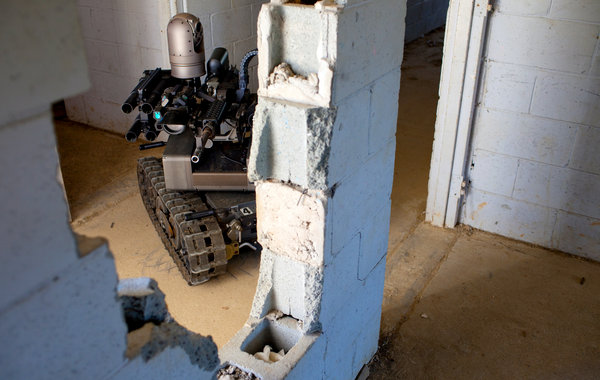
MAARS ground robot (NYT)

The New York Times recently had a good article on the development of robot warfare, covering surveillance drones, and actual warfighting machines, inspired, it seems, by a visit to the annual ‘Robotics Rodeo‘ held by the US military at Fort Benning in Georgia every October. These things are only going to get more common and more sophisticated… never mind that they kill plenty of civilians, they keep ‘our boys’ out of harm’s way, eh?

US military crowdsourcing communications

Marketing site, Brandchannel, reports on a US Army program, the Joint Tactical Radio System (JTRS or ‘Jitters’), which they say is going to crowdsource video surveillance on the battlefield. Actually, if you watch the embedded video piece from the US Army itself, you’ll see that the program is much more fundamental than this, it is about integrating different radio systems and trying to make the best use of scarce EM bandwidth in order to allow all kinds of more efficient communications – which would of course include video surveillance data or any other kind of data sent over wireless.

However, all is not what Brandchannel thinks. According to Global Security, the JTRS program was already in trouble back in 2005 and rumours of its demise continued to circulate – Wired’s Danger Room reported on this back in 2007. It is still in existence but has been scaled back, the contractors have switched and the costs have risen to more than $1Bn.

The latest bit of boosterism, and claims from the JTRS people that the system will include the ability for troops to access surveillance images from military UAVs and could be in place by 2014, comes therefore in this context, and also in the context of the hacking of US military surveillance drones by insurgents using cheap Russian TV downloading software. One of the really interesting things about this is how the context of military expertise is changing: one of the key justifications for all this is the concept that US troops will already be familiar with handheld devices and streaming video etc. Network-centric warfare turns out to be no different from kids using their iPhones  to watch movies… if, of course, it ever actually works.

Does the expansion of surveillance make assassination harder? Not in a world of UAVs…

Following the killing of Mahmood Al-Mabhouh is Dubai, allegedly by Israeli Mossad agents, some people are starting to ask whether political assassination is being made more difficult by the proliferation of everyday surveillance. The Washington Post argues that it is, and they give three other cases, including that of Alexandr Litvinenko in London in 2006. But there’s a number of reasons to think that this is a superficial argument.

However the obvious thing about all of these is that they were successful assassinations. They were not prevented by any surveillance technologies. In the Dubai case, the much-trumpeted new international passport regime did not uncover a relatively simple set  of photo-swaps – and anyone who has talked to airport security will know how slapdash most ID checks really are. Litvinenko is as dead as Georgi Markov, famously killed by the Bulgarian secret service with a poisoned-tipped umbrella in London in 1978, and we still don’t really have a clear idea of what was actually going on in the Markov case despite some high-profile charges being laid.

Another thing is that there are several kinds of assassination: the first are those that are meant to be clearly noticed, so as to send a message to the followers or group associated with the deceased. Surveillance technologies, and particularly CCTV,  help such causes by providing readily viewable pictures that contribute to a media PR-campaign that is as important as the killing itself. Mossad in this case, if it was Mossad, were hiding in plain sight – they weren’t really trying to do this in total secrecy. And, let’s not forget many of the operatives who carry out these kinds of actions are considered disposable and replaceable.

The second kind are those where the killers simply don’t care one way or the other what anyone else knows or thinks (as in most of the missile attacks by Israel on the compounds of Hamas leaders within Gaza or the 2002 killing of Qaed Senyan al-Harthi by a remote-controlled USAF drone in the Yemen). The third kind are those that are not meant to be seen as a killing, but are disguised as accidents – in most of those cases, we will never know: conspiracy theories swirl around many such suspicious events, and this fog of unknowing only helps further disguise those probably quite small number of truly fake accidents and discredits their investigation. One could argue that such secret killings may be affected by widespread surveillance, but those involved in such cases are far more careful and more likely to use methods to leverage or get around conventional surveillance techniques.

Then of course, there is the fact that the techniques of assassination are becoming more high-tech and powerful too. The use of remote-control drones as in the al-Harthi case is now commonplace for the US military in Afghanistan and Pakistan, indeed the CIA chief, Leon Panetta, last year described UAVs as “the only game in town for stopping Al-Qaeda.” And now there are many more nations equipping themselves with UAVs – which, of course, can be both surveillance devices and weapons platforms. Just the other day, Israel announced the world’s largest drone – the Eltan from Heron Industries, which can apparently fly for 20 hours non-stop. India has already agreed to buy drones from the same company. And, even local police forces in many cities are now investing in micro-UAVs (MAVs): there’s plenty of potential for such devices to be weaponized – and modelled after (or disguised as) birds or animals too.

Finally, assassinations were not that common anyway, so it’s hard to see any statistically significant downward trends. If anything, if one considers many of the uses of drones and precision-targeted missile strikes on the leaders of terrorist and rebel groups as ‘assassinations’, then they may be increasing in number rather than declining, albeit more confined to those with wealth and resources…

(Thanks to Aaron Martin for pointing me to The Washington Post article)

Pentagon seeks bids for 3D-surveillance system

DARPA are seeking bids for a high resolution three-dimensional battlefield surveillance system. The so-called Fine Detail Optical Surveillance (FDOS) program is looking to develop “a fundamentally new optical ISR capability that can provide ultra high-resolution 3D images for rapid, in-field identification of a diverse set of targets… for use in an active battlefield or hostile environments with designs tailored to allow for soldier portable applications as well as UAV integration.”

As Wired maagazine points out, the Pentagon are already deep into a virtual 3D surveillance scheme, the evily-named Gorgon Stare, that involves 12 cameras attached to Reaper drones, and DARPA already have another development programme called Autonomous Real-time Ground Ubiquitous Surveillance – Imaging System (ARGUS-IS), which involves “a 1.8 Gigapixels video sensor”. There’s more details here.

Artist's Impression of the ARGUS system (Wired)

There’s no getting away from it: semi-autonomous robots and unmanned aerial vehicles are the new silver bullet for both military and civil uses, both in surveillance and warfighting itself. It’s about time more researchers and activitists paid this some greater attention…

The drone surge

The Huffington Post has a really interesting article on the current and future use of drones (whether they be UAVs, MAVs or other things) by the US military. Judging from the early comments, it seems there are some people also think these things are great because ‘they keep US soldiers safe’ – unfortunately they don’t seem to do the same for the villagers of the impoverished countries where they are deployed. As the International Campiagn for Robotic Arms Control (ICRAC) is arguing, there needs to be an international treaty or convention to regulate the use of such machines when they are used as or part of weapons systems, but beyond that, these systems, out of theline of vision of the general public, in terms of their policy development and often their physical deployment, are seen as ‘the future of surveillance’ within many nations too – as was revealed in Britain just the other day. The military-industrial complex is now the security-industrial complex and there is a decreasing gap between military tech and its civilian counterparts…

Controlling Robotic Weapons

I’m delighted to be informed by Professor Noel Sharkey that I have been invited to become the first member of the Advisory Board of the International Campaign for Robotic Arms Control (ICRAC). ICRAC aims to help prevent the unfettered spread of automated weapons systems and to produce an international convention or some other kind of binding agreement to control their use. I’ve been tracking the develeopment of robotic surveillance (and killing) systems for quite a while now and I think this campaign is absolutely essential. This piece recently in The Times of London goes into some of the issues quite well. There is a lot of work to do here to persuade governments to control what many militaries think will be ‘essential’ to warfare in this coming century, but I think that the landmines campaign is a good example of what can be done here – but this time before robotic weapons become too common.

More military robots…

A story in the Daily Mail shows two new military robot surveillance devices developed for the UK Ministry of Defence’s Defence and Equipment Support (DES) group. The first is a throwable rolling robot equipped with multiple sensors, which can be chucked like a hand-grenade and then operated by remote-control. The second is another Micro-(Unmanned) Aerial Vehicle (Micro-UAV or MAV), a tiny helicopter which carries a surveillance camera. There have been rolling surveillance robots around for a while now (like the Rotundus GroundBot from Sweden), but this toughened version seems to be unique. The helicopter MAV doesn’t seem to be particularly new, indeed it looks at least from the pictures, pretty similar to the one controversially bought by Staffordshire police in Britain – which is made by MicroDrones of Germany.

The proliferation of such devices in both military and civil use is pretty much unchecked and unnoticed by legislators at present. Media coverage seems to be limited to ‘hey, cool!’ and yes, they are pretty cool as pieces of technology, but being used in useful humanitarian contexts (for example, rolling robots getting pictures of a partially-collapsed building or MAVs flying over a disaster zone) is a whole lot different from warfare, which is a whole lot different again from civilian law enforcement, commercial espionage or simple voyeuristic purposes. As surveillance gets increasingly small, mobile and independent, we have a whole new set of problems for privacy, and despite the fact that we warned regulators about these problems back in 2006 in our Report on the Surveillance Society, little government thought seems to have been devoted to these and other new technologies of surveillance.

The use of robots in war is of course something else I have become very interested in, especially as these flying and rolling sensor-platforms are increasingly independent in their operation and, like the US Predator drones employed in Afghanistan and Pakistan or the MAARS battlefield robot made by Qinetiq / Foster-Miller, become weapons platforms too. This is an urgent but still largely unnoticed international human rights and arms control issue, and one which the new International Committee for Robotic Arms Control (in which I am now getting involved), will hopefully play a leading role in addressing.