The case of the serial killer and a South Korean surveillance surge

the case of the serial killer, Kang Ho-Soon, looks like it will be the signal for a surveillance surge in South Korea

Martin Innes described how certain ´signal crimes´ can trigger major cultural shifts, changes in policy or in many cases what, a few years ago, I called a ´surveillance surge´. In the UK, the case of James Bulger was one such incident that continues to resonate in all sorts of ways, but in particular has been held to be a major factor in the nationwide expansion of CCTV. 9/11 can be seen as another for the expansion of surveillance in the USA. Now the case of the serial killer, Kang Ho-Soon, looks like it will be the signal for a surveillance surge in South Korea.

Kang, described as a classic psychopath, killed seven women in Gyeonggi province between late 2006 and 2008. He met the women through personal ads and by offering them lifts home as they were waiting at bus stops at night, and then raped and killed them before disposing of the bodies in remote locations. His capture was at least partly down to CCTV images of his car near the sites of the murders.

According to Kim Rahn´s story in the Korean Times, South Korea seems to in the grip of frenzy of fear of strangers, with massive increases in applications to companies offering mobile phone location and tracking services, all schools in Seoul installing CCTV apparently to prevent violence and kidnappings, and in Gyeonggi province, 1,724 surveillance cameras, many with high resolution night vision will be installed. The murders have also sparked new debates about the use of the death penalty in the country.

But, and there is always a ´but´, one interesting fact in the story is that the bus stops where Kang met his victims were unlit. Street lighting is now apparently also to be added. Now it is one of the truisms of studies of CCTV that improved street lighting is a far better deterrent of opportunist crime than cameras – not that you are ever going to deter a true psychopath. Neither street lighting nor all the CCTV cameras in the world will do that.

More broadly however, I wonder whether South Korea is going through a similar breakdown of the feeling of social assurance that Japan is experiencing. At the risk of sounding like George W. Bush, I know Japan is not South Korea and South Korea is not Japan, but both societies traditionally had highly structured, ordered cultures which have been rapidly transformed in the face of industrialisation and globalisation. From my own research in Japan, it seems that the move towards increasing surveillance is strongly connected to this transformation. However at the same time, increasing surveillance is also encouraging the further decline of trust and a move toward a society of strangers. This can be seen as part of what David Lyon is starting to call the ´surveillance spiral´, a self-reinforcing movement in which more surveillance is always the answer to the problems that can at least partly be traced to living in a surveillance society.


Private Security in Brazil: the global versus the specific

One of the purposes of my project here is to differentiate what is the product of globalising forces (or indeed generator of such forces), and what is more specific and particular to each of the countries and cities that I am examining. If you skim Mike Davis and Daniel Bertrand Monk´s 2007 collection, Evil Paradises, you can certainly come away with the overall impression that everything bad in the world is down to neoliberal capitalism. But actually, many of the contributors to that book, particularly Tim Mitchell on the reasons why the state and private capital are so entangled in Egypt and Mike Davis himself on Dubai, are quite careful about describing the particular historical roots and contemporary developments that have led to the situations they observe. I am trying to do the same.

insurgentAs I wrote last week, the private security industry here in Brazil is obvious and ubiquitous. It is easy to see this simply as part of a trend towards privatisation, and the growth of personal, community and class-based responses to risk and fear that is pretty much the same, or is at least in evidence, all over the world. However, there are several factors here that point internally and backwards in time. The first was made clear to me reading James Holston´s superb 2008 book Insurgent Citizenship, which is both an excellent ethnographic study of contemporary conflicts over housing and land in Saõ Paulo and an illuminating historical account of the roots of such conflicts in the development of citizenship, property rights and order in Brazil from its foundation.

Brazilian National Guard troops in the C19th

Holston makes a comparison between the foundation of Brazil and the other, and in many ways superficially similar, federal state in the Americas, the USA. He argues that whilst the USA consolidated itself within a smaller territory before expanding west, Brazil arrived as a massive fully-formed state. In consequence,  the USA developed a form of governance that expanded with the territory, and this included centrally-determined land surveying and an emphasis on small townships to control territory and organise development. Brazil on the other hand, being basically divided between highly administered colonial towns and practically no administration at all elsewhere, had ´an incapacity to consolidate itself´ (65). The state therefore depended on large landowners, and in particular after the creation of the National Guard (1831), which was delegated to these property owners, these landowners also acquired a military-police power. Effectively, this conflation of private interest and the law, or coronelismo, was built into the governing structure and culture of Brazil.

One of the thousands of private security firms...

It is a masterly analysis but Holston´s one slight error, I think, is to call this ´a nationwide privatisation of the public´ (66). It is hard to argue this when the public had never really yet existed in anything like the idealised sense in which it is used by political scientists – in other words the nature of the ´public´ in Brazil was always pre-defined by the private, and by the power of the private, rather than the other way around. In other words, what has happened since, off and on, has been a struggle by the more democratic and progressive interests in Brazil to bring the private into the public. You can see this right up to the present day with the struggles by the state to prohibit and eradicate the so-called Autodefesas Comunitárias, the authoritarian paramilitary groups that have emerged in Rio and other cities in recent years. The struggle is essentially one of creating the ´public´.

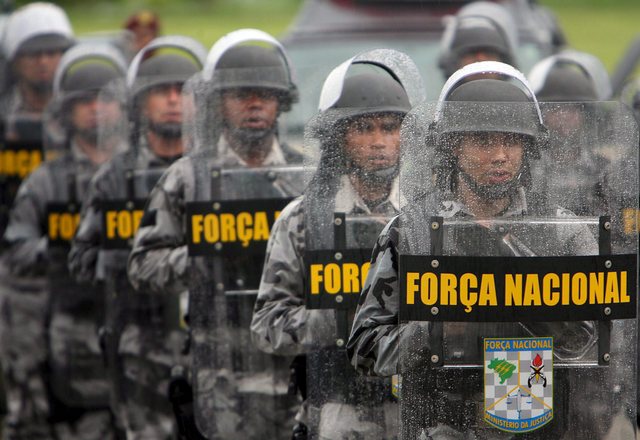
Member of the elite Brazilian National Public Security Force in training, 2007 (EPA/Antônio Lacerda)
Members of the elite Brazilian National Public Security Force in training, 2007 (EPA/Antônio Lacerda)

The ADC issue highlights another historical reason for the dependence on and trust in, private security in Brazil. The reason is simply that the law is not trusted. Judges and courts have long been perceived as essentially tools of privilege and the official police in their various forms are not trusted by many people of all social classes. The former, as with coronelismo, goes way back into the post-colonial period, but the latter is also a particular legacy of the dictatorships (which can also be seen as the ultimate private control of the public), the last of which only ended in 1985. This leaves Lula´s government, the first that can really claim to be at all progressive, with several major problems: making an untrusted police more trustworthy whilst at the same time increasing their effectiveness and equipment; regulating the thousands of private security firms and, if possible, reducing the dependence of property-owning Brazilians upon them; and finally, and most importantly, dealing with the massive underlying inequalities, that are also a product of what Holston calls the the inclusive but inegalitarian nature of Brazil´s constitution and subsequent socio-economic development. The latter subject is outside the scope of my project, but I will be continuing to delve into the differentiations and intersections between segurança pública and segurança privada whilst I am here.

Brazil: Surveillance Society or Security Society?

although there are many forms of surveillance in evidence, Brazil is not fundamentally a ´surveillance society´

What I am doing here is a broad survey of issues around surveillance. I am trying to get to grips with as wide a range of indicators as possible. One impression I have already – which as an impression may be partly or entirely wrong – is that although there are many forms of surveillance in evidence, Brazil is not fundamentally a ´surveillance society´ in the way that the UK is, or in the rather different way that Japan is: Brazil is much more a ´security society´. This is not to say, for example, that there are not many CCTV cameras in the country: Marta Kanashiro´s article in Surveillance & Society last year indicated that there are well over a million cameras (the total is hard to estimate because of the number of illegal installations).

However, surveillance here is very much tied into security. It´s not a ´security state´ – although it still retains reminders of its more authoritarian past – the concentration on security is largely private. Industry reports I have found, for example, this one from the Massachussets South America Office, indicate that the security industry is growing at rates of betwen 10 and 15% regardless of wider economic trends. Foreign companies are poised like vultures over the thousands of SME security companies that make up the huge private security sector, and positively salivate over the high crime figures.

If one talks in abstracts and absolutes, investment in security at a national level seems to make a difference to these figures. The Fórum Brasileiro de Segurança Pública (or Fórum Segurança, the Brazilian Forum on Public Safety), an independent network of local groups, experts and members of state and private secuirty organisations, has started to publish an annual report. The second report, available late last year, indicates a strong correlation between increased spending ($35 Billion US in 2007) and the decline in homicides. For example, in Rio there was an increase in spending of 4.4% and a decline in homicides of 4.7%. A summary in English is available here.

The big thing is not so much public space surveillance (although the industry report mentioned above estimates a $1Bn US market for electronic surveillance technology mainly for the private sector), but both fortification (especially the upsurge in the building of secure condominiums) and the increasing numbers of human security operatives. These may be private security, the new Municipal Guards – basically private security now employed by more than 750 local mayors – or even more worryingly, the urban militias, particularly in Rio. Despite the massive investment in public safety highlighted by Fórum Segurança, official police and other state agents of security and safety are still poorly paid, demotivated and not trusted. To remedy their perceived weakness, in particular in dealing with drug trafficking gangs, so-called Autodefesas Comunitárias (ADC, or Community Self-Defence) groups have emerged. These are paramilitaries made up of current and former police, soldiers, firemen and private security, who basically invade favelas to drive out traffickers in the name of safety, but which soon come to dominate the area and create a new kind of violent order. Now a report by the Parliamentary Hearing Commission into the Militias of Rio de Janeiro, has named names (including several local representatives), and various measures are promised.

Internet Surveillance in Brazil (2)

I’ve been catching up with what has been going on in Brazil in terms of Internet surveillance over the past few months. The good news is that the opposition has had some success in persuading several members of Brazil’s lower house, the Chamber of Deputies, to take their criticisms seriously.

Sérgio Amadeu, who is an Professor at the Faculade Cásper Líbero in São Paulo, a self-described ‘militant for free software’, and one of the originators of the ‘NÃO’ campaign against the proposed bill of Senator Azeredo, reported in December on the outcome of a public consultation on the bill and a flashmob protest against it in São Paulo in November. The outcome has been that a new counter-proposal is being developed by various activist organisations and individuals together with Deputy Julio Semeghini favouring Internet freedom. In fact, the proposal would recast Azeredo’s proposed law on the basis of net citizenship rather than cybercrime.

Professor Amadeu claims that now the Ministry of Justice is in contact with the campaign and that the Secretary for Legislative Affairs at the Ministry, Pedro Abramovay, has apparently shown that he is rather more interested in an appropriate balance between Internet freedom and security. I am always rather suspicious about talk of ‘balance’ in these contexts, and we still don’t know who these impressions will be transformed into action or how many lower house legislators share Deputy Semeghini’s view, but it sounds like there is some reason to be positive – that and the fact that as of today, 134494 people have signed the petition against Azeredo’s bill.

Violent Crime in Brazil

Murder rates in Brazil and Sao Paulo (The Economist)
Murder rates in Brazil and São Paulo (The Economist, 2008)

Most people tend to think of Brazilian cities as divided and violent, with especially high rates of gang-related gun deaths in and around the favelas. Certainly that was the impression I was starting to get. However, there was an excellent piece last year in The Economist on falling murder rates in Brazilian cities. Yes, that´s right, I said falling murder rates. And not just falling, plummeting.

However, as the article points out, the decline is largely due to a halving of the murder rate in Brazil´s second city, São Paulo. The Economist put this down to a combination of: tighter gun control; better policing (including community policing initiatives and a large new Murder Squad, which ¨uses computer profiling to spot patterns and to act preventively¨); and, a relative decline in the youth demographic as the baby-boom cohort of children born after the mass immigration from the 1970s ages – the gangsters are getting older and getting out of crime, and there are slightly fewer young recruits to replace them. But one note of caution is that this may all be the temporary result of one particular gang gaining a dominant and unchallengable position. My view (not The Economist´s) is that if this latter development is a genuinely long-term trend, it could either result in a move to more legal community development activities by the gang (as has happened in some US cities) or a more stable but persistant pattern of criminality such as that in exhibited by the endemic gang-cultures of Southern Italy or in Japan…

Of course, I should also note that these figures are official ones from the Ministry of Health and I have no idea yet how reliable are the collection or categorisation methods for crime statistics used by the Brazilian authorities.

(thanks to Rodrigo Firmino for this one)