
Following the damning reports of the House of Lords Constitution Committee and yesterday, the International Commission of Jurists, now Stella Rimington, ex-Head of the security service, MI5, has warned that Britain risks becoming a police state. In an internview with the Spanish newspaper La Vanguardia reported by the Daily Telegraph, Ms Rimington attacked government plans for the National Identity Register and the soon-expected plans for a database of all communications (delayed from last year). If even ex-heads of the security service are now asking the government to change direction, in addition to civil liberties experts, independent judges, and just about everyone else, their stock of excuses must be rapidly diminishing. The current cabinet must know that their actions smack of the desperation of a failing government desperately searching for votes in being ‘tough on crime and terrorism’… but they seem to be locked into a trajectory of ever-increasing surveillance and security that they cannot justify but cannot escape. You do wonder who is actually advising them that this is all a good idea…
Category: Europe
UK and USA have actively undermined international law
A major new report by the independent International Commission of Jurists has concluded that the actions taken by the many countries, but in particular the USA and the UK, since 9/11 in the name of fighting terrorism add up to “a serious threat to the integrity of the international human rights legal framework.” Acording to the BBC, the eminent jurists have been ‘shocked’ by the “excessive or abusive counter-terrorism measures in a wide range of countries around the world,” including detention without trial, torture (and of course the massive extension of surveillance powers). The report, entitled Assessing Damage, Urging Action is available for download here.
Talk to Parliamentary Committee
I’ve been invited back to the British Parliament (yes, I know – I’m surprised they keep asking me back too!). This time it is to address a meeting of the Parliamentary & Scientific Committee on the subject of “Security Technology and Individual Freedom” in April, just after I get back from Brazil.
Is there anything anyone wants me to tell them? 😉
Some things are just wrong
It is disturbing that… the default position for state officials seems to be that surveillance is a normal, even required part of everyday life.
Ok, there are some things about surveillance that are arguable, some things that are good, but some things are just wrong.
The Guardian today is reporting the story of Nick Gibson who is taking over the tenancy of a pub in Islington in north London. The police have insisted that he will not receive the licence he needs to run the pub unless he installs CCTV and is prepared to hand over footage to them whenever they want. Mr Gibson complained to his Member of Parliament, Emily Thornberry (not Thornhill as The Guardian claims), but she is apparently a spineless New Labour loyalist who has no time for niceties like civil liberties. She refused to represent him on the grounds that other local residents ‘want more CCTV’.
It is one thing to want to install CCTV if you run a business. Your customers can chose whether to patronise your establishment or not. It is however, entirely another matter to be quasi-legally blackmailed into installing it by police. There is no law that mandate the installation of surveillance cameras an in fact there is no statutory basis for CCTV at all in the UK – it is something that the Lords committee report on surveillance recommended as a matter of urgency. The police are simply abusing their right to impose licensing conditions to make local policy. The installation of CCTV is not a matter of ‘common-sense’, it is an ethical judgement, and police should not be be able to override the ethical judgement of individuals by edict in this way.
This is a very worrying case, because it shows that there is a kind of cozy ‘common-sense’ authoritarianism developing in the UK. It is disturbing that despite all the research, including that of the Home Office and the Association of Chief Police Officers, showing that CCTV has very limited utility, the default position for state officials seems to be that surveillance is a normal, even required part of everyday life.
Privatising political policing in the UK?
Another good piece by Henry Porter on the Guardian’s Comment is Free website, against the influence of the Association of Chief Police Officers (ACPO), which despite being a private organisation with no public accountability, has a very large influence on policy. The particular concern is with reports that ACPO has set up a new Confidential Intelligence Unit (CIU), to monitor so-called ‘domestic extremists’ which will apparently be based at Scotland Yard. They are currently advertising for a Chief Executive.
According the Emergency Services News, the CIU will target environmental groups and those behind anti-Israel demonstrations and ” infiltrate neo-Nazi groups, animal liberation groups and organisations behind unlawful industrial action such as secondary picketing.” In other words we are back to the bad old days of defining everyone who doesn’t agree with the state as ‘subversives’ and putting them under surveillance. This is hardly new. I was one of a quite a large number of environmental protestors targeted by a private detective agency employed by the government back in the early 1990s, and in fact this kind of activity, far from being incidental to ordinary policing was at the heart of the ‘new police’ in Britain from their foundation in the Nineteenth Century. Statewatch founder, Tony Bunyan’s excellent history of The Political Police in Britain (Quartet, 1977) shows how the experience of colonial rule of India and Ireland was imported back to Britain. Targeting organised labour is hardly new either: immediately after the first world war, the British government introduced the Emergency Powers Act (1920) which was specifically targeted at strikes, and was used many times against striking workers. This was also always one of the major functions of MI5.
This isn’t the only recent story of this nature either. Last year The Guardian drew attention to the practice of ‘blacklisting’ workers, mainly those who are known as union activists or radicals. It was in reference to the new National Dismissal Register (NDR), which keeps a record of all workers who are dismissed from their jobs, supposedly for wrongdoing. The initiative was originally set up a joint venture between the Home Office and the British Retail Consortium through an organisation called Action Against Business Crime (AABC), although after revelations about its activities, the government rapidly withdrew leading to the announcement of its closure to new business on December 19th, 2008. However the website now seems to indicate its resurrection…
We have been here before too. Another product of the post-WW1 paranoia about organised labour was The Economic League, a right-wing anti-communist, anti-union organisation, that had attempted to prevent those it saw as dangerous subversives from gaining employment. (see: Arthur McIvor. 1988. ‘A Crusade for Capitalism’: The Economic League, 1919-39. Journal of Contemporary History 23(4): 631-655). The League was finally wound up in 1993, following the end of the Cold War, and more importantly the massive negative publicity it had endured. However, some of those involved went on to form CAPRiM, which continues to do much the same job of selling blacklists of workers to subscribing companies, and which may or may not be connected to the NDR.
The very significant point here though is that ACPO is an undemocratic, unaccountable, private organisation. Yet it is being allowed to operate a new private intelligence service from within New Scotland Yard, the headquarters of the Metropolitan Police, a publicly-funded and accountable body. This is effectively a kind of privatisation of MI5 functions. There are several questions here.
Firstly, what is the CIU’s relationship to the Metropolitan Police’s National Extremism Tactical Co-ordination Unit (NETCU), which sprung to prominence last year with much the same agenda and a disgraceful planted scare story in The Observer implying that environmental activists were terrorists? (the story has since been removed, but see my old blog for some details).
Secondly and more importantly, how can the Home Secretary possibly justify this outsourcing of anti-democratic internal security activities? It was unable to do so with the NDR, and it seems the only reasons for this new public-private initiative is to keep the CIU free from examination (and Freedom of Information requests) from the public and ‘off balance-sheet’ so not subject to National Audit Office or Parliamentary budgetary scrutiny. Yet in that case, how can its position within police headquarters be justified? If it is public, it should be subject to parliamentary and judicial oversight – as the Lords Constitution Committee on Surveillance recently demanded for all surveillance activities – and if it is private, it should not be allowed to benefit from public funds.
They can’t have it both ways.
Britain is a surveillance society and it must change: detailed anaysis of the Lords Constitution Committee report
This is probably the best parliamentary report on surveillance I have ever read, and if only half of the recommendations are given any attention by the government, then Britain will be a much better place.
It’s 3.00am here in Brazil, and I have just spent the last four hours reading, analyzing and writing about the House of Lords Constitution Committee Report Surveillance: Citizens and the State. My expectations of the work of the committee have generally not been disappointed. This is probably the best parliamentary report on surveillance I have ever read, and if only half of the recommendations are given any attention by the government, then Britain will be a much better place. However it is not only relevant to Britain. The UK seems to have come to be regarded as some kind of model for other democracies to follow in terms of surveillance and security – at least by governments. Reading this report should serve to disabuse others of any notion that Britain is a good example.
Here’s the detailed analysis. It is long and there are no pictures! But this is serious stuff. I have gone through the whole report and thought about all the recommendations. It is worth remembering first of all what the Committee was asked to do. Here are the questions they started out with:
- Have increased surveillance and data collection by the state fundamentally altered the way it relates to its citizens?
- What forms of surveillance and data collection might be considered constitutionally proper or improper? Is there a line that should not be crossed? How could it be identified?
- What effect do public and private sector surveillance and data collection have on a citizen’s liberty and privacy?
- How have surveillance and data collection altered the nature of citizenship in the 21st century, especially in terms of citizens’ relationship with the state?
- Is the Data Protection Act 1998 sufficient to protect citizens? Is there a need for additional constitutional protection for citizens in relation to surveillance and the collection of data?
The answers to the first and last questions are, in short ‘yes’ and ‘no’ respectively. Their basic conclusion is that increasing surveillance by the state is the greatest change to the nature of the relationship between state and individual in Britain since the end of the second world war. In opposition to the House of Commons Home Affairs Committee report from last year, and largely in support of our Report on the Surveillance Society form 2006 and that of the Royal Academy of Engineers from 2007, they show that Britain is a surveillance society, and that this must change. They do not go so far as to recommend an Information Act to bring all legislation in this area together, as I have been arguing, but they do advocate significant new legal / constitutional measures to rebalance the state-individual relationship in favour of the individual.
There are 8 chapters of consideration of all of the evidence given, which is treated in a very careful and even-handed way. The Home Office, the police and the Surveillance Commissioners for example, all come in for a telling-off at various points, but at the same time, some of the current government’s initiatives on openness are quite rightly praised (although of course they don’t go far enough in tackling the culture of secrecy that has plagued British government for far too long).
Who comes out of it well? First of all, the Information Commissioner, Richard Thomas and his office (the ICO). This is entirely right. None of this debate would have happened without him and he continues to push the agenda forward in an activist manner that many campaigners should look to as an example. Secondly, the media. The Lords seem to be very aware of the role of investigative journalists in holding the government to account. People are too willing these days to make blanket generalisations about the media as if they were all superficial and obsessed with celebrity. In the case of surveillance, the BBC and The Guardian in particular have done a great job. Thirdly academics and campaigners alike come across as far more informed and sensible about this than the state, which leads the Lords to recommend that the government pay us far more attention. On a personal note, it is a bit disconcerting to see myself, Surveillance Studies Network and other people and organizations with whom I work mentioned (approvingly) quite so much in such an important document…
The Committee place the two values of privacy and freedom as the foundations of its recommendations. The Lords argue that privacy and the restraint of state powers are at the heart of liberty, and that they should be taken into account at all times. There is, I am very pleased to see no mention of ‘trade-offs’ between freedom and security and it seems that they accepted my argument (they do quote me on this) that when claims to protect fundamental freedoms by increasing security are actually eroding those freedoms, the tacit agreement that binds people and state is broken. They stress that all organisations involved in surveillance and date handling need to give far more attention to privacy at all stage, indeed that it should be built in.
There are many individual recommendations.The first concern the Information Commissioner. Basically, the Lords argue that he should be given more extensive powers and more resources, specifically:
- to have a role in assessing the effect on any new surveillance measure on public trust;
- to be able to monitor the human rights (Article 8, ECHR) effects of government and private surveillance practices on the public;
- to be consulted by the government at the earliest stages of policy development – they specifically attack the government for not doing thus far; to extend the ICO’s power of inspection to private companies (again something I am quoted on) – they don’t note that the power of inspection over government departments was only granted in a rush by Gordon Brown following the revelations of disastrous losses of data by various state bodies;
- to speed up the implementation of the ICO’s new power to fine bodies that break the rule on data protection and freedom of information;
- to be a statutory consultee on all surveillance and data processing laws and for the ICO to report to Parliament on this;
- for the government and the ICO to undertake a review of the law governing citizens’ consent to use of their personal data – there is quite a lot of interesting discussion in the body of the report on how consent might operate, and I am very pleased that they haven’t, unlike the government, given up on the importance of consent;
- for the government to work with the ICO on raising public awareness as it should already be doing but has failed to do;
- and finally, and this is really important – for the Data Protection Act to be amended to mandate a Privacy Impact Assessments (PIA) “prior to the adoption of any new surveillance, data collection or processing scheme, including new arrangements for data sharing” with a role for the ICO in overseeing these. The government will probably try to ignore this, but this is the most crucial recommendation for future policy.
On the various other commissions – of which there are too many in my opinion – they merely recommend that the Surveillance and Communications Commissioner work together better and seek the advice of the ICO, especially with regard to the misuse of powers under the Regulations of Investigatory Powers Act (RIPA), and that the Investigatory Powers Tribunal stops hiding from the public. These are weak recommendations. Later they are rather more robust about the problems of having too many ineffectual regulators of RIPA, but despite a brief mention, any recommendations regarding the regulation of the Intelligence Services get quietly dropped along the way (not surprisingly). I would have thought that recommending at the very least that the offices of the Surveillance and Communications Commissioners are brought under the control of the ICO, if not completely absorbed into the ICO, would have been a much better long-term move.
They also have a number of other recommendations on the egregious RIPA, firstly that the (inadequate) administrative procedures are reviewed and secondly that the government should think again about the whole business of allowing Local Authorities police powers, and that in any case, these powers” should only be available for the investigation of serious criminal offences which would attract a custodial sentence of at least two years.” In my opinion, this effectively amounts to saying ‘repeal RIPA’ without saying so directly. The use of intense targeted surveillance powers to deal with minor infractions is what a lot of RIPA is all about whether that was the intention or not. It is an ill-thought out and badly worded law, like so many in this area.
The Lords recognize this deficiency in detail and specificity and argue as a general point, following the Human Rights Committee, that “the Government’s powers should be set out in primary legislation.” Crucially they also note that the government has not seemed very concerned with what happens after legislation is passed or how it works. They recommend the formation of a new Joint Committee in parliament on surveillance and data powers that would have post-legislative scrutiny as one of its key functions.
There are several measures concerning particular technologies. Their coverage of technologies of surveillance and data-collections is not too bad. I gave a seminar to the Committee on the range of surveillance technologies before they started their hearings, and I was beginning to despair at the levels of knowledge – “can they really do that?” was a common cry – and yet here they consider everything from CCTV to ubiquitous computing / ambient intelligence. There are still major deficiencies however. Although they take my point that government needs to get ahead of the technological game in order to regulate effectively, they still have not. They don’t recommend anything specific about the use of scanners in public places, location tracking, about the increasing dependence on RFID, or about the new flexibility, mobility, decrease in size and bodily intrusiveness of surveillance technologies and what this means for regulation. Mind you that is all in our report to the ICO that inspired all this (see Paragraph 4!)
They recommend that:
- the Government comply fully with the recent ruling from the European Court of Human Rights that DNA profiles of innocent people are no longer kept indefinitely on the National DNA Database (NDNAD) – they also rule out a complete national database on both liberty and cost grounds, and argue that there should be a single, clear law governing the NDNAD and better transparency all-round.
- On CCTV, they recommend more research on “the effectiveness of CCTV in preventing, detecting and investigating crime”, and more importantly that the government finally put CCTV on a proper statutory basis, with clear regulations, and systems of complaint and redress.
- The report is at its weakest on the proposed new National Identity Register (NIR) and ID card. No2ID will not be happy, as all that they say is that “the Government’s development of identification systems should give priority to citizen-oriented considerations.” This is practically meaningless.Considering that this is the Constitution Committee report, and that the NIR and ID card are at the heart of how the government sees the information relationship between state and individual, this is also an unacceptable and compromised omission. No doubt it is evidence of a key area of disagreement amongst members, but the Chair should have banged some heads together on this one!
- Although it is treated as a legislative measure, the Lords recommend mandatory encryption of personal data “in some circumstances.” This should have been stronger – bear in mind that most of the data lost by the state over the last few years was not encrypted
- They also recommend that the government incorporate ‘design solutions’ in particular Privacy-Enhancing Technologies (PETs) in all new schemes. This is good as a minimum – we have to make sure that the government doesn’t use PETs as a way of claiming to have dealt with the problem – ooh, look: technology!
In other general measures for the whole of government, the Lords return to their central themes, specifically:
- that Government should instruct government agencies and private organisations involved in surveillance and data use on compliance with Article 8 ECHR and in particular the legal meanings of necessity and proportionality. They also recommend legal aid should be available for challenges under Article 8.
- a system of judicial oversight for surveillance carried out by public authorities, with compensation “to those subject to unlawful surveillance by the police, intelligence services, or other public bodies” acting under RIPA. This would be a severe blow the ad-hoc and effectively extra-legal expansion of surveillance powers under the present government. It would be great if it happens, but I am not going to hold my breath until it does…
- increasing the stature and power of the data protection minister
- lots of general blah about improving safeguards and restrictions on data handling and implementing standards and training, and education, to improve public confidence. But the thing is, public confidence isn’t really the main issue. Public confidence is low because the government and its private sector contractors have been time and again demonstrated to be incompetent.
- there are also several paragraphs of recommendations which basically amount to saying ‘listen to the public’ and particularly, pay attention to pressure groups and research in this area because they know what they are talking about. They are right, you know – we do! They also want more research to get better information on public opinion in this area. We can do that too!
Despite this slight degeneration into well-meaning generality at the end, and despite the glaring hole when it comes to the NIR and ID cards, the principles advocated by this report, if implemented, would transform the direction of government in Britain. Many of the individual recommendations are things that I and others have been arguing for, for some time.
So what was the government’s first response? Well, the thoroughly useless Home Secretary, Jacqui Smith, according to the BBC has “rejected claims of a surveillance society as “not for one moment” true and called for “common sense” guidelines on CCTV and DNA.” When she has read the report she will realize that such guidelines are right in front of her – indeed, she got ‘common sense’ from the European Court on the DNA database some time ago and her department still does not know what to do with it!
As I said, if even half of this reported is acted on, Britain’s ways of dealing with surveillance will be transformed. I am not paying much attention to the Conservatives – in opposition you can say anything and they will beat the government with the liberty stick one day and the security stick the next. The question is, are New Labour brave enough to admit that their approach to surveillance has been almost entirely wrong?
We will soon find out.
More CCTV stories: from Jerusalem to Cambridge
CCTV cameras are seen as the answer to anything and everything. It’s not much more than a form of magical thinking.
Two contrasting CCTV stories today.
On the one hand, we have a seemingly typical story of civic authorities wanting to install cameras, right down to the lazy, cliched, headline: ‘Smile, you’re on surveillance camera’ – how many times have we seen variations on that one? The cameras are proposed to arrest a decline in custom at a busy city market except… that the city is Jerusalem, and the market is the Mahane Yehuda market, a favoured target for suicide bombers. Now, I am not entirely sure how cameras will stop a determined suicide bomber, who by definition isn’t really that bothered about being seen committing a crime, but this is just an extreme case of underlying causes being missed. There are the usual civil rights concerns raised, and the effectiveness of cameras questioned. But suicide bombing isn’t just some unavoidable fact of life, it’s directly related to the ongoing repression by Israel of the Palestinian territories… a clear case of sticking plaster for a mortal wound if ever I saw one.
Here as in many cases, CCTV cameras are seen as the answer to anything and everything. It’s not much more than a form of magical thinking.
On the other hand, we see the town of Cambridge, Massachusetts, voting against allowing Homeland Security cameras to be used. It’s another extreme case of course. You could hardy find a more comfortable and safe middle-class town with a higher concentration of liberal intellectuals – they even had a former head of ACLU speaking at the meeting. It must be positively terrifying to be a city councilor in the face of informed opposition like that. Of course the story is replete with all kinds of ironies, not least the city representative who argues that the city voted against it only because there hasn’t been enough public participation!
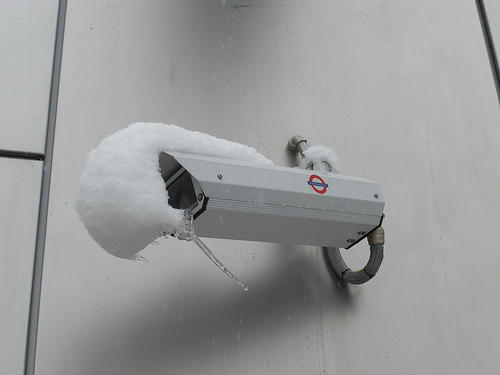
However, as the article also notes, the cameras are already installed, they just aren’t switched on. Perhaps, like this snowbound camera photographed yesterday in London, their ‘magic’ will work anyway and everyone will be happy…
Datawars Conference
There will be a very interesting -looking conference in Amsterdam, 11-12 June, called Datawars: Fighting Terrorism through Data. According to the call for papers, the workshop will be held at the University of Amsterdam in June and will explore the ethical and political implications of the new data-led approach to security, risk and fighting terrorism in Europe. Suggested topics include:
- Privacy, security and human rights
- Ethics, responsibility and justice in European data wars
- Risk, prevention, preemption
- Data and surveillance
- Private authorities, states and the European Union
- Constituting Europe through data
It´s part of a project run by a couple of excellent researchers, Louise Amoore and Marieke de Goede, of the Universities of Durham and Amsterdam respectively (who probably don´t remember but I worked in an tiny attic office opposite them in the Politics Dept at Newcastle for a few months just after my PhD!). I might go as I have been doing some work on attempts to create global databases, called ´From Echelon to Server in the Sky´, but the timing might be awkward (unfortunately I can´t reveal why yet…).
Corrupting automated surveillance
OK, so automated surveillance systems are always right, aren’t they? I mean, they wouldn’t allow systems to be put into place that didn’t work, would they?

That was probably the attitude of many Italians who were supposedly caught jumping red lights by a new T-redspeed looped-camera system manufactured by KRIA. However, the BBC is reporting today that the system had been rigged by shortening the traffic light sequence, and that hundreds of officials were involved in the scam that earned them a great deal of money.
Now, the advocates of automated surveillance will say that there was nothing wrong with the technology itself, and that may be true in this case, but technologies exist within social systems and, unless you try to remove people altogether or by developing heuristic systems – both of which have their own ethical and practical problems – then these kind of things are always going to happen. It’s something those involved in assessing technologies for public use should think about, but in this case it seems they had thought about it, and their only thought was how much cash they could make…
Major new report on surveillance out next week

I hear on the grapevine that the British House of Lords’ Constitution Committee Report on Surveillance and Data Sharing will be out next Friday 6th February. The inquiry conducted by the committee has been one of the most thorough of any so far conducted, and certainly promises to be more considered than the rather rushed House of Commons Home Affairs Committee report, A Surveillance Society? from last year. Both reports were ordered largely in response to the Report on the Surveillance Society that Surveillance Studies Network wrote for the UK Information Commissioner in late 2006, and which is still getting coverage around the world (see CCTV in Canada for example). Check the Committee’s website for the report itself and, of course, back here for a review, on Friday.
 ubisurv