Privatising political policing in the UK?

Another good piece by Henry Porter on the Guardian’s Comment is Free website, against the influence of the Association of Chief Police Officers (ACPO), which despite being a private organisation with no public accountability, has a very large influence on policy. The particular concern is with reports that ACPO has set up a new Confidential Intelligence Unit (CIU), to monitor so-called ‘domestic extremists’ which will apparently be based at Scotland Yard. They are currently advertising for a Chief Executive.

According the Emergency Services News, the CIU will target environmental groups and those behind anti-Israel demonstrations and ” infiltrate neo-Nazi groups, animal liberation groups and organisations behind unlawful industrial action such as secondary picketing.” In other words we are back to the bad old days of defining everyone who doesn’t agree with the state as ‘subversives’ and putting them under surveillance. This is hardly new. I was one of a quite a large number of environmental protestors targeted by a private detective agency employed by the government back in the early 1990s, and in fact this kind of activity, far from being incidental to ordinary policing was at the heart of the ‘new police’ in Britain from their foundation in the Nineteenth Century. Statewatch founder, Tony Bunyan’s excellent history of The Political Police in Britain (Quartet, 1977) shows how the experience of colonial rule of India and Ireland was imported back to Britain. Targeting organised labour is hardly new either: immediately after the first world war, the British government introduced the Emergency Powers Act (1920) which was specifically targeted at strikes, and was used many times against striking workers. This was also always one of the major functions of MI5.

This isn’t the only recent story of this nature either. Last year The Guardian drew attention to the practice of ‘blacklisting’ workers, mainly those who are known as union activists or radicals. It was in reference to the new National Dismissal Register (NDR), which keeps a record of all workers who are dismissed from their jobs, supposedly for wrongdoing. The initiative was originally set up a joint venture between the Home Office and the British Retail Consortium through an organisation called Action Against Business Crime (AABC), although after revelations about its activities, the government rapidly withdrew leading to the announcement of its closure to new business on December 19th, 2008. However the website now seems to indicate its resurrection…

We have been here before too. Another product of the post-WW1 paranoia about organised labour was The Economic League, a right-wing anti-communist, anti-union organisation, that had attempted to prevent those it saw as dangerous subversives from gaining employment. (see: Arthur McIvor. 1988. ‘A Crusade for Capitalism’: The Economic League, 1919-39. Journal of Contemporary History 23(4): 631-655). The League was finally wound up in 1993, following the end of the Cold War, and more importantly the massive negative publicity it had endured. However, some of those involved went on to form CAPRiM, which continues to do much the same job of selling blacklists of workers to subscribing companies, and which may or may not be connected to the NDR.

The very significant point here though is that ACPO is an undemocratic, unaccountable, private organisation. Yet it is being allowed to operate a new private intelligence service from within New Scotland Yard, the headquarters of the Metropolitan Police, a publicly-funded and accountable body. This is effectively a kind of privatisation of MI5 functions. There are several questions here.

Firstly, what is the CIU’s relationship to the Metropolitan Police’s National Extremism Tactical Co-ordination Unit (NETCU), which sprung to prominence last year with much the same agenda and a disgraceful planted scare story in The Observer implying that environmental activists were terrorists? (the story has since been removed, but see my old blog for some details).

Secondly and more importantly, how can the Home Secretary possibly justify this outsourcing of anti-democratic internal security activities? It was unable to do so with the NDR, and it seems the only reasons for this new public-private initiative is to keep the CIU free from examination (and Freedom of Information requests) from the public and ‘off balance-sheet’ so not subject to National Audit Office or Parliamentary budgetary scrutiny. Yet in that case, how can its position within police headquarters be justified? If it is public, it should be subject to parliamentary and judicial oversight – as the Lords Constitution Committee on Surveillance recently demanded for all surveillance activities – and if it is private, it should not be allowed to benefit from public funds.

They can’t have it both ways.

Britain is a surveillance society and it must change: detailed anaysis of the Lords Constitution Committee report

This is probably the best parliamentary report on surveillance I have ever read, and if only half of the recommendations are given any attention by the government, then Britain will be a much better place.

It’s 3.00am here in Brazil, and I have just spent the last four hours reading, analyzing and writing about the House of Lords Constitution Committee Report Surveillance: Citizens and the State. My expectations of the work of the committee have generally not been disappointed. This is probably the best parliamentary report on surveillance I have ever read, and if only half of the recommendations are given any attention by the government, then Britain will be a much better place. However it is not only relevant to Britain. The UK seems to have come to be regarded as some kind of model for other democracies to follow in terms of surveillance and security – at least by governments. Reading this report should serve to disabuse others of any notion that Britain is a good example.

Here’s the detailed analysis. It is long and there are no pictures! But this is serious stuff. I have gone through the whole report and thought about all the recommendations. It is worth remembering first of all what the Committee was asked to do. Here are the questions they started out with:

  • Have increased surveillance and data collection by the state fundamentally altered the way it relates to its citizens?
  • What forms of surveillance and data collection might be considered constitutionally proper or improper? Is there a line that should not be crossed? How could it be identified?
  • What effect do public and private sector surveillance and data collection have on a citizen’s liberty and privacy?
  • How have surveillance and data collection altered the nature of citizenship in the 21st century, especially in terms of citizens’ relationship with the state?
  • Is the Data Protection Act 1998 sufficient to protect citizens? Is there a need for additional constitutional protection for citizens in relation to surveillance and the collection of data?

The answers to the first and last questions are, in short ‘yes’ and ‘no’ respectively. Their basic conclusion is that increasing surveillance by the state is the greatest change to the nature of the relationship between state and individual in Britain since the end of the second world war. In opposition to the House of Commons Home Affairs Committee report from last year, and largely in support of our Report on the Surveillance Society form 2006 and that of the Royal Academy of Engineers from 2007, they show that Britain is a surveillance society, and that this must change. They do not go so far as to recommend an Information Act to bring all legislation in this area together, as I have been arguing, but they do advocate significant new legal / constitutional measures to rebalance the state-individual relationship in favour of the individual.

There are 8 chapters of consideration of all of the evidence given, which is treated in a very careful and even-handed way. The Home Office, the police and the Surveillance Commissioners for example, all come in for a telling-off at various points, but at the same time, some of the current government’s initiatives on openness are quite rightly praised (although of course they don’t go far enough in tackling the culture of secrecy that has plagued British government for far too long).

Who comes out of it well? First of all, the Information Commissioner, Richard Thomas and his office (the ICO). This is entirely right. None of this debate would have happened without him and he continues to push the agenda forward in an activist manner that many campaigners should look to as an example. Secondly, the media. The Lords seem to be very aware of the role of investigative journalists in holding the government to account. People are too willing these days to make blanket generalisations about the media as if they were all superficial and obsessed with celebrity. In the case of surveillance, the BBC and The Guardian in particular have done a great job. Thirdly academics and campaigners alike come across as far more informed and sensible about this than the state, which leads the Lords to recommend that the government pay us far more attention. On a personal note, it is a bit disconcerting to see myself, Surveillance Studies Network and other people and organizations with whom I work mentioned (approvingly) quite so much in such an important document…

The Committee place the two values of privacy and freedom as the foundations of its recommendations. The Lords argue that privacy and the restraint of state powers are at the heart of liberty, and that they should be taken into account at all times. There is, I am very pleased to see no mention of ‘trade-offs’ between freedom and security and it seems that they accepted my argument (they do quote me on this) that when claims to protect fundamental freedoms by increasing security are actually eroding those freedoms, the tacit agreement that binds people and state is broken. They stress that all organisations involved in surveillance and date handling need to give far more attention to privacy at all stage, indeed that it should be built in.

There are many individual recommendations.The first concern the Information Commissioner. Basically, the Lords argue that he should be given more extensive powers and more resources, specifically:

  • to have a role in assessing the effect on any new surveillance measure on public trust;
  • to be able to monitor the human rights (Article 8, ECHR) effects of government and private surveillance practices on the public;
  • to be consulted by the government at the earliest stages of policy development – they specifically attack the government for not doing thus far; to extend the ICO’s power of inspection to private companies (again something I am quoted on) – they don’t note that the power of inspection over government departments was only granted in a rush by Gordon Brown following the revelations of disastrous losses of data by various state bodies;
  • to speed up the implementation of the ICO’s new power to fine bodies that break the rule on data protection and freedom of information;
  • to be a statutory consultee on all surveillance and data processing laws and for the ICO to report to Parliament on this;
  • for the government and the ICO to undertake a review of the law governing citizens’ consent to use of their personal data – there is quite a lot of interesting discussion in the body of the report on how consent might operate, and I am very pleased that they haven’t, unlike the government, given up on the importance of consent;
  • for the government to work with the ICO on raising public awareness as it should already be doing but has failed to do;
  • and finally, and this is really important – for the Data Protection Act to be amended to mandate a Privacy Impact Assessments (PIA) “prior to the adoption of any new surveillance, data collection or processing scheme, including new arrangements for data sharing” with a role for the ICO in overseeing these. The government will probably try to ignore this, but this is the most crucial recommendation for future policy.

On the various other commissions – of which there are too many in my opinion – they merely recommend that the Surveillance and Communications Commissioner work together better and seek the advice of the ICO, especially with regard to the misuse of powers under the Regulations of Investigatory Powers Act (RIPA), and that the Investigatory Powers Tribunal stops hiding from the public. These are weak recommendations. Later they are rather more robust about the problems of having too many ineffectual regulators of RIPA, but despite a brief mention, any recommendations regarding the regulation of the Intelligence Services get quietly dropped along the way (not surprisingly). I would have thought that recommending at the very least that the offices of the Surveillance and Communications Commissioners are brought under the control of the ICO, if not completely absorbed into the ICO, would have been a much better long-term move.

They also have a number of other recommendations on the egregious RIPA, firstly that the (inadequate) administrative procedures are reviewed and secondly that the government should think again about the whole business of allowing Local Authorities police powers, and that in any case, these powers” should only be available for the investigation of serious criminal offences which would attract a custodial sentence of at least two years.” In my opinion, this effectively amounts to saying ‘repeal RIPA’ without saying so directly. The use of intense targeted surveillance powers to deal with minor infractions is what a lot of RIPA is all about whether that was the intention or not. It is an ill-thought out and badly worded law, like so many in this area.

The Lords recognize this deficiency in detail and specificity and argue as a general point, following the Human Rights Committee, that “the Government’s powers should be set out in primary legislation.” Crucially they also note that the government has not seemed very concerned with what happens after legislation is passed or how it works. They recommend the formation of a new Joint Committee in parliament on surveillance and data powers that would have post-legislative scrutiny as one of its key functions.

There are several measures concerning particular technologies. Their coverage of technologies of surveillance and data-collections is not too bad. I gave a seminar to the Committee on the range of surveillance technologies before they started their hearings, and I was beginning to despair at the levels of knowledge – “can they really do that?” was a common cry – and yet here they consider everything from CCTV to ubiquitous computing / ambient intelligence. There are still major deficiencies however. Although they take my point that government needs to get ahead of the technological game in order to regulate effectively, they still have not. They don’t recommend anything specific about the use of scanners in public places, location tracking, about the increasing dependence on RFID, or about the new flexibility, mobility, decrease in size and bodily intrusiveness of surveillance technologies and what this means for regulation. Mind you that is all in our report to the ICO that inspired all this (see Paragraph 4!)

They recommend that:

  • the Government comply fully with the recent ruling from the European Court of Human Rights that DNA profiles of innocent people are no longer kept indefinitely on the National DNA Database (NDNAD) – they also rule out a complete national database on both liberty and cost grounds, and argue that there should be a single, clear law governing the NDNAD and better transparency all-round.
  • On CCTV, they recommend more research on “the effectiveness of CCTV in preventing, detecting and investigating crime”, and more importantly that the government finally put CCTV on a proper statutory basis, with clear regulations, and systems of complaint and redress.
  • The report is at its weakest on the proposed new National Identity Register (NIR) and ID card. No2ID will not be happy, as all that they say is that “the Government’s development of identification systems should give priority to citizen-oriented considerations.” This is practically meaningless.Considering that this is the Constitution Committee report, and that the NIR and ID card are at the heart of how the government sees the information relationship between state and individual, this is also an unacceptable and compromised omission. No doubt it is evidence of a key area of disagreement amongst members, but the Chair should have banged some heads together on this one!
  • Although it is treated as a legislative measure, the Lords recommend mandatory encryption of personal data “in some circumstances.” This should have been stronger – bear in mind that most of the data lost by the state over the last few years was not encrypted
  • They also recommend that the government incorporate ‘design solutions’ in particular Privacy-Enhancing Technologies (PETs) in all new schemes. This is good as a minimum – we have to make sure that the government doesn’t use PETs as a way of claiming to have dealt with the problem – ooh, look: technology!

In other general measures for the whole of government, the Lords return to their central themes, specifically:

  • that Government should instruct government agencies and private organisations involved in surveillance and data use on compliance with Article 8 ECHR and in particular the legal meanings of necessity and proportionality. They also recommend legal aid should be available for challenges under Article 8.
  • a system of judicial oversight for surveillance carried out by public authorities, with compensation “to those subject to unlawful surveillance by the police, intelligence services, or other public bodies” acting under RIPA. This would be a severe blow the ad-hoc and effectively extra-legal expansion of surveillance powers under the present government. It would be great if it happens, but I am not going to hold my breath until it does…
  • increasing the stature and power of the data protection minister
  • lots of general blah about improving safeguards and restrictions on data handling and implementing standards and training, and education, to improve public confidence. But the thing is, public confidence isn’t really the main issue. Public confidence is low because the government and its private sector contractors have been time and again demonstrated to be incompetent.
  • there are also several paragraphs of recommendations which basically amount to saying ‘listen to the public’ and particularly, pay attention to pressure groups and research in this area because they know what they are talking about. They are right, you know – we do! They also want more research to get better information on public opinion in this area. We can do that too!

Despite this slight degeneration into well-meaning generality at the end, and despite the glaring hole when it comes to the NIR and ID cards, the principles advocated by this report, if implemented, would transform the direction of government in Britain. Many of the individual recommendations are things that I and others have been arguing for, for some time.

So what was the government’s first response? Well, the thoroughly useless Home Secretary, Jacqui Smith, according to the BBC has “rejected claims of a surveillance society as “not for one moment” true and called for “common sense” guidelines on CCTV and DNA.” When she has read the report she will realize that such guidelines are right in front of her – indeed, she got ‘common sense’ from the European Court on the DNA database some time ago and her department still does not know what to do with it!

As I said, if even half of this reported is acted on, Britain’s ways of dealing with surveillance will be transformed. I am not paying much attention to the Conservatives – in opposition you can say anything and they will beat the government with the liberty stick one day and the security stick the next. The question is, are New Labour brave enough to admit that their approach to surveillance has been almost entirely wrong?

We will soon find out.

More CCTV stories: from Jerusalem to Cambridge

CCTV cameras are seen as the answer to anything and everything. It’s not much more than a form of magical thinking.

Two contrasting CCTV stories today.

On the one hand, we have a seemingly typical story of civic authorities wanting to install cameras, right down to the lazy, cliched, headline: ‘Smile, you’re on surveillance camera’ – how many times have we seen variations on that one? The cameras are proposed to arrest a decline in custom at a busy city market except… that the city is Jerusalem, and the market is the Mahane Yehuda market, a favoured target for suicide bombers. Now, I am not entirely sure how cameras will stop a determined suicide bomber, who by definition isn’t really that bothered about being seen committing a crime, but this is just an extreme case of underlying causes being missed. There are the usual civil rights concerns raised, and the effectiveness of cameras questioned. But suicide bombing isn’t just some unavoidable fact of life, it’s directly related to the ongoing repression by Israel of the Palestinian territories… a clear case of sticking plaster for a mortal wound if ever I saw one.

Here as in many cases, CCTV cameras are seen as the answer to anything and everything. It’s not much more than a form of magical thinking.

On the other hand, we see the town of Cambridge, Massachusetts, voting against allowing Homeland Security cameras to be used. It’s another extreme case of course. You could hardy find a more comfortable and safe middle-class town with a higher concentration of liberal intellectuals – they even had a former head of ACLU speaking at the meeting. It must be positively terrifying to be a city councilor in the face of informed opposition like that. Of course the story is replete with all kinds of ironies, not least the city representative who argues that the city voted against it only because there hasn’t been enough public participation!

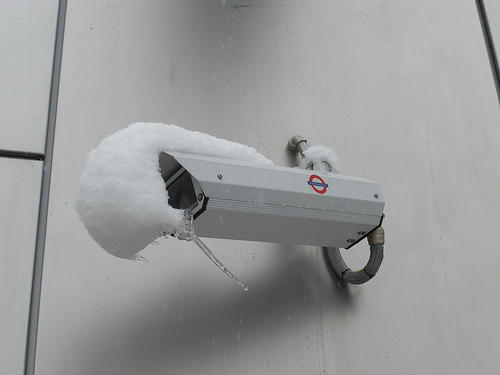
However, as the article also notes, the cameras are already installed, they just aren’t switched on. Perhaps, like this snowbound camera photographed yesterday in London, their ‘magic’ will work anyway and everyone will be happy…

They can see through snow, you know. London CCTV camera (by Almost Wiity on boingboing)
They can see through snow, you know. London CCTV camera (by Almost Witty on boingboing.net)

Major new report on surveillance out next week

House of Lords
House of Lords

I hear on the grapevine that the British House of Lords’ Constitution Committee Report on Surveillance and Data Sharing will be out next Friday 6th February. The inquiry conducted by the committee has been one of the most thorough of any so far conducted, and certainly promises to be more considered than the rather rushed House of Commons Home Affairs Committee report, A Surveillance Society? from last year. Both reports were ordered largely in response to the Report on the Surveillance Society that Surveillance Studies Network wrote for the UK Information Commissioner in late 2006, and which is still getting coverage around the world (see CCTV in Canada for example). Check the Committee’s website for the report itself and, of course, back here for a review, on Friday.

Digital Britain to be just like Digital Brazil?

There has been a serious global push for several years now by corporate content creators to hobble the Internet, and turn it into something more like television.

Time to catch up on a story that I missed this week. Boingboing reported the release of the UK government’s consultation document on Digital Britain. I had a eerie feeling of deja vu because the proposals are just like parts of Senator Azeredo’s bill that is halfway through the legislative process here in Brazil. Effectively it regards the Internet as some kind of untamed zone which must be brought under state control through a Rights Agency and ISPs acting increasingly as surveillance agents over the activities of their users, in this case particularly with regard to file-sharing.

The similarity is not surprising. There has been a serious global push for several years now by corporate content creators to hobble the Internet, and turn it into something more like television. The fact that the Digital Britain plan is filed under ‘broadcasting’ on the government’s website says quite a lot about the lack of tech savvy of state regulators in this area. What governments, in listening only to the corporate argument, don’t appear to realise is that we are actually collectively and autonomously coming up with better ways of ‘regulation’ of content through initiatives like Creative Commons and so on.

As in Brazil, where a serious netizen counter-plan is now emerging, with parliamentary support, there needs to be some serious organisation in Britain to present the alternatives to destroying the Internet and all is messy, unruly creativity. The Open Rights Group are trying to do this – let’s get behind them and make this more than just a few tech-savvy usual suspects.

Come to Britain and we will fingerprint your kids…

fingerprintLast week I mentioned the approval of the biometric passports scheme by the European Parliament, and that there were several countries that planned to fingerprint children under the age of 12 despite the legal, ethical and technical problems with this.

However, what I didn´t mention is that – surprise, surprise – Britain is one of the countries that does fingerprint kids, and indeed it has already been fingerprinting foreign children resident in Britain as young as 6. As Privacy International´s Gus Hossein argues on The Guardian´s Comment is Free website, the UK government claims that this is only bcause the EU has forced this upon them when in fact it was the UK government that forced the EU into adopting that position in the first place!

Now, as I mentioned, the European Parliament has pushed the age limit upwards, but will this make any difference to the UK Home Office? Given that the Home Office is still ´carefully considering´ its responce to the kicking it received from the European Court of Human Rights over the taking and retention of the DNA of 857,000 children, I wouldn´t bank on it.

Top Ten Problems with UK Information Sharing Proposals

Chris Pounder of Amberhawk information consultants sends me his Top Ten Problems with the British government´s new information-sharing proposals that are to be found buried deep in the Coroners and Justice Bill, where perhaps they thought no-one would notice… these are part of much lengthier and more thorough analysis submitted to the Joint parliamentary Committee on Human Rights (JCHR), which explains why the proposals ignore or conflict with the recommendations of 2008´s Data Sharing Review conducted by Richard Thomas and Mark Walport for the Ministry of Justice itself. These are sumarised by me here, and any errors and omissions are therefore my own:

  1. Lack of scrutiny. There is no provision for the JCHR to scrutinise this (or any other) wide-ranging statutory power which impacts on Article 8 of the European Convention on Human Rights (ECHR), nor any attempt to explain how this provision is consistent with human rights legislation.
  2. The extension of information sharing beyond personal data. The use of “any person” in the Bill means that it applies to information sharing by any public or private body or individual. “Information sharing” powers are not limited to personal data and the person who receives the shared information might be a foreign government or organisation. [for example the FBI´s proposed Server in the Sky]
  3. The “exceptional” may become the routine The Data Sharing Review recommended that the sharing of personal data should be legitimised in exceptional circumstances. However, in the Bill there is instead a legitimation of general information sharing, whenever it falls within a “relevant policy objective” [which is basically anything a Minister decides].
  4. The generality of an Information Sharing Order. There is no limit as to how “person”, “purpose” and “information class” are specified in an Order. There is no explicit requirement for the purpose of the information sharing to be one of those specified in Article 8(2) ECHR.
  5. The prospect of unlimited data sharing from large Government databases. The Bill appears to facilitate data sharing from any Government database without Parliament being explicitly informed of this sharing when an Order is before Parliament. The prohibition in the clause only relates to Part 1 of the Regulation of Investigatory Powers Act (RIPA). By implication, sharing from other national databases (e.g. the national identity register of the ID Cards Act) does not need to be explicitly mentioned in an Order. This means that unlimited data can be shared from these other national databases by means of a general order-making provision.
  6. The exclusion of critical comment on the purpose of the processing. In the Bill, the Information Commissioner is not allowed to comment on whether “the sharing of information enabled by the order is necessary to secure a relevant policy objective”. The effect is to inhibit the Commissioner from commenting on the purpose of the processing, which is the main purpose of the Information Commissioner! Plus, because this applies to more than personal information, much of the proposed sharing is outside his remit.”
  7. The range of the powers. The powers are widely drawn and their application is very broad. There is no explicit provision in the main sharing provisions which would facilitate data subject rights and freedoms (e.g. right to object ; need to obtain consent). Instead, these provisions can “modify” the application of any law (including the Data Protection Act and the Human Rights Act) which will weaken the protection afforded to data subjects.
  8. The lack of transparency. There is no obligation to disclose to the Information Commissioner or Parliament any background document or legal advice about a proposed Information Sharing Order. There is no obligation to answer any formal request for information from the Commissioner. There is no obligation to engage the public on the subject of a draft Information Sharing Order.
  9. The irrelevance of the proposed Code of Practice. There is nothing in these information sharing clauses which expressly states that the sharing of personal data has to be consistent with the proposed non-statutory Code of Practice. The Code is not subject to approval by Parliament; rather, it is subject to approval by the Secretary of State (SoS).There is no provision which sets out what happens if there is a disagreement between SoS and Information Commissioner about the content of a Code. There is no active role for Parliament in relation to the content of a Code.
  10. Orders can be implemented to achieve purely administrative objectives. For example, suppose Ministers are told by civil servants that the problems associated with one of the Government’s big database projects would be resolved if they used criminal convictions from the Police National Computer. The Bill allows the Minister to argue that the sharing was necessary to secure a policy objective, it was proportionate as there was no other way of securing the policy objective (abandoning a large IT project is not an option), and it was in the public interest to secure the policy objective (given the amount of money committed to the project). This means that sharing which could be excessive and disproportionate in terms of Article 8 becomes necessary and proportionate in terms of realising a policy objective.

Previously, I commented that No2ID were overstating their case that this proposal was the greatest threat to information rights after the ID Register. After reading Chris´s analysis, I think they might be underestimating its importance. The creation of a generalised and weakly accountable ability for the state to share information of any kind with any one they wish, is a far greater threat than the creation of any single database, however extensive. I disagree with their views on the Data Sharing Review, but No2ID’s data sharing site still has the best summary of proposals and action people can take…

Keep quiet or get labelled a terrorist…

BoingBoing brings this piece from the Daily Kos to my attention. It’s a disturbing story of what has happened on a number of occasions to people who annoy flight attendants and end up being labeled as terrorists. These ridiculous rulings have been severely debilitating – in the most extreme case, one woman lost access to her children, and in a Kafkaesque twist was unable to argue the case because she could not reach the custody hearing (in Hawai’i) because she was banned from flying!

These rulings have all occurred through extreme interpretations of the provisions of the US PATRIOT Act. However both this tendency for laws to extend their reach is not unique to the USA, indeed Britain may be far more culpable in this regard but in its mundane, bureaucratic way. Examples include the way that the Harassment Act, designed to protect people from stalkers, has become a tool of corporations against protestors, and the Regulation of Investigatory Powers Act (RIPA), which has enabled local authorities to employ intensive surveillance of individuals for such heinous acts as recycling wrongly.

The other issue here is once again, one of responsibilization, the enabling of ordinary people in minor positions of responsibility, or none, to use powers that would previously have been reserved to law enforcement officials or the court system. In the USA, it is flight attendants, whose role has increased markedly as post-9/11 provisions have ratcheted up expectations of passenger behaviour, but in Britain, the New Labour administration has enabled hundreds of bureaucrats to issue fines without any court process through the Regulatory Enforcement and Sanction Act, passed last year.

Basically, there are more and more people who, on a whim and with little or no evidence, can make life extremely difficult if you don’t conform to increasingly tight behavioural norms based on pre-established categories – ‘acting like a terrorist‘ being just one. Some of these norms we may even agree with – no-one likes rudeness – but what is happening is a process of desocialization and the replacement of what used to be matters of civility by narrow protocols.

Civil liberties in Britain

In February, the Convention on Modern Liberty will be taking place in cities across the UK and online. Unfortunately I will still be in Brazil and there are no listed events in Newcastle, which is a great shame – I would certainly have been organising some. This is an issue that tends to cross party lines and unite people of all political persuasions, so I hope as many people as possible in the UK get involved…

The Guardian newspaper´s Comment is Free site also has a special section set up for the event called Liberty Central. Surveillance Studies Network and Surveillance & Society were supposed to be listed there (they contacted us), but they aren´t yet…

New UK government attack on information rights

… a blatant attempt to gut the already inadequate safeguards in the Data Protection Act…

Time for some news from back home in Airstrip One… I’ve argued since our Report on the Surveillance Society came out back in 2006, that two of the biggest problems with information rights in Britain are:

  1. the lack of any constitutional protection for personal information and the consequent contingency of any laws on data protection; and
  2. the apparent belief on the part of the state that it has information rights over the personal information of citizens (or subjects, in reality).

Thus the state can demand information for the ID card scheme under threat of fines or even imprisonment, yet it is entirely the individual’s fault if information is incorrect.

Now, the ever-vigilant NO2ID campaign has noticed something that few others have, that hidden in a new criminal justice bill, the Coroners and Justice Bill is a measure to amend the Data Protection Act to enable government ministers to issue so-called ‘Information Sharing Orders’.

The clause (152, in Part 8, if you’re interested) reads as follows:

152 Information sharing

(1) After section 50 of the Data Protection Act 1998 (c. 29) insert—

“Part 5A Information Sharing

50A Power to enable information sharing

(1) Subject to the following provisions of this Part, a designated authority may by order (an “information-sharing order”) enable any person to share information which consists of or includes personal data.

(2) For the purposes of this Part—

“designated authority” means—

(a) an appropriate Minister,

(b) the Scottish Ministers,

(c) the Welsh Ministers, or

(d) a Northern Ireland department;

“appropriate Minister” means—

(a) the Secretary of State,

(b) the Treasury, or

(c) any other Minister in charge of a government department.

(3) For the purposes of this Part a person shares information if the person—

(a) discloses the information by transmission, dissemination or otherwise making it available, or

(b) consults or uses the information for a purpose other than the purpose for which the information was obtained.

(4) A designated authority may make an information-sharing order only if it is entitled to make the order by virtue of section 50C and it is satisfied—

(a) that the sharing of information enabled by the order is necessary to secure a relevant policy objective,

(b) that the effect of the provision made by the order is proportionate to that policy objective, and

(c) that the provision made by the order strikes a fair balance between the public interest and the interests of any person affected by it.

(5) An information-sharing order must—

(a) specify the person, or class of persons, enabled to share the information;

(b) specify the purposes for which the information may be shared;

(c) specify the information, or describe the class of information, that may be shared.

(6) An information-sharing order may not enable any sharing of information which (in the absence of any provision made by the order)”

Whilst this is not necessarily “as grave a threat to privacy as the entire ID Scheme” as NO2ID claim, the clause is written so broadly (a characteristic of New Labour’s approach to legislating) that it could mean that a Minister with the will could authorise any kind of personal information from any source to be used for as yet unspecified purposes for which it was never intended to be used. It is a blatant attempt to gut the already inadequate safeguards in the Data Protection Act, albeit in particular (ill-defined) instances and at Ministerial level, rather than a blanket provision applying to almost all public authorities (like say, the Regulation of Investigatory Powers Act(RIPA) which enabled local authorities to spy on people for tiny suspected infractions).

However, we shouldn’t allow the precedent to be set at any level…

Check the No2ID site for what you can do to stop this clause.