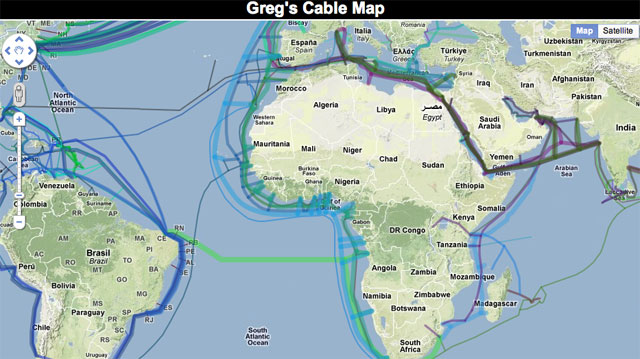
There’s a fascinating interactive map of the world’s undersea communications cables here. It’s also a pretty good guesstimation guide as to where there are, or are likely to be, NSA or subordinate agencies’ (and other non-affiliated intelligence services’) field stations that funnel the data flowing through such cables through computer systems that analyse traffic and content data.
There’s been a lot of controversy over this summer about the threats made to several large western mobile technology providers mainly by Asian and Middle-Eastern governments to ban their products and services unless they made it easier for their internal intelligence services and political police to access the accounts of users. The arguments actually started way back in 2008 in India, when the country’s Home Ministry demanded access to all communications made through Research in Motion’s (RIM) famous Blackberry smartphone, which was starting to spread rapidly in the country’s business community. Not much came of this beyond RIM agreeing in principle to the demand. Then over this summer, the issue flared up again, both in India and most strongly in the United Arab Emirates (UAE) and Saudi Arabia. RIM’s data servers were located outside the countries and the UAE’s Telecommunications Regulatory Authority (TRA) said that RIM was providing an illegal service which was “causing serious social, judicial and national security repercussions”. Both countries have notorious internal police and employ torture against political opponents.RIM initially defended its encrypted services and its commitment to the privacy of its users in a full statement issued at the beginning of August. However, they soon caved in when they realised that this could cause a cascade of bans across the Middle-East, India and beyond and promised to place a data server in both nations, and now India is once again increasing the pressure on RIM to do the same for its internal security services. So instead of a cascade of bans, we now have a massive increase in corporate-facilitated state surveillance. It’s Google and China all over again, but RIM put up even less of a fight.
However, a lot of people in these increasingly intrusive and often authoritarian regimes are not happy with the new accord between states and technology-providers, and this may yet prove more powerful than what states want. In Iran, Isa Saharkhiz, a leading dissident journalist and member of the anti-government Green Movement is suing another manufacturer, Nokia Siemens Networks, in a US court for providing the Iranian regime with the means to monitor its mobile networks. NSN have washed their hand of this, saying it isn’t their fault what the Iranian government does with the technology, and insist that they have to provide “a lawful interception capability”, comparing this to the United States and Europe, and claiming that standardisation of their devices means that “it is unrealistic to demand… that wireless communications systems based on global technology standards be sold without that capability.”
There is an interesting point buried in all of this, which is that the same backdoors built into western communications systems (and long before 9/11 came along too) are now being exploited by countries with even fewer scruples about using this information to unjustly imprison and torture political opponents. But the companies concerned still have moral choices to make, they have Corporate Social Responsibility (CSR) which is not simply a superficial agreement with anyone who shouts ‘security’ but a duty to their customers and to the human community. Whatever they say, they are making a conscious choice to make it easier for violent and oppressive regimes to operate. This cannot be shrugged off by blaming it on ‘standards’ (especially in an era of the supposed personal service and ‘mass customization’ of which the very same companies boast), and if they are going to claim adherence to ‘standards’, what about those most important standards of all, as stated clearly in the Universal Declaration of Human Rights, Article 12 of which states: “No one shall be subjected to arbitrary interference with his privacy, family, home or correspondence,” and in Article 19: “Everyone has the right to freedom of opinion and expression; this right includes freedom to hold opinions without interference and to seek, receive and impart information and ideas through any media and regardless of frontiers.”
James Bamford has a superb review of the new book by Matthew Aid about the US National Security Agency (NSA) in the New York Review of Books this month. What seems to be causing a stir around the intelligence research (and computing) community is the reference to a report by the MITRE corporation into a the information needs of the NSA in relation to new central NSA data repository being constructed in the deserts of Utah. The report, which is being rather speculative, says that IF the trend for increasing numbers of sensors collecting all kinds of information continues, then the kind of storage capacity required would be in the range of yottabytes by 2015 – as CrunchGear blog points out: there are “a thousand gigabytes in a terabyte, a thousand terabytes in a petabyte, a thousand petabytes in an exabyte, a thousand exabytes in a zettabyte, and a thousand zettabytes in a yottabyte. In other words, a yottabyte is 1,000,000,000,000,000GB.” However CrunchGear misses the ‘ifs’ in the report as some of the comments on the story point out. There is no doubt however, that the NSA will have some technical capabilities that are way beyond what the ordinary commercial market currently provides and it’s probably useless to speculate just how far beyond. Perhaps more important in any case, are the technologies and techniques required to sort such a huge amount of information into usable data and to create meaningful categories and profiles from it – that is where the cutting edge is. The size of storage units is not really even that interesting… The other interesting thing here is the hint of competition within US intelligence that never seems to stop: just a few months back, the FBI was revealed to have its Investigative Data Warehouse (IDW) plan. Data Warehouses or repositories seem to be the current fashion in intelligence: whilst the whole rest of the world moves more towards ‘cloud computing’ and more open systems, they collect it all and lock it down.
I’ve noted before that there seems to be a concerted push around the world by governments to introduce comprehensive new telecoms surveillance laws that force telecommunications and Internet Service Providers (ISPs) to record, store, and provide access to and/or share with state intelligence agencies, the traffic and/or communications data of their customers (in other words, users like us). What is noticeably here is that there is a particular logic that appears in the arguments of governments who are attempting to persuade their parliaments or people of the need for such laws. This logic that is firstly, circular and self-referential, in that it makes reference to the fact that other governments have passed such laws as if this in itself provides some compelling reason for the law to be passed in their own country. The second part of this is a king of competitive disadvantage arguments that flows from the first argument: if ‘we’ don’t have this law, then somehow we are falling behind in a never openly discussed intelligence-capability race that will hit national technological innovation too.
The media often seem oblivious to what seems obvious, and hence the story on the CTV news site today with reference to Canada’s currently proposed communications law that would allow the Canadian Security and Intelligence Service (CSIS) warrantless access to such the data from Internet and telecoms providers. They consider it to be ‘unexpected’ that the parliamentary Security Intelligence Review Committee has come out in support of the bill. Looking at the reasons why though, they are exactly what one would expect if one has been following the debates around the world and contain exactly the logics I have outlined. The story notes that the committee “points out that governments in the United States and Europe have already passed laws requiring co-operation between security agencies and online service providers” (without, incidentally, pointing out that these remain enormously controversial, or that other governments have abandoned some of their attempts) and later that “intelligence technology… requires continued access to new talent and innovative research.” However they won’t go into details as it is a “very sensitive matter.”
And absent from this debate as usual is the fact that this is not just a question of ‘national security’ if you set up these systems, you feed the US National Security Agency too. Canadian intelligence is still bound by agreements made after WW2, particularly the CANUSA agreement on Signals Intelligence (SIGINT), later incorporated into the UKUSA structure. And as we all know, right now, the USA does not always have the same strategic interests as Canada (the issue of arctic sovereignty is just one example). If this bill is passed, it’s a license for US spies, not just Canadian ones.
According to Madsen, two NSA programs for text interception are known to exist, one called PINWALE, which mainly targets Russian e-mails, and secondly the STELLAR WIND program, which “was initiated by the George W. Bush administration with the cooperation of major U.S. telecommunications carriers, including AT&T and Verizon.” and “was a major priority of the NSA program”.
Madesen gives details of how PINWALE and there’s little reason to suppose that STELLAR WIND is very different. Basically these programs search a range of ‘metadatabases’, repositories of captured text from millions of people around the world, outside and inside the USA. The search parameters include: “date-time, group, natural language, IP address, sender and recipients, operating system, and other information embedded in the header”.
Madesen claims that both STELLAR WIND and PINWALE “negated both USSID 18 and the Foreign Intelligence Surveillance Act of 1978 [which were introduced following the Church Committee report into illegal operations by the NSA in the 1960s and early 1970s] by permitting NSA analysts to read the e-mails, faxes, and text messages of U.S. persons”
The three metadatabases are called LION HEART, LION ROAR, and LION FUSION and were developed, as with many NSA systems in conjunction with an external contractor, in this case, Booz Allen Hamilton, which Madsen previously revealed was also responsible for FIRSTFRUITS, program used to track the articles, and communications of particular journalists.
There’s more detail in the article, and one other thing is certain. All these exotic codenames will now be history, as all intelligence agencies have a policy of changing them once they are revealed. Journalists still talk about ECHELON as if it exists as an active NSA operation, but that one hasn’t existed under that name for twenty years or more. There are a huge diversity of NSA programs for all kinds of communications interception and sorting. Each component will have its own terminology and many will be temporary parts of a greater whole, which may not even exist by the time they are revealed. At least former insiders like Madsen can keep some track of developments…
An aerial view of the NSA's station at Yakima in Washington State (Cryptome)
If the NSA can put this down to a period of bad leadership and bad policy, it might be allowed to get on with what it does relatively unhindered in the Obama era.
Boingboing has a link to a ten-miunte long MSNBC inerview with Russell Tice, an ex-National Security Agency (NSA) employee who is the latest in the long line of NSA whistleblowers after the likes of Wayne Madsen and Magaret Newsham. Tice’s revelations concern the NSA’s monitoring of internal communications in the USA after 9/11. According to Tice, the NSA both swept all US communications and also targeted specific groups, including journalists, for more comprehensive collection.
I have no idea how genuine Tice is and in many ways, despite the occasional choice phrase to describe SIGINT operations like the one with which I titled this post, he is a lot less interesting than Madsen or Newsham in that he’s not really telling us anything we didn’t know already. There is also a rather naive attitude from mainstream organisations like MSNBC that this is all down to the evil President Bush. This seems to suggest a lack of knowledge of history – do they really not remember the massive scandal over the very same use of watchlists by the NSA on behalf of the FBI in the 1960s? The huge inquiry led by Senator Frank Church in the 1970s? Can they continue to pretend that this is all totally new and that we can forget about ECHELON and the fact that this kind of surveillance is pervasive and systematic and becomes more so as technologies of collection, archiving and analysis improve? That is and always has been, what the NSA does in conjunction with its UKUSA network of largely subordinate allies and helpers (see this nice summary from Le Monde).
Of course this could be another explanation of Tice’s role, and the reason why he is being allowed to do the rounds of the newspapers and TV stations. Far from being simply a disaffected employee, he might be either a knowing or unknowing part of a media strategy by the NSA. If the NSA can put this down to a period of bad leadership and bad policy, it might be allowed to get on with what it does relatively unhindered in the Obama era. We shall see… or rather, we probably won’t!
NB: I wrote my PhD thesis on the networks of NSA-related bases around the world, including Menwith Hill, not far from where I live. It is worth checking out Cryptome’s Eyeball series of aerial views of NSA and other secret sites.
Fort George C. Meade, Maryland, Headquarters of the NSA
An official report into allegations that the British intelligence services could have prevented the bombing of the town of Omagh by a renegade faction of the IRA in 1998 has, not entirely surprisingly, vindicated the intelligence services.
BBC TV’s current affairs strand, Panorama, had alleged that Government Communications Headquarters (GCHQ, Britain’s equivalent of the US National Security Agency) had been monitoring the mobile phone communications of the bombers as they were moving towards Omagh, but did not inform the police on the ground in Northern Ireland.
The inquiry, chaired by the Intelligence Services Commissioner, Sir Peter Gibson, found no convincing evidence for this claim – which is of course, not to say that is wasn’t true. Let’s face it, it is highly unlikely that you would ever get GCHQ to admit to making mistakes let alone deliberately not giving information to the police on the ground. And even the ISC is not going to know whether GCHQ bosses are telling the whole truth or withholding information.
Justice in the case of the Omagh bombing has been hampered by murky behind the scenes dealings, despite the fact that it is widely known who was involved in planning and carrying out the attacks. Certainly the families of the victims of Omagh are probably right to reject the findings of this cozy establishment report, so typical of the way the British state polices itself.



 ubisurv