
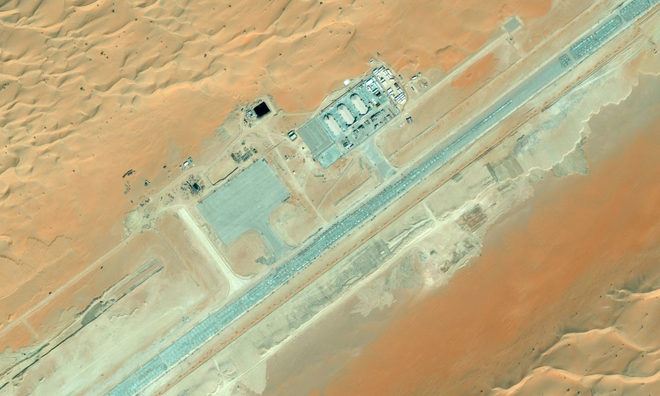
 Wired’s Danger Room blog has published pictures of what may be the hitherto secret CIA drone base in Saudi Arabia, revealed as part the confirmation hearings for John Brenner as proposed Director of the CIA…
Category: Middle East
Obama’s drone wars in question
So much has been happening over the US drone warfare program over the last few weeks that it’s hard to keep up.
First, the United Nations Special Rapporteur for Human Rights and Counter-Terrorism, instigated an inquiry into the targeted killing programs operated by the USA, largely using drones, and focusing on the issue of civilian casualties. The rapporteur, Ben Emmerson, made it clear that the inquiry would pull no punches and might result in war crimes charges against the US, should evidence be discovered of such crimes.
Second, NBC television in the USA revealed a leaked Justice Department document laying out the legal justification for the targeted assassination of US citizens using drones. The full memo is also available from this link and assembles a tortuous argument about how US citizens can be killed by their own government from above if there an “informed, high-level” official decides that the person has “recently” been involved in undefined “activities” threatening a violent attack against the US and “there is no evidence suggesting that he has renounced or abandoned such activities.”
And now, the Washington Post is reporting that the nomination of President Obama’s counter-terrorism guru, John Brennan, to head the CIA, has led to all sorts of revelations and difficult questions for Brennan to answer about the CIA’s targeted assassination program, including the acknowledgement of a secret drone base, at a still undisclosed location, in Saudi Arabia.
A while ago it looked like Obama’s drone strategy was unassailable despite increasing public knowledge via the Bureau of Investigative Journalism and criticisms from groups like the International Committee for Robot Arms Control. Now, this is going mainstream and it’s not looking so good for what former CIA Director, Leon Panetta, called the ‘only game in town’.
Anti-surveillance architecture
 Architecture seems increasing implicated in the generation of a ubiquitous surveillance society, not simply in the relatively longstanding modernist obsession with glass and visibility, but with security increasingly considered not as option but as infrastructure. It was nice to see at least some people concerned with creating anti-surveillance architectures. Two great examples are Deborah Natsios, and Eyal Weizman, and another I recently came across (via The Verge), is Asher J. Kohn, whose Shura City project, aims to create a living environment in an Islamic cultural context, that is protected from drone surveillance. As Kohn states:
“Shura City is constructed to be livable. It is built according to local logic, using local materials, and amenable to local needs. It is meantto be alien – but not hostile – from the outside while homey and familiar from the inside. It is meant to confuse the machines and their distant operators while creating a safe zone forpeople whose lives are being rended by war. Shura City is not about judgment on the survivors or destruction of their persecutors. Shura City is about using architecture to create a space for humanity in an increasingly inhuman sphere.”
‘Turning Off’ the Internet
Boing Boing contributors have been doing a fascinating job of documenting the place of the Internet and social media in the ongoing turmoil spreading across Arabic countries. Until recently the focus had been on the use of social media tools by activists, but in the last few days, the empire has struck back. In particular the Egyptian state has effectively ‘turned off’ the Internet, cutting Net access and communications between Egypt and the rest of the world.
What’s particularly interesting is that the rulers of western ‘democracies’ seem to want similar powers. I’ve been writing about the growing movement amongst states to develop powers to split or close the Internet entirely for some time (see here, here and here, for example). Most recently, I reported on French efforts to develop Internet censorship power in wide-ranging circumstances, and as Sean Bonner on BB points out, a bill was introduced into Congress last year by, it’s that man again, Joe Liebermann, to give the USA government even greater powers to cut off civilian access to the Net entirely in the event of a ‘cyber-emergency’.
This is not a drill, people, this is happening…
New Book – Surveillance and Control in Israel/Palestine
 The Surveillance Studies Centre says: Congratulations to Elia Zureik, David Lyon, Yasmeen Abu-Laban and all the contributors on their new book Surveillance and Control in Israel/Palestine, now available from Routledge. The book is an edited collection of papers from the research workshop, States of Exception, Surveillance and Population Management: The Case of Israel/Palestine, organized by The New Transparency Project in Cyprus, December 2008.
ISBN: 978-0-415-58861-4
TABLE OF CONTENTS
Preface – Elia Zureik, David Lyon and Yasmeen Abu-Laban
Part I: Introduction
1. Colonialism, Surveillance and Population Control: Israel/Palestine – Elia Zureik
Part II: Theories of Surveillance in Conflict Zones
2. Identification, Colonialism and Control: Surveillant Sorting in Israel/Palestine – David Lyon
3. Making Place for the Palestinians in the Altneuland: Herzl, Anti-Semitism, and the Jewish State – Glenn Bowman
Part III: Civilian Surveillance
4. Ominous Designs: Israel’s Strategies and Tactics of Controlling the Palestinians during the First Two Decades – Ahmad Sa’di
5. The Matrix of Surveillance in Times of National Conflict: The Israeli-Palestinian Case – Hillel Cohen
6. The Changing Patterns of Disciplining Palestinian National Memory in Israel – Tamir Sorek
Part IV: Political Economy and Globalization of Surveillance
7. Laboratories of War: Surveillance and US-Israeli Collaboration in War and Security – Steven Graham
8. Israel’s Emergence as a Homeland Security Capital – Neve Gordon
9. From Tanks to Wheelchairs: Unmanned Aerial Vehicles, Zionist Battlefield Experiments, and the Transparency of the Civilian – Nick Denes
Part V: Citizenship Criteria and State Construction
10. Legal Analysis and Critique of Some Surveillance Methods Used by Israel – Usama Halabi
11. Orange, Green, and Blue: Colour-Coded Paperwork for Palestinian Population Control – Helga Tawil-Souri
12. “You Must Know Your Stock”: Census as Surveillance Practice in 1948 and 1967 – Anat E. Leibler
Part VI: Surveillance, Racialization, and Uncertainty
13. Exclusionary Surveillance and Spatial Uncertainty in the Occupied Palestinian Territories – Ariel Handel
14. “Israelization” of Social Sorting and the “Palestinianization” of the Racial Contract: Reframing Israel/Palestine and The War on Terror – Yasmeen Abu-Laban and Abigail B. Bakan
Part VII: Territory and Population Management in Conflict Zones
15. British and Zionist Data Gathering on Palestinian Arab Land Ownership and Population during the Mandate – Michael Fischbach
16. Surveillance and Spatial Flows in the Occupied Palestinian Territories – Nurhan Abujidi
17. Territorial Dispossession and Population Control of the Palestinians – Rassem Khamaisi
Part VIII: Social Ordering, Biopolitics and Profiling
18. The Palestinian Authority Security Apparatus: Biopolitics, Surveillance and Resistance in the Occupied Palestinian Territories – Nigel Parsons
19. Behavioural Profiling in Israeli Aviation Security as a Tool for Social Control – Reg Whitaker
Latest round of Wikileaks shows nothing new, but changes everything
The ongoing Wikileaks revelations have been fascinating, but the latest round, those of US diplomatic cables, are perhaps the least revealing thus far. Basically, there’s a lot of the usual personal opinion and gossip that one would expect and the unsurprising revelations that the US gathers information on its allies as well as its enemies. The only really challenging insight is that Saudi Arabia want Iran dealt with far more urgently, it seems, than Israel. But then, even that is hardly unexpected given the religious and political gulf between those two states.
The more important thing for the longer-term is the process going on here, the fact that nation-states, even powerful ones, no longer seem to be able to have complete control over the information that they generate. Potentially, this is not about international relations at all or about any one particular nation-state, but potentially challenges the asymmetrical relationship between all nation-states the their peoples. Of course, there are already right-wing US politicians scrambling to label Wikileaks as a terrorist organisation, which just shows how corrupted the use of the idea of ‘terrorism’ has become, but below this, it demonstrates the very real fear of losing control amongst the political elite. The problem is that, with the current wave of nationalism sweeping the USA, such desperate sentiments play well to the gallery…
Backdoors for Spies in Mobile Devices
There’s been a lot of controversy over this summer about the threats made to several large western mobile technology providers mainly by Asian and Middle-Eastern governments to ban their products and services unless they made it easier for their internal intelligence services and political police to access the accounts of users. The arguments actually started way back in 2008 in India, when the country’s Home Ministry demanded access to all communications made through Research in Motion’s (RIM) famous Blackberry smartphone, which was starting to spread rapidly in the country’s business community. Not much came of this beyond RIM agreeing in principle to the demand. Then over this summer, the issue flared up again, both in India and most strongly in the United Arab Emirates (UAE) and Saudi Arabia. RIM’s data servers were located outside the countries and the UAE’s Telecommunications Regulatory Authority (TRA) said that RIM was providing an illegal service which was “causing serious social, judicial and national security repercussions”. Both countries have notorious internal police and employ torture against political opponents.RIM initially defended its encrypted services and its commitment to the privacy of its users in a full statement issued at the beginning of August. However, they soon caved in when they realised that this could cause a cascade of bans across the Middle-East, India and beyond and promised to place a data server in both nations, and now India is once again increasing the pressure on RIM to do the same for its internal security services. So instead of a cascade of bans, we now have a massive increase in corporate-facilitated state surveillance. It’s Google and China all over again, but RIM put up even less of a fight.
However, a lot of people in these increasingly intrusive and often authoritarian regimes are not happy with the new accord between states and technology-providers, and this may yet prove more powerful than what states want. In Iran, Isa Saharkhiz, a leading dissident journalist and member of the anti-government Green Movement is suing another manufacturer, Nokia Siemens Networks, in a US court for providing the Iranian regime with the means to monitor its mobile networks. NSN have washed their hand of this, saying it isn’t their fault what the Iranian government does with the technology, and insist that they have to provide “a lawful interception capability”, comparing this to the United States and Europe, and claiming that standardisation of their devices means that “it is unrealistic to demand… that wireless communications systems based on global technology standards be sold without that capability.”
There is an interesting point buried in all of this, which is that the same backdoors built into western communications systems (and long before 9/11 came along too) are now being exploited by countries with even fewer scruples about using this information to unjustly imprison and torture political opponents. But the companies concerned still have moral choices to make, they have Corporate Social Responsibility (CSR) which is not simply a superficial agreement with anyone who shouts ‘security’ but a duty to their customers and to the human community. Whatever they say, they are making a conscious choice to make it easier for violent and oppressive regimes to operate. This cannot be shrugged off by blaming it on ‘standards’ (especially in an era of the supposed personal service and ‘mass customization’ of which the very same companies boast), and if they are going to claim adherence to ‘standards’, what about those most important standards of all, as stated clearly in the Universal Declaration of Human Rights, Article 12 of which states: “No one shall be subjected to arbitrary interference with his privacy, family, home or correspondence,” and in Article 19: “Everyone has the right to freedom of opinion and expression; this right includes freedom to hold opinions without interference and to seek, receive and impart information and ideas through any media and regardless of frontiers.”
Surveillance and Ethical Investment
An interesting case today. Associated Press is reporting that Sweden’s major pension fund has decided to drop the company, Elbit Systems, from its investment portfolio on the grounds that it provides surveillance equipment to the separation barrier that cuts through the Occupied Territories of the West Bank. The find has an ethical policy and as the European Union considers the barrier to be in violation of international law, it seems they had little moral choice but to drop it. Interestingly the Israeli government has complained on behalf of this private company, which of course just serves to highlight still further the close links between the state and security firms and arms manufacturers in Israel. I am not sure that it’s particularly ethical for any national pension fund to be propping up another nation’s security policies, let alone a policy that is so controversial not to say overtly illegal. But beyond this Elbit is a major arms company that would, I thought, in any case have been off-limits for a fund with ‘ethics’ – see: Neve Gordon’s report on The Political Economy of Israel’s Homeland Security produced for The New Transparency collaborative research initiative here at the Surveillance Studies Centre at Queen’s.
Does the expansion of surveillance make assassination harder? Not in a world of UAVs…
Following the killing of Mahmood Al-Mabhouh is Dubai, allegedly by Israeli Mossad agents, some people are starting to ask whether political assassination is being made more difficult by the proliferation of everyday surveillance. The Washington Post argues that it is, and they give three other cases, including that of Alexandr Litvinenko in London in 2006. But there’s a number of reasons to think that this is a superficial argument.
However the obvious thing about all of these is that they were successful assassinations. They were not prevented by any surveillance technologies. In the Dubai case, the much-trumpeted new international passport regime did not uncover a relatively simple set of photo-swaps – and anyone who has talked to airport security will know how slapdash most ID checks really are. Litvinenko is as dead as Georgi Markov, famously killed by the Bulgarian secret service with a poisoned-tipped umbrella in London in 1978, and we still don’t really have a clear idea of what was actually going on in the Markov case despite some high-profile charges being laid.
Another thing is that there are several kinds of assassination: the first are those that are meant to be clearly noticed, so as to send a message to the followers or group associated with the deceased. Surveillance technologies, and particularly CCTV, help such causes by providing readily viewable pictures that contribute to a media PR-campaign that is as important as the killing itself. Mossad in this case, if it was Mossad, were hiding in plain sight – they weren’t really trying to do this in total secrecy. And, let’s not forget many of the operatives who carry out these kinds of actions are considered disposable and replaceable.
The second kind are those where the killers simply don’t care one way or the other what anyone else knows or thinks (as in most of the missile attacks by Israel on the compounds of Hamas leaders within Gaza or the 2002 killing of Qaed Senyan al-Harthi by a remote-controlled USAF drone in the Yemen). The third kind are those that are not meant to be seen as a killing, but are disguised as accidents – in most of those cases, we will never know: conspiracy theories swirl around many such suspicious events, and this fog of unknowing only helps further disguise those probably quite small number of truly fake accidents and discredits their investigation. One could argue that such secret killings may be affected by widespread surveillance, but those involved in such cases are far more careful and more likely to use methods to leverage or get around conventional surveillance techniques.
Then of course, there is the fact that the techniques of assassination are becoming more high-tech and powerful too. The use of remote-control drones as in the al-Harthi case is now commonplace for the US military in Afghanistan and Pakistan, indeed the CIA chief, Leon Panetta, last year described UAVs as “the only game in town for stopping Al-Qaeda.” And now there are many more nations equipping themselves with UAVs – which, of course, can be both surveillance devices and weapons platforms. Just the other day, Israel announced the world’s largest drone – the Eltan from Heron Industries, which can apparently fly for 20 hours non-stop. India has already agreed to buy drones from the same company. And, even local police forces in many cities are now investing in micro-UAVs (MAVs): there’s plenty of potential for such devices to be weaponized – and modelled after (or disguised as) birds or animals too.
Finally, assassinations were not that common anyway, so it’s hard to see any statistically significant downward trends. If anything, if one considers many of the uses of drones and precision-targeted missile strikes on the leaders of terrorist and rebel groups as ‘assassinations’, then they may be increasing in number rather than declining, albeit more confined to those with wealth and resources…
(Thanks to Aaron Martin for pointing me to The Washington Post article)
Iraqi resistance hacks US drones
According to the Wall Street Journal, US surveillance drones (you know, the future of military surveillance…) have allegedly been hacked by Iranian-backed Shi’ite forces in Iraq, using $26 off-the-shelf Russian software called Skygrabber – and they may have been compromised in Afghanistan too.
It is, as my informant, Aaron Martin, points out, amazing that the military surveillance systems of the world’s most resourced and technologically-developed military could be hacked so easily and for so long without notice. It also makes me wonder how many other networked surveillance systems would be vulnerable or are being hacked using the same or similar systems. If for example, organised criminal gangs could access the video surveillance systems of major cities, this would further call into question the effectiveness of these systems. Or alternatively, of course, it could point the way to a more accountable, open-access kind of surveillance – as Aaron and I are exploring in a paper we are currently writing.
 ubisurv