
India is investing massively in surveillance equipment both at national level and within the country, Video surveillance is expanding in cities, and it is also putting R&D and operational funds into major projects like a new mountain-top border radar system and now, a satellite platform that, it is claimed, will be “fitted with an intelligent sensor that will pick up conversations and communications across the borders.” Presumably this means a system rather like the US satellites that have been in operation since the 1980s that ‘vacuum’ up microwave communications signals from mobile telephones, rather than some kind of impossibly powerful microphone! Interestingly the story in the Hindu continually refers to the new devices, whether they be radar or satellites, as “network-centric”, and is peppered with references to “electronic warfare”, showing that Indian military planners have almost entirely swallowed US strategic doctrines that emerged from the 1990s. With the USA now operating openly in Pakistan, the source of recent terrorist raids into India, and tensions ratcheting up with China, it seems that the US is backing India as its major regional partner, or at least that India is aping US methods.
Category: satellites
Surveillance Image of the Week: Global Satellites…
A great graphic from Michael Paukner on Flickr of all the world’s satellites, working and defunct, plus debris, by country. Interestingly, China and France appear to the worst litterers of space as a proportion of the amount of stuff they have up there. Russia have the most out of commission satellites and the USA (not surprisingly) have the most working devices. Of course, this graphic doesn’t distinguish civil from military, nor say what are their functions, but the sheer amount of stuff in orbit indicates why there will be serious conflict over the use of orbital space soon enough…

USA builds massive new space surveillance system
My headline is a slightly more accurate version of the way that news of the new ‘Space Fence’ system has been headlined, for example here in Computerworld. The Space Fence system, whose first stage is a $30 Million US project for Northrop-Grumman, will replace a 1961 VHF radio infrastructure known as the Air Force Space Surveillance System built in 1961.
Although the spin is that the system is all about tracking space debris, this is actually part of the DoD’s satellite tracking operations – which certainly does cover debris, insofar as they are a threat to US satellites, but is also crucially to make sure that an accurate picture of the increasing number of smaller ‘micro-satellites’ from an every-expanding number of countries can be obtained. In that sense, this program is indeed a ‘fence’, a further attempt to enforce the notion that space is effectively US territory.
Another US court says police GPS tracking does need a warrant
The complex landscape of the US judicial system has thrown up a ruling on the police use of GPS tracking devices completely at odds with the recent ruling handed down by the appeals court in Wisconsin. The New York appeals court ruled 4-3 that police GPS tracking should require a warrant. Judge Lipmann’s words on the case, quoted by the New York Times, are particularly interesting as it appears that he wa taking a long view of potential harm in making his decision. He said:
“One need only consider what the police may learn, practically effortlessly, from planting a single device. The whole of a person’s progress through the world, into both public and private spatial spheres, can be charted and recorded over lengthy periods possibly limited only by the need to change the transmitting unit’s batteries. Disclosed in the data retrieved from the transmitting unit, nearly instantaneously with the press of a button on the highly portable receiving unit, will be trips the indisputably private nature of which takes little imagination to conjure: trips to the psychiatrist, the plastic surgeon, the abortion clinic, the AIDS treatment center, the strip club, the criminal defense attorney, the by-the-hour motel, the union meeting, the mosque, synagogue or church, the gay bar and on and on. What the technology yields and records with breathtaking quality and quantity, is a highly detailed profile, not simply of where we go, but by easy inference, of our associations — political, religious, amicable and amorous, to name only a few — and of the pattern of our professional and avocational pursuits. When multiple GPS devices are utilized, even more precisely resolved inferences about our activities are possible. And, with GPS becoming an increasingly routine feature in cars and cell phones, it will be possible to tell from the technology with ever increasing precision who we are and are not with, when we are and are not with them, and what we do and do not carry on our persons — to mention just a few of the highly feasible empirical configurations.”
This long term thinking has to be applauded. Sometimes imagination is necessary in the law, and particularly when the issue is one of socio-technical changes. The technological determinism of ‘if it exists, then it must be used’ is a way of thinking that has to be challenged. The question now for the USA is if either of these case or others will find their way to the federal courts. Until then, US citizens and police do not really know where they stand and the constitutional questions remain open.
India joins the battle for orbital space

India has launched its first major military surveillance satellite, RISAT-2, a platform for high-resolution Synthetic Aperture Radar (SAR), which puts it up there with the kind of things that the USA were launching over 10 years ago. Of course although, as The Times of India comment shows, being part of the club of orbital space powers is a consideration, the main motivations are most immediately, dealing with the threat of Pakistani Islamic extremists, and in the long term, regional competition with China, which has its own active satellite launch (and satellite-killing) program. One thing which about which the paper is entirely correct is that Indian high tech is more advanced than China’s and this home-grown satellite marks a small but significant shift in global surveillance power towards India. Whether, for a country still struggling with massive poverty and inequality, it is what anyone ‘needs’ or is any more than an expensive strategic symbol is another question.
SIVAM and Brazilian extremist nationalism

Whilst finishing up my work in Rio de Janeiro yesterday, I came across this interesting bunch of people, mv-brasil, who appear to be a Brazilian nationalist movement, with much in common with organisations like the British National Party or the various right-wing groups in the USA. Their website contains the usual odd mixture of anti-globalisation, evangelical Christian (they campaign against Halloween) and anti-United Nations / New World Order stuff with the added anti-Americanism. There of course is the usual rather uncomfortable fact of the ‘Brazilian Christian’ nationalist being a representative of a colonial power that invaded the country and took it from the indigenous people, but they roll over this one with some nods to Indian rights when it suits their cause, most notably when it comes to the Amazon.

One of the T-shirts for sale makes reference to this, being against ‘internationalisation and privatisation’ of the Amazon by the USA. It is a conspiracy theory I’ve come across before when I was doing some research on the SIVAM program – which provides some actual evidence for contentions that there is a secret American program to control the rainforest. I had someone tell me here in complete good faith that it was a ‘fact’ that several Amazonian tribes already thought that they were part of the USA and flew the US flag! This is combined with the fact the UN and international environmental organisations are very concerned about the destruction of the rainforest and the perceived lack of effort by successive Brazilian administrations to stop it. Put all this together and you have the ingredients for nationalist paranoia.
 So what is SIVAM? And why would I be interested in it anyway? The reason is that SIVAM is a surveillance system. Announced at the Earth Summit in 1992, and finally completed in 2002 and fully operationial from 2004, the Sistema de Vigilância da Amazônia (SIVAM) is a multipurpose, multi-agency network of satellite, aerial and ground surveillance and response that aims to monitor the illegal traffic of drugs and forest animals and plants, control national borders and those of indigenous peoples’ lands, and prevent the further destruction of protected areas of forest. A good technical account in English can be found in Aviation Today from 2002, and there is an interesting article on its construction here.

The problem is that, although an initiative of various Brazilian government agencies including the environment and Indian affairs ministries, the federal police and the army, SIVAM is supported and funded by the USA – most of the initial $1.39Bn US cost came through a grant from the U.S. Export-Import Bank, and the consortium that supplies the equipment includes giant US military supplier, Raytheon – amongst many others from Brazil to Sweden. The visit of former President George W. Bush’s right-hand man and then Secretary of State for Defense, Donald Rumsfeld, to the SIVAM control centre in 2005, was widely reported in Bazil. It was of course interpreted by many as further evidence of Brazil’s ceding of control of the Amazon to the USA, or even presaging a US invasion of the Amazon, as Senator Norm Coleman discovered on a fact-finding mission later that year.
Latin American countries have every right to be suspicious of US motives: the Monroe Doctrine; George Kennan’s Cold War ‘grand area’ vision; the support for dictators like Augosto Pinochet; the invasions of Panama and Grenada; Plan Columbia and the widespread use of military ‘advisors’… the list goes on. And it is certainly the case that US strategic surveillance plans for ‘Full Spectrum Dominance’ and the like, have have long included ‘leveraging’ any system in which they are involved from the International Space Station to things like SIVAM. So of course they will have a strategic interest, and no doubt SIVAM data will find its way to US military C4ISR centres, but this does not amount to a plan to invade Brazil or take control of the Amazon.
China calls for better international regulation of space
…it is the USA that effectively controls earth orbit. However many other emerging economies see no reason why this should be the case….
Following last week’s collision between an obsolete Russian military satellite and an US Iridium communications satellite, there has been a lot of discussion about the management of orbital space (or, more accurately, the lack of it). Orbital positions are managed by the International Telecommunications Union (ITU), but the effective control of orbital space is a matter of power projection – i.e.: which country can maintain a stronger and more pervasive presence in space. With the Russian program almost defunct, and European satellites limited in number, it is the USA that effectively controls earth orbit. However many other emerging economies see no reason why this should be the case. India now has a regular launch program and in particular China is massively expanding its space presence, even making noises about its ability to destroy satellites if necessary.
China seems now to be using this incident to sound out other countries and the international scientific community about a more coherent and comprehensive international management of orbital space. In an article published on the official English-language news site, Chinadaily, various senior Chinese scientists and People’s Daily journalists are quoted in favour of “establishing a system for the promotion of space safety is an important method of space traffic management”, through “long-term cooperation from the international community”, and perhaps even a “space traffic law”, although it is acknowledged that this is “still a very remote concept”.
The one organisation that is not going to like this at all is the US military. USSTRATCOM has absorbed the space power doctrine developed in the 1990s by USSPACECOM, which argued effectively that orbital space should be part of US military plans for ‘Full-Spectrum Dominance’ (FSD) and that international projects like the International Space Station would be tolerated only insofar as they could be ‘leveraged’ to US advantage. The US military wants to maintain the ‘ultimate high ground’ that dominance of earth orbit gives them, for communications, for surveillance, for weapons targeting. They are not even very keen on the EU Galileo project, the new and more technically-advanced rival to GPS (which is a US military system).
Just as with the discussion about internationalising management of the Internet and moving it beyond US government control, any suggestions of a more comprehensive international management of space are likely to be resisted even at the expense of logic and reason. The Chinese know this very well, and are being rather cleverly provocative. They are however, right.
Satellite collision opens up the world of space surveillance
Top story on many news channels today is the collision of a US Iridium telecommunications satellite with an obsolete Russian military satellite. Iridium is an interesting company that is almost permanently bankrupt (due to the rise of GPS-enabled mobile telephones) yet whose largest single customer is the US Department of Defense, which uses a Hawaii-based gateway for a secure network using NSA-approved handsets.

Even more interesting however is that the story mentions the obscure work of the Space Surveillance Network or SPACETRACK, formerly operated by US Space Command (USSPACECOM), now along with all of that influential body’s operations, part of US Strategic Command (USSTRATCOM). This global network of 25 bases using Phased-Array Radar and other tracking systems includes the RAF station at Fylingdales in North Yorkshire.
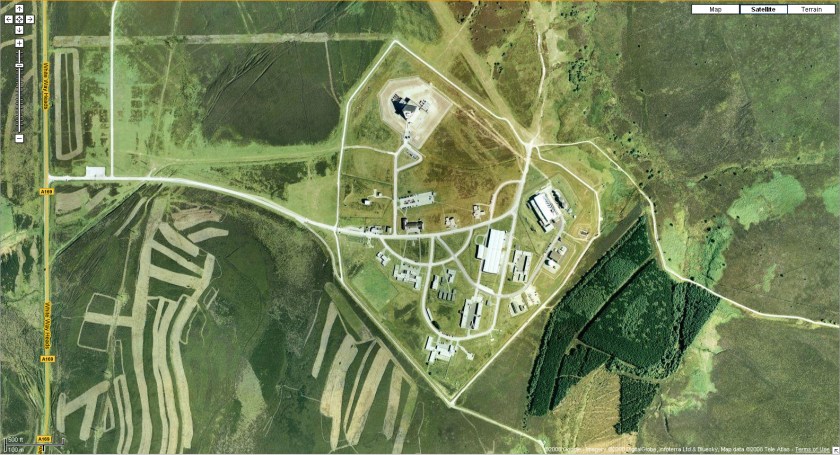

SPACETRACK continually watches earth orbit for new objects, which are then added to the US space catalogue. It also tracks debris fields, which are increasing in number and becoming more of a hazard for new space craft, and therefore problems for both military and civilian communications, weather, mapping and surveillance systems. This collision would seem to have been in relatively low orbit which causes the most problems. Cleaning up earth orbit would be a very good idea, but few people seem to have any serious ideas as to how it might be done. Some even argue that such a clean-up could destroy a valuable source of historical information!
 ubisurv