Fortress Toronto for G20 summit

There is an interesting article yesterday in the Toronto Star that does a good job of describing what will happen when the G20 arrives in town in June this year.

Of course, it will be accompanied by all the security and surveillance that these days comes as part and parcel of these ‘mega-events‘ (see also: here and here) whether they be sporting, economic or political – with the added hyper-security around world leaders. Rather like the peripatetic monarch’s court that used to be a feature of high mediaeval European societies, the travelling circus of global governance brings with it, its own security norms, creating locked-down ‘islands’ within cities, temporarily removing the rights and liberties of residents, and moving out and on those people seen to be ‘out-of place’ (the homeless, street vendors, protestors and so on). In many cases, ordinary people are suddenly potential troublemakers, and residents are harassed in advance by intelligence services who check profiles, backgrounds, political affiliations and so on. Business within the zone are usually negatively affected – even if the case is made, as it normally is, that there will be some nebulous ‘economic benefit’, which (oh, so conveniently) happens to cover the costs of security. The events are often also ‘test-beds’ for new technologies of surveillance and security – last year at the Pittsburgh G20 summit, we saw the use of sonic weapons on protestors for example.

Why do cities put up with this? Well, it’s all about inter-urban competition. For urban authorities these mega-events reinforce the global status of the city, or allow it to climb the ever-incrasing numbers of rankings of ‘world cities’ of ‘global cities’.  Toronto, like so many other cities in the second or third rank of global cities, is obsessed with appearing to be world class, and the local government will put up with almost any kind of inconvenience to its citizens that is seen to benefit the city’s global status.

I’ll be keeping an eye on developments, but if I was a Toronto resident, and if I could, I’d just leave town for a couple of weeks before and during the event…
The drone surge

The Huffington Post has a really interesting article on the current and future use of drones (whether they be UAVs, MAVs or other things) by the US military. Judging from the early comments, it seems there are some people also think these things are great because ‘they keep US soldiers safe’ – unfortunately they don’t seem to do the same for the villagers of the impoverished countries where they are deployed. As the International Campiagn for Robotic Arms Control (ICRAC) is arguing, there needs to be an international treaty or convention to regulate the use of such machines when they are used as or part of weapons systems, but beyond that, these systems, out of theline of vision of the general public, in terms of their policy development and often their physical deployment, are seen as ‘the future of surveillance’ within many nations too – as was revealed in Britain just the other day. The military-industrial complex is now the security-industrial complex and there is a decreasing gap between military tech and its civilian counterparts…

Surveillance fraud

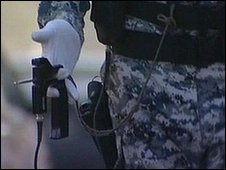
Add together a climate of fear, a trust in surveillance and security technology and a massively profitable industry, you get a perfect climate for fraud. Now, one of the most outrageous frauds in the area of surveillance and security has just been exposed courtesy of ex-magician and sceptic James Randi, and the BBC’s Newsnight team. A British manufacturer owned by Jim McCormick, based in Somerset, UK, has sold around $85 million US worth of their ADE-651 ‘explosives detector’ to the Iraqi government, and it is now in common use throughout the Middle East at checkpoints and borders. Yet the ADE-651 has no technical capabilities to detect anything. It is just a lump of plastic with a hinged metal rod sticking out of it, and contains only a basic commercial anti-theft tag – and is very similar to several previous fake bomb detectors.

The ADE-651 'working' in Iraq (BBC)

Mr McCormick has stated that the device is based on ‘dowsing’ principles (which have no known scientific basis). This device may have resulted already in many needless deaths, and yet some people still seem to put their trust in it, including a senior Iraqi military commander, Major General Jehad al-Jabiri, who is quoted as saying “whether it’s magic or scientific, what I care about is it detects bombs.” Or perhaps he cares more about his kick-back…

Security and the Economy (again)

The whole body scanners issue has once again brought to the fore the question of the relationship of security and the economy (see here, here and here). This is a more complex question than the political economy which argues that security companies benefit, therefore there are economic interests behind every surveillance surge than occurs. Of course, some companies, scanner makers, Rapiscan and L3 in particular in this case, make a lot of money form their patented systems: each one of the 44 L3 Scanners that Canadian airports are installing costs around $250,000 CAN (125,000 Euro), which adds up to a hefty income to L3. And of course there are connections to the revolving door of US Homeland Security governance at least: Michael Chertoff, the former Head of HOmeland Security from 2005-9 was making the case for scanners immediately after the December 25th thighbomber’s failed attempt, yet he neglected to mention his role as consultant to Rapiscan, which was awarded millions of dollars of contracts under his watch.

However, there are other interests here, notably the aviation industry, airlines and airports, not to mention those of travelers. The Toronto Globe and Mail today reports how airlines in Canada are increasingly concerned that already growing security levies from government (to provide security) will only spiral with every new measure introduced. The airlines expect the government to bear the costs. The government has merely said that it will try to ensure that costs passed on are minimised. However someone has to pay, somewhere along the line. If airlines (or their passengers) are not paying, then tax-payers are and it’s debatable whether ultimately, subsidising the security costs of international travelers is really what taxes should be for when times are hard. Of course no government wants this to come down to a ‘security versus the economy’ argument, but that has to be discussed, alongside the still largely unaddressed issues of privacy and other individual and collective liberties.

After the Thighbomber: Virtual Strip Searches at every airport?

The botched attempt to bomb a flight into the US by a the son of a wealthy Nigerian family, using explosive components strapped to his thigh, has led to an immediate techno-economic consequence, which is to speed up the process of installing terahertz wave or other body scanners in major airports, which if nothing else will provide a guaranteed income stream to Rapiscan and Qinetiq, who make these kinds of machines. Schipol in Amsterdam, where  announced they would be extending their body scanning operation and the British government almost immediately followed by saying that major British airports would be rolling out body scanning within weeks. Now, Canada is to do the same.

But, will this make a real difference or is it just more symbolic security? The scanners certainly ‘work’ in the sense that they do provide pretty good images of what is under the clothes of passengers (see below). However, interpreting what is seen is still no easy task and will the scanners will certainly not replace physical searches, but will add yet another extra layer of surveillant sorting and therefore delay. And there are questions over the effectiveness of the scanners in particular areas of the body. The Toronto Sun reports that trials at Kelowna Airport in British Columbia “left blind spots over the head and feet”, so these machines are certainly not the ‘silver bullet’.

Then of course, there are the privacy issues. I don’t have any particular problem with the technology, provided it is restricted to airports and doesn’t start to get used in other, more everyday, social settings (which given the rapid development of this technology is by no means certain). However, as I noted the last time I wrote about this, there will be many religious, gender-based and personal reasons for objecting to their use. The other question of course is whether, every time some lone lunatic tries something like this – that was, let us not forget, poorly planned and ineffective, and which should have been prevented by other conventional intelligence operations working properly – it makes sense to jump and harden security (or at least be seen to harden security) for everyone travelling internationally. Doing this just plays into the hands of terrorists as it disrupts the ordinary workings of an open society.

Body Scan Image (US TSA)

Meet Rio’s new security advisor…

if this appointment is any sign of what is to come… this is going to be war on the favelas.

So, with Rio de Janeiro now hosting the FIFA World Cup in 2014 and the Olympics in 2016, and a huge set of social problems providing big obstacles to a PR success and the place climbing the world rankings of ‘global cities’, who have the right-wing administration of Governor Sergio Cabral and Mayor Eduardo Paes appointed to advise them on security?

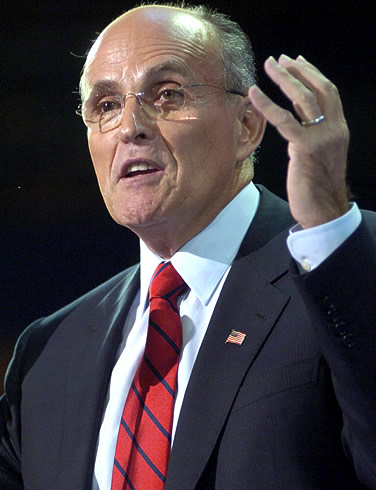
Rudy Giuliani

Well, it’s none other than Mr Zero Tolerance himself, the ex-Mayor of New York and failed presidential candidate, Rudy Giuliani.

As I’ve argued before, Giuliani’s macho urban politics have inspired the new tough choque de ordem (shock of order) approach that has flourished under Paes undermining the previous progressive social measures of former Mayor Cesar Maia, in particular the Favela Bairro program that attempted to make the illegal settlements in which the excluded minority of Rio’s population live, into normal functioning neighbourhoods. Cabral and Paes have turned this back into an ongoing confrontation, which is costing lives and livelihoods, and if this appointment is any sign of what is to come, the World Cup and the Olympics are going to mean more than just the usual high security and surveillance exhibition that these mega-events have become – this is going to be war on the favelas and war on the poor.

(As ever, thanks to my eyes in Rio, Paola Baretto Leblanc, for the link).

The Vancouver Statement on the 2010 Winter Olympics

Following recent discussion, a number of leading surveillance researchers have signed and issued the following ‘Vancouver Statement’ of which I did the first draft (followed by multiple revisions from many hands!). If you are a researcher who has done any work on mega-event security and surveillance, and agree with the statement, you are encouraged to send your name and affiliation to Adam Molnar at UVic. It is being press-released and hopefully discussed in the BC Legislative Assembly.

The Vancouver Statement of Surveillance, Security and Privacy Researchers about the Vancouver 2010 Olympic Winter Games

As researchers from Canada and the wider world, who are conducting research on the global security dynamics of mega-events, we agree:

  • that the Olympic Games should be a celebration of human achievement, friendship and trust between people and nations.

However, having analysed past and planned Olympics and other mega events, from a variety of historical and international perspectives, we recognise:

  • that recent Games have increasingly taken place in and contributed to a climate of fear, heightened security and surveillance; and
  • that this has often been to the detriment of democracy, transparency and human rights, with serious implications for international, national and local norms and laws.

Therefore, we ask the City of Vancouver, the Province of British Columbia and the Government of Canada:

  • to moderate the escalation of security measures for Vancouver 2010 and to strive to respect the true spirit of the event;
  • to be as open as possible about the necessary security and surveillance practices and rationales;
  • to withdraw temporary bylaws that restrict Charter rights of freedom of speech and assembly;
  • to work constructively with the Provincial and Federal Privacy Commissioners;
  • to respect the rights of all individuals and groups, whether they be local people or visitors, and pay particular attention to the impacts on vulnerable people;
  • to conduct a full, independent public assessment of the security and surveillance measures, once the Games are over, addressing their costs (financial and otherwise), their effectiveness, and lessons to be learned for future mega-events;
  • not to assume a permanent legacy of increased video surveillance and hardened security measures in the Vancouver/Whistler area, and to have full and open public discussion on any such proposed legacy.

We hope that these recommendations will contribute to a unique and positive Olympic legacy by which Vancouver, British Columbia and Canada will be remembered for setting the highest ethical standards.

For further information, contact:

Richard Smith, tel: 778-782-5116; or Colin Bennett

And there’s now more on Richard’s blog!

The Surveillance Games

I’ll be off the next few days at ‘The Surveillance Games’ conference in Vancouver.

Coincidentally, the local police have recently announce that they will be buying the same kind of sonic weapons we saw being used against protestors at the Pittsburgh G8 meeting. Except they want us to call them ‘megaphones’ and claim they won’t use them aggressively*. I think we still need to call a weapon a weapon. Just think, with such rebranding the police could get over their recent little problem with tasers too: just call them ‘joy-buzzers’ (just with a whole lot more ‘joy’...). The urban arms race that such mega-events always spark off as manufacturers push their latest toys to anxious governments, of course just adds another layer of bitter irony to the fact that Canada also intends to ignore its own call for global truce during the Games… it seems that you don’t even need the actual gesture for gesture politics these days.

*Even if these devices were just megaphones, this purchase would in any case be rather ironic given that Vancouver city has banned protestors from using any amplification devices by amending their bylaws in July 2009.