Quiet in the Library! Controlling the Internet

For many supposedly liberal politicians and bureaucrats the Internet is just a library of information, and we all know that libraries must be quiet and orderly, used responsibly and under the supervision of trained librarians…

Just a quick one: Boing Boing covered the story of an Australian EFF information rights campaigner, Geordie Guy, who has received a death threat from supporters of the government´s plan to control the Internet – just like so many other states around the world.

Surveillance cameras in Dajuyuan, Shenzhen (Rolling Stone)

It is no accident that the EFF campaign in Australia makes reference to their government´s plan as a ‘great wall’.  The first government to do this was, of course, China with its jīndùn gōngchéng (‘Golden Shield’) system which was exposed by Greg Walton.

As Naomi Klein´s more recent investigations have shown, it seems that western governments and companies are not only deeply involved with supplying equipment and expertise to China´s new surveillance state, but also see the development of the combined physical and virtual surveillance infrastructure being built by the authoritarian Chinese government as some kind of model for their own supposedly more liberal nations.

The Internet seems to worry all sorts of otherwise level-headed and well-meaning people. I was invited to speak at a recent conference in Finland on security in the Baltic states, and I got into a small argument with the rapporteur of one of the working groups, who said that one of their conclusions was that ‘we’ must stamp out hate-speech on the Internet. I asked the rapporteur how they would intend to do this without destroying the structures which enabled the creativity and freedom of the Net, and the response was that stamping out hate-speech was too important and just must be done. I suspect this is how a lot of supposedly liberal politicians and bureaucrats are thinking. For them the Internet is just a library of information, and we all know that libraries must be quiet and orderly, used responsibly and under the supervision of trained librarians. If enforcing order destroys everything that makes the Internet so revolutionary and so important, so what? Order must be maintained. There must be quiet in the library!

Facebook surveillance

Another great piece in the Ottawa Citizen´s Surveillance series, which is turning out to be probably the best newspaper coverage of the broad sweep of surveillance that I have yet seen.

This time they are talking to Dan Trottier and Val Steeves about the way that social networking technologies, and in particular Facebook, track individuals and groups.

The complete series The Surveillance Society: A Special Citizen Series, runs as follows:

31/01: The rise of the surveillance society

01/01: How surveillance categorizes us

02/02: Social networks and surveillance

03/02: Spying on each other

04/02: The promise and threat of behavioural targeting

05/02: Watching the watchers

Congratulations to reporter, Don Butler, in particular on some excellent work.

Digital Britain to be just like Digital Brazil?

There has been a serious global push for several years now by corporate content creators to hobble the Internet, and turn it into something more like television.

Time to catch up on a story that I missed this week. Boingboing reported the release of the UK government’s consultation document on Digital Britain. I had a eerie feeling of deja vu because the proposals are just like parts of Senator Azeredo’s bill that is halfway through the legislative process here in Brazil. Effectively it regards the Internet as some kind of untamed zone which must be brought under state control through a Rights Agency and ISPs acting increasingly as surveillance agents over the activities of their users, in this case particularly with regard to file-sharing.

The similarity is not surprising. There has been a serious global push for several years now by corporate content creators to hobble the Internet, and turn it into something more like television. The fact that the Digital Britain plan is filed under ‘broadcasting’ on the government’s website says quite a lot about the lack of tech savvy of state regulators in this area. What governments, in listening only to the corporate argument, don’t appear to realise is that we are actually collectively and autonomously coming up with better ways of ‘regulation’ of content through initiatives like Creative Commons and so on.

As in Brazil, where a serious netizen counter-plan is now emerging, with parliamentary support, there needs to be some serious organisation in Britain to present the alternatives to destroying the Internet and all is messy, unruly creativity. The Open Rights Group are trying to do this – let’s get behind them and make this more than just a few tech-savvy usual suspects.

Who killed Bambi?

Google Street View seems to be the surveillance system we currently love to hate, and now those horrible, nasty people only gone and have killed a baby deer. How can Google possibly top this? Perhaps only if Larry Page was captured on camera punching some cute fluffy kittens…

googlebambi
The Daily What preserves the evidence - they have now been removed from Street View

The ironic thing is that the incident was uncovered by viewing Google Street View. Don’t people have better things to do? The more you discover about participatory surveillance or synopticism, the more you realise that the answer is probably not… which is exactly the urge (or lack of it) that Google Street View taps into: the terminal ennui of spectacular consumer capitalism. Sometimes, it’s not Foucault or Kafka or Orwell we should be reading but J.G. Ballard

Google and Wikipedia

A nice rant in The Register from Encyclopedia Britannica president, Jorge Cauz, who claims that Google deliberately prioritizes Wikipedia entries. The article by Cade Metz goes on to produce a pretty convincing back up argument that this is true, and the excuse that Google offers that its search algorithms just do their job is clearly bogus. As Metz reminds us ¨those mindless Google algorithms aren’t controlled by mindless Google algorithms. They’re controlled by Google.¨ This truism is something many people tend to forget when they think about automated systems… And this is the company that of course we all use, but is now taking this trust to try to persuade us to give them all of our files with it´s new ´Gdrive´, part of its cloud-computing initiative that is supposed to see personal computing become simply software.

typing_monkeyAnd it´s not as if Wikipedia is a sound source of information. Take a look at the entry on surveillance – it´s a disjointed mess that shows evidence of all sorts of axe-grinding, self-promotion and personal pathologies, along with some increasingly burried attempts at co-ordination and making sense of it all. I generally tell my students to avoid it. The myth of Web 2.0 is that an infinite number of monkeys with typewriters might be able to produce the complete works of Shakespeare but, in practice, a small number of apes with computers can´t even produce a coherent definition of surveillance. This doesn´t mean I am in favour of the proposals to flag revisions to Wikipedia for approval by editors. Wikis are what they are. All that people, including those who run Wikipedia, need to do is be aware of that and not think that Wikipedia is anything more than it is. Especially Google´s programmers.

Virtual surveillance fail

this Open-Circuit TV (OCTV) is also about ´responsibilizing´citizens, trying to turn ordinary people into civic spies. Luckily, whilst people love to watch, they generally refuse to behave as agents of surveillance

The US-Mexican border has been a pretty good barometer of the levels of paranoia, waste and stupidity around immigration and surveillance for quite some time now. Now the El Paso Times of Texas reports on the stupendous failure of one massive initiative that was supposed to spread the burden of watching the border by installing webcams (and associated infrastructure) for US citizens to watch online and report anything suspicious.

Around $2 Million US was sunk into the program, yet it had few tangible outcomes. The figures, released under the Texas Public Information Act show that despite 1,894,288 hits on the website, there have been just 3 arrests out of a projected 1200, and only 8 incidents reported in total out of a projected 50,000.

What made me laugh was the comment from the office of Governor Rick Perry, who initiated the scheme, that the only problem was the way in which the scheme´s success had been assessed – there is a quote from a spokesperson that is a classic of government evasion: apparently, ¨the progress reports need to be adjusted to come in line with the strategy¨!

The only sensible comment on the whole debacle comes from Scott Stewart, a surveillance and security expert from Stratfor, who notes as all surveillance experts already know, that cameras are not that effective at deterring or stopping crime, and blames our naive faith in technological solutions that ¨can provide us with a false sense of security¨.

This isn´t just about whether cameras work though.

Of course there are wider issues about the fairness of US relations with Mexico which, under NAFTA, effectively mean that the US uses Mexico as a source of cheap labour and land for manufacturing and the free flow of goods, but does not permit the free flow of people. However for studies of surveillance, it is also about whether encouraging virtual voyeurism is either socially desirable or effective in reducing crime. In terms of effectiveness, of course Bruce Schneier has been arguing for quite a while that most security schemes are inefficient and counterproductive and there was an excellent paper by John Mueller of Ohio State University exploding the statistical myths around security measures in the War on Terror.

But this Open-Circuit Television (OCTV) – not the the usual Closed-Circuit Television (CCTV) we are used to in malls and big cities – is also about ´responsibilizing´citizens, trying to turn ordinary people into civic spies. Luckily, whilst people love to watch, they generally refuse to behave as states would want and do not willingly become agents of surveillance – as this scheme and the experiment in the London borough of Shoreditch with such participatory surveillance schemes, which was similarly successful amongst viewers but achieved no measurable result and was shelved, show.

Note: Hille Koskela of the University of Helsinki, who works mainly on webcams, has been following the Texas border watch scheme and will be presenting a paper on it at our Surveillance, Security and Social Control in Latin America sumposium here in Curitiba in March… I look forward to hearing her analysis.

Internet Surveillance in Brazil (2)

I’ve been catching up with what has been going on in Brazil in terms of Internet surveillance over the past few months. The good news is that the opposition has had some success in persuading several members of Brazil’s lower house, the Chamber of Deputies, to take their criticisms seriously.

Sérgio Amadeu, who is an Professor at the Faculade Cásper Líbero in São Paulo, a self-described ‘militant for free software’, and one of the originators of the ‘NÃO’ campaign against the proposed bill of Senator Azeredo, reported in December on the outcome of a public consultation on the bill and a flashmob protest against it in São Paulo in November. The outcome has been that a new counter-proposal is being developed by various activist organisations and individuals together with Deputy Julio Semeghini favouring Internet freedom. In fact, the proposal would recast Azeredo’s proposed law on the basis of net citizenship rather than cybercrime.

Professor Amadeu claims that now the Ministry of Justice is in contact with the campaign and that the Secretary for Legislative Affairs at the Ministry, Pedro Abramovay, has apparently shown that he is rather more interested in an appropriate balance between Internet freedom and security. I am always rather suspicious about talk of ‘balance’ in these contexts, and we still don’t know who these impressions will be transformed into action or how many lower house legislators share Deputy Semeghini’s view, but it sounds like there is some reason to be positive – that and the fact that as of today, 134494 people have signed the petition against Azeredo’s bill.

Obama’s new NSA-approved PDA

One story I didn’t mention last week, but which still seems to be doing the rounds, is the saga of new US President Obama´s PDA. Obama is well-known as a Blackberry-addict, using it constantly during the campaign, but as CNET pointed out such wireless devices are known to be highly insecure and vulnerable to all kinds of illicit monitoring and capture. There is, however, one device approved by the US National Security Agency (NSA), which its own employees use, the Sectera Edge Secure Mobile Environment Portable Electronic Device (SME PED), made by defence contractor, General Dynamics C4 Systems of Scottsdale, Arizona. It looks pretty similar to athe Palm Treo series, apart from the strengthned chasis, ‘secure’ ports and special ‘trusted’ display… all this for just $3500! (I hope he´s better at not losing his phones than me…)

Obama´s new PDA
Obama's new PDA

The rest of us, I guess will just have to put up with our insecure communications. The CNET article gives plenty of scary examples of just how insecure they are to simple hacking, even without the NSA’s rather more sophisticated programs. Of course even such NSA-approved ‘secure’ systems will undoubtedly have built-in backdoors that are accessible to the NSA, which is one of the main reasons they are even involved in the development of such technologies. And it is not just these unusual products of course – remember the Windows backdoor revelations from a few years back? Or further back, the Swedish government’s discovery that the NSA could access all their encrypted Lotus Notes documents – this later reverse engineering of the backdoor by Adam Back shows that the spooks are not without a (very bleak) sense of humour. Obama might now have secure communications, but there is always one agency whose evesdropping even he will not be able to avoid…

“Harpooning fish from an airplane”: NSA surveillance of US citizens

If the NSA can put this down to a period of bad leadership and bad policy, it might be allowed to get on with what it does relatively unhindered in the Obama era.

Boingboing has a link to a ten-miunte long MSNBC inerview with Russell Tice, an ex-National Security Agency (NSA) employee who is the latest in the long line of NSA whistleblowers after the likes of Wayne Madsen and Magaret Newsham. Tice’s revelations concern the NSA’s monitoring of internal communications in the USA after 9/11. According to Tice, the NSA both swept all US communications and also targeted specific groups, including journalists, for more comprehensive collection.

I have no idea how genuine Tice is and in many ways, despite the occasional choice phrase to describe SIGINT operations like the one with which I titled this post, he is a lot less interesting than Madsen or Newsham in that he’s not really telling us anything we didn’t know already. There is also a rather naive attitude from mainstream organisations like MSNBC that this is all down to the evil President Bush. This seems to suggest a lack of knowledge of history – do they really not remember the massive scandal over the very same use of watchlists by the NSA on behalf of the FBI in the 1960s? The huge inquiry led by Senator Frank Church in the 1970s? Can they continue to pretend that this is all totally new and that we can forget about ECHELON and the fact that this kind of surveillance is pervasive and systematic and becomes more so as technologies of collection, archiving and analysis improve? That is and always has been, what the NSA does in conjunction with its UKUSA network of largely subordinate allies and helpers (see this nice summary from Le Monde).

Of course this could be another explanation of Tice’s role, and the reason why he is being allowed to do the rounds of the newspapers and TV stations. Far from being simply a disaffected employee, he might be either a knowing or unknowing part of a media strategy by the NSA. If the NSA can put this down to a period of bad leadership and bad policy, it might be allowed to get on with what it does relatively unhindered in the Obama era. We shall see… or rather, we probably won’t!

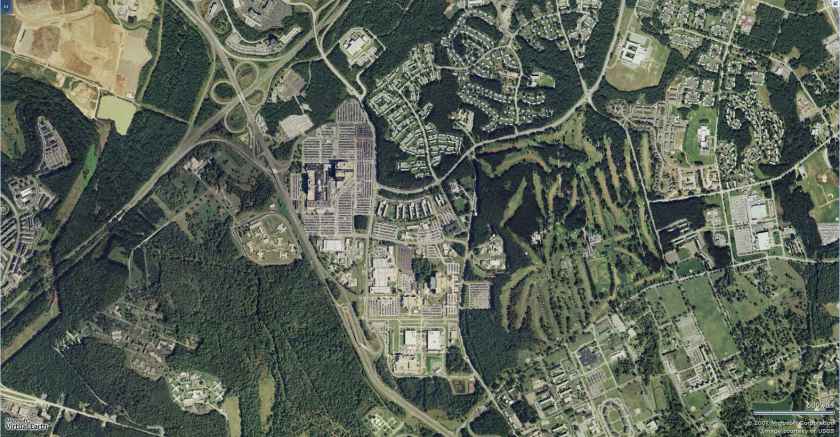
NB: I wrote my PhD thesis on the networks of NSA-related bases around the world, including Menwith Hill, not far from where I live. It is worth checking out Cryptome’s Eyeball series of aerial views of NSA and other secret sites.

Fort George C. Meade, Maryland, Headquarters of the NSA