Microsoft takes Cryptome down!

John Young’s Cryptome is perhaps the world’s most informative repository of (now, not so) secret documents and whistleblower’s information. Around since 1996, and with its multiple mirror-sites and determined owner, governments have tried and failed to close it down. However now the evil monopolist and maker of appalling bloatware, Microsoft, has succeeded where states have failed by issuing copyright infringement threats against its ISP, Network Solutions. This apparently worried the company more than any government, and as seems to be the usual craven attitude in these cases, the ISP backed down. According to Wired, they have even put a block on the transfer of the domain name so John Young can’t move ISPs…

The problem was that Cryptome published a short Microsoft document, the Microsoft Online Services Global Criminal Compliance Handbook, about the storage and handling of user data held on online servers,which also offers advice on subpoena tactics, info about state backdoors and more. The odd thing is that this document is old news and openly available elsewhere on the web, including via the link above. Given Microsoft’s well-documented links to US intelligence, could this just be an excuse to take out Cryptome, which has revealed so much about the National Security Agency over the years? Or is this just Microsoft’s usual clumsy, blinkered legal blundering?

Does the expansion of surveillance make assassination harder? Not in a world of UAVs…

Following the killing of Mahmood Al-Mabhouh is Dubai, allegedly by Israeli Mossad agents, some people are starting to ask whether political assassination is being made more difficult by the proliferation of everyday surveillance. The Washington Post argues that it is, and they give three other cases, including that of Alexandr Litvinenko in London in 2006. But there’s a number of reasons to think that this is a superficial argument.

However the obvious thing about all of these is that they were successful assassinations. They were not prevented by any surveillance technologies. In the Dubai case, the much-trumpeted new international passport regime did not uncover a relatively simple set  of photo-swaps – and anyone who has talked to airport security will know how slapdash most ID checks really are. Litvinenko is as dead as Georgi Markov, famously killed by the Bulgarian secret service with a poisoned-tipped umbrella in London in 1978, and we still don’t really have a clear idea of what was actually going on in the Markov case despite some high-profile charges being laid.

Another thing is that there are several kinds of assassination: the first are those that are meant to be clearly noticed, so as to send a message to the followers or group associated with the deceased. Surveillance technologies, and particularly CCTV,  help such causes by providing readily viewable pictures that contribute to a media PR-campaign that is as important as the killing itself. Mossad in this case, if it was Mossad, were hiding in plain sight – they weren’t really trying to do this in total secrecy. And, let’s not forget many of the operatives who carry out these kinds of actions are considered disposable and replaceable.

The second kind are those where the killers simply don’t care one way or the other what anyone else knows or thinks (as in most of the missile attacks by Israel on the compounds of Hamas leaders within Gaza or the 2002 killing of Qaed Senyan al-Harthi by a remote-controlled USAF drone in the Yemen). The third kind are those that are not meant to be seen as a killing, but are disguised as accidents – in most of those cases, we will never know: conspiracy theories swirl around many such suspicious events, and this fog of unknowing only helps further disguise those probably quite small number of truly fake accidents and discredits their investigation. One could argue that such secret killings may be affected by widespread surveillance, but those involved in such cases are far more careful and more likely to use methods to leverage or get around conventional surveillance techniques.

Then of course, there is the fact that the techniques of assassination are becoming more high-tech and powerful too. The use of remote-control drones as in the al-Harthi case is now commonplace for the US military in Afghanistan and Pakistan, indeed the CIA chief, Leon Panetta, last year described UAVs as “the only game in town for stopping Al-Qaeda.” And now there are many more nations equipping themselves with UAVs – which, of course, can be both surveillance devices and weapons platforms. Just the other day, Israel announced the world’s largest drone – the Eltan from Heron Industries, which can apparently fly for 20 hours non-stop. India has already agreed to buy drones from the same company. And, even local police forces in many cities are now investing in micro-UAVs (MAVs): there’s plenty of potential for such devices to be weaponized – and modelled after (or disguised as) birds or animals too.

Finally, assassinations were not that common anyway, so it’s hard to see any statistically significant downward trends. If anything, if one considers many of the uses of drones and precision-targeted missile strikes on the leaders of terrorist and rebel groups as ‘assassinations’, then they may be increasing in number rather than declining, albeit more confined to those with wealth and resources…

(Thanks to Aaron Martin for pointing me to The Washington Post article)

Indian surveillance build-up continues

India is investing massively in surveillance equipment both at national level and within the country, Video surveillance is expanding in cities, and it is also putting R&D and operational funds into major projects like a new mountain-top border radar system and now, a satellite platform that, it is claimed, will be “fitted with an intelligent sensor that will pick up conversations and communications across the borders.” Presumably this means a system rather like the US satellites that have been in operation since the 1980s that ‘vacuum’ up microwave communications signals from mobile telephones, rather than some kind of impossibly powerful microphone! Interestingly the story in the Hindu continually refers to the new devices, whether they be radar or satellites, as “network-centric”, and is peppered with references to “electronic warfare”,  showing that Indian military planners have almost entirely swallowed US strategic doctrines that emerged from the 1990s. With the USA now operating openly in Pakistan, the source of recent terrorist raids into India, and tensions ratcheting up with China, it seems that the US is backing India as its major regional partner, or at least that India is aping US methods.

Pentagon seeks bids for 3D-surveillance system

DARPA are seeking bids for a high resolution three-dimensional battlefield surveillance system. The so-called Fine Detail Optical Surveillance (FDOS) program is looking to develop “a fundamentally new optical ISR capability that can provide ultra high-resolution 3D images for rapid, in-field identification of a diverse set of targets… for use in an active battlefield or hostile environments with designs tailored to allow for soldier portable applications as well as UAV integration.”

As Wired maagazine points out, the Pentagon are already deep into a virtual 3D surveillance scheme, the evily-named Gorgon Stare, that involves 12 cameras attached to Reaper drones, and DARPA already have another development programme called Autonomous Real-time Ground Ubiquitous Surveillance – Imaging System (ARGUS-IS), which involves “a 1.8 Gigapixels video sensor”. There’s more details here.

Artist's Impression of the ARGUS system (Wired)

There’s no getting away from it: semi-autonomous robots and unmanned aerial vehicles are the new silver bullet for both military and civil uses, both in surveillance and warfighting itself. It’s about time more researchers and activitists paid this some greater attention…

The drone surge

The Huffington Post has a really interesting article on the current and future use of drones (whether they be UAVs, MAVs or other things) by the US military. Judging from the early comments, it seems there are some people also think these things are great because ‘they keep US soldiers safe’ – unfortunately they don’t seem to do the same for the villagers of the impoverished countries where they are deployed. As the International Campiagn for Robotic Arms Control (ICRAC) is arguing, there needs to be an international treaty or convention to regulate the use of such machines when they are used as or part of weapons systems, but beyond that, these systems, out of theline of vision of the general public, in terms of their policy development and often their physical deployment, are seen as ‘the future of surveillance’ within many nations too – as was revealed in Britain just the other day. The military-industrial complex is now the security-industrial complex and there is a decreasing gap between military tech and its civilian counterparts…

UK’s secret national flying camera strategy

If there was any doubt left, it seems the British government has finally given up all pretense of trying to balance civil liberties and security. A plan has been revealed by The Guardian newspaper for a national strategy for surveillance by Unmanned Aerial Vehicles (UAVs). And we are not just talking the micro-helicopter UAVs used by many UK police forces already, but 22m-long airships, the G22, which can stay airborne for many hours. The military drones will require special certification for civilian use.

And of course, these devices are supposed to be in place for the 2012 Olympics, but even in the documentation secured under the Freedom of Information Act (FoIA), it is made very clear that the drones will be used for a multiplicity of ‘routine’ operations, including from orders and fisheries activity to conventional policing and even “[detecting] theft from cash machines, preventing theft of tractors and monitoring antisocial driving… event security and covert urban surveillance” as well as all the kinds of activities that the already controversial Regulation of Investigatory Powers Act (RIPA) covers, including “fly-posting, fly-tipping, abandoned vehicles, abnormal loads, waste management”.

If this wasn’t bad enough, the whole thing has been developed in secret with the British governments favourite arms manufacturer, BAe Sytems, is projected to run as a public-private partnership due to the massive expense, and it has even been suggested that the surveillance data could be sold to private companies, according to The Guardian.

And the ‘selling’ of this to the public has already begun. Some suggestions of the use of high-flying drones had been made by Kent police, who had claimed it would be to “monitor shipping and detect immigrants crossing from France”. However, as The Guardian goes on to show this was a ruse which was part of long-term PR strategy to divert attention away from civil liberties issues. One 2007 document apparently states, “There is potential for these [maritime] uses to be projected as a ‘good news’ story to the public rather than more ‘big brother’.”

It’s really hard to say anything polite about these plans, the way they have been developed, and the complete lack of interest in or concern for the British public’s very real and growing fear of a surveillance state in the UK.

A footnote: almost as soon as this news was revealed, the British government raised the terrorist threat level to ‘severe’, without providing any indication that was any specific threat. Now, this may be entirely coincidental (and there are a couple of high-level meetings on Yemen and Afghanistan strategy in London next week), but if the threat level was much higher, the British public might suddenly be more amenable to the introduction of something to protect them from this ‘severe’ threat, like, say, flying drone cameras, don’t you think?

Surveillance fraud

Add together a climate of fear, a trust in surveillance and security technology and a massively profitable industry, you get a perfect climate for fraud. Now, one of the most outrageous frauds in the area of surveillance and security has just been exposed courtesy of ex-magician and sceptic James Randi, and the BBC’s Newsnight team. A British manufacturer owned by Jim McCormick, based in Somerset, UK, has sold around $85 million US worth of their ADE-651 ‘explosives detector’ to the Iraqi government, and it is now in common use throughout the Middle East at checkpoints and borders. Yet the ADE-651 has no technical capabilities to detect anything. It is just a lump of plastic with a hinged metal rod sticking out of it, and contains only a basic commercial anti-theft tag – and is very similar to several previous fake bomb detectors.

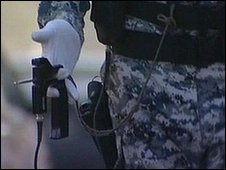
The ADE-651 'working' in Iraq (BBC)

Mr McCormick has stated that the device is based on ‘dowsing’ principles (which have no known scientific basis). This device may have resulted already in many needless deaths, and yet some people still seem to put their trust in it, including a senior Iraqi military commander, Major General Jehad al-Jabiri, who is quoted as saying “whether it’s magic or scientific, what I care about is it detects bombs.” Or perhaps he cares more about his kick-back…

Security and the Economy (again)

The whole body scanners issue has once again brought to the fore the question of the relationship of security and the economy (see here, here and here). This is a more complex question than the political economy which argues that security companies benefit, therefore there are economic interests behind every surveillance surge than occurs. Of course, some companies, scanner makers, Rapiscan and L3 in particular in this case, make a lot of money form their patented systems: each one of the 44 L3 Scanners that Canadian airports are installing costs around $250,000 CAN (125,000 Euro), which adds up to a hefty income to L3. And of course there are connections to the revolving door of US Homeland Security governance at least: Michael Chertoff, the former Head of HOmeland Security from 2005-9 was making the case for scanners immediately after the December 25th thighbomber’s failed attempt, yet he neglected to mention his role as consultant to Rapiscan, which was awarded millions of dollars of contracts under his watch.

However, there are other interests here, notably the aviation industry, airlines and airports, not to mention those of travelers. The Toronto Globe and Mail today reports how airlines in Canada are increasingly concerned that already growing security levies from government (to provide security) will only spiral with every new measure introduced. The airlines expect the government to bear the costs. The government has merely said that it will try to ensure that costs passed on are minimised. However someone has to pay, somewhere along the line. If airlines (or their passengers) are not paying, then tax-payers are and it’s debatable whether ultimately, subsidising the security costs of international travelers is really what taxes should be for when times are hard. Of course no government wants this to come down to a ‘security versus the economy’ argument, but that has to be discussed, alongside the still largely unaddressed issues of privacy and other individual and collective liberties.

Vancouver Olympic surveillance legacies

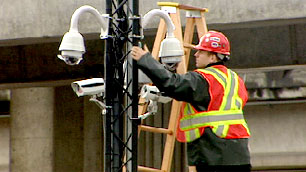
A city worker installs video surveillance cameras outside GM Place in downtown Vancouver. (CBC)

As the CCTV cameras are going up, Vancouverites are starting to become more concerned now about what the legacy of increased security and surveillance will be after the Olympics. Although the initial promises were that the cameras would be taken down afterwards, with the money that has been put into building a swish new control room, it seems unlikely that the authorities will want to ‘waste’ this investment. As we warned in our Vancouver Statement in November, it seems as if the Games have become a globe-trotting Trojan horse for the video surveillance industry.