Occupy the Internet!

I’ve been writing for several years now about the creeping attempts by nominally democratic governments to control or even close the Internet (see here for example). This week the biggest such step for some time occurs as the world’s most powerful democracy, the USA, begins a new process of introducing such controls. There are two bills before the House of Representatives (the Stop Online Piracy Bill, SOPA) and the Senate (the Protect IP act), which essentially do the same thing (although the House bill goes further): assert a wide-ranging heavy-handed jurisdiction on the Internet even beyond US borders.

Of course, the US bills do not do this as China does, in the name of political and social order, but in the name of commerce. The bills are supposedly about protecting American intellectual property, however their effect is likely to be severely chilling to free expression and the dissemination of ideas and to innovation, social and economic. The bills, amongst many other provisions, will allow corporation to sue website owners and ISPs for even unknowingly hosting or communicating copyrighted materials illicitly.

As Michael Geist has shown, SOPA in particular also asserts US jurisdiction over vast swathes of the Internet on the grounds that any site whose name is registered with a US registrar is considered a ‘US site’ regardless of the location of its server and given that name-registration of top-level (.com, .org, .net etc)  names is entirely controlled from within the USA, the provisions mean that every top-level domain is considered to be ‘US’. Further it claims that IP addresses (the numerical address of site) within the whole North American region (ARIN) which includes Canada, Mexico and the Caribbean, are also ‘domestic’ for the purposes of this law. Basically, the USA is asserting a kind of Munro-doctrine for the Internet.

I wrote, half-jokingly, some time ago that the US state invented the Internet, but they don’t like how it’s being used and now they want it back: this is the demand in writing. The big problem in opposing this is of course the fact that US citizens have already been thoroughly bombarded with propaganda that has told them that they are ‘under threat’ from pirates and hackers and even cyberwar – and that openness makes them insecure. They’ve been told that the Wikileaks model of accountability through openness and transparency is an attack on the USA. In an age of economic insecurity, no doubt the protection of American jobs will also be wheeled out as an excuse.

But this is quite simply another manifestation of immoral corporate greed. Intellectual Property is in itself a kind of information-age enclosure, a concept that, while it may have some use in limited forms, has become so far-reaching that it is ludicrous, and through which financial and legal strength can simply steamroller traditional or alternative visions of fairness, sharing and openness – even though these things have been shown to be vital in real innovation. If this is an infowar, I know which side I am on, and which side you should be on, and it is not the side of Protect IP and SOPA and the negative politics of closure, it is with Anonymous and the Pirate Party, with open flows, open source and open access. We have to tell them that they can’t have the Internet back, it’s ours now. We have to occupy the Internet, to build around these attempts to stifle innovation and sharing and we have to do it now.

In the meantime, you can express your displeasure here: http://americancensorship.org/

See also: The Internet Must Be Defended! Part 1, Part 2, Part 3, Part 4.
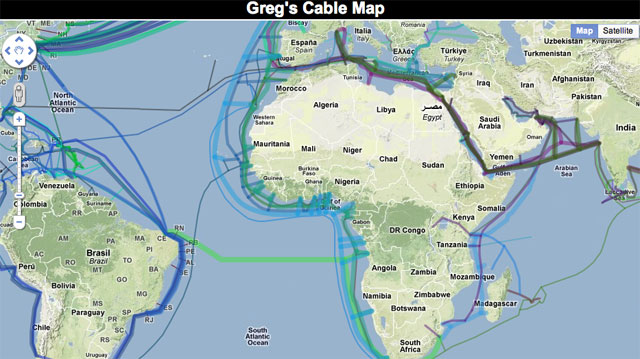
Greg’s Cable Map

Greg's Cable Map

There’s a fascinating interactive map of the world’s undersea communications cables here. It’s also a pretty good guesstimation guide as to where there are, or are likely to be, NSA or subordinate agencies’ (and other non-affiliated intelligence services’) field stations that funnel the data flowing through such cables through computer systems that analyse traffic and content data.

(via Gizmondo)

UK U-turn on Interception Consulation

The BBC reports that the UK Home Office has been forced by the European Union to accept input from civil and digital rights groups over the revision of its Regulation of Investigatory Powers Act (RIPA) – I’ve posted lots on RIPA here in the past, so it’s worth doing a search of this site for some of the backstory.

The u-turn was apparently sparked by the EU’s report on the Phorm debacle (see also here) which, amongst other things concluded that the UK was in breach of the Privacy Directive for having no adequate complaints procedure or systems of legal redress for those who believe they have been subject to illicit surveillance. Amongst the little nuggets in this story is the fact that since its creation in 1986, the Interception Commissioner has upheld four complaints. Yes, four. 4.

The consultation has also been extended to the 17th of December, so get writing if you haven’t already made your views known. You can find the consultation document here (pdf).

German Constitutional Court shoots down new ‘Lawful Access’ Provisions

Germany’s Constitutional Court is one of the few such national institutions that has been brave enough to interpret the right to privacy as actually meaning something that might outweight the state’s desire to know. According to the BBC, in a really strong decision, it has just ruled that a 2008 law, requiring all telecommunications traffic data to be stored for 6 months, violated privacy rights of citizens and should be struck out. Germany had already threatened to veto the European Union’s Telecommunications Directive 2006/24/EC (which came into force last year), a move which prompted the Council of Minister to take the unethical and devious step of redefining the Directive as belonging to the ‘commercial’ field (which requires only majority vote) as opposed to being a matter of ‘security’ (in which there has to be unanimity). We will now see what is the reaction of the German government to their own law being declared unconstitutional, and indeed, what international reverberations this have – the USA will certainly not like this.

(Thanks to ‘Unkraut’ for the pointer)

Private Sector Data Losses

People often concentrate rather too much on abuses by the state of personal data. But private sector organisations are certainly no better. One key example was made public this week, when the new UK Information Commissioner, Christopher Graham, announced that he would be prosecuting a major mobile phone company (he is not saying which one yet*) for selling personal information which it held on customers. The trade in personal information is a very difficult thing to regulate: telecoms companies will deny up front that they ever do anything like this, but yet we know it happens frequently in every jurisdiction, in both management-sanctioned and illicit forms; and practically, of course, once the information is ‘out there’, it cannot be recalled. So, no-one should feel safe just because they have ticked (or unticked) that little box under all that often indeciferable text about what a company might do with your data. I hope that whatever firm this is, it gets hits where it will hurt most, on its bottom line.

*Update: T-Mobile have now confirmed that they are the company responsible.

Canadian Internet Snooping Law

I’ve noted before that there seems to be a concerted push around the world by governments to introduce comprehensive new telecoms surveillance laws that force telecommunications and Internet Service Providers (ISPs) to record, store, and provide access to and/or share with state intelligence agencies, the traffic and/or communications data of their customers (in other words, users like us). What is noticeably here is that there is a particular logic that appears in the arguments of governments who are attempting to persuade their parliaments or people of the need for such laws. This logic that is firstly, circular and self-referential, in that it makes reference to the fact that other governments have passed such laws as if this in itself provides some compelling reason for the law to be passed in their own country. The second part of this is a king of competitive disadvantage arguments that flows from the first argument: if ‘we’ don’t have this law, then somehow we are falling behind in a never openly discussed intelligence-capability race that will hit national technological innovation too.

The media often seem oblivious to what seems obvious, and hence the story on the CTV news site today with reference to Canada’s currently proposed communications law that would allow the Canadian Security and Intelligence Service (CSIS) warrantless access to such the data from Internet and telecoms providers. They consider it to be ‘unexpected’ that the parliamentary Security Intelligence Review Committee has come out in support of the bill. Looking at the reasons why though, they are exactly what one would expect if one has been following the debates around the world and contain exactly the logics I have outlined. The story notes that the committee “points out that governments in the United States and Europe have already passed laws requiring co-operation between security agencies and online service providers” (without, incidentally, pointing out that these remain enormously controversial, or that other governments have abandoned some of their attempts) and later that “intelligence technology… requires continued access to new talent and innovative research.” However they won’t go into details as it is a “very sensitive matter.”

And absent from this debate as usual is the fact that this is not just a question of ‘national security’ if you set up these systems, you feed the US National Security Agency too. Canadian intelligence is still bound by agreements made after WW2, particularly the CANUSA agreement on Signals Intelligence (SIGINT), later incorporated into the UKUSA structure. And as we all know, right now, the USA does not always have the same strategic interests as Canada (the issue of arctic sovereignty is just one example). If this bill is passed, it’s a license for US spies, not just Canadian ones.

EU to EULA if UK is OK

It is a kind of digital enclosure, an attempt to impose on the Internet the same kind of removal of common rights that the British ruling classes imposed on the land from the Seventeenth Century onwards…

I have just completed an article on the UK as a ‘bad example’ to the rest of Europe, and lo and behold another piece of regressive, repressive idiocy by the British government appears. It seems that the UK is trying to amend the proposed EU-wide Telecommunications package to destroy the principle of net neutrality. Their proposals will “remove the principle of users’ rights to access and distribute Internet content and services”, and replace it with “a ‘principle’  that users can be told not only the conditions for access, but also the conditions for the use of applications and services.”

In other words, they want to make the entire Internet work by End-User Licensing Agreements (EULAs) rather than the general principle of end-to-end connectivity. It is a kind of digital enclosure, an attempt to impose on the Internet the same kind of removal of common rights that the British ruling classes imposed on the land from the Seventeenth Century onwards. There is nothing about the Internet Age about this, indeed it is pre-industrial – it is pure justification of the same powerful economic interests that the British state has always represented. And, as the original report points out, this is particularly bitter because both the British (OFCOM-originated) amendments and their duplicate Czech mini-me amendments have a lot of their substantive justitifications cut’n’pasted wholesale from Wikipedia!

Like the thieves who stole our land, they are utterly shameless.

(I think I originally saw this in BoingBoing, and sorry for not linking it, but it keeps crashing my little computer right now…)

Satellite collision opens up the world of space surveillance

Top story on many news channels today is the collision of a US Iridium telecommunications satellite with an obsolete Russian military satellite. Iridium is an interesting company that is almost permanently bankrupt (due to the rise of GPS-enabled mobile telephones) yet whose largest single customer is the US Department of Defense, which uses a Hawaii-based gateway for a secure network using NSA-approved handsets.

The Phased Array Radar pyramid at RAF Fylingdales (Yorkshire CND)

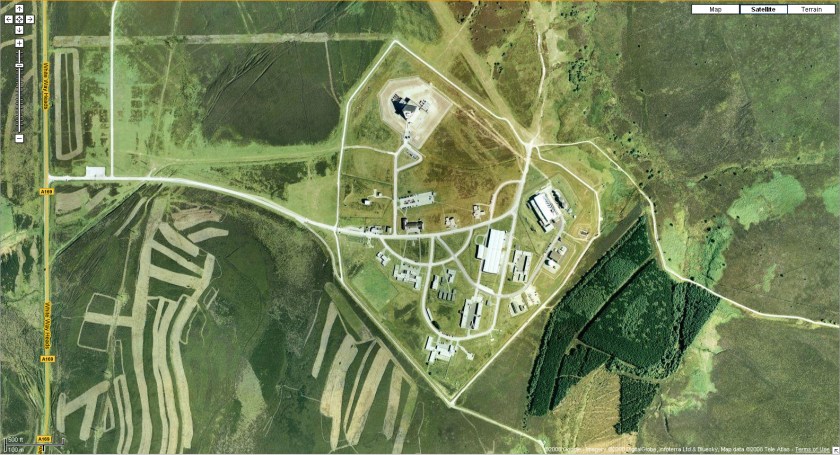
Even more interesting however is that the story mentions the obscure work of the Space Surveillance Network or SPACETRACK, formerly operated by US Space Command (USSPACECOM), now along with all of that influential body’s operations, part of US Strategic Command (USSTRATCOM). This global network of 25 bases using Phased-Array Radar and other tracking systems includes the RAF station at Fylingdales in North Yorkshire.

Satellite view of RAF Fylingdales (Cryptome)
Debris in Low Earth Orbit (NSA Orbital Debris Program Office)

SPACETRACK continually watches earth orbit for new objects, which are then added to the US space catalogue. It also tracks debris fields, which are increasing in number and becoming more of a hazard for new space craft, and therefore problems for both military and civilian communications, weather, mapping and surveillance systems. This collision would seem to have been in relatively low orbit which causes the most problems. Cleaning up earth orbit would be a very good idea, but few people seem to have any serious ideas as to how it might be done. Some even argue that such a clean-up could destroy a valuable source of historical information!