Rio police invade favelas ahead of FIFA World Cup and Olympics

As I, along with many others, predicted as soon as it was announced that Rio de Janeiro would host the two most globally important sports mega-events, the Rio authorities have launched a major drive to occupy and ‘pacify’ a growing number of the most significant favelas (informal settlements) in the city.

The rationale behind this is to drive out the gangs which control many of these communities. To this end a series of special police units has been created, the UPPs, which attempt to gain control of the settlements. Early experiments were in three favelas, one of which, Santa Marta, I visited in early 2009, when, along with Paola Barreto Leblanc, I conducted interviews with community association leaders and police.

Just last week the police moved into the largest favela, Rocinha. Unusually with police raids of this kind, there was little overt violence and ‘collateral damage’. This is certainly an improvement on some previous operations. However, not everyone was that impressed. This video from ITN News shows the stage-managed nature of the event, which seems to have been largely a demonstration of the ability of the Rio authorities to produce security on demand. As the reporter notes, only one person was arrested which means that hundreds of gang members (in this case of the Amigos dos Amigos, AdA, or ‘Friends of Friends’) will either have fled or remain in the favela.

The plan is apparently for the net to be widened still further, with Sergio Cabral, the Governor, claiming that 40 UPPs will be established, including very soon in the Mare Complex, 16 favelas with over 130,000 in all, which is vital to the preparation for the mega-events as it is close to the international aiport and other major transport links from Rio to the economic hub of Brazil, Sao Paulo. Many AdA members from Rocinha may have fled to the Mare Complex and at some point the pacification is bound to be become violent and less media-friendly. There are also, at least two other alliances of gangs who occupy other important favelas.

The current authorities have also started to emphasize the ‘community-building’ intention of these pacification measures, but it should not be forgotten that almost the first act that Cabral and his sidekick, the Mayor of Rio, Eduardo Paes, implemented on coming to office was to cancel the internationally-praised slum-upgrading program, favela bairro (see some thoughts I had on this after my interviews in 2009) of the former Mayor Cesar Maia, which was aimed at a much deeper and longer-term improvements not just at appeasing middle class voters and impressing the International Olympic Committee and FIFA. We will also see whether, like in Santa Marta, the initial community building efforts are undermined (or perhaps aided) by the installation of surveillance cameras

Helping robots find their way in the city

Many approaches to developing cities as automated environments, whether this be for robotics, for augmented reality or ubiquitous computing tend to take as their premise the addition of items, generally computing devices, to the environment. Thus, for example, RFID chips can be embedded in buildings and objects which could (and indeed in some cases, already do) communicate with each other and with mobile devices to form networks to enable all kinds of location-based services, mobile commerce and of course, surveillance.

But for robots in the city, such a complex network of communication is not strictly necessary. Cities already contain many relatively stable points by which such artificial entities can orient themselves, however not all of them are obvious. One recent Japanese paper, mentioned in Boing Boing, advocates the use of manhole covers, which tend to be static, metallic, quite distinctive and relatively long-lasting – all useful qualities in establishing location. The shape of manhole covers could be recorded and used as location-finding data with no need for embedded chips and the like.

It isn’t mentioned in the article, but I wonder whether such data could also be used for other inhabitants of the city with limited sensory capabilities: impaired humans? Could one equip people with devices that read the same data and use this to help sensorially-impaired people to navigate the city more effectively? On the less positive side, I also wonder whether such data would prove to be highly desirable information for use in urban warfare…

Trouble in paradise

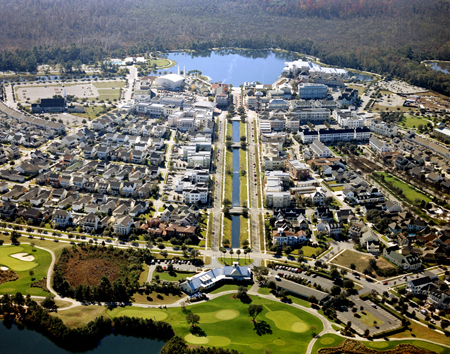
Layout view of Celebration

The town of Celebration in Florida, which is both famous and notorious (depending on your ethical and political persuasions) as the Disney Corporation’s ideology made material, has seen both its first murder and a fatal police shoot-out in the last few days.

First, a 58-year-old man, Matteo Patrick Giovanditto, was found dead in his apartment, apparently murdered, and just days later, one Craig Foushee, a man 52 who had had marital problems, barricaded himself inside his home and fired several shots at police before turning the gun on himself.

Some reports mention that Celebration is the utopian epitome of ‘new urbanism’, except that it has always seemed to me more like a parody of the new urbanism, a version taken to ridiculous and paranoid extremes with its enforced neighbourliness and codes of conduct and property maintenance.

And the apparently unconnected events read like the start of late J.G. Ballard novel – Cocaine Nights or Super-Cannes – with all kinds of poison bubbling under the perfect postmodern surface of this nostalgic, branded ‘retroscape’ (Brown and Sherry, 2003).

Will Augmented Reality just be really, really boring?

BoingBoing draws my attention to a video produced by London firm, Berg, with the London office of Japanese advertising agency, Dentsu. Cory Doctorow, who posted this one, and who I usually find to be bang on the money, comments that it presents an imagination of ‘Augmented Reality’ that isn’t ‘an advertising hell’. That may be true, but it’s hardly an inspiring vision of the future of such a potentially empowering technology.  For a start, most of what is shown isn’t really ‘AR’ at all, just ways of displaying social media on different kinds of surfaces so you can’t escape from it – and in fact, Berg/Dentsu do term it ‘incidental media’. To me, AR, if it is to be anything useful at all, means a heightened sensory environment, and one that should start with providing ways for those already disadvantaged to experience the city. Bill Mitchell called the last book of his City of Bits trilogy, Me++, and AR should really create a City++. The dreary corporate Berg/Dentsu future isn’t anyway near this, in fact it’s a City–, it’s reality reduced to endless news and personal updates. If it’s not hell, it’s more like a meaningless limbo… I know that many visions of the future go way over the top, but this is so timid and unimaginative, it just makes the future look boring.

New Orleans Ditches Surveillance Cameras

For a while now, I have been wondering how long it would be before the combination of cost and manifest ineffectiveness made urban authorities consider removing CCTV schemes. I had thought, given its long history of public space video surveillance, was that it might be Britain where this was most like to happen. What I didn’t expect was that one of the first big examples would be from the USA, which since 2001 has been going through the kind of expansion of CCTV seen in Britain in the 1990s.

But, surprise, surprise, here is New Orleans’ Mayor, Mitch Landrieu, arguing that a mere 6 indictments in 7 years (which is the success rate of New Orleans’ video surveillance system) is not enough to justify the costs and intrusion of CCTV:

“Most of us can agree that based on the way that they were installed, based on the way that they operated and the way that they were not maintained, that they were not a good investment.”

Woah! What was that? Public space CCTV doesn’t work? Who knew?

Well actually, it isn’t just New Orleans and its particular unmaintained and faulty system. Most urban authorities already know this. Police forced already know this. I would argue that much the same could be said for those in London, which has an far, far more intensive network in public spaces, yet the police themselves admit that only 3% of street robberies are solved with the help of CCTV. The difference is that now some of them are admitting what they have known for some time. The problem is that the public still largely believe that they ‘work’ (whatever that means anyway). And ironically this means in New Orleans that the cameras are staying up, even if they are turned off (as in fact many all over the world are anyway, and many more are not actually being watched by anyone)…

Meanwhile, in the rest of the USA, Homeland Security and stimulus plan-funded Justice Department CCTV systems continue to proliferate.

(Thanks to Aaron Martin for finding this story!)

Rio de Janeiro to continue in hardline direction

The Brazilian presidential elections may be only at the half-way stage – with Lula’s hand-picked successor, Dilma Rousseff, not quite securing the 50% she needed to avoid a run-off, largely due to a late surge by the radical Green Party candidate, Maria Silva – but the results of the elections for Rio de Janeiro’s Governor were much clearer. The incumbent, Sergio Cabral, was easily re-elected with just over 66% of the vote. Second was, once again, a Green Party candidate, Fernando Gabeira, with almost 21%, followed by a slew of minor candidates.

Cabral was expected to win as he is supported by the growing middle classes who have done well due to the economic bouyancy of Rio in the last few years. However, it is by no means clear that this result will do much good for the poorest in society. Cabral, along with the Mayor Eduardo Paes, favours a hardline approach to the favelas and their inhabitants, favouring a law-enforcement and crime-control approach to a social one – what Paes calls the choque de ordem. In this sense he is out of step with the national government, however for the middle class of Rio reading their copies of O Globo behind the doors of their secured apartments, the favelas represent not an unfair city which is still unable to close the massive gap between the rich, growing ever richer, and the poor, but a spectre of criminal disorder and a source of fear

The upcoming mega-events, particularly the FIFA World Cup, 2014, and the Olympics in 2016, have only strengthened the feeling amongst the privileged that Rio must simply crack down on violence rather than dealing with the underlying problems (poverty and the international drugs and small arms trades) that fuel the violence. What this means in practice is ‘out of sight, out of mind’: walling off favelas, installing surveillance cameras, stopping the illegal street vending that gives many in the favelas some small hope of a livelihood, and demolishing high-profile new construction.

*For more on my work in Brazil and in Rio de Janeiro, see the entries from January to April last year…

City of Leon to install mass public iris-scanning

The City of Leon in Mexico, if a report in Fast Company are to be believed, is going ahead with a scheme that goes far further than any other urban surveillance project yet in existence. They are already installing scanners that according to their manufacturers, Global Rainmakers Inc., an until recently secretive company with ties to US military operations, can read the irises of up to 50 people per minute.

Now, we have to be careful here. Gizmondo, as usual has gone way over the top with reports of ‘the end of privacy’ (which, if you believed their stories has already happened as many times as the apocalypse for 7th Day Adventists…) and talk of the ‘entire city’ being covered and ‘real-world’ operations (i.e. in uncontrolled settings). In fact, if you read the  Fast Company report, and indeed the actual description of the products from the company, they are far more limited even in their claims (which are likely to be exaggerated anyway). There is no indication that the iris scanners proposed will work in uncontrolled settings. When the company talk about the scanners working ‘on the fly’, they mean that they will work when someone is basically looking at the scanner or near enough whilst no more than 2 metres away (in the most advanced and expensive model and significantly less for most of them) and moving at no more than 1.5 metres per second (and, again, slower for the lower range devices). All the examples on the company website show ‘pinch points’ being used (walls, fences, gates etc.) to channel those being identified towards the scanner. In other words, they would not necessarily work in wide public streets or squares anyway and certainly not when people were moving freely.

So is this what is being proposed? Well, there are two phases of the partnership with Leon that the company has announced – and we have as yet no word from Leon itself on this. Phase I will cover the settings in which one might expect levels of access control to be high: prisons, police stations etc. Phase II will supposedly cover “mass transit, medical centers and banks, among other [unnammed] public and private locations”. It is also worth noting that the scheme’s enrolment is limited to convicted criminals, with all other enrolment on an entirely voluntary basis.

I am not saying that this is not highly concerning – it is. But we need to be careful of all kinds of things here. First of all, the Fast Company report is pure corporate PR, and the dreams of the CEO of Rainmakers, Jeff Carter (basically, world domination and ‘the end of fraud’ – ha ha ha, as if…) are the same kind of macho bulltoffee that one would expect from any thrusting executive in a newish company in a highly competitive marketplace. Secondly, there’s a whole lot of space here for both technological failure and resistance. The current government Leon may well find that the adverse publicity from this will lose rather than gain them votes and that in itself could see the end of the scheme, or its being limited to Phase I. In addition, without this being part of wider national networks, there may in the end be little real incentive for anyone to enrol voluntarily in this. Why would banks in Leon require this form of identification but not those in Mexico City or Toluca for example? Will the city authorities force everyone who use public transport to undergo an iris scan (which would make the ‘voluntary’ enrolment a sham)? This could all end being as insignificant as the Mexican companies offering RFID implants as a supposed antidote to kidnapping, it could be the start of a seismic shift in the nature of urban space, or it could be a messy mixture.

I hope my colleagues in Mexico are paying attention though – and I will try to keep updated on what’s really going on beyond the corporate PR.

Rio favelas hit by flooding

One of the things I noted this time last year when I visited Rio de Janeiro was the perilous situation of the poorest areas of informal housing, the favelas or morros when it comes to flooding and landslides. Just in the last 24 hours, huge amounts of rain has caused land and debris slides that have killed around 100 in the state according to the BBC, and in particular 13 people have been killed in Morro dos Prazeres, a favela I visited with my colleague Paola, according to The Guardian*. The centre of the city is deep in water. My thoughts are with all the people I met last year in Rio, and all the communities affected by this disaster.

Augmented Reality or alternate (un)realities?

There’s an amusing article with a serious point to it by the ever-acerbic Charlie Brooker on The Guardian website, on the potential social transformations of so-called ‘augmented reality’ technologies. The idea that ‘augmented reality’ inevitably will diminish or dehumanise as much as it adds or extends is one that has been made many times before, but usually in regard to the ‘subject’, i.e: the person experiencing the augmented reality. What Brooker’s satirical article is saying is that the humanity that is potenitally diminished in these systems is that of ‘others’ who may be effectively hidden by the information that the person using AR desires, and perhaps even deliberately so. I can see this. I think it’s actually a real possibility and the humour of Brooker’s approach shoudn’t disguise the fact that he’s an incredibly perceptive commentator.

Meet Rio’s new security advisor…

if this appointment is any sign of what is to come… this is going to be war on the favelas.

So, with Rio de Janeiro now hosting the FIFA World Cup in 2014 and the Olympics in 2016, and a huge set of social problems providing big obstacles to a PR success and the place climbing the world rankings of ‘global cities’, who have the right-wing administration of Governor Sergio Cabral and Mayor Eduardo Paes appointed to advise them on security?

Rudy Giuliani

Well, it’s none other than Mr Zero Tolerance himself, the ex-Mayor of New York and failed presidential candidate, Rudy Giuliani.

As I’ve argued before, Giuliani’s macho urban politics have inspired the new tough choque de ordem (shock of order) approach that has flourished under Paes undermining the previous progressive social measures of former Mayor Cesar Maia, in particular the Favela Bairro program that attempted to make the illegal settlements in which the excluded minority of Rio’s population live, into normal functioning neighbourhoods. Cabral and Paes have turned this back into an ongoing confrontation, which is costing lives and livelihoods, and if this appointment is any sign of what is to come, the World Cup and the Olympics are going to mean more than just the usual high security and surveillance exhibition that these mega-events have become – this is going to be war on the favelas and war on the poor.

(As ever, thanks to my eyes in Rio, Paola Baretto Leblanc, for the link).