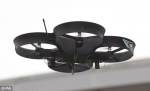
The USAF continues to use the Afghanistan / Pakistan conflict as a test bed for new military surveillance technologies and robotic weapons. The latest thing is apparently the RQ-170, codenamed Sentinel, which is a radar-evading UAV or drone aircraft.
This picture of the aircraft was apparently shot near Kandahar…
The Sentinel (source unknown)
It seems that as this conflict drags on, more and more of these things will get wheeled out. Its only purpose seems to have become to field test all these black-project developed technologies that the US security-industrial complex has been churning out. It wasn’t that long after the Predator drone emerged that we saw a weaponized version. It is unclear whether there is any such version of the Sentinel yet, but no doubt there will be soon enough. The increasing reliance on remote-controlled and robotic weapons seems to be a new article of faith amongst the world’s wealthier militaries.
I’m delighted to be informed by Professor Noel Sharkey that I have been invited to become the first member of the Advisory Board of the International Campaign for Robotic Arms Control (ICRAC). ICRAC aims to help prevent the unfettered spread of automated weapons systems and to produce an international convention or some other kind of binding agreement to control their use. I’ve been tracking the develeopment of robotic surveillance (and killing) systems for quite a while now and I think this campaign is absolutely essential. This piece recently in The Times of London goes into some of the issues quite well. There is a lot of work to do here to persuade governments to control what many militaries think will be ‘essential’ to warfare in this coming century, but I think that the landmines campaign is a good example of what can be done here – but this time before robotic weapons become too common.
A story in the Daily Mail shows two new military robot surveillance devices developed for the UK Ministry of Defence’s Defence and Equipment Support (DES) group. The first is a throwable rolling robot equipped with multiple sensors, which can be chucked like a hand-grenade and then operated by remote-control. The second is another Micro-(Unmanned) Aerial Vehicle (Micro-UAV or MAV), a tiny helicopter which carries a surveillance camera. There have been rolling surveillance robots around for a while now (like the Rotundus GroundBot from Sweden), but this toughened version seems to be unique. The helicopter MAV doesn’t seem to be particularly new, indeed it looks at least from the pictures, pretty similar to the one controversially bought by Staffordshire police in Britain – which is made by MicroDrones of Germany.
The proliferation of such devices in both military and civil use is pretty much unchecked and unnoticed by legislators at present. Media coverage seems to be limited to ‘hey, cool!’ and yes, they are pretty cool as pieces of technology, but being used in useful humanitarian contexts (for example, rolling robots getting pictures of a partially-collapsed building or MAVs flying over a disaster zone) is a whole lot different from warfare, which is a whole lot different again from civilian law enforcement, commercial espionage or simple voyeuristic purposes. As surveillance gets increasingly small, mobile and independent, we have a whole new set of problems for privacy, and despite the fact that we warned regulators about these problems back in 2006 in our Report on the Surveillance Society, little government thought seems to have been devoted to these and other new technologies of surveillance.
The use of robots in war is of course something else I have become very interested in, especially as these flying and rolling sensor-platforms are increasingly independent in their operation and, like the US Predator drones employed in Afghanistan and Pakistan or the MAARS battlefield robot made by Qinetiq / Foster-Miller, become weapons platforms too. This is an urgent but still largely unnoticed international human rights and arms control issue, and one which the new International Committee for Robotic Arms Control (in which I am now getting involved), will hopefully play a leading role in addressing.
Torin Monahan sent me this interesting video from the US Air Force showing ideas on Micro-Aerial Vehicles (MAVs) – nature-mimicking drones or independent robots that are intended to ‘enhance the capability of the future war-fighter’…
There is a superb and chilling new report out today that utterly demolishes the European Union’s claims to be in any way an ethical or progressive leader on issues of security and surveillance. The report written by Ben Hayes for the Transantional Institute and Statewatch, documents in some detail the new vision for security in the EU, which the authors describe as a ‘neo-con-opticon.’ The report confirms a lot of things that have been concerning me about the direction and emphasis of EU security research and the increasingly unnacountable and behind closed-doors ways in which security policy is being developed. I asked back in January in an editorial in Surveillance & Society whether surveillance was becoming the new ‘baroque arsenal’, Mary Kaldor’s famous phrase to describe the huge, intricate and complex technocentric security structures of the second Cold War. This report answers that question with a resounding ‘yes’.
The press release quotes from the introduction:
“Despite the often benign intent behind collaborative European research into integrated land, air, maritime, space and cyber-surveillance systems, the EU’s security and R&D policy is coalescing around a high-tech blueprint for a new kind of security. It envisages a future world of red zones and green zones; external borders controlled by military force and internally by a sprawling network of physical and virtual security checkpoints; public spaces, micro-states and mega events policed by high-tech surveillance systems and rapid reaction forces; peacekeeping and crisis management missions that make no operational distinction between the suburbs of Basra or the Banlieue; and the increasing integration of defence and national security functions at home and abroad.
It is not just a case of sleepwalking into or waking up to a surveillance society, as the UK’s Information Commissioner famously warned, it feels more like turning a blind eye to the start of a new kind of arms race, one in which all the weapons are pointing inwards. Welcome to the NeoConOpticon.”
And whilst you are at it, download Tony Bunyan’s equally superb report, The Shape of Things to Come – the EU Future Group, on the EU’s thoroughly undemocratic attempt to bypass public debate and hand internal security and surveillance policy over to the transnational security companies and the police and intelligence services.
(thanks to Rosamunde van Brakel for passing this on)
The estimable Professor Noel Sharkey is calling today for a debate on the use of robotic weapon systems, like the UAVs that I have been covering sporadically. He’s right of course, but we need to go much further and much faster. With increasing numbers of counties turning to remote-controlled weapon systems, and the potential deployment of more independent or even ‘intelligent’ robots in war, hat we need is an international convention which will limit the development and use of automated weapon systems, with clear guidelines on what lines are not to be crossed. In the case of atomic, biological and chemical weapons these kinds of conventions have had mixed success, but we have had very few clear examples of the use of such weapons in international conflicts.
According to The Times of India, the Indian military is investing massively in boom military industry of the moment – Unmanned Aerial Vehicles (UAVs or drones).
An IAL Heron TP UAV in flight
The initial order is apparently for coastal protection and involves the purchase of Heron UAVs from Israel Aerospace Industries, a specialist in such technologies which produces everything from large payload drones to tiny micro-UAVs like the Mosquito, which can be launched by hand and is designed for “providing real-time imagery data in restricted urban areas.” The Indian Defence Research and Development Organisation (DRDO) and Aeronautical Development Establishment (ADE) have also been developing their own drones in conjunction with IAI, the latest being the Rustom MALE.
A Predator UAV equiped with Hellfire missile (USAF)
Herons are supposedly unarmed but armed versions were used in the 2006 invasion of Lebanon by Israeli armed forces. The ToI article also makes it clear that Indian forces will be buying more overtly aggressive drones such as the US Predator systems that have been used to such devastating effect against Al-Qaeda and the Taliban in the Pakistan-Afghanistan frontier regions. Far from easing up on the use of these remote-control killing machines, Obama’s administration has accelerated their use. They put fewer US troops in the firing line, and can attack remote areas, from where it is also very difficult to get an accurate independent view on their activities. However they are alleged to have been massively inaccurate, with the Pakistan government claiming that only 10 out of 60 missions between January 2006 and April 2009 had hit their targets, killing 14 Al-Qaeda leaders and 687 civilians, an appalling ratio.
With the advent of strategic bombing and then the ICBM, the Twentieth Century saw a massive increase of the role of remote surveillance in warfare, which was intimately linked to the growth in destructive power and the ability to not to understand the consequences in any direct or emotional way. Even with the tank and artillery ground warfare was not so remote, but now in the Twenty-first Century we are seeing surveillance-based, remote-control warfare becoming increasingly normalised. It is not surprising to see both hypocritical states like the USA and Israel intimately involved in the promotion of this form of conflict which looks cleaner and more ‘moral’ from the point of view of the user, but which in fact simply further isolates them from the consequences of their action. Real time surveillance turns everyday life in to a simulation, and drone-based warfare makes war into something like a game. And it’s a deadly and amoral game that increasing numbers of states, like India, are now playing.
My headline is a slightly more accurate version of the way that news of the new ‘Space Fence’ system has been headlined, for example here in Computerworld. The Space Fence system, whose first stage is a $30 Million US project for Northrop-Grumman, will replace a 1961 VHF radio infrastructure known as the Air Force Space Surveillance System built in 1961.
Although the spin is that the system is all about tracking space debris, this is actually part of the DoD’s satellite tracking operations – which certainly does cover debris, insofar as they are a threat to US satellites, but is also crucially to make sure that an accurate picture of the increasing number of smaller ‘micro-satellites’ from an every-expanding number of countries can be obtained. In that sense, this program is indeed a ‘fence’, a further attempt to enforce the notion that space is effectively US territory.
Whilst finishing up my work in Rio de Janeiro yesterday, I came across this interesting bunch of people, mv-brasil, who appear to be a Brazilian nationalist movement, with much in common with organisations like the British National Party or the various right-wing groups in the USA. Their website contains the usual odd mixture of anti-globalisation, evangelical Christian (they campaign against Halloween) and anti-United Nations / New World Order stuff with the added anti-Americanism. There of course is the usual rather uncomfortable fact of the ‘Brazilian Christian’ nationalist being a representative of a colonial power that invaded the country and took it from the indigenous people, but they roll over this one with some nods to Indian rights when it suits their cause, most notably when it comes to the Amazon.
A t-shirt with anti-internationalisation and privatisation of the Amazon slogan
One of the T-shirts for sale makes reference to this, being against ‘internationalisation and privatisation’ of the Amazon by the USA. It is a conspiracy theory I’ve come across before when I was doing some research on the SIVAM program – which provides some actual evidence for contentions that there is a secret American program to control the rainforest. I had someone tell me here in complete good faith that it was a ‘fact’ that several Amazonian tribes already thought that they were part of the USA and flew the US flag! This is combined with the fact the UN and international environmental organisations are very concerned about the destruction of the rainforest and the perceived lack of effort by successive Brazilian administrations to stop it. Put all this together and you have the ingredients for nationalist paranoia.
So what is SIVAM? And why would I be interested in it anyway? The reason is that SIVAM is a surveillance system. Announced at the Earth Summit in 1992, and finally completed in 2002 and fully operationial from 2004, the Sistema de Vigilância da Amazônia (SIVAM) is a multipurpose, multi-agency network of satellite, aerial and ground surveillance and response that aims to monitor the illegal traffic of drugs and forest animals and plants, control national borders and those of indigenous peoples’ lands, and prevent the further destruction of protected areas of forest. A good technical account in English can be found in Aviation Today from 2002, and there is an interesting article on its construction here.
Donald Rumsefld visits the SIVAM control centre, 23 March 2005 (Wikimeda Commons)
The problem is that, although an initiative of various Brazilian government agencies including the environment and Indian affairs ministries, the federal police and the army, SIVAM is supported and funded by the USA – most of the initial $1.39Bn US cost came through a grant from the U.S. Export-Import Bank, and the consortium that supplies the equipment includes giant US military supplier, Raytheon – amongst many others from Brazil to Sweden. The visit of former President George W. Bush’s right-hand man and then Secretary of State for Defense, Donald Rumsfeld, to the SIVAM control centre in 2005, was widely reported in Bazil. It was of course interpreted by many as further evidence of Brazil’s ceding of control of the Amazon to the USA, or even presaging a US invasion of the Amazon, as Senator Norm Coleman discovered on a fact-finding mission later that year.
Latin American countries have every right to be suspicious of US motives: the Monroe Doctrine; George Kennan’s Cold War ‘grand area’ vision; the support for dictators like Augosto Pinochet; the invasions of Panama and Grenada; Plan Columbia and the widespread use of military ‘advisors’… the list goes on. And it is certainly the case that US strategic surveillance plans for ‘Full Spectrum Dominance’ and the like, have have long included ‘leveraging’ any system in which they are involved from the International Space Station to things like SIVAM. So of course they will have a strategic interest, and no doubt SIVAM data will find its way to US military C4ISR centres, but this does not amount to a plan to invade Brazil or take control of the Amazon.









 So what is SIVAM? And why would I be interested in it anyway? The reason is that SIVAM is a surveillance system. Announced at the Earth Summit in 1992, and finally completed in 2002 and fully operationial from 2004, the
 ubisurv