US plans surveillance drone airship

I am sure there will be arguments about the violation of airspace, which will not be trivial as the ongoing diplomatic and increasingly military row over US surveillance vessels off China is showing…

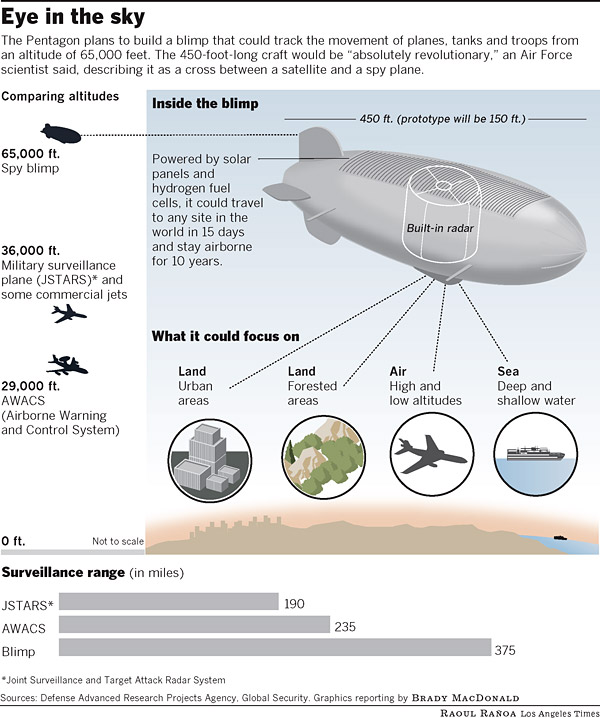
Unmanned aerial vehicles (UAVs) are one of the fastest-developing areas of surveillance technology. A new plan revealed by the US Department of Defense combines old and new tech with a plan, first revealed by the Los Angeles Times, for an pilotless surveillance airship called ISIS (Integrated Sensor Is the Structure) that will fly right at 65,000 feet (about 20km) high, right at the edge of ‘airspace’. The point of the airship is to provide the kind of constant watch that a geostationary satellite provides, but at a much lower level so that for more detailed pictures of the precise movements of vehicles, objects and people could be observed.

airship

Well, as usual, the reports only seem to to be concerned about how great this would be for US military tactics, and are not interested in the law, politics and ethics of such devices. For example, I am sure there will be arguments about the violation of airspace, which will not be trivial as the ongoing diplomatic and increasingly military row over US surveillance vessels off China is showing. And of course there are issues around the violation of human rights by such intrusive technology: international violations are very hard to deal with, however. And this will only be the beginning. The new Obama administration has promised more investment in intelligence and surveillance and less in warfighting. That sounds good in some ways, but of course just poses new problems and new issues for those of us concerned with ongoing US attempts to cover the whole world with surveillance for the benefit of its strategic aims.

Surveillance and the ‘Open-source Insurgency’

Hierarchical, national and corporate bodies are profoundly afraid of the openness, apparent lack of interest in conventional goals and absence of obvious leadership or deference that is represented by the new collaborative networks like Open-source. They are not ‘under control’. The answer for the military-industrial complex is a consistent one, and as usual it combines strategic military and economic goals. This answer is surveillance.

The US military-industrial complex is always trying to identify new threats to bolster its budgets. There was a minor outcry a few years ago when US military powerpoint slides on strategy seemed to indicate that it regarded international civil society organisations, including the Red Cross, as a potential source of such threat. Then came 9/11 and the war on terror and for a while it didn’t need these phantom menaces as there were real global enemies, and fortunately for the military-industrial complex, it seemed that those enemies might be infinitely expandable and malleable into what was briefly termed the ‘long war’.

But the war on terror isn’t what it was. So there seems to be some effort to resurrect previous threats. One of these is ‘the war on drugs’ now rebranded as ‘narco-terrorism’ or ‘narco-insurgency’. And the particular focus of the concern is closer to the United States: Mexico. Writing in the self-proclaimed ‘capitalist tool’, Forbes magazine, Reihan Salaam argued that Mexico’s ongoing struggle with drug-related violence was a major threat which could ‘blind-side’ the USA. Now, Republicans like Salaam are struggling to find anything important to say when its obvious what the major global problems are, and the US electorate has decided that the Republicans aren’t the people to solve them. He is of course correct that there is a serious situation in Mexico – and indeed elsewhere in Latin-America: the drug-trafficking gangs are also the major problem for the Brazilian government in any attempt to include their excluded favela communities. However, he makes no mention of the other underlying cause of destabilization in the USA’s southern neighbour – the way in which NAFTA has transformed Mexico into a subordinate economic role to the USA as source of cheap production facilities and cheap labour, all the while being told that its people are not wanted in the USA. The EU has its critics, but at least its building of free-trade has been accompanied by a far greater degree of free movement of people and reciprocal political rights. Nor is there any reference to the consumption of cocaine and crack in the USA that is driving the trade (as the first comment on the article notes).

Instead Salaam tries to analyze the Mexican situation using a recent strategic theory, and one which is profoundly worrying in its implications. In an essay in the New York Times in October 2005, John Robb argued that the Iraq war had turned into what he termed an ‘open-source’ insurgency, “a resilient network made up of small, autonomous groups”. He argued that those resisting the US occupation and other armed groups were like open-source software developers in that “the insurgents have subordinated their individual goals to the common goal of the movement”. (Never mind once again, that there is an obvious underlying common goal – that of getting rid of an occupying foreign power!).

Now of course, in many ways this was just a restatement of the whole post-Cold War, network-centric warfare hypothesis. There are also echoes back to the kind of language which has been used to describe ‘eastern’ or ‘foreign’ peoples for centuries – the British in India being unable to tell ‘them’ apart, the faceless and numberless ‘yellow peril’, the ‘godless communists’ who subordinated their individual will to the collective, and the ‘clash of civilizations’. It’s the hive-mind, the fear of humans who don’t appear to act ‘like us’. Without the overt racism of course: this is Orientalism 2.0, the politically-correct version!

However the addition of the label ‘open-source’ is no accident. Hierarchical, national and corporate bodies are profoundly afraid of the openness, apparent lack of interest in conventional goals (profit, advancement, etc.), and absence of obvious leadership or deference that is represented by the new collaborative networks like Open-source. They are not ‘under control’.

So how to bring them ‘under control’? John Robb’s first (and rather refreshing) answer was that in many ways you probably can’t and that in Iraq, the US should have probably ‘let them win’. But this is an unpopular response for the uneconstructed military-industrial complex. For them the first answer is a consistent one, and as usual it combines strategic military and economic goals. This answer is surveillance. For the Internet, we have seen, and continue to see, attempts in multiple countries to attack the basis of what makes the Internet creative and free, in the name of all kinds of ‘risks’ (mainly terrorism, identity crime, pirating and paedophilia). Of course these risks are no greater on the Internet than in the material world, but the Internet is still for many people, and many politicians in particular, a vast, unknown terrain which they do not understand: ‘here be dragons’ as the old maps used to have it of any such ‘terra incognita’.

For countries afflicted by the new ‘open-source insurgency’, the answer is the same. The Defense Industry Daily today starts off its story on Mexico with the apparently uncontentious statement that “Mexico needs surveillance.” It then lists with the usual kind of techno-pornographic relish of these publications, all the mainly Israeli UAVs and surveillance craft that the Mexican state is buying. We are supposed to cheer. We are supposed to think that this is evidence of Mexico’s growing maturity. Soon Mexico will be monitored and ‘under control’. No evidence of whether surveillance ‘works’ (even in military terms) troubles these kinds of stories. That is taken as self-evident. And certainly there is no question of whether this could in any way be the wrong approach, or even a counterproductive strategy. As the Brazilian parliamentarian to whom I was talking yesterday said, about the favelas, the only answer to both crime (because, let’s not forget that’s what ‘narco-terrorism’ really is) and the poverty on which it feeds, is in the long-term (and that means starting now not later): sanitation, schools, hospitals, transport, jobs – in other words providing the poor with access to the same society that the wealthier enjoy. Extending intensive high-tech military surveillance across the global south is not only a complete failure to address these underlying issues, it also diverts much-needed money away from social priorities. It is the wrong answer to the wrong question… except for the defense industry.

Datawars Conference

There will be a very interesting -looking conference in Amsterdam, 11-12 June, called Datawars: Fighting Terrorism through Data. According to the call for papers, the workshop will be held at the University of Amsterdam in June and will explore the ethical and political implications of the new data-led approach to security, risk and fighting terrorism in Europe. Suggested topics include:

  • Privacy, security and human rights
  • Ethics, responsibility and justice in European data wars
  • Risk, prevention, preemption
  • Data and surveillance
  • Private authorities, states and the European Union
  • Constituting Europe through data

It´s part of a project run by a couple of excellent researchers, Louise Amoore and Marieke de Goede, of the Universities of Durham and Amsterdam respectively (who probably don´t remember but I worked in an tiny attic office opposite them in the Politics Dept at Newcastle for a few months just after my PhD!). I might go as I have been doing some work on attempts to create global databases, called ´From Echelon to Server in the Sky´, but the timing might be awkward (unfortunately I can´t reveal why yet…).

Learning Surveillance Systems

Several years ago, during my postdoctoral work on algorithmic surveillance, I was warning of the problems associated with the development of heuristic (learning) software applied to surveillance systems. I argued that their popularity would grow as the amount of data acquired through growing numbers of cameras that could not possibly be watched by human operators. Today in CSO Security and Risk, a magazine for ´security executives´, there is a piece by Eric Eaton which summarises the current state of the art, and which makes exactly that argument as a reason why operators of surveillance systems should consider using such learning software. As Eaton says,

¨Various tools have emerged that not only “see video better,” but also analyze the digitized output of video cameras in real time to learn and recognize normal behavior, and detect and alert on all abnormal patterns of activity without any human input.¨

Judge, jury... and executioner
Judge, jury... and executioner (IPC magazines)

The key issue here, and one which I mentioned in my post about angry robots the other day, is the automated determination of normality. As French theorist, Michalis Lianos, argued in Le Nouveau Contrôle Social back in 2001, the implementation of these kinds of systems threatens to replace social negotiation with a process of judgement and sometimes even the consequences (which in some border control systems can be fatal – Judge Dredd as computer).

Eaton identifies the first part of this conundrum when he says that ¨the key to successful surveillance is learning normal behaviors¨and he believes that this will enable systems to filter out such activity and ¨help predict, and prevent, future threats.¨ He does admit that in many cases the numbers of actual instances of systems detecting suspicious behaviour is very small and therefore the cost of systems may not be economically justified, but there is as usual amongst his ´5 musts´ for security operators, no place to be found for ethics, human rights (or indeed humanity outside of systems operators) or consideration of the wider social impacts of the growth in use of learning security machines.

No doubt he would say, as most developers and operators do, that this is simply a matter of how systems are used in compliance with best practice and the law, which in itself ignores the possibility of already consciously or unconsciously programmed-in biases, but the more that systems become intelligent and are able to make decisions independently of human operators, the thinner this legalistic response becomes. I´m not saying that we are about to have automatic car park CCTV cameras with guns any time soon, but it´s about time we had some forward-looking policy on the use of heuristic systems before they become as normal as Eaton suggests…

The robots are coming and now they’re angry…

A mindless drone robot is one thing but an independent robot with a tiny mind capable only of death and destruction – that is something else entirely.

Whilst I was doing my PhD in the late 90s, I met a guy called Steve Wright who used to run the Omega Foundation (who were like the ‘Lone Gunman’ organisation from the X-Files, but for real), and who is now at the Praxis Centre at Manchester Metropolitan University, UK. He was investigating the development of new forms of automated killing and control systems and ever since then, I’ve been keeping an eye on the development of remote-controlled and increasingly automated surveillance technologies, and in particular the development of robotic devices that are able not only to collect or transfer data, but to respond physically.

Two stories this week reflect the variety of developments in all kinds of different arenas, and raise all sorts of issues around the distancing of human responsibility from material, in many cases, punitive or lethal action.

'Intruder' captured by web-slinging robot
Japanese security robot (AP)

The first was the news that Japanese technologists have produced a mobile remote-controlled robot that can fire a net over ‘intruders’. Until recent years such developments had been carried out largely in the area of military research by organisations like the RAND corporation in the USA. However, particularly since the end of the Cold War when military supply companies started to look to diversify and find new markets in a more uncertain time when the ‘military-industrial complex’ might no longer ensure their profits, there has been a gradual ‘securitization’ of civil life. One consequence of this has been that so-called ‘less-lethal’ weapons are increasing regarded as normal for use in law enforcement, private security organisations and even by individuals.

However a further change has been in the when these operations can be automated when an intermediary technology using sensors of some kind is placed between the person operating them and the person(s) or thing(s) being monitored. This removes the person from the consequences of their action and allows them to place the moral burden of action onto the machine. The operation is aided still more if the machine itself can be ‘humanized’, in the way that Japanese robots so often are. But a kawaii(cute) weaponized robot is still a weaponized robot.

A 'Predator' Drone (USAF)

In the skies above Afghanistan, Iraq and Gaza however, ‘cuteness’ doesn’t matter. Remote-control military machines have been stealthily entering the front lines, colonising the vertical battlespace, with lethal consequences that have not yet been considered enough. This week we saw US unmanned aircraft operated by the CIA kill a total of 21 people in Pakistan, one of the few aspects of Bush-era policy that new President Obama has not (yet) promised to change.

All of these machines are still under some kind of control from human operators, but several profoundly misguided scientists are trying to create systems that are more independent, even ‘intelligent’. This week, I read about Professor Mandyam Srinivasan of Queensland University in Australia who, at least according to a report in The Australian, thinks it is a great idea to give missiles brains like angry bees. A mindless drone robot is one thing but an independent robot with a tiny mind capable only of death and destruction – that is something else entirely. I can think of few things that are less in the spirit of social progress than this, but he’s hardly the only one thinking this way: there are billions of dollars being pumped into this kind of research around the world…