Sorting Daemons

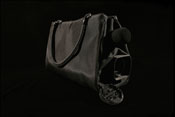
Kathleen Ritter (2006) 'Hidden Camera'

After the excellent opening seminar over the weekend, the exhibition, Sorting Daemons: Art, Surveillance Regimes and Social Control is on at the Agnes Etherington Art Centre in Kingston, Ontario, from 16 January – 18 April. The exhibition features works in a range of media-including painting, photography, video, installation and responsive electronic art-by artists Brenda Goldstein, Antonia Hirsch, David Kemp, Tran T. Kim-Trang, Germaine Koh and Ian Verchere, Arnold Koroshegyi, Ruthann Lee, Michael Lewis, Jill Magid, Walid Ra’ad; Kathleen Ritter, David Rokeby, Tom Sherman, Cheryl Sourkes and John Watt.  There is also a special video program, which draws on artists’ tapes produced over the past two decades. This exhibition extends off-site with presentation of Kathleen Ritter’s Hidden Camera at the Union Gallery in Queen’s University’s Stauffer Library until March 9.

The curators, Jan Allen and Sarah E.K. Smith, are also interested in having the exhibition go on tour in future, and would like to hear from galleries who might want to host the show. I’ll pass on any such inquiries…

Augmented Reality or alternate (un)realities?

There’s an amusing article with a serious point to it by the ever-acerbic Charlie Brooker on The Guardian website, on the potential social transformations of so-called ‘augmented reality’ technologies. The idea that ‘augmented reality’ inevitably will diminish or dehumanise as much as it adds or extends is one that has been made many times before, but usually in regard to the ‘subject’, i.e: the person experiencing the augmented reality. What Brooker’s satirical article is saying is that the humanity that is potenitally diminished in these systems is that of ‘others’ who may be effectively hidden by the information that the person using AR desires, and perhaps even deliberately so. I can see this. I think it’s actually a real possibility and the humour of Brooker’s approach shoudn’t disguise the fact that he’s an incredibly perceptive commentator.

Surveillance Image of the Week No.4: Being Invisible

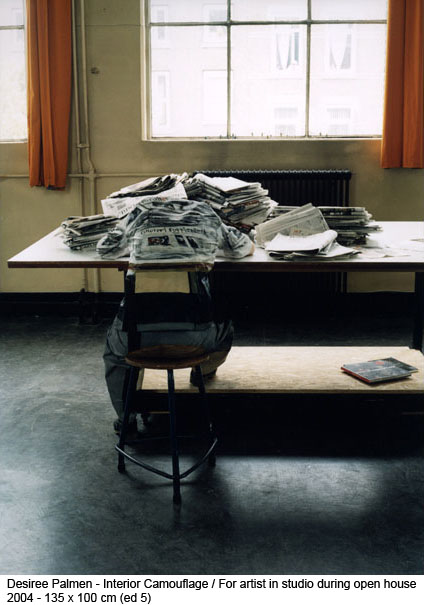
David Lyon sent me a reference to this wonderful Dutch artist, Desiree Palmen, who makes painstakingly painted or modelled invisibility disguises to comment on the ubiquity of video surveillance. They are somehow more beautiful for their hand-crafted (as opposed to high-tech) nature. For the picture below, her technique was to take a photograph of the interior and then paint it onto a canvass designed to be worn by the subject, who was then photographed again wearing the painted canvass in place.

Canadians should be concerned about camera surveillance

A new report by the Surveillance Camera Awareness Network (SCAN) at Queen’s University shows that Canadians believe surveillance cameras promote safety, but their perceptions don’t match the actual evidence. The first of its kind in Canada, A Report on Camera Surveillance in Canada will be used as background to help structure new federal surveillance legislation.

“There is little or no evidence that surveillance deters crime,” says David Lyon, coordinator of the report and director of the school’s new Surveillance Studies Centre. “Media such as TV police shows and crime stoppers promote the perception that cameras are more important than they really are.”

The report looks at the rapid growth of surveillance in Canadian society based on studies about:

  • The lack of Canadian legislation addressing public camera surveillance
  • Camera surveillance as big business
  • An exploration of camera operators
  • Research on public opinions about camera surveillance
  • Camera surveillance as one of the legacies of hosting the Olympic Games
  • Camera surveillance in Ottawa taxicabs
  • Camera surveillance in shopping malls

“The public should be concerned,” adds Professor Lyon. “Surveillance technology is constantly changing. Closed-circuit television does not accurately describe it anymore; now surveillance footage is increasingly digitized and free to flow online. What stops are in place to prevent it from falling into the wrong hands? We need to question the social ethics of surveillance footage as well as establish legal limits on how the footage can be used.”

(The Surveillance Camera Awareness Network at the Queen’s Surveillance Centre completed the report with funding from the Office of the Privacy Commissioner and the Social Sciences and Humanities Research Council of Canada. The report is the topic of a surveillance workshop on January 15 and 16, 2010 at Queen’s University).

Press Release from Queen’s University.

Contact: Jeff Drake
jeff.drake@queensu.ca
613-533-2877
Queen’s University

What now for the UK’s anti-terrorism laws?

On the 12th of January, the European Court of Human Rights (ECHR) ruled in the case of Gillan and Quinton v. the United Kingdom, that UK police powers to randomly stop and search people under Sections 44-47 of The Terrorism Act (2000) were unlawful. This is the third recent ruling by the ECHR against the current direction of the UK’s security policies (after the ruling in S. and Marper v. the UK, against the police retaining DNA profiles and fingerprints from people not convicted of any offence). It also follows the furore over the London Metropolitan Police’s interpretation of Sections 43, 44 and 58s of The Terrorism Act in relation to public photography.* The case was brought by two people, Pennie Quinton a journalist who was on her way to cover a demonstration against an arms fair in London in September 2003,, and Kevin Gillan, who was cycling past.

Section 44 allows the police to stop and search anyone on the basis of a ‘reasonable suspicion’ that they may be in posssession of information or items that may be useful in committing an act of terrorism. The case in the ECHR was on several principles, most of which were rejected, but most importantly the Court found that arbitrary stop and search dis violate Article 8 of the European Convention, on the right to privacy. This was because “the use of the coercive powers conferred by the legislation to require an individual to submit to a detailed search of his person, his clothing and his personal belongings amounts to a clear interference with the right to respect for private life”.

Furthermore the UK government once again argued, as it did equally unsuccessfully in the case of Peck v. UK back in 2003, that Article 8 did not apply as there was no right privacy in public places. This argument, the Court not only rejected but actually argued that the publicness of the stop and search made the violation of privacy worse:

“Although the search is undertaken in a public place, this does not mean that Article 8 is inapplicable. Indeed, in the Court’s view, the public nature of the search may, in certain cases, compound the seriousness of the interference because of an element of humiliation and embarrassment. Items such as bags, wallets, notebooks and diaries may, moreover, contain personal information which the owner may feel uncomfortable about having exposed to the view of his companions or the wider public.”

This was a well-thought out ruling which made the arguments pretty clear. However the response of the UK government, as in the DNA case, leaves a lot to be desired. In fact, it has basically said, “make me”! The government intends to ignore the ruling in everyday practice, as it did with Peck, and will continue to allow police to carry out such searches whilst it appeals the case. This also means that there will be no disciplinary action against any officer who follows this policy, despite its now being unlawful.

*This of course is by no means over either, and there will be a mass photography action, “I’m a Photographer Not a Terrorist!”, on January 23rd at 12 Noon, Trafalgar Square in London.

Moscow cops watch pre-recorded video footage

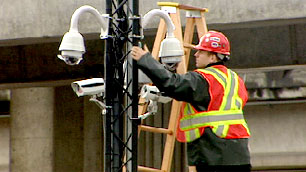
The police in the Russian capital have admitted that their police officers in several districts were watching pre-recorded video footage in place of live streaming surveillance pictures for an undetermined proportion of the five months from May to September last year, according to RT. It seems that the private company subcontracted to maintain the system, StroyMontageService, was defrauding the police of the equivalent of over a million dollars by recycling footage and not actually servicing the city’s video surveillance system.

Several questions are raised immediately here. Firstly, how closely were police actually watching if they didn’t even notice that they were watching recorded footage (surely the time-codes would have been wrong?); secondly, if the codes had been changed, how would there have been any way of them knowing, unless and until a major live situation was quite clearly not visible? Thirdly, how frequent is this kind of either deliberate fraud by subcontractor elsewhere, and indeed how common are simple errors that might lead to the same outcome? And finally, did this lack of live video feed make any difference to Moscow’s crime rate or clear-up rate. If they took five months to notice, it does rather suggest that video surveillance plays little role in either…

After the Thighbomber: Virtual Strip Searches at every airport?

The botched attempt to bomb a flight into the US by a the son of a wealthy Nigerian family, using explosive components strapped to his thigh, has led to an immediate techno-economic consequence, which is to speed up the process of installing terahertz wave or other body scanners in major airports, which if nothing else will provide a guaranteed income stream to Rapiscan and Qinetiq, who make these kinds of machines. Schipol in Amsterdam, where  announced they would be extending their body scanning operation and the British government almost immediately followed by saying that major British airports would be rolling out body scanning within weeks. Now, Canada is to do the same.

But, will this make a real difference or is it just more symbolic security? The scanners certainly ‘work’ in the sense that they do provide pretty good images of what is under the clothes of passengers (see below). However, interpreting what is seen is still no easy task and will the scanners will certainly not replace physical searches, but will add yet another extra layer of surveillant sorting and therefore delay. And there are questions over the effectiveness of the scanners in particular areas of the body. The Toronto Sun reports that trials at Kelowna Airport in British Columbia “left blind spots over the head and feet”, so these machines are certainly not the ‘silver bullet’.

Then of course, there are the privacy issues. I don’t have any particular problem with the technology, provided it is restricted to airports and doesn’t start to get used in other, more everyday, social settings (which given the rapid development of this technology is by no means certain). However, as I noted the last time I wrote about this, there will be many religious, gender-based and personal reasons for objecting to their use. The other question of course is whether, every time some lone lunatic tries something like this – that was, let us not forget, poorly planned and ineffective, and which should have been prevented by other conventional intelligence operations working properly – it makes sense to jump and harden security (or at least be seen to harden security) for everyone travelling internationally. Doing this just plays into the hands of terrorists as it disrupts the ordinary workings of an open society.

Body Scan Image (US TSA)

Iraqi resistance hacks US drones

According to the Wall Street Journal, US surveillance drones (you know, the future of military surveillance…) have allegedly been hacked by Iranian-backed Shi’ite forces in Iraq, using $26 off-the-shelf Russian software called Skygrabber – and they may have been compromised in Afghanistan too.

It is, as my informant, Aaron Martin, points out, amazing that the military surveillance systems of the world’s most resourced and technologically-developed military could be hacked so easily and for so long without notice. It also makes me wonder how many other networked surveillance systems would be vulnerable or are being hacked using the same or similar systems. If for example, organised criminal gangs could access the video surveillance systems of major cities, this would further call into question the effectiveness of these systems. Or alternatively, of course, it could point the way to a more accountable, open-access kind of surveillance – as Aaron and I are exploring in a paper we are currently writing.

British cops still haven’t got the message about photography

There is a disturbing film and story on The Guardian site which shows two London Police Community Support Officers (PCSOs) hassling an Italian art student, Simona Bonomo, largely, it seems to me, because she wasn’t submissive towards them and stood up for herself. This comes several months after the Home Office issued new guidelines, yet it looks like photography and filming is still being treated as if it is inherently suspicious – as Marc Vallée points out.

The additional issue is that PCSOs are not even proper trained police officers in the first place, yet they increasingly seem to be under the impression that they can make the kind of judgements that senior police officers should be making. There need to be some changes to UK law here (amongst many of course!) – one to replace Section 44 of the Terrorism Act, since it seems clear that it can’t be interpreted appropriately, and secondly, the powers of PCSOs need to more carefully delineated and restricted.

For those involved in photography, video or film-making, in the UK or nearby, there will be a mass photography action, “I’m a Photographer Not a Terrorist!”, on January 23rd at 12 Noon, Trafalgar Square in London.