UK ID Card Program scrapped after election (and more)

As both the Conservative Party and the Liberal Democrats in the UK had the scrapping of the National Identity Card card scheme as part of their manifesto, the unpopular program has been suspended immediately by the new coalition government, pending further announcements.

The full statement reads as follows:

“Both Parties that now form the new Government stated in their manifestos that they will cancel Identity Cards and the National Identity Register. We will announce in due course how this will be achieved. Applications can continue to be made for ID cards but we would advise anyone thinking of applying to wait for further announcements.

Until Parliament agrees otherwise, identity cards remain valid and as such can still be used as an identity document and for travel within Europe. We will update you with further information as soon as we have it.”

But although the cards will almost certainly go, despite the statement it is unclear yet what will be the fate of the National Identity Register (NIR), the new central database at the heart of the scheme. Neither party, and the Tories especially, said anything specific in their manifestos about scrapping the database, so we will see what happens here – although the statement issued seems categorical about this too. Although the end of the card scheme reduces opportunities for the ‘papers, please’ style abuse of minorities, it is the database that is of biggest concern to those interested in surveillance and social sorting. I have long favoured a secure central government Information Clearinghouse, which whilst transferring necessary information as needed and consented to between different parts of government, would not in itself hold any data. I suspect however, that some fudge will emerge!

In the meantime, the price of the coalition also was reported to include new legislation regulating video surveillance (CCTV) cameras (only about 20 years too late, but that’s the speed of British politics for you), and the review of many of the new powers in the (Anti-)Terrorism and Civil Contingencies Acts (and perhaps the Regulation of Investigatory Powers Act too – though it hasn’t yet been mentioned specifically). It is very rare that legislation is repealed or rolled back but we may yet see an increase in civil liberties under the new coalition. The one big worry in this are though is the Conservative opposition to the Human Rights Act – however with their Liberal Democrat partners being committed to the HRA, I can’t see any moves to repeal the act in this Parliament.

I am cautiously optimistic…
Chicago’s Cameras Continue to Increase

The Associated Press is reporting on Chicago’s ongoing efforts to integrate it’s public and private camera systems together into one seamless visual surveillance system of perhaps  10,000 networked cameras, including those in schools. This is a long way from the very limited ‘closed-circuit’ of the original video surveillance systems. There really isn’t another city that is doing anything close to this. London, for all it’s large numbers of cameras, is a patchwork of disconnected, often archaic, systems bound by multiple domains of regulation. Chicago’s network, in contrast, is being developed, through large Homeland Security and Federal stimulus grants, with connection in mind and regulation in the post-9/11 era is only to the benefit of the state’s efforts. The particularly interesting thing is the way the boundary of acceptability is continually pushed out by this process of connection and integration. For example, the AP story confirms that Chicago Police Superintendent, Jody Weis, has been quoted on several occasions he would like to add secret cameras “as small as matchboxes” to the network. And there are few critical voices.

UK’s secret national flying camera strategy

If there was any doubt left, it seems the British government has finally given up all pretense of trying to balance civil liberties and security. A plan has been revealed by The Guardian newspaper for a national strategy for surveillance by Unmanned Aerial Vehicles (UAVs). And we are not just talking the micro-helicopter UAVs used by many UK police forces already, but 22m-long airships, the G22, which can stay airborne for many hours. The military drones will require special certification for civilian use.

And of course, these devices are supposed to be in place for the 2012 Olympics, but even in the documentation secured under the Freedom of Information Act (FoIA), it is made very clear that the drones will be used for a multiplicity of ‘routine’ operations, including from orders and fisheries activity to conventional policing and even “[detecting] theft from cash machines, preventing theft of tractors and monitoring antisocial driving… event security and covert urban surveillance” as well as all the kinds of activities that the already controversial Regulation of Investigatory Powers Act (RIPA) covers, including “fly-posting, fly-tipping, abandoned vehicles, abnormal loads, waste management”.

If this wasn’t bad enough, the whole thing has been developed in secret with the British governments favourite arms manufacturer, BAe Sytems, is projected to run as a public-private partnership due to the massive expense, and it has even been suggested that the surveillance data could be sold to private companies, according to The Guardian.

And the ‘selling’ of this to the public has already begun. Some suggestions of the use of high-flying drones had been made by Kent police, who had claimed it would be to “monitor shipping and detect immigrants crossing from France”. However, as The Guardian goes on to show this was a ruse which was part of long-term PR strategy to divert attention away from civil liberties issues. One 2007 document apparently states, “There is potential for these [maritime] uses to be projected as a ‘good news’ story to the public rather than more ‘big brother’.”

It’s really hard to say anything polite about these plans, the way they have been developed, and the complete lack of interest in or concern for the British public’s very real and growing fear of a surveillance state in the UK.

A footnote: almost as soon as this news was revealed, the British government raised the terrorist threat level to ‘severe’, without providing any indication that was any specific threat. Now, this may be entirely coincidental (and there are a couple of high-level meetings on Yemen and Afghanistan strategy in London next week), but if the threat level was much higher, the British public might suddenly be more amenable to the introduction of something to protect them from this ‘severe’ threat, like, say, flying drone cameras, don’t you think?

Vancouver Olympic surveillance legacies

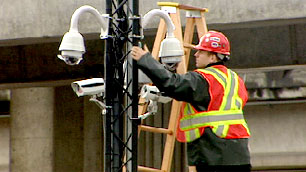
A city worker installs video surveillance cameras outside GM Place in downtown Vancouver. (CBC)

As the CCTV cameras are going up, Vancouverites are starting to become more concerned now about what the legacy of increased security and surveillance will be after the Olympics. Although the initial promises were that the cameras would be taken down afterwards, with the money that has been put into building a swish new control room, it seems unlikely that the authorities will want to ‘waste’ this investment. As we warned in our Vancouver Statement in November, it seems as if the Games have become a globe-trotting Trojan horse for the video surveillance industry.

Surveillance Image of the Week No.4: Being Invisible

David Lyon sent me a reference to this wonderful Dutch artist, Desiree Palmen, who makes painstakingly painted or modelled invisibility disguises to comment on the ubiquity of video surveillance. They are somehow more beautiful for their hand-crafted (as opposed to high-tech) nature. For the picture below, her technique was to take a photograph of the interior and then paint it onto a canvass designed to be worn by the subject, who was then photographed again wearing the painted canvass in place.

Canadians should be concerned about camera surveillance

A new report by the Surveillance Camera Awareness Network (SCAN) at Queen’s University shows that Canadians believe surveillance cameras promote safety, but their perceptions don’t match the actual evidence. The first of its kind in Canada, A Report on Camera Surveillance in Canada will be used as background to help structure new federal surveillance legislation.

“There is little or no evidence that surveillance deters crime,” says David Lyon, coordinator of the report and director of the school’s new Surveillance Studies Centre. “Media such as TV police shows and crime stoppers promote the perception that cameras are more important than they really are.”

The report looks at the rapid growth of surveillance in Canadian society based on studies about:

  • The lack of Canadian legislation addressing public camera surveillance
  • Camera surveillance as big business
  • An exploration of camera operators
  • Research on public opinions about camera surveillance
  • Camera surveillance as one of the legacies of hosting the Olympic Games
  • Camera surveillance in Ottawa taxicabs
  • Camera surveillance in shopping malls

“The public should be concerned,” adds Professor Lyon. “Surveillance technology is constantly changing. Closed-circuit television does not accurately describe it anymore; now surveillance footage is increasingly digitized and free to flow online. What stops are in place to prevent it from falling into the wrong hands? We need to question the social ethics of surveillance footage as well as establish legal limits on how the footage can be used.”

(The Surveillance Camera Awareness Network at the Queen’s Surveillance Centre completed the report with funding from the Office of the Privacy Commissioner and the Social Sciences and Humanities Research Council of Canada. The report is the topic of a surveillance workshop on January 15 and 16, 2010 at Queen’s University).

Press Release from Queen’s University.

Contact: Jeff Drake
jeff.drake@queensu.ca
613-533-2877
Queen’s University

Moscow cops watch pre-recorded video footage

The police in the Russian capital have admitted that their police officers in several districts were watching pre-recorded video footage in place of live streaming surveillance pictures for an undetermined proportion of the five months from May to September last year, according to RT. It seems that the private company subcontracted to maintain the system, StroyMontageService, was defrauding the police of the equivalent of over a million dollars by recycling footage and not actually servicing the city’s video surveillance system.

Several questions are raised immediately here. Firstly, how closely were police actually watching if they didn’t even notice that they were watching recorded footage (surely the time-codes would have been wrong?); secondly, if the codes had been changed, how would there have been any way of them knowing, unless and until a major live situation was quite clearly not visible? Thirdly, how frequent is this kind of either deliberate fraud by subcontractor elsewhere, and indeed how common are simple errors that might lead to the same outcome? And finally, did this lack of live video feed make any difference to Moscow’s crime rate or clear-up rate. If they took five months to notice, it does rather suggest that video surveillance plays little role in either…

UK government to make CCTV useful?

That’s the way The Register puts it anyway… and there is more than a grain of truth in this. After 20 years of open-street video surveillance in Britain, it is not a safer place and the cameras are not event helping to solve that many crimes, let alone preventing them (which, let us not forget) was what was promised back at the beginning. The government in the UK is now (finally) becoming concerned about this and is apparently going to appoint a CCTV Commissioner or something similar and try to rationalise the crazy landscape of video surveillance in Britain.

However, the key lesson from the fact that video surveillance doesn’t really work should surely be that they might want to start reducing the numbers of cameras and putting the investment into something else. This isn’t going to happen. Instead, the UK government is still promoting video surveillance around the world and more and more places in every country seem to think that they should install CCTV because it ‘works in Britain.’ I even saw one story the other day saying that there had been no formal studies of the effectiveness of CCTV, which of course is simply not true – there have and they generally show little effect on crime, but the conclusion of this article was that in the absence of evidence, cameras were a sensible precaution.

How does that logic work? Since when did effective public policy on crime consist of throwing money at shiny toys? I think it was Harold Macmillan who said that when we need to be seen to be doing something, form a committee. In a high-tech age, people aren’t bought off by committees any more, but shiny gadgets will do it. And if the shine wears off, if the ordinary dull old cameras now don’t work, then there will be even shinier and newer mobile cameras, flying cameras, and probably cameras with frickin’ laser beams… Public policy on crime seems to be stuck on a technological treadmill. It’s time to step off.

Watching Them Watching You

The city government of Rio de Janeiro has voted 46 to 3 in favour of installing video surveillance cameras inside all new police vehicles, and overridden the veto of the Governor, Sergio Cabral.

Cabral, who is otherwise all in favour of video surveillance, did everything he could to stop this law, but in vain. The reason that the pro-police governor is so against this particular law and order measure is that the cameras are supposed to be installed not simply to ‘protect’ police officers but also to prevent abuse of power, corrupt practice and police violence against suspects. This is a huge issue in Rio (and Brazil more generally), and we saw a good example of this recently with the inhumane actions by officers after the fatal assault on Evandro, the founder of Afro-Reggae.

However, I do wonder how officers will take this development, how the cameras will be used in practice, and how many of them will conveniently experience technical failures at important moments…

(Thanks to Paola Barreto Leblanc for the heads up)

Manu Luksch

I am hosting the London-based Austrian new media artist and film director, Manu Luksch, here at Queen’s for a couple of days. On Tuesday 1st December, she is giving a presentation on her work on censorship in Iran and then in the evening, she is introducing and discussing her film, Faceless, a movie composed entirely of ‘found’ video surveillance footage (see the poster, below). You can find out more about her work on her website. She’ll be going on from here to Montreal…