The mundane costs of independent drones

It’s been an aim of developers for quite a while to develop more independently functioning surveillance drones that can fly around and recharge themselves in some way – whether it’s solar gliders in the stratosphere or, at street level, biomimetic bird-like micro-UAVs that can ‘perch’ and draw power from electricity cables. This was one of the original aims of the DARPA call that led to the creation of that beautiful marvel of engineering / dystopian nightmare surveillance tool, the Nano Hummingbird. If you are an engineer, this is certainly convenient and probably looks a lot like a ‘free lunch’ – there is certainly no mention of any possible costs or downsides in this piece on engineering.com. But as we all should know, there is no such thing as free lunch.

Firstly and most importantly, there’s the question of whether societies want either identifiable or camouflaged surveillance devices flying around us at all times. A mobile surveillance device essentially becomes even more independent and less limited by its construction if it can ‘feed’ itself. And while the US Federal Aviation Authority in particular has just recently put a bar on commercial drone delivery services (PDF), it certainly hasn’t prohibited other kinds of drone use, and many other national regulatory bodies are yet to decide on what to do, while drone manufacturers are pushing hard for less ‘bureaucratic’ licensing and fewer controls.

The second objection is less fundamental but perhaps more effective at igniting opposition to such devices. It might be that any single device would draw minute amounts of power from cables, but what happens if (or when) there are thousands, even millions, of these devices – flying, crawling, creeping, rolling, slithering – and all hungry for electricity? I would suggest that, just like the cumulative effect of millions of computers and mobile phones, this would be substantial and unlike the claims made for smartphones, this would be additional rather than replacing less efficient devices. And this is not including the energy use of the huge server farms that provide the big data infrastructure for all of these things. So, who pays for this? Essentially we do: increased energy demand means higher bills and especially when the power is being drawn in an unaccountable way as with a biomimetic bird on a wire. And unlike the more voluntary decision to use a phone because of its benefits to us, paying for our own surveillance in this way would seem to be less obviously ‘for our own good’ and certainly has the potential to incite the ire of ‘ordinary middle-class homeowners’ (that holy grail of political marketing) and not just the usual small-government libertarian right or pro-privacy and anti-surveillance left.
 

On rejecting drones

There’s an all-too infrequently unquestioned assumption in a lot of popular and academic writing about surveillance, that surveillance just spreads and intensifies and that new surveillance technologies proceed in a teleological manner to fulfill their designed purpose. Sure, we have all read the science and technology studies literature and pay lip service to ideas of technological failure and we all keep searching for ‘resistance’ or even just ‘politics’, but even if, like me, we talk deliberately talk about ‘sociotechnical trajectories’ without trying to assign one possible direction to these trajectories, we very rarely make the retreat, diminution and easing off of surveillance the central focus of our work or our writing.

Drones have been the latest demonstration of this. Practically all my blog entries on the subject over the last few years have been telling a story of the seemingly unstoppable spread of drones from particular military applications to widespread military use, to civilian policing and thence to other government and private uses. So it is really instructive to see the introduction of drone surveillance stopped in its apparent tracks twice in one week. This is exactly what has happened in Seattle, Washington, and Charlottesville, Virginia this week. The Seattle Police Department had intended to implement a strategy of drone surveillance and had purchased two Micro-UAVs (MAVs). But rather than these following the CCTV route of government promotion and general public apathy or support bolstered the usual police surveys showing how ‘effective’ the new technology has been, instead, following massive public concern over privacy,  Mayor Mike McGinn this week returned the two drones to the manufacturer and put a stop to any further development. He stopped short of introducing any ordinance banning drones, as Charlottesville did in the same week with a resolution pledging that the city would not purchase any such technology and calling on the state legislature to introduce an outright ban.

However in many ways the Seattle decision might be more influential as it is a far larger metropolis and this could resonate in major cities across North America – and beyond, given that Seattle is an aspiring global city too. But how influential? We will have to see. Certainly the UAV manufacturers and police associations will try to fight back with renewed PR and sales pitches – I am fully expecting lots of ‘drone success stories’ in the media in the next few weeks and months as a result. But what these two decisions should do is remind us all that the domestic politics of drones is still open, the future is unwritten and there are many possible trajectories – which we should emphasize more than we do.

US drone based in Saudia Arabia revealed?

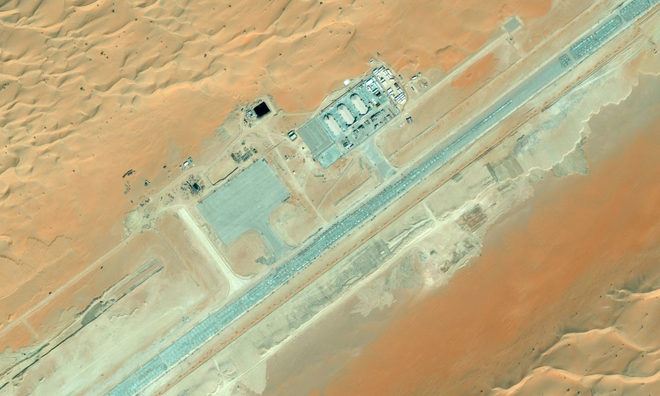
003Wired’s Danger Room blog has published pictures of what may be the hitherto secret CIA drone base in Saudi Arabia, revealed as part the confirmation hearings for John Brenner as proposed Director of the CIA…

Drone Britain

Despite the supposed anti-surveillance tendencies of the new coalition government in Britain, one kind of surveillance would seem to be expanding, as it is almost everywhere in the world: that of surveillance Unmanned Aerial Vehicles (UAVs), Micro-unmanned Aerial Vehicles (MAVs) or flying drone cameras. There are so many previous stories on this blog about drones you’d be better off searching than me providing links here!

The Guardian reported on Friday that a growing number of different agencies are either ordering drones or have plans to do so, including he Serious Organised Crime Agency (SOCA), four police forces (Merseyside, Essex, Staffordshire and the British Transport Police), the Environment Agency, and even some Fire Services (West Midlands and South Wales). This follows the story in January that there was what seemed to be an evolving secret national strategy for drones.

So far, their use has been limited not by ethical concerns but by the requirements of the Civil Aviation Authority (CAA) which insists that they must be “licensed when flown within 50 metres of a person, property or structure.” This remains its position, but it will be interesting to see how stringent are the licensing requirements as drones increase in number and whether the expansion in UAV use is in any way affected by the government’s stated policy aim to bring CCTV under stricter regulation.

(thanks to Charles Raab for this)

Mapping drone strikes

Via Boingboing, an analysis and map of US UAV drone strikes on the tribal regions of Pakistan from 2004. Some good stuff from NewAmerica. What is particularly interested, if not unpredictable, is the way that weaponized UAVs have in the course of just a few years become a ‘normal’ part of the US war machine, with deaths from drone strikes possibly doubling from 2008-9. We can’t be sure of the exact numbers.

Does the expansion of surveillance make assassination harder? Not in a world of UAVs…

Following the killing of Mahmood Al-Mabhouh is Dubai, allegedly by Israeli Mossad agents, some people are starting to ask whether political assassination is being made more difficult by the proliferation of everyday surveillance. The Washington Post argues that it is, and they give three other cases, including that of Alexandr Litvinenko in London in 2006. But there’s a number of reasons to think that this is a superficial argument.

However the obvious thing about all of these is that they were successful assassinations. They were not prevented by any surveillance technologies. In the Dubai case, the much-trumpeted new international passport regime did not uncover a relatively simple set  of photo-swaps – and anyone who has talked to airport security will know how slapdash most ID checks really are. Litvinenko is as dead as Georgi Markov, famously killed by the Bulgarian secret service with a poisoned-tipped umbrella in London in 1978, and we still don’t really have a clear idea of what was actually going on in the Markov case despite some high-profile charges being laid.

Another thing is that there are several kinds of assassination: the first are those that are meant to be clearly noticed, so as to send a message to the followers or group associated with the deceased. Surveillance technologies, and particularly CCTV,  help such causes by providing readily viewable pictures that contribute to a media PR-campaign that is as important as the killing itself. Mossad in this case, if it was Mossad, were hiding in plain sight – they weren’t really trying to do this in total secrecy. And, let’s not forget many of the operatives who carry out these kinds of actions are considered disposable and replaceable.

The second kind are those where the killers simply don’t care one way or the other what anyone else knows or thinks (as in most of the missile attacks by Israel on the compounds of Hamas leaders within Gaza or the 2002 killing of Qaed Senyan al-Harthi by a remote-controlled USAF drone in the Yemen). The third kind are those that are not meant to be seen as a killing, but are disguised as accidents – in most of those cases, we will never know: conspiracy theories swirl around many such suspicious events, and this fog of unknowing only helps further disguise those probably quite small number of truly fake accidents and discredits their investigation. One could argue that such secret killings may be affected by widespread surveillance, but those involved in such cases are far more careful and more likely to use methods to leverage or get around conventional surveillance techniques.

Then of course, there is the fact that the techniques of assassination are becoming more high-tech and powerful too. The use of remote-control drones as in the al-Harthi case is now commonplace for the US military in Afghanistan and Pakistan, indeed the CIA chief, Leon Panetta, last year described UAVs as “the only game in town for stopping Al-Qaeda.” And now there are many more nations equipping themselves with UAVs – which, of course, can be both surveillance devices and weapons platforms. Just the other day, Israel announced the world’s largest drone – the Eltan from Heron Industries, which can apparently fly for 20 hours non-stop. India has already agreed to buy drones from the same company. And, even local police forces in many cities are now investing in micro-UAVs (MAVs): there’s plenty of potential for such devices to be weaponized – and modelled after (or disguised as) birds or animals too.

Finally, assassinations were not that common anyway, so it’s hard to see any statistically significant downward trends. If anything, if one considers many of the uses of drones and precision-targeted missile strikes on the leaders of terrorist and rebel groups as ‘assassinations’, then they may be increasing in number rather than declining, albeit more confined to those with wealth and resources…

(Thanks to Aaron Martin for pointing me to The Washington Post article)

New UAVs in Afghanistan

The USAF continues to use the Afghanistan / Pakistan conflict as a test bed for new military surveillance technologies and robotic weapons. The latest thing is apparently the RQ-170, codenamed Sentinel, which is a radar-evading UAV or drone aircraft.

This picture of the aircraft was apparently shot near Kandahar…

The Sentinel (source unknown)

It seems that as this conflict drags on, more and more of these things will get wheeled out. Its only purpose seems to have become to field test all these black-project developed technologies that the US security-industrial complex has been churning out. It wasn’t that long after the Predator drone emerged that we saw a weaponized version. It is unclear whether there is any such version of the Sentinel yet, but no doubt there will be soon enough. The increasing reliance on remote-controlled and robotic weapons seems to be a new article of faith amongst the world’s wealthier militaries.

US plans surveillance drone airship

I am sure there will be arguments about the violation of airspace, which will not be trivial as the ongoing diplomatic and increasingly military row over US surveillance vessels off China is showing…

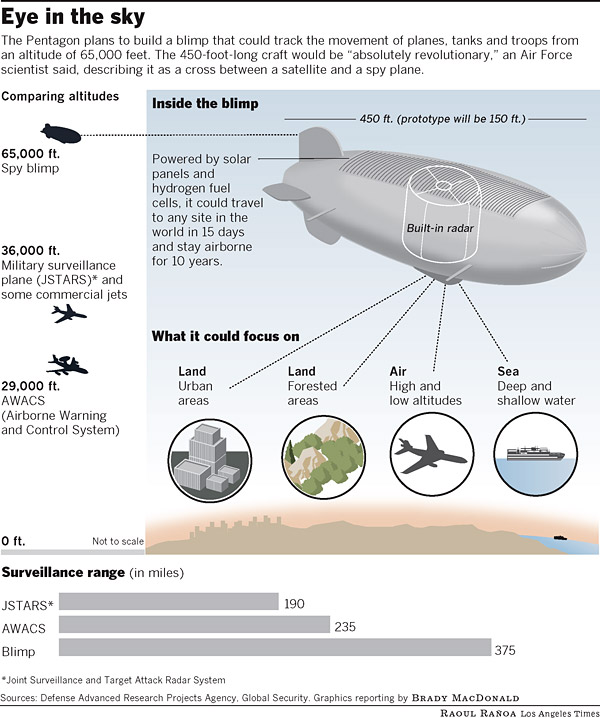
Unmanned aerial vehicles (UAVs) are one of the fastest-developing areas of surveillance technology. A new plan revealed by the US Department of Defense combines old and new tech with a plan, first revealed by the Los Angeles Times, for an pilotless surveillance airship called ISIS (Integrated Sensor Is the Structure) that will fly right at 65,000 feet (about 20km) high, right at the edge of ‘airspace’. The point of the airship is to provide the kind of constant watch that a geostationary satellite provides, but at a much lower level so that for more detailed pictures of the precise movements of vehicles, objects and people could be observed.

airship

Well, as usual, the reports only seem to to be concerned about how great this would be for US military tactics, and are not interested in the law, politics and ethics of such devices. For example, I am sure there will be arguments about the violation of airspace, which will not be trivial as the ongoing diplomatic and increasingly military row over US surveillance vessels off China is showing. And of course there are issues around the violation of human rights by such intrusive technology: international violations are very hard to deal with, however. And this will only be the beginning. The new Obama administration has promised more investment in intelligence and surveillance and less in warfighting. That sounds good in some ways, but of course just poses new problems and new issues for those of us concerned with ongoing US attempts to cover the whole world with surveillance for the benefit of its strategic aims.