North American military drone policy update

The USA has established organized Pacific and Atlantic surveillance UAV squadrons (of 12-24 aircraft each) for the first time, for border and sea lane monitoring. These are a variant of the Northrop-Grumman MQ-4 drones I mentioned the other day, which Japan are also buying. The order establishing the program can be found via Cryptome here. Cryptome has also published the locations of the bases from which they will fly, Ventura Country naval base in California and and Mayport naval base near Jacksonville in Florida.

It is increasingly seeming like UAVs will continue to form the core of Obama’s military strategy, and it seems no coincidence that he has nominated John Brennan, described as the ‘architect’ of his drone policy, to be the new head of the Central Intelligence Agency.

Meanwhile, Canada is more likely to have widespread use of drones by police and the private sector before it gets any military models. It was reported just at the end of last year that the Canadian military drone program is now not likely to be in operation until 2017 and the cost has gone up to over $1Bn (Can). This doesn’t seem to have attracted anything like the attention that has been given to the ingoing farago surrounding the Canadian government’s attempt to purchase US Lockheed F-35 fighter jets, although admittedly that is no estimated as being something in the region of 50 times as expensive…

(Thanks to Chris Prince for keeping me updated on this!)


East Asia Drone Wars

Northrop-Grumman Global Hawk (USAF)

In one of my only posts last year, around this time, I argued that 2012 would be in the ‘year of the drone’ – and it certainly lived up to that. But we’re still only just beginning. This is already the decade of the drone. Unmanned Aerial Vehicles (UAVs) are going to be everywhere in the coming few years (and of course not just in international disputes – I am writing about the spread of domestic surveillance drones for a major report on Surveillance in Canada that we’re producing right now).

Media outlets are reporting that the dispute over maritime territory between China and Japan is ramping up through the use of UAVs.  At the moment both countries rely heavily on conventional naval or fisheries surveillance vessels, which are limited in terms of speed of deployment and numbers. However, surveillance drones could enable a more consistent presence over the disputed islands (and more importantly the sea around them, whose fisheries and below seabed mineral resources are the real underlying issue here).

However, there are big differences in the politics and the political economy of each state’s strategic trajectory here. Japan is relying on its longstanding ‘alliance’ with the USA, and is likely to purchase US-made Northrop-Grumman Global Hawks, further emphasizing the military dependency Japan still has on the USA. China, on the other hand, is speeding up development of its own UAVs, in multiple different models. US industry sources seem more worried by alleged breaches of intellectual property rights in the drones’ design than by strategic issues – but of course, China has almost certainly had access to both hardware and software from downed US drones, which is all part of what some analysts are terming a ‘drone race’ with the USA.

and the Chinese version (Chengdu Aircraft Co.)

But this isn’t just about surveillance. Like the USA’s models, many of China’s UAVs are armed or can be weaponized very easily, and again like the USA, China has also been looking to export markets – most recently, Pakistan has been discussing the purchase of several armed drones from China, following the distinct lack of success in its own UAV development program.

The Global Hawks that Japan is buying are not armed, but this doesn’t mean that Japan is acting less aggressively here or will not in future used armed drones. Despite the post-WW2 US-imposed but popular ‘pacifist’ constitution of the country, the recent return to power of rightist PM Shinzo Abe might will mean both more heated rhetoric over territorial claims and attempts to increase the of the country’s self-defence forces: a review of Japanese military spending – with a view to increasing it – was announced just yesterday.

Drones would seem to be a politically popular choice in this regard as they do not involve putting Japanese lives at risk, or at least not directly; however the longer term outcomes any drone war in East Asia would not likely favour a Japan whose regional economic and political power is influence declining relative to China’s.

Will 2012 be the year of the drone?

My first post of 2012 – and, yes, my New’s Year’s Resolution is to blog regularly again – is not about a new subject. Unmanned Aerial Vehicles (UAVs) or drones, are already on their way to being a standard tool of national security and increasingly of policing too. However, given decreasing price of small Micro-Unmanned Aerial Vehicles (MAVs), it was also inevitable that NGOs, activist and citizen groups and even individuals, would soon start to operate them as a form of sousveillance or counter-surveillance, or simply as surveillance.

Some Occupy protestors in Europe and the USA had already made use of commercially available MAVs to broadcast footage of protest. And, the BBC reports today that the Sea Shepherd Conservation Society, the radical direct action anti-whaling group, will this year use an Osprey drone aircraft to monitor Japanese whaling fleets operating in the southern oceans. Sea Shepherd has always been technically adventurous (and PR savvy), operating radar-invisible speedboats and even a submarine in the past.

But it all suggests that drones have made the leap from military to policing to civil use with remarkable speed, and I suggest that in 2012 we will see the proliferation of MAVs operated by non-government users. Let’s just see how fast governments now try to outlaw drones in response…

Sea Shepherd activists test their drone


Increasing ‘popularity’ of drones

National Public Radio (NPR)  in the US broadcast an interesting short piece on the spread of drones or Unmanned Aerial Vehicles (UAVs). Drones of all sizes are now increasingly used by national and local states – I think ‘popular’ is the wrong word as most people have no idea that they are so widespread or even that they are likely to be operating at all. There’s also a longer piece by Barbara Ehrenreich on the more general issue of robotic warfare on the Guardian’s Comment is Free site today.

According to my sources in the UK, they have just started flying Reaper drones out of RAF Northolt over London, in preparation for the 2012 London Olympics.

Robot Warfare

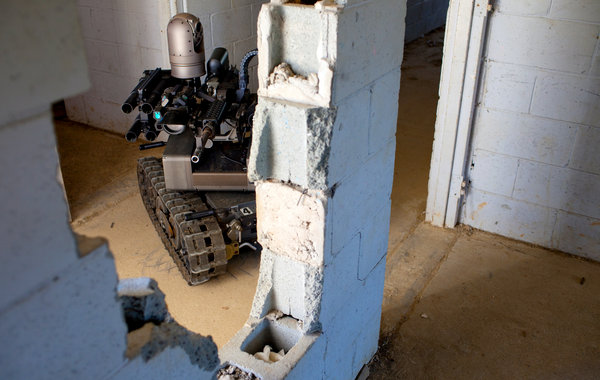
MAARS ground robot (NYT)

The New York Times recently had a good article on the development of robot warfare, covering surveillance drones, and actual warfighting machines, inspired, it seems, by a visit to the annual ‘Robotics Rodeo‘ held by the US military at Fort Benning in Georgia every October. These things are only going to get more common and more sophisticated… never mind that they kill plenty of civilians, they keep ‘our boys’ out of harm’s way, eh?

Manchester Surveillance Blimp Axed

The axed Manchester Police drone (Guardian)

Police in Manchester, UK, have axed a tethered surveillance balloon that cost them 80,000 GBP (around $130,000 US). The supposedly covert balloon – if a large white blimp with ‘POLICE’ written on the side in big blue letters can be called ‘covert’ – had been intended to be used for monitoring of public order at large-scale events. However it was a victim of a more conventional Manchester problem – bad weather. Apparently it did not function very well in wet and windy weather. One would have thought that this might have occurred to the police of a notoriously wet and windy town…

This might seem like a victory for anti-surveillance forces, but of course, this will only increase the pressure for more versatile and weather-proof aerial surveillance, i.e. the micro-UAVs (or camera drones) that several other forces have already purchased, not to mention the more expensive powered high-level surveillance airships of the kind specified in the secret South-Coast Partnership report on drone surveillance.

Pentagon seeks bids for 3D-surveillance system

DARPA are seeking bids for a high resolution three-dimensional battlefield surveillance system. The so-called Fine Detail Optical Surveillance (FDOS) program is looking to develop “a fundamentally new optical ISR capability that can provide ultra high-resolution 3D images for rapid, in-field identification of a diverse set of targets… for use in an active battlefield or hostile environments with designs tailored to allow for soldier portable applications as well as UAV integration.”

As Wired maagazine points out, the Pentagon are already deep into a virtual 3D surveillance scheme, the evily-named Gorgon Stare, that involves 12 cameras attached to Reaper drones, and DARPA already have another development programme called Autonomous Real-time Ground Ubiquitous Surveillance – Imaging System (ARGUS-IS), which involves “a 1.8 Gigapixels video sensor”. There’s more details here.

Artist's Impression of the ARGUS system (Wired)

There’s no getting away from it: semi-autonomous robots and unmanned aerial vehicles are the new silver bullet for both military and civil uses, both in surveillance and warfighting itself. It’s about time more researchers and activitists paid this some greater attention…

The drone surge

The Huffington Post has a really interesting article on the current and future use of drones (whether they be UAVs, MAVs or other things) by the US military. Judging from the early comments, it seems there are some people also think these things are great because ‘they keep US soldiers safe’ – unfortunately they don’t seem to do the same for the villagers of the impoverished countries where they are deployed. As the International Campiagn for Robotic Arms Control (ICRAC) is arguing, there needs to be an international treaty or convention to regulate the use of such machines when they are used as or part of weapons systems, but beyond that, these systems, out of theline of vision of the general public, in terms of their policy development and often their physical deployment, are seen as ‘the future of surveillance’ within many nations too – as was revealed in Britain just the other day. The military-industrial complex is now the security-industrial complex and there is a decreasing gap between military tech and its civilian counterparts…

UK’s secret national flying camera strategy

If there was any doubt left, it seems the British government has finally given up all pretense of trying to balance civil liberties and security. A plan has been revealed by The Guardian newspaper for a national strategy for surveillance by Unmanned Aerial Vehicles (UAVs). And we are not just talking the micro-helicopter UAVs used by many UK police forces already, but 22m-long airships, the G22, which can stay airborne for many hours. The military drones will require special certification for civilian use.

And of course, these devices are supposed to be in place for the 2012 Olympics, but even in the documentation secured under the Freedom of Information Act (FoIA), it is made very clear that the drones will be used for a multiplicity of ‘routine’ operations, including from orders and fisheries activity to conventional policing and even “[detecting] theft from cash machines, preventing theft of tractors and monitoring antisocial driving… event security and covert urban surveillance” as well as all the kinds of activities that the already controversial Regulation of Investigatory Powers Act (RIPA) covers, including “fly-posting, fly-tipping, abandoned vehicles, abnormal loads, waste management”.

If this wasn’t bad enough, the whole thing has been developed in secret with the British governments favourite arms manufacturer, BAe Sytems, is projected to run as a public-private partnership due to the massive expense, and it has even been suggested that the surveillance data could be sold to private companies, according to The Guardian.

And the ‘selling’ of this to the public has already begun. Some suggestions of the use of high-flying drones had been made by Kent police, who had claimed it would be to “monitor shipping and detect immigrants crossing from France”. However, as The Guardian goes on to show this was a ruse which was part of long-term PR strategy to divert attention away from civil liberties issues. One 2007 document apparently states, “There is potential for these [maritime] uses to be projected as a ‘good news’ story to the public rather than more ‘big brother’.”

It’s really hard to say anything polite about these plans, the way they have been developed, and the complete lack of interest in or concern for the British public’s very real and growing fear of a surveillance state in the UK.

A footnote: almost as soon as this news was revealed, the British government raised the terrorist threat level to ‘severe’, without providing any indication that was any specific threat. Now, this may be entirely coincidental (and there are a couple of high-level meetings on Yemen and Afghanistan strategy in London next week), but if the threat level was much higher, the British public might suddenly be more amenable to the introduction of something to protect them from this ‘severe’ threat, like, say, flying drone cameras, don’t you think?

Iraqi resistance hacks US drones

According to the Wall Street Journal, US surveillance drones (you know, the future of military surveillance…) have allegedly been hacked by Iranian-backed Shi’ite forces in Iraq, using $26 off-the-shelf Russian software called Skygrabber – and they may have been compromised in Afghanistan too.

It is, as my informant, Aaron Martin, points out, amazing that the military surveillance systems of the world’s most resourced and technologically-developed military could be hacked so easily and for so long without notice. It also makes me wonder how many other networked surveillance systems would be vulnerable or are being hacked using the same or similar systems. If for example, organised criminal gangs could access the video surveillance systems of major cities, this would further call into question the effectiveness of these systems. Or alternatively, of course, it could point the way to a more accountable, open-access kind of surveillance – as Aaron and I are exploring in a paper we are currently writing.