Guess who likes the UK’s proposals to control the Internet?

In the wake of the riots, several British Conservative MPs, and indeed PM David Cameron himself, have suggested a harsher regime of state control of both messenger services and social networks. Their suggestions have attracted widespread derision from almost everybody who either knows something about the Internet and communications more broadly, or who places any value on freedom of speech, assembly and communication and regards these things as foundational to any democratic society.

However, the a yet vague proposals have gained support from one quarter: China. The Chinese state-controlled media have suggested that the Conservative Party’s undemocratic suggestions prove that the Chinese state was right all along about controlling the Internet and that now these events are causing liberal democracies to support the Chinese model of highly regulated provision (via Boing Boing).

This is pretty much what I have been suggesting is happening for the last 2 or 3 years – see here, here, here and here. It is just that now, the pretense of democratic communication is being dropped by western governments. And just in case David Cameron doesn’t get it – and he really does not appear to right now, no, it is not a good thing that the Chinese government likes your ideas: it makes you look undemocratic and authoritarian.

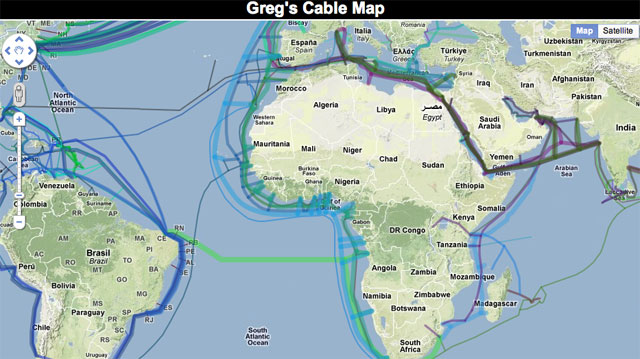
Greg’s Cable Map

Greg's Cable Map

There’s a fascinating interactive map of the world’s undersea communications cables here. It’s also a pretty good guesstimation guide as to where there are, or are likely to be, NSA or subordinate agencies’ (and other non-affiliated intelligence services’) field stations that funnel the data flowing through such cables through computer systems that analyse traffic and content data.

(via Gizmondo)

‘Turning Off’ the Internet

Boing Boing contributors have been doing a fascinating job of documenting the place of the Internet and social media in the ongoing turmoil spreading across Arabic countries. Until recently the focus had been on the use of social media tools by activists, but in the last few days, the empire has struck back. In particular the Egyptian state has effectively ‘turned off’ the Internet, cutting Net access and communications between Egypt and the rest of the world.

What’s particularly interesting is that the rulers of western ‘democracies’ seem to want similar powers. I’ve been writing about the growing movement amongst states to develop powers to split or close the Internet entirely for some time (see here, here and here, for example). Most recently, I reported on French efforts to develop Internet censorship power in wide-ranging circumstances, and as Sean Bonner on BB points out, a bill was introduced into Congress last year by, it’s that man again, Joe Liebermann, to give the USA government even greater powers to cut off civilian access to the Net entirely in the event of a ‘cyber-emergency’.

This is not a drill, people, this is happening…

The Internet Must Be Defended!

As I am just putting the finishing touches on a new issue of Surveillance & Society, on surveillance and empowerment, the furore over the Wikileaks website and it’s publication of secret cables from US diplomatic sources has been growing. Over the last few days, Julian Assange, the public face of the website and one of its founders has been arrested in London on supposedly unrelated charges as US right-wing critics call for his head, the site’s domain name has been withdrawn, Amazon has kicked the organization off its US cloud computing service, one of Assange’s bank accounts has been seized, and major companies involved in money transfer, Paypal, Visa and Mastercard, have all stopped serving Wikileaks claiming that Wikileaks had breached their terms of service.

At the same time, hundreds of mirror sites for Wikileaks have been set up around the world, and the leaks show no sign of slowing down. The revelations themselves are frequently mundane or confirm what informed analysts knew already, but it is not the content of these particular leaks that is important, it is the point at which they come in the struggle over information rights and the long-term future of the Internet.

The journal which I manage is presaged on open-access to knowledge. I support institutional transparency and accountability at the same time as I defend personal privacy. It is vital not to get the two mixed up. In the case of Wikileaks, the revelation of secret information is not a breach of anyone’s personal privacy, rather it is a massively important development in our ability to hold states to account in the information age. It is about equalization, democratization and the potential creation of a global polity to hold the already globalized economy and political elites accountable.

John Naughton, writing on The Guardian website, argues that western states who claim openness is part of freedom and democracy cannot have it both ways. We should, he says, ‘live with the Wikileakable world’. It is this view we accept, not the ambivalence of people like digital critic, Clay Shirky, who, despite being a long-term advocate of openness seemingly so long as the openness of the Internet remained safely confined to areas like economic innovation, cannot bring himself to defend this openness when its genuinely political potential is beginning to be realised.

The alternative to openness is closure, as Naughton argues. The Internet, created by the US military but long freed from their control, is now under thread of being recaptured, renationalized, sterilized and controlled. With multiple attacks on the net from everything from capitalist states’ redefinition of intellectual property and copyrights, through increasingly comprehensive surveillance of Internet traffic by almost all states, to totalitarian states’ censorship of sites, and now the two becoming increasingly indistinguishable over the case of Wikileaks, now is the time for all who support an open and liberatory Internet to stand up.

Over 30 years ago, between 1975 and 1976 at the Collège de France, Michel Foucault gave a powerful series of lectures entitled Society Must Be Defended. With so much that is social vested in these electronic chains of connection and communication, we must now argue clearly and forcefully that, nation-states and what they want be damned, “The Internet Must Be Defended!”

Closing the Internet

A lot of my current thinking is based around the dynamic of opening / closing. I’ve been considering the way in which elements of state power, and in particular the military and intelligence agencies, regard openness per se as a threat. Now, Wired’s Threat Level blog (just about my favourite reading right now), has an excellent take on the response to what has been termed (in a deliberately mixed-up phrase) the ‘open-source insurgency’. This  is the way in which the ex-head of US intelligence, now working for ‘contractor’*, Booz Allen Hamilton, Michael McConnell. is promoting the re-engineering of the Internet. This is necessary, it is argued, because the current openness of the Net means that terrorists and criminals can flourish. This re-engineering would make attribution, geo-location, intelligence analysis and impact assessment — who did it, from where, why and what was the result — more manageable”. In other words to close the Internet. remove everything that is innovative and democratic about it, and make it easier for agencies like the NSA to monitor it.

Along with a whole raft of measures like extending ‘lawful access’ regimes, introducing corporate-biased copyright and anti-peer-2-peer legislation, censorship and Net filtering, this is an attack on what the Internet has become and to turn it into something simply for consumption – something, in other words, more like television. But there is another layer here too – the US military, I suspect, still has a nostalgic longing for when the Internet was its private domain. It’s a long way from its origins, and now perhaps the military want it back. But it isn’t theirs anymore, it’s ours and we need to fight for it.

* or, more accurately, arm’s length consulting agency of the US state.

Facebook forced to grow up by Canadians

Wel, Facebook has finally been forced to grow up  and develop a sensible approach to personal data. Previously, as I have documented elsewhere, the US-based social networking site had pretty much assumed ownership of all personal data in perpetuity. However it has now promised to develop new privacy and consent rules and ways of allowing site users to chose which data they will allow to be shared with third parties.

So why the sudden change of heart? Well, it’s all down to those pesky Canucks. Yes, where the USA couldn’t bothered and where the EU didn’t even try, the Canadian Privacy Commissioner, Jennifer Stoddart, had declared Facebook to be in violation of Canada’s privacy laws. And it turns out that in complying it was just easier for Facebook to make wholesale changes for all customers rather than trying to apply different rules to different jurisdictions.

This suggests an interesting new phenomenon. Instead of transnational corporations being able to always seek out a country with the lowest standards as a basis for compliance on issues like privacy and data protection, a nation with higher standards and an activist regulator has shown itself able to force such a company to adjust its global operations to its much higher standard. This is good news for net users worldwide.

However, we shouldn’t rejoice too much: as Google and Yahoo have shown in the case of China, in the absense of any meaningful internal ethical standards, a big enough market can still impose distinct and separate policies that are far more harmful to the interests of individual users in those nations.

Australia gives up net censorship plan

Some good news for once. The Sydney Morning Herald reports that the heinous plans that the Australian government had for surveilling and censoring the Internet have been iced. The plans would have introduced mandatory filtering of the Internet in Australia despite the technical impossibility and political and ethical objections. The fight over these proposals had been vicious with opponents even receiving death threats, but the side of both sense and liberty appears to have won an important victory.

Now, let’s see if similar good sense will prevail in other countries which are advocating similar, if not quite as extreme, China-style net-disabling proposals like the UK and Brazil

(Thanks to bOINGbOING who’ve been keeping us up to date on this one)

The loneliness of personal data

Surveillance like this harms us all: it makes our lives banal and reveals only the sadness and the pain.

Still from I Love Alaska

There is something at once banal and heartbreaking about what is revealed through the examination of personal data. The episodic film, I Love Alaska, captures this beautifully. The film by Lernert Engelberts and Sander Plug is based on AOL’s accidental exposure of the search data of hundreds of thousands of its users, and focuses on just one, 711391. The film consists of an actress reading out the (unusually discursive and plain language) search terms of User 711391 like an incantation, with background sound from Alaskan locations and static camera shots that serve to emphasize her boredom, isolation and loneliness.

I was watching episode 5 of the film when two stories popped into my inbox that just happened to be related. The first was from the New York Times business section and dealt with the other side of the recent US sporting scandal over revelations that baseball player Alex Rodriguez has taken steroids. Like User 711391, Rodriguez had given up his data (in this case, a sample) in the belief that the data would be anonymous and aggregated. But it wasn’t.

So, then we come to how the state deals with this. The Toronto Globe and Mail comments on the way the Canadian federal government is, like so many others, proposing to introduce new legislation to monitor and control Internet use. The comment argues that there is no general need to store personal Internet use data (or Canada will end up like the UK…), and that Internet surveillance should be governed by judicial oversight. Quite so. But, as the NYT article points out, it isn’t just the expanding appetite of the state for data (frequently coupled in the UK with incompetence in data handling) that we should fear but the growth in numbers of, and lack of any oversight or control over, private-sector dataveillance operations.

Some people will argue that any talk of privacy here is irrelevant: User 711391 was cheating on her husband; Rodrguez was taking steroids; there are paedophiles and terrorists conspiring on the Internet. With surveillance the guilty are revealed. Surely, as Damon Knight’s classic short story, ‘I See You’, claimed, with everything exposed we are truly free from ‘sin’? But no. In its revelations, surveillance like this harms us all: it makes our lives banal and reveals only the sadness and the pain. For User 711391, her access to the Internet served at different times as her main source of entertainment, desire, friendship, and even conscience. The AOL debacle revealed all of this and demeaned her and many others in the process. Most of us deserve the comfort of our very ordinary secrets and the ability for things to be forgotten. This is the true value of privacy.

(Thanks to Chiara Fonio for letting me know about I Love Alaska)

Quiet in the Library! Controlling the Internet

For many supposedly liberal politicians and bureaucrats the Internet is just a library of information, and we all know that libraries must be quiet and orderly, used responsibly and under the supervision of trained librarians…

Just a quick one: Boing Boing covered the story of an Australian EFF information rights campaigner, Geordie Guy, who has received a death threat from supporters of the government´s plan to control the Internet – just like so many other states around the world.

Surveillance cameras in Dajuyuan, Shenzhen (Rolling Stone)

It is no accident that the EFF campaign in Australia makes reference to their government´s plan as a ‘great wall’.  The first government to do this was, of course, China with its jīndùn gōngchéng (‘Golden Shield’) system which was exposed by Greg Walton.

As Naomi Klein´s more recent investigations have shown, it seems that western governments and companies are not only deeply involved with supplying equipment and expertise to China´s new surveillance state, but also see the development of the combined physical and virtual surveillance infrastructure being built by the authoritarian Chinese government as some kind of model for their own supposedly more liberal nations.

The Internet seems to worry all sorts of otherwise level-headed and well-meaning people. I was invited to speak at a recent conference in Finland on security in the Baltic states, and I got into a small argument with the rapporteur of one of the working groups, who said that one of their conclusions was that ‘we’ must stamp out hate-speech on the Internet. I asked the rapporteur how they would intend to do this without destroying the structures which enabled the creativity and freedom of the Net, and the response was that stamping out hate-speech was too important and just must be done. I suspect this is how a lot of supposedly liberal politicians and bureaucrats are thinking. For them the Internet is just a library of information, and we all know that libraries must be quiet and orderly, used responsibly and under the supervision of trained librarians. If enforcing order destroys everything that makes the Internet so revolutionary and so important, so what? Order must be maintained. There must be quiet in the library!

Digital Britain to be just like Digital Brazil?

There has been a serious global push for several years now by corporate content creators to hobble the Internet, and turn it into something more like television.

Time to catch up on a story that I missed this week. Boingboing reported the release of the UK government’s consultation document on Digital Britain. I had a eerie feeling of deja vu because the proposals are just like parts of Senator Azeredo’s bill that is halfway through the legislative process here in Brazil. Effectively it regards the Internet as some kind of untamed zone which must be brought under state control through a Rights Agency and ISPs acting increasingly as surveillance agents over the activities of their users, in this case particularly with regard to file-sharing.

The similarity is not surprising. There has been a serious global push for several years now by corporate content creators to hobble the Internet, and turn it into something more like television. The fact that the Digital Britain plan is filed under ‘broadcasting’ on the government’s website says quite a lot about the lack of tech savvy of state regulators in this area. What governments, in listening only to the corporate argument, don’t appear to realise is that we are actually collectively and autonomously coming up with better ways of ‘regulation’ of content through initiatives like Creative Commons and so on.

As in Brazil, where a serious netizen counter-plan is now emerging, with parliamentary support, there needs to be some serious organisation in Britain to present the alternatives to destroying the Internet and all is messy, unruly creativity. The Open Rights Group are trying to do this – let’s get behind them and make this more than just a few tech-savvy usual suspects.