It is, as my informant, Aaron Martin, points out, amazing that the military surveillance systems of the world’s most resourced and technologically-developed military could be hacked so easily and for so long without notice. It also makes me wonder how many other networked surveillance systems would be vulnerable or are being hacked using the same or similar systems. If for example, organised criminal gangs could access the video surveillance systems of major cities, this would further call into question the effectiveness of these systems. Or alternatively, of course, it could point the way to a more accountable, open-access kind of surveillance – as Aaron and I are exploring in a paper we are currently writing.
The USAF continues to use the Afghanistan / Pakistan conflict as a test bed for new military surveillance technologies and robotic weapons. The latest thing is apparently the RQ-170, codenamed Sentinel, which is a radar-evading UAV or drone aircraft.
This picture of the aircraft was apparently shot near Kandahar…
The Sentinel (source unknown)
It seems that as this conflict drags on, more and more of these things will get wheeled out. Its only purpose seems to have become to field test all these black-project developed technologies that the US security-industrial complex has been churning out. It wasn’t that long after the Predator drone emerged that we saw a weaponized version. It is unclear whether there is any such version of the Sentinel yet, but no doubt there will be soon enough. The increasing reliance on remote-controlled and robotic weapons seems to be a new article of faith amongst the world’s wealthier militaries.
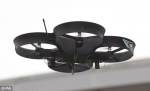
A story in the Daily Mail shows two new military robot surveillance devices developed for the UK Ministry of Defence’s Defence and Equipment Support (DES) group. The first is a throwable rolling robot equipped with multiple sensors, which can be chucked like a hand-grenade and then operated by remote-control. The second is another Micro-(Unmanned) Aerial Vehicle (Micro-UAV or MAV), a tiny helicopter which carries a surveillance camera. There have been rolling surveillance robots around for a while now (like the Rotundus GroundBot from Sweden), but this toughened version seems to be unique. The helicopter MAV doesn’t seem to be particularly new, indeed it looks at least from the pictures, pretty similar to the one controversially bought by Staffordshire police in Britain – which is made by MicroDrones of Germany.
The proliferation of such devices in both military and civil use is pretty much unchecked and unnoticed by legislators at present. Media coverage seems to be limited to ‘hey, cool!’ and yes, they are pretty cool as pieces of technology, but being used in useful humanitarian contexts (for example, rolling robots getting pictures of a partially-collapsed building or MAVs flying over a disaster zone) is a whole lot different from warfare, which is a whole lot different again from civilian law enforcement, commercial espionage or simple voyeuristic purposes. As surveillance gets increasingly small, mobile and independent, we have a whole new set of problems for privacy, and despite the fact that we warned regulators about these problems back in 2006 in our Report on the Surveillance Society, little government thought seems to have been devoted to these and other new technologies of surveillance.
The use of robots in war is of course something else I have become very interested in, especially as these flying and rolling sensor-platforms are increasingly independent in their operation and, like the US Predator drones employed in Afghanistan and Pakistan or the MAARS battlefield robot made by Qinetiq / Foster-Miller, become weapons platforms too. This is an urgent but still largely unnoticed international human rights and arms control issue, and one which the new International Committee for Robotic Arms Control (in which I am now getting involved), will hopefully play a leading role in addressing.
Torin Monahan sent me this interesting video from the US Air Force showing ideas on Micro-Aerial Vehicles (MAVs) – nature-mimicking drones or independent robots that are intended to ‘enhance the capability of the future war-fighter’…
The mass mooning of the US balloon camera owned by Sierra Nevada Corporation went ahead, but the irony was that the system had already been disabled by the weather. Apparently a large thunderstorm cause a gash in the fabric of the balloon last week which, if nothing else, should prove rather more effective than the protest in making sure that the US government does not invest in it.
However the wider issue of the US surveillance of the border with Canada remains (not mention that of the Mexican border, already a major concern) and whilst this particular technology and the appropriately ridiculous protest, has attracted most attention in the media, let’s not forget that camera towers have been erected and the USA is flying UAVs along the border. Surely President Obama should realise that the paranoid policies of his predecessor do nothing apart from damage relationships (and trade) with a close neighbour?
According to The Times of India, the Indian military is investing massively in boom military industry of the moment – Unmanned Aerial Vehicles (UAVs or drones).
An IAL Heron TP UAV in flight
The initial order is apparently for coastal protection and involves the purchase of Heron UAVs from Israel Aerospace Industries, a specialist in such technologies which produces everything from large payload drones to tiny micro-UAVs like the Mosquito, which can be launched by hand and is designed for “providing real-time imagery data in restricted urban areas.” The Indian Defence Research and Development Organisation (DRDO) and Aeronautical Development Establishment (ADE) have also been developing their own drones in conjunction with IAI, the latest being the Rustom MALE.
A Predator UAV equiped with Hellfire missile (USAF)
Herons are supposedly unarmed but armed versions were used in the 2006 invasion of Lebanon by Israeli armed forces. The ToI article also makes it clear that Indian forces will be buying more overtly aggressive drones such as the US Predator systems that have been used to such devastating effect against Al-Qaeda and the Taliban in the Pakistan-Afghanistan frontier regions. Far from easing up on the use of these remote-control killing machines, Obama’s administration has accelerated their use. They put fewer US troops in the firing line, and can attack remote areas, from where it is also very difficult to get an accurate independent view on their activities. However they are alleged to have been massively inaccurate, with the Pakistan government claiming that only 10 out of 60 missions between January 2006 and April 2009 had hit their targets, killing 14 Al-Qaeda leaders and 687 civilians, an appalling ratio.
With the advent of strategic bombing and then the ICBM, the Twentieth Century saw a massive increase of the role of remote surveillance in warfare, which was intimately linked to the growth in destructive power and the ability to not to understand the consequences in any direct or emotional way. Even with the tank and artillery ground warfare was not so remote, but now in the Twenty-first Century we are seeing surveillance-based, remote-control warfare becoming increasingly normalised. It is not surprising to see both hypocritical states like the USA and Israel intimately involved in the promotion of this form of conflict which looks cleaner and more ‘moral’ from the point of view of the user, but which in fact simply further isolates them from the consequences of their action. Real time surveillance turns everyday life in to a simulation, and drone-based warfare makes war into something like a game. And it’s a deadly and amoral game that increasing numbers of states, like India, are now playing.
There has been a lot of interest in the US border with Mexico in recent years, and rightly so. However, what not so many people have noticed is that the closing of the closing of the USA is taking place along the world’s largest land border between two countries, the border between the USA and Canada.
Unmanned Aerial Vehicles (UAVs) already patrol the airspace (and at a low enough level that private flights have had to be restricted, thereby doing two security jobs with one technology). However, the most recent announcement concerned the installation of video surveillance towers to monitor waterways. This is all on the basis of very little information about whether this is either cost-effective or necessary; according to the AP article, the Border Patrol themselves admit this: “What we don’t know is how often that vulnerability is exploited […] if, in fact, there’s a lot more going on than we thought, then this technology will help us identify it and it will help us respond and apprehend those people in ways that we haven’t before.” So essentially, this is surveillance to see whether surveillance is necessary – it seems we are now in a surveillance double-bind, so you no longer need a strong reason to install cameras; they are their own justification and may be justified in retrospect whatever does or does not happen. If nothing is seen, they will be said to be a deterrent, if something is detected then they will be proclaimed as showing the need for surveillance!
The technology employed against those tricky Canucks will be provided by the same supplier, Boeing, that has been so criticised for its failures on the Mexican border (and there have been plenty of failures down there). It seems that even when it comes to the trump card of security, which normally wins hands-down, the congressional pork-barrel remains the joker in the pack. Now, the Canadians and local firms along the US border have already been complaining about the post-9/11 restrictions that have begun to stifle cross-border trade on which many of those communities depend. In a recession, such considerations might be thought to count for something, but it seems that the mighty Boeing’s profits matter more…
I am sure there will be arguments about the violation of airspace, which will not be trivial as the ongoing diplomatic and increasingly military row over US surveillance vessels off China is showing…
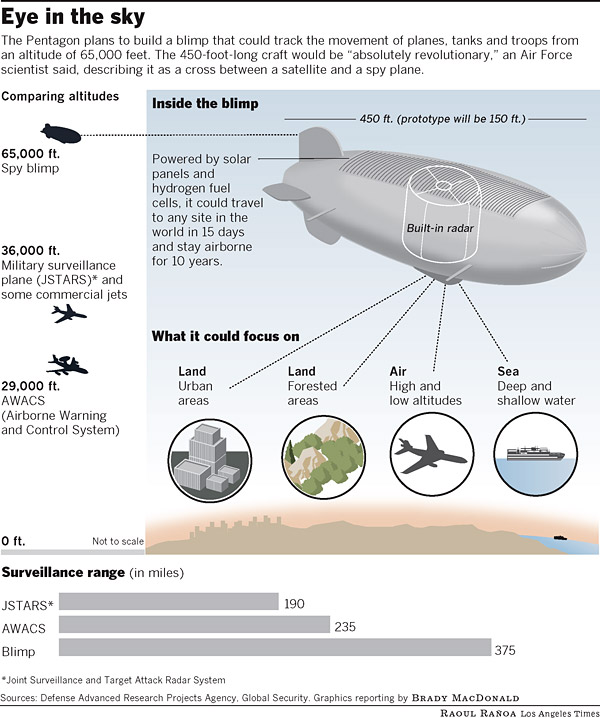
Unmanned aerial vehicles (UAVs) are one of the fastest-developing areas of surveillance technology. A new plan revealed by the US Department of Defense combines old and new tech with a plan, first revealed by the Los Angeles Times, for an pilotless surveillance airship called ISIS (Integrated Sensor Is the Structure) that will fly right at 65,000 feet (about 20km) high, right at the edge of ‘airspace’. The point of the airship is to provide the kind of constant watch that a geostationary satellite provides, but at a much lower level so that for more detailed pictures of the precise movements of vehicles, objects and people could be observed.
Well, as usual, the reports only seem to to be concerned about how great this would be for US military tactics, and are not interested in the law, politics and ethics of such devices. For example, I am sure there will be arguments about the violation of airspace, which will not be trivial as the ongoing diplomatic and increasingly military row over US surveillance vessels off China is showing. And of course there are issues around the violation of human rights by such intrusive technology: international violations are very hard to deal with, however. And this will only be the beginning. The new Obama administration has promised more investment in intelligence and surveillance and less in warfighting. That sounds good in some ways, but of course just poses new problems and new issues for those of us concerned with ongoing US attempts to cover the whole world with surveillance for the benefit of its strategic aims.






 ubisurv