FAA includes privacy requirements for drones, but no enforcement

The US Federal Aviation Authority released a roadmap for the introduction of drones (UAVs) into US airspace (PDF) last week. Whether it happens this way or not is a moot point as previous deadlines have been consistently missed. However, they also released a list of requirements for meeting privacy standards (PDF).

Mark Calo in Forbes says that the FAA’s plan for privacy from drone surveillance is ‘pretty sensible’, which it is if you consider that the FAA’s primary job is, as it repeats in response to comments demanding great privacy protections throughout the document, “to provide the safest, most efficient aerospace system in the world.” Marc Rotenberg has pointed out, the problem is that it wasn’t their plan but the result of external pressure from EPIC and ACLU and others.

However, the broader question is whether the FAA is the correct institution to be overseeing this process of the introduction of a technology whose main purpose is surveillance. The overall context for this is the enthusiastic support for the rollout of drones offered by the roadmap. As the FAA keeps saying, it is not a privacy regulator. Not surprisingly, this is not an organisation that has any real overall scepticism, let alone any critical attitude to what it sees primarily as aviation technologies. But of course the US doesn’t have a single independent privacy regulator as such. Even so, the FAA has conceded at least that it has some responsibility here and is insisting that operators have a publicly-accessible privacy policy, that they report annually on compliance, and that they observe relevent laws (without specifying in much detail what those are). However, the FAA won’t be actively monitoring this, let alone enforcing it or sanctioning misconduct. For example, it won’t be suspending or removing operator’s licenses if they don’t comply with their requirements, unless the Department of Justice or another law enforcement agency actually files charges against the operator. So the requirements are weak and lack teeth.

The right time to intervene to strengthen human rights in relation to threats to those rights posed by new technologies is always before they are introduced. If this is not done then the widespread use of those technologies can shift what people understand as ‘normal’ and reduce expectations of privacy (and other rights). And it is much more difficult to legislate in retrospect. We’ve seen this with public space CCTV. In other words, while technologies do not determine social relations, they will interact with people, individually and in groups, in both positive and negative ways, and the job of politics and of policy is to ensure that the positive effects are maximized and the negative ones, minimized*. This means federal regulation. However, given the way in which the US  favours private over state intervention, it’s not surprising that this is not a popular way of dealing with things there.

What will result from the FAA’s weak set of privacy requirements in drone operations without real oversight is privacy protection as a bureaucratic box-ticking exercise.

*It should also be noted that this includes the possibility of not allowing any particular technology to be used in public space if the latter cannot be minimized to a level that not be harmful to socially desirable goals. Not enough attention is paid to the possibility of just saying ‘no’ to the public use of any particular technology.
On rejecting drones

There’s an all-too infrequently unquestioned assumption in a lot of popular and academic writing about surveillance, that surveillance just spreads and intensifies and that new surveillance technologies proceed in a teleological manner to fulfill their designed purpose. Sure, we have all read the science and technology studies literature and pay lip service to ideas of technological failure and we all keep searching for ‘resistance’ or even just ‘politics’, but even if, like me, we talk deliberately talk about ‘sociotechnical trajectories’ without trying to assign one possible direction to these trajectories, we very rarely make the retreat, diminution and easing off of surveillance the central focus of our work or our writing.

Drones have been the latest demonstration of this. Practically all my blog entries on the subject over the last few years have been telling a story of the seemingly unstoppable spread of drones from particular military applications to widespread military use, to civilian policing and thence to other government and private uses. So it is really instructive to see the introduction of drone surveillance stopped in its apparent tracks twice in one week. This is exactly what has happened in Seattle, Washington, and Charlottesville, Virginia this week. The Seattle Police Department had intended to implement a strategy of drone surveillance and had purchased two Micro-UAVs (MAVs). But rather than these following the CCTV route of government promotion and general public apathy or support bolstered the usual police surveys showing how ‘effective’ the new technology has been, instead, following massive public concern over privacy,  Mayor Mike McGinn this week returned the two drones to the manufacturer and put a stop to any further development. He stopped short of introducing any ordinance banning drones, as Charlottesville did in the same week with a resolution pledging that the city would not purchase any such technology and calling on the state legislature to introduce an outright ban.

However in many ways the Seattle decision might be more influential as it is a far larger metropolis and this could resonate in major cities across North America – and beyond, given that Seattle is an aspiring global city too. But how influential? We will have to see. Certainly the UAV manufacturers and police associations will try to fight back with renewed PR and sales pitches – I am fully expecting lots of ‘drone success stories’ in the media in the next few weeks and months as a result. But what these two decisions should do is remind us all that the domestic politics of drones is still open, the future is unwritten and there are many possible trajectories – which we should emphasize more than we do.

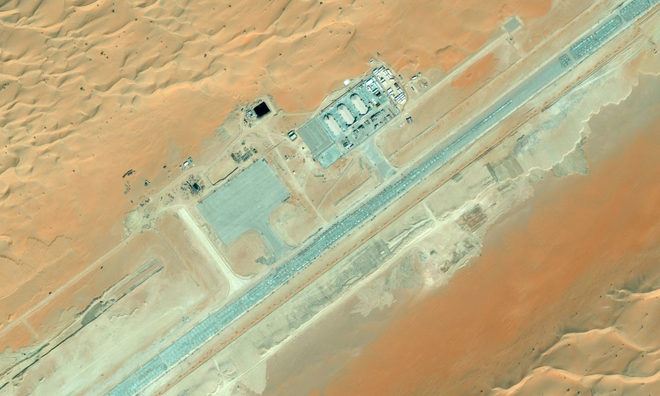
US drone based in Saudia Arabia revealed?

003Wired’s Danger Room blog has published pictures of what may be the hitherto secret CIA drone base in Saudi Arabia, revealed as part the confirmation hearings for John Brenner as proposed Director of the CIA…

Obama’s drone wars in question

So much has been happening over the US drone warfare program over the last few weeks that it’s hard to keep up.

First, the United Nations Special Rapporteur for Human Rights and Counter-Terrorism, instigated an inquiry into the targeted killing programs operated by the USA, largely using drones, and focusing on the issue of civilian casualties. The rapporteur, Ben Emmerson, made it clear that the inquiry would pull no punches and might result in war crimes charges against the US, should evidence be discovered of such crimes.

Second, NBC television in the USA revealed a leaked Justice Department document laying out the legal justification for the targeted assassination of US citizens using drones. The full memo is also available from this link and assembles a tortuous argument about how US citizens can be killed by their own government from above if there an “informed, high-level” official decides that the person has “recently” been involved in undefined “activities” threatening a violent attack against the US and “there is  no evidence suggesting that he has renounced or abandoned such activities.”

And now, the Washington Post is reporting that the nomination of President Obama’s counter-terrorism guru, John Brennan, to head the CIA, has led to all sorts of revelations and difficult questions for Brennan to answer about the CIA’s targeted assassination program, including the acknowledgement of a secret drone base, at a still undisclosed location, in Saudi Arabia.

A while ago it looked like Obama’s drone strategy was unassailable despite increasing public knowledge via the Bureau of Investigative Journalism and criticisms from groups like the International Committee for Robot Arms Control. Now, this is going mainstream and it’s not looking so good for what former CIA Director, Leon Panetta, called the ‘only game in town’.


Will 2012 be the year of the drone?

My first post of 2012 – and, yes, my New’s Year’s Resolution is to blog regularly again – is not about a new subject. Unmanned Aerial Vehicles (UAVs) or drones, are already on their way to being a standard tool of national security and increasingly of policing too. However, given decreasing price of small Micro-Unmanned Aerial Vehicles (MAVs), it was also inevitable that NGOs, activist and citizen groups and even individuals, would soon start to operate them as a form of sousveillance or counter-surveillance, or simply as surveillance.

Some Occupy protestors in Europe and the USA had already made use of commercially available MAVs to broadcast footage of protest. And, the BBC reports today that the Sea Shepherd Conservation Society, the radical direct action anti-whaling group, will this year use an Osprey drone aircraft to monitor Japanese whaling fleets operating in the southern oceans. Sea Shepherd has always been technically adventurous (and PR savvy), operating radar-invisible speedboats and even a submarine in the past.

But it all suggests that drones have made the leap from military to policing to civil use with remarkable speed, and I suggest that in 2012 we will see the proliferation of MAVs operated by non-government users. Let’s just see how fast governments now try to outlaw drones in response…

Sea Shepherd activists test their drone


Manchester Surveillance Blimp Axed

The axed Manchester Police drone (Guardian)

Police in Manchester, UK, have axed a tethered surveillance balloon that cost them 80,000 GBP (around $130,000 US). The supposedly covert balloon – if a large white blimp with ‘POLICE’ written on the side in big blue letters can be called ‘covert’ – had been intended to be used for monitoring of public order at large-scale events. However it was a victim of a more conventional Manchester problem – bad weather. Apparently it did not function very well in wet and windy weather. One would have thought that this might have occurred to the police of a notoriously wet and windy town…

This might seem like a victory for anti-surveillance forces, but of course, this will only increase the pressure for more versatile and weather-proof aerial surveillance, i.e. the micro-UAVs (or camera drones) that several other forces have already purchased, not to mention the more expensive powered high-level surveillance airships of the kind specified in the secret South-Coast Partnership report on drone surveillance.

Time for an international convention on robotic weapons

The estimable Professor Noel Sharkey is calling today for a debate on the use of robotic weapon systems, like the UAVs that I have been covering sporadically. He’s right of course, but we need to go much further and much faster. With increasing numbers of counties turning to remote-controlled weapon systems, and the potential deployment of more independent or even ‘intelligent’ robots in war, hat we need is an international convention which will limit the development and use of automated weapon systems, with clear guidelines on what lines are not to be crossed. In the case of atomic, biological and chemical weapons these kinds of conventions have had mixed success, but we have had very few clear examples of the use of such weapons in international conflicts.

Flying into trouble?

Governments will find it harder and harder to stand up to this kind of pressure from the growing security economy – all the companies grown fat on the War on Terror

Two recent stories of the cancellation of airborne surveillance programs should remind us that the route to a surveillance society is not an inevitable technological trajectory.

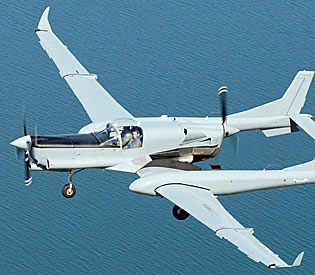
You don't see that very often! An airborne DEA surveillance plane (Photo by Schweizer Aircraft/MCT).

One is a classic tale of secret budgets disguising incompetence and disorganisation rather than efficient espionage. The US Drugs Enforcement Agency (DEA) has ended an experimental air surveillance program, following almost total equipment failure. The planes, in short, didn’t fly, or didn’t fly much. Almost $15 million US down the drain, and no accountability because this was an ultra-secret, need-to-know, maximum deniability, ‘black earmark’ project…

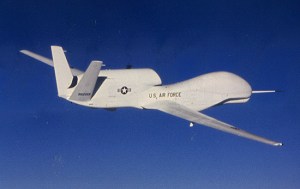
The other is a more courageous story of a government finally standing up to the pressure or its larger ‘allies’, and the fear-mongering PR of arms companies. In this case, the Australian government has withdrawn from the BAMS Global Hawk Unmanned Aerial Vehicle (UAV) program. It has cost the country $15 Million AUS, but this will save almost $1 Billion AUS. It also puts a small dent in the massive expansion of UAVs, now being used everywhere from the skies of Afghanistan to the streets of Liverpool. This decision did not make the military-industrial complex very happy and the story in The Australian shows clear evidence of corporate PR spin at work – the emotional blackmail of claiming that this decision could cost Australian lives in the event of more bushfires (or in other stories, it would leave Australia open to terrorism).

Global Hawk (USAF)
Global Hawk (USAF)

Even in a recession, governments will find it harder and harder to stand up to this kind of public pressure from the growing security economy – all the companies grown fat on the War on Terror that have the ear of the military and are backed by US-led consortia. It is to their credit that the Australian government has not given in – as for the US DEA, well, that is the opposite lesson – secrecy and the assumption of necessity can lead to massively wasteful state procurement and an absence of real security. The question is whether either lesson will prompt wider leaning…