Hille Koskela’s new book

pelkoTop Finnish surveillance studies academic, Hille Koskela, has a new book out, Pelkokierre – pelon politiikka, turvamarkkinat ja kamppailu kaupunkitilasta (‘The Spiral of Fear. Politics of Fear, Security Business, and the Struggle over Urban Space’). It looks like a fine addition to the literature on fear, security and surveillance, but unfortunately I can’t read it – as it’s in Suomi. Great cover though!

It should of course be translated into English and made available by an English-language publisher, but I doubt this will happen. Publishers don’t like to take what they consider to be a risk by publishing academic work from foreign countries, so unless the author is very famous or dead (or preferably both) it doesn’t happen. We tried very hard to get Michalis Lianos’s very important French book on control society published by an English-language publisher, with many supporting letters and so on, but there was no real interest.

Anyway, Hille has sent me a translation of the table of contents, which are:

1. The paradoxes of security

2. Birth of the security society
Relevant theories in sociology, social policy, geography, architecture, media studies, law and IR

3. The ontology of fear
The social production of fear, the spatial and temporal patterns, fear  as a commodity, streetwise semiotics

4. Fear in everyday life
Housing, workplaces, SUVs, public transport, tourism, child rearing,  ‘threatening’ teenagers, high school massacres

5. The architecture of fear
The classic ideas of Jacobs and Newman, contemporary architecture in public and private spaces, gating, surveillance

6. The politics of fear
Legislation (the public order act etc.), national and local security strategies, urban security politics, ‘the war’ on graffiti

7. The economy of fear
Security services, technology and other security products, images of place, crime and fear in the media

8. Towards a culture of tolerance

More border madness

I could probably blog all the time just about border surveillance and security issues… Aaron Martin has pointed out the reported latest new development on the Israel-Palestine border, which is an apparently arbitrarily used stamp which allows visitors to visit only the Palestinian territories in the West Bank and not Israel itself. Gaza remain closed to foreign visitors, and effectively an open-air prison camp.

It seems hard to define this as a ‘policy’ since the Israeli government officially deny that any order was given for the new stamp, despite the fact there is witness and photographic evidence of its use. Its purpose seems to be clearly to define for future reference, ‘enemies of Israel’ and to make it as hard as possible for those interested in the welfare of Palestinians to enter Israel.

Fingerprint

41F2aVrLpyL._SS500_I haven’t looked at BoingBoing in a while, but it so happened that the first post today when I finally did check in was about something wonderful and surveillance-related… this is Andrea Anastasio’s new multilayered artwork / book, Fingerprint, an exploration and extrapolation that resulted from the experience of being fingerprinted on entering the USA a few years ago.
Moon protest highlights wider border surveillance issues

The mass mooning of the US balloon camera owned by Sierra Nevada Corporation went ahead, but the irony was that the system had already been disabled by the weather. Apparently a large thunderstorm cause a gash in the fabric of the balloon last week which, if nothing else, should prove rather more effective than the protest in making sure that the US government does not invest in it.

However the wider issue of the US surveillance of the border with Canada remains (not mention that of the Mexican border, already a major concern) and whilst this particular technology and the appropriately ridiculous protest, has attracted most attention in the media, let’s not forget that camera towers have been erected and the USA is flying UAVs along the border. Surely President Obama should realise that the paranoid policies of his predecessor do nothing apart from damage relationships (and trade) with a close neighbour?

Meanwhile, back in the USA…

Just when you though the USA might not be going down the same kind of vehicle tracking route that the UK, Japan and Brazil are following, former Congressman, longtime privacy advocate and erstwhile scourge of ECHELON, Bob Barr, reports in his Atlanta Journal and Constitution blog, that increasing numbers of jurisdications in the States are indeed investing in license plate reading systems. California seems to be leading the way, but there’s plenty of others states following, and no doubt this will be another way of wasting (sorry, investing) Obama’s massive recession-busting boost for security…

Vehicle tracking in Japan: N-system

Back in February, I reported from Brazil about the progress of a proposed RFID-based vehicle tracking system, SINIAV. Of course RFID is not at all necessary for tracking. In the UK, the police have used Automatic Numberplate Recognition (ANPR) systems based on roadside cameras since 1993 in London – following the Provisional IRA bombings of the City and Docklands (see the account in my erstwhile collaborator, Jon Coaffee‘s book, Terrorism, Risk and the City – and since 2005, this has been in the process of being expanded into a nationwide network (see also the official Press Release from the Association of Chief Police Officers concerning the launch here).

What is rather less well-known to the outside world is that Japan developed such an automated camera system far earlier, from the early 1980s. The so-called N-system thereafter was gradually expanded to cover almost all major expressways and strategic urban locations in Tokyo and Osaka. Kabukicho, the entertainment district in Shinjuku, which I have spent some time studying over the last few years and will write about more tomorrow, is surrounded by N-system cameras and it is, I estimate, impossible to drive into this area without your license plate being recorded. These cameras are in addition to the 50 CCTV cameras that cover just about every street within the district. N-system is supposed to have played a major role on snaring suspects from the apocaylptic cult, Aum Shinrikyo, which carried out the Sarin gas attacks on the Tokyo underground in 1995, and who also assassinated top policemen and judges. Aum, now renamed ‘Aleph’, has been under official state surveillance ever since.

The Japanese police are not very forthcoming about N-system, let alone the details of how long data is kept and what it is used for. However one particular lawyer’s office in Tokyo did a very good investigation of the constitutional, legal and practical aspects of N-system back in the late 90s, and the updated pages are available here, including a nice little animation explaining how the system works.

We will hopefully be talking to them before we leave Tokyo. We still have time for a few more interviews here including the East Japan Railways security research lab, the Japanese consumers’ association, the organisation for the welfare of foreign workers, and the Suginami ward community safety people. And I will also just about have time to shoot down to Kobe to talk to Professor Kiyoshi Abe, a friend and collaborator, who is also one of the leading surveillance researchers here.

Japanese surveillance studies researchers

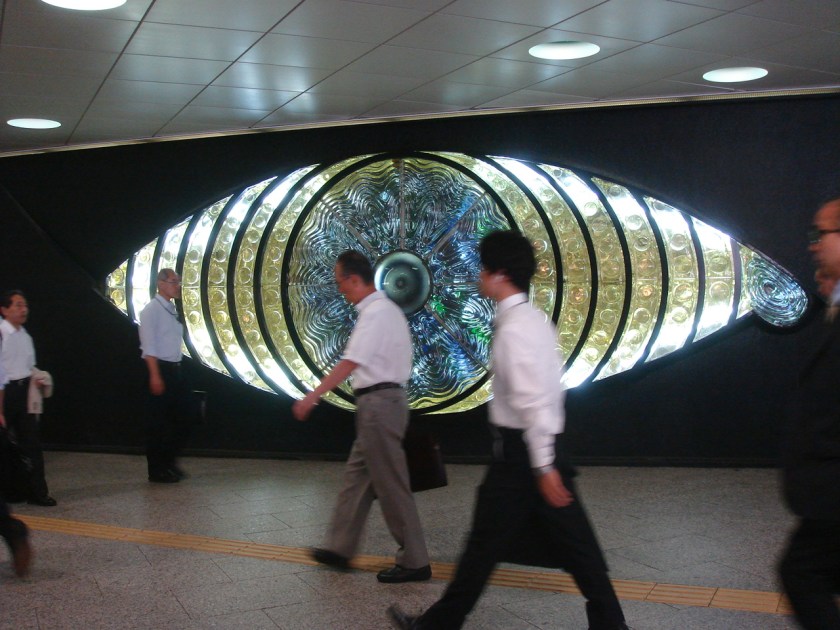
Somebody's watching you... office workers walk past an installation in Shinjuku station, Tokyo

We’ve met with several Japanese surveillance studies researchers whilst out here this time. I mentioned Ogura Toshimaru already the other day, but we also had a long meeting the week before with Hino Kimihiro, a researcher into bohan machizukuri (community security development), and government advisor on security planning. Dr Hino has been carrying out a number of research projects on both ‘designing out crime’ and on the effectiveness and public acceptability of CCTV in Japan. I hadn’t come across this research before as my contacts here were mainly in social sciences and law and Dr Hino tends to publish in urban planning journals and is not connected to other Japanese surveillance researchers. His work is very interesting and reminiscent of that of Martin Gill or Farrington and Welsh in the UK. It is a shame, that just like those researchers who have carried out analyses of CCTV for the UK Home Office, his assessments tend to be ignored by the government. Dr Hino’s latest project is to assess the trials of a new movement recognition system in Kawasaki city. I hope he can come to the January Camera Surveillance workshop at Queen’s University, Ontario, or the April Surveillance & Society conference in London (details coming soon!).

I also met today with Tajima Yasuhiko, a professor of media law in the School of Journalism at Jochi (Sophia) University in Tokyo. Professor Tajima has been one of the most important critical voices in the debate about surveillance in Japan, and has bridged the academic and activist world, being involved with legal action against juki-net and Google StreetView. We had a productive conversation about the politics of surveillance in Japan and the prospects for critical voices to be heard. He wasn’t optimistic that they would be, and neither am I after our meeting at the Prime Minister’s IT Strategic JQ the other day, however I am also convinved that in many ways Japan has not yet gown as coordinated and centralised a route on issues of security and surveillance as has the UK. There is, so far as I can see, no real attempt to link up things like juki-net or other databases and the anshin anzen (or bohan) machizukuri agenda, and i-Japan, national and local police, and wider community security agendas do not really coordinate at all. This is due to the lack of an obvious ‘threat’ like that of terrorism in the UK, around which such coordination can occur. The government half-heartedly tries to get people worried about North Korea, but really they aren’t, and ‘ageing society’, whilst a phrase used to justify almost anything (including central databases) is a worry, it does not generate the fear that comes with the war on terror.

We also considered the relative weakness of Japanese civil liberties organisations and the failure of the mainstream media to pick up on issues of privacy and surveillance. There seems to be some effort now to try to coordinate various organisations to push for an explicit constitutional protection for privacy (rather than the rather vague inclusion of such an idea in a wider notion of the ‘pursuit of happiness’), but whilst I can see that being happily accepted after the government has got its central database(s), I can’t see it being done in time to alter either this trajectory or the way in which the database(s) are built.

China – the ultimate surveillance state?

Most societies are surveillance societies of one kind or another and to a greater or lesser extent, but there are very few comprehensive surveillance states, i.e: nations where the government is really interested in what you are doing and thinking and has the will and the resources to find out. Iran has a pretty serious network of petty officials, informers and spies who enforce both moral and legal norms; Burma has a regime of fear and military rule; and several states, usually those with less comprehensive control, have vicious and arbitrary systems of punishment (like Sudan). However few have the combination of wealth, technological resources, a complete lack of concern for outside opinion, and state will to keep control on any moves to greater political diversity as that possessed by China.

According to a report in Xinhua today, China’s police have in the last few years installed more than 2.75 million cameras in public space, largely in urban areas, and are now moving to install cameras in rural locations too, “linked to police stations, community police service posts and farmer security guards in rural areas to establish a comprehensive security network”.

As Naomi Klein’s report last year showed, helped by willing western companies and law enforcement agencies, China is becoming a vast laboratory for surveillance and social control. The aim is a fully integrated system that can police real world and online behaviour. The ruling Communist Party, whilst opening up the economy is determined to prove, contrary to US assertions, that you can indeed have a free market system and still have complete one-party authoritarian control. And as anyone who has ever tried to have a discussion on Chinese politics with Chinese students or visiting academics, the control extends deep into the education system, with ‘normal’ patriotism preventing the development of all but the most banal of views counter to the approved picture.

It is probably sometimes worth remembering that however bad the UK or Japan or the USA or any other democratic state seems to have become in this regard, China still takes the prize for the world’s most comprehensive surveillance society.

Private sector data loss in Japan

I’ve blogged a fair bit in the past about state and private data losses in the UK. In Japan too this has been a big problem, and is a reasons given by central government for the need to centralise databases and by opponents talking about the risk of such centralisation.

The latest major data loss, just the other day, was by the giant banking combine, Mitsubishi UFJ Nicos, which accidentally ‘threw away’ personal data on almost 200,000 customers from 1993 to 2001. Of course MUFJ Nicos say there is no security or financial risk, but then organisations in these situation always say something like that…

Not all of these data losses are accidents however. Back in April, another part of the Mitsubishi keiretsu (a Japanese term for a loosely-connected ‘family’ of companies), Mitsubishi UFJ Securities, fired one of its managers, Hideaki Kubo, who is alleged to have stolen personal data on almost one and and half million customers, and had allegedly already sold data on 49,000 to data brokers for the rather unimpressive sum of just 32,0000 Yen (around $3200 US). He is believed to have had considerable debts.

In short, it doesn’t matter how strong your firewalls are, or how good your computer security is, if there is an employee, or a government bureaucrat with access to sensitive data, who is in financial difficulty or who is simply aggrieved or greedy, then data will leak out. The risks are not small, in fact it seems almost inevitable, and I believe that the number and scale of such losses are probably significantly under-reported by both private firms and government. Of course, it is also significant just how many supposedly reputably companies are prepared to pay for stolen data. This trade is certainly not taken seriously enough by regulators in most countries…