I'm David Murakami Wood. I'm currently Canada Research Chair at the University of Ottawa. I like reading, cycling, running, and I am slowly coming to the realization of the limits of getting older.
Not surveillance-related, but here’s some of the many, many pictures that I took whilst getting very sunburnt walking around the big open spaces under the huge skies of Brasilia last week. There are a couple more pictures of the Parliament complex in my report from my meeting there last week. My first set of photos of Niemeyer’s work from Sao Paulo can be found here.
You read it right. The former UK Home Secretary, with a reputation as one of the most authoritarian of recent years (though it is hard to chose in that regard), will condemn the growth of surveillance in a speech at the University of Essex today. He will also, according to Tom Young at VUnet, call for the ID card scheme (which he introduced!) to be scrapped, and for the information-sharing powers that were hidden in the new Coroners and Justice Bill, to be reduced. He also argues that the latter will happen as he knows the Justice Minister, Jack Straw, recognises the problem.
I don’t know whether to laugh or cry. Certainly it is fantastic when a prominent figure like this changes their mind and is prepared to admit that they were wrong, I just wish that sometimes they listened to the arguments against what they were doing when they were in office. In addition, of course Blunkett spent several years after leaving office writing very strong pro-surveillance, pro-ID card pieces for the populist, right-wing tabloid newspaper, The Sun, and is (or was) according to the Register of House of Commons Members Interests, paid £25-30,000 ($35-40,000 US) as the Chair of the International Advisory Committee of Entrust Inc., a company that works on digital certification and Internet surveillance, and which was involved in consortia for the ID card contract. Perhaps they have had enough of him.
But let’s hope he really has had a genuine change of heart.
t seems that there is a mood in Germany for much stronger action, and a growing awareness that the country cannot, unlike in the UK at present, or indeed Germany in its own recent past, be allowed to slip into a situation in which surveillance becomes normal…
There is a major ongoing storm in Germany over the behaviour of its major corporations in spying on workers. There is a nice summary news report from the BBC which you can watch here.
The newest scandal emerged in January when it was revealed that the railway company, Deutsche Bahn, had conducted surveillance operations against thousands of its staff, both workers and management, possibly over years. The operations, with names like ‘Squirrel’, involved all kinds of intrusive internal espionage including tracking family members. The company’s aim was apparently to do with corruption and links to other rival corporations but the management have now admitted they went too far.
Internal security was also the reason behind the massive surveillance operations at Deutsche Telekom, the communications giant, possibly dating back to 2000. Here journalists and managers were targeted by a private detective agency. And of course then there was last year’s scandal over the way that the Lidl supermarket chain created a kind of Stasi-style operation at many of its stores and warehouses in Germany and the Czech Republic with secret cameras and operatives making detailed notes on the movements (especially toilet breaks) of its employees. According to The Guardian, the level of personal detail recorded by the store was incredible, one entry read: “Frau M wanted to make a call with her mobile phone at 14.05 … She received the recorded message that she only had 85 cents left on her prepaid mobile. She managed to reach a friend with whom she would like to cook this evening, but on condition that her wage had been paid into her bank, because she would otherwise not have enough money to go shopping.”
In the BBC report, the conclusion seems to be that better data protections laws are needed. Certainly this is true. But the cases involving corporations are important because they provide clear and comprehensible examples of how people ‘with nothing to hide’ can be targeted anyway and do have to be worried. There are enough of them too to show that this is not a series of isolated cases, but a part of a ‘culture of surveillance’. However it seems that there is a mood in Germany for much stronger action, and a growing awareness that the country cannot, unlike in the UK at present, or indeed Germany in its own recent past, be allowed to slip into a situation in which surveillance becomes normal. This means more than stronger DP, it means not allowing corporations and government to reduce fundamental liberties with arguments about ‘exceptions’. There seems to be growing awareness from the strong German Trades Unions in particular about this, we will see if this translates into wider social, and state, action.
Not a million miles away from my office at Newcastle University, back in the UK, this stencil has appeared (“nothing to do with me, guv, I was in Brazil, honest…”)
Claremont Bridge, camera and comment (photo: Jon Swords)
Maybe what Jacqui Smith needs is a dose of ‘Chinese democracy’ to go with her Chinese-style attitude to security and surveillance…
In the last fortnight there have been interesting developments that have reminded us, as if we needed reminding, that those who want to infringe on the liberty of others need to be absolutely squeaky-clean themselves or risk severe censure, and that those who introduce systems which encourage suspicion and spying should not be surprised if people no longer trust them and start to investigate their activities.
The first of course was the saga of Jacqui Smith’s apartment. The basic facts are that the UK Home Secretary has been claiming £24,000 (around $35,000 US) per year in allowances for an apartment that she does not actually live in. The particular irony (and we love a bit of irony in Britain!) was that she has been reported by a neighbour – in other words she was a victim of the kind of suspicious, back-stabbing, trust-no-one society that she has been encouraging. Of course she should resign if she had any intelligence or integrity, but we already know to the cost of our civil liberties that she does not.
Funnily enough, it is to China we go to another example and one with, it seems, a rather more accountable outcome. This is almost the second time in a row that I have unfavourably compared a western country to China – this is getting rather disturbing particularly as I am no friend of the Chinese state, being a long-term Free Tibet supporter. However, Variety (of all places) is reporting that Yu Bing, who is director of the internet monitoring department of Beijing’s Public Security Bureau, and therefore a major figure in the infamous Golden Shield, and surveillance of journalists, bloggers and net democracy activists (as well as those just trying to access unapproved content), has been arrested for taking bribes from a contractor.
Admittedly it is a lot more than the sums in the Jacqui Smith case (40M Yuan, or about $5.8M US), and corruption is endemic within the Chinese state at all levels, but it does show a rather different attitude to the establishment towards top officials who fail to live up to the standards we expect of them. Maybe what Jacqui Smith needs is a dose of ‘Chinese democracy’ to go with her Chinese-style attitude to security and surveillance?
I am just on my way back from Brasilia to Curitiba, so there won’t be anything from me this Sunday. The next few days are also ‘Carnaval’ here in Brazil 🙂 so not much work will be happening, and certainly I won’t be in the university (as it is closed!) and I may take a trip or two out of town. I might also try to catch up on a few things which I will post here – but probably there won’t be more than a post a day over the coming week…
…despite Britain’s reputation as a surveillance society… the USA is now eclipsing the UK. The post-9/11 surveillance surge has seen to that.
Back in the USA again. Chicago has been featuring a lot this week for its CCTV system. Newspapers generally offered glowing assessments of its capabilities based around homey anecdotes of pretty harmless incidents ‘solved’ by CCTV – in this case the stories, for example those in the Chicago Sun-Times and the New York Times, featured a theft from a Salvation Army kettle, which sounds like it is straight from a Mayoral press release. It is depressingly poor journalism and once again, all very reminiscent of the situation in the UK in the 1990s before academic and even government assessments dampened the enthusiasm for CCTV. There’s also a depressing naivety (and factual incorrectness) about the insistence from the authorities and from some ‘experts’ that these cameras have nothing to do with human rights like privacy as they are all in public spaces.
But there is one very important difference. Chicago, with massive investment from the Department for Homeland Security, has gone much further than most UK cities, not only in coverage but also in capabilities. First of all, Daley and police-chief Orozco have promised that “We’re going to grow the system until we eventually cover one end of the city to the other” in other words they do want, as the Chicago Sun-Times subheading claims, ” a camera on every street corner.”
The particular innovation that the city is pushing here is the linking up of the law-enforcement aspects with emergency services through something called Computer-Aided Dispatch (CAD). This is system that uses a live Geographic Information System to match camera location to reported incident location, so that when an incident is called in via 911, the nearest cameras can immediately turn to picture the scene. This is part of what Chicago calls ‘Operation Virtual Shield’, a fibre-optic cable system which links the cameras with other biological and chemical weapons-detection system in a “homeland security grid.’’
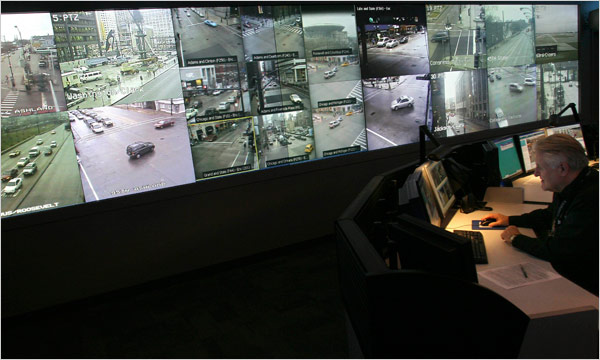
The Chicago control room (New York Times)
As part of the work we did for our latest book, Jon Coaffee Pete Rogers and I visited and analysed several different cities in the UK to assess their emergency-response and surveillance systems. While most had intentions to use the cameras for more active emergency-response purposes and particular local police were starting to try to install override systems for the multiple local camera systems that exist in the UK in the case of citywide emergencies (like a mass evacuation). And in particular, Manchester (whose high-tech control room looks like the Chicago one as seen in the NYT (picture above) and also often features in media PR for CCTV) has gone further down the Chicago route than most. But they still don’t come close. Britain’s systems are fragmented, ageing, generally not integrated with other functions and certainly don’t link to other kinds of sensors. Britain has introduced some stupid authoritarianism like the infamous ‘shouting cameras’ mostly as part of the Respect (sic) Zones initiative. But despite Britain’s reputation as a surveillance society I suspect that in terms of advanced integrated cameras systems, the USA is now eclipsing the UK. The post-9/11 surveillance surge has seen to that.
There’s two other points worth noting here. The first is that Chicago is bidding for the Olympics in 2016. I can almost hear multiple researchers in surveillance studies around the world, releasing a collective ‘of course!’. Mega-events like the Olympics, the World Cup – there will be a fantastic conference on this theme in November this year in Vancouver – or other non-sporting ones like world summits or the G-8 conference are often the trigger for the introduction of repressive measures and new surveillance systems. This was true in Japan (where state CCTV was first introduced because of the soccer World Cup in 2002), in South Africa (for various major world summits), and in Athens for the Olympics in 2004. Mayor Daley wants the city to be 100% free from the possibility of terrorist attack. Laving aside the actual impossibility of that desire, how far will he go to get there?
Well, the last Olympic venue, Beijing, might give some indication. For it is actually the plans in authoritarian, non-democratic China that seem most similar to what is going on in Chicago. Even the names have an eerie reminiscence: China’s Golden Shield, Chicago’s Virtual Shield. That is trivial, however the substance is not. The Chinese government, as Naomi Klein has written, is installing massive and comprehensive camera systems in every major city in China. It is also, of course, linking this system into its infamous Internet monitoring operation, with the ultimate aim of being able to track individuals in real and virtual space. Of course, the US, like most other nations is now trying to control Internet use too and the NSA already keeps massive data banks of communications traffic information as well as doing real-time monitoring as recent revelations have, once again, shown. But, it’s different in the USA isn’t it? The USA wouldn’t link up all these systems, would it? The Land of the Free? The home of democracy? I wouldn’t bet against it…
Largely unnoticed in commentary on US President Obama’s fiscal stimulus plan has been the $4Bn for the Justice Department. Now there are various very worthy programs nominated for funding including quite a large chunk to combat violence against women, but also a lot of cash washing around for rather more vague aims, in particular the $2Bn (i.e.: half the cash injection) for the Edward Byrne Justice Assistance Grant (JAG) program “to fund grants for state and local programs that combat crime”.
The JAG program has already providing funding for many cities to install cameras as part of ‘demonstration programs’, as well as covert surveillance capabilities. However $2Bn is a massive increase in funding and will allow some rather more ambitious schemes to be funded. With the current popularity of CCTV cameras as a catch-all solution in the USA (regardless of negative assessments of their effectiveness elsewhere – see ACLU’s recent convenient US-focused summary), could one side-effect of the stimulus package be a massive ‘surveillance surge’ in the USA? After all, this is exactly what happened in the UK in the 1990s when central state funding through the ‘City Challenge’ program sparked a mania for installing city-centre CCTV systems – see the editorial and the articles by Will Webster, Pete Fussey and Roy Coleman in the special issue of Surveillance & Society on CCTV.
Those concerned with civil liberties and the intensifying push for videosurveillance in the USA should keep a careful eye on applications to the JAG program.
I had a great meeting at the architecturally stunning Camara dos Deputados (the Brazilian equivalent of the British House of Commons or the House of Representatives in the USA), which almost made up for the fact that it was the only one of the three scheduled interviews that I had arranged that actually went ahead… it really does look like I will have to come back.
The parliamentary buildings in Brasilia, originally laid out by Lucio Costa. The Camara dos Deputados, by Oscar Niemeyer, is to the right.
This meeting took place in the Comissao de Direitos Humanos e Minorias (the Commission for Human Rights and Minorities) and was with Federal Deputy and committee member, Pompeo de Mattos, the secretary of the Commission, Marcio Marques de Araujo, and Hebe Guimareas-Dalgaard, who works in the International Relations office and who served as translator.
The meeting covered all sorts of background issues around security in Brazil, and concentrated on Deputado de Mattos’s specialities in this area, which are in justice and drug-trafficking issues. Again, I won’t do more than summarize a few immediately important things here. There was a lot of talk of police corruption and some hair-raising stories of the ways in which military police officers in particular has become involved in selling equipment and ammunition, and of course the autodefesas communitarias that I have mentioned before. Interestingly though, it was the deputy’s opinion that the military police, despite having a ‘culture of violence’ inherited from their role as enforcers of the military dictatorship, were less corrupt (in an everyday way) than the civil police. The latter are even lower down the police food-chain and correspondingly more poorly paid and equipped.
The inadequacies of the civil police has led many Mayors of larger towns and cities to introduce so-called ‘Municipal Guards’ – basically private security given some official status. They have few powers but are basically there to increase the visibility of security, a kind of prophylactic community policing. The problem is however that the official police and the massive private security sector are thoroughly intermixed already. Many officers moonlight as private security guards, which leads to all kinds of conflicts of interest.
Deputado de Mattos was certainly not obsessed with the inadequacies of the police however. Serious and organized crime associated with drug-trafficking paralyzes the everyday life of poorer areas of large cities in Brazil. Despite the fears of the rich over crime, it is the poorest that suffer most. He described the drug gangs as being the major obstacle to any positive change in Brazilian cities. However he didn’t see any militaristic solution – fighting a war against the drug gangs would only lead to more violence. The only solution to the problems of both crime and the poverty from which it emerges is social inclusion. The favelados must be provided with the same opportunities and infrastructure as everyone else. The need schools, hospitals, transport, and so on. Programs like Bolsa Familia, however well-intentioned, make no fundamental difference, he argued – contradicting, as most people with whom I have talked have done, the assessment of external organisations like the World Bank.
However providing such opportunities is not easy, and not just because of the costs. The drug-gangs actively resist any attempt by the state to introduce services, to the extent of intimidating or even killing construction workers. And this shouldn’t be in any way romanticized as some kind of popular resistance of the poor to the imposition of unwanted state interference – this is an attempt to maintain the rule of fear and violence. Somehow, one can never get away from the security issue in Brazil.
Leaving the Camara dos Deputados, looking past the parliamentary buildings up towards the Esplanada dos Ministerios, with all the government Ministries lined up in identical blocks.
(Thanks to Deputado Pompeo de Mattos, who as you will see if you check out his website is quite a character. He is fiercely proud of his southern ‘gaucho’ roots, and writes poetry to that effect. He is also – and I don’t say this very often of politicians – a genuinely nice guy. Thanks also to Marcio Marques de Araujo and to Hebe Guimares-Dalgaard without whom the meeting would have been impossible).
It is hard to say anything about Facebook that hasn’t been said elsewhere. Of course, the decision to reverse its attempt to change its terms, which would have made it nigh on impossible for members to remove material they had posted, is a good one. Effectively what it would have done is made Facebook the owner of all personal data posted on the site.
The campaign against it was of course organised through Facebook groups! That in itself should have been enough to persuade Facebook’s young owners of the power and passion generated by the system they had created. But I don’t think they really do understand it, or indeed very much about the implications of what they are doing at all. I mentioned their youth. Last time Facebook got into trouble, it was because of comments made by their ‘Marketing Director’ (age: 24) at Davos, which were (apparently erroneously) taken by the press to indicate that Facebook was going to sell personal data.
Now, I know that it’s not cool and probably won’t make me popular to knock youth at a time where youth is everything (despite the fact that the word is ageing) – Fast Company last month had snowboarder Shaun White as its cover star in a story full of fawning admiration about how rich he had become by telling big companies about the youth market. But at least White seems to have his head screwed on – maybe it’s a class thing? Facebook’s owners on the other hand need to grow up a bit. They need to learn a bit more about the value of some rather old-fashioned fundamental rights, particularly privacy, and strop treating the system they have created as the personal spare-time sophomore project as which it began. I think that they just didn’t appreciate how people would view their proposals.
There is a serious issue here. Privacy is something that you only start to truly truly understand as you get older. Partly this is because your mistakes and your secrets get more serious and more potentially damaging as you get older! But, as I have said before, most of those are nobody’s business but your own and no-one benefits from forced transparency – honesty and conscience are also profoundly personal matters. It has been argued that the ‘youthfulness’ of the Net has encouraged a general carelessness with privacy. I am not sure that is entirely true, as Facebook users have shown – they care. But it’s the careless and – let’s face it – privileged youth of many of these new entrepreneurs, the fast companies, which is more concerning. Most are not success stories from the wrong side of the tracks, who have learned ‘the hard way’.
The threat of legal action from EPIC, which was preparing to take them to the Federal Trade Commission might have concentrated minds in this regard. Maybe it was just the threat itself – EPIC have a strong record in these kinds of cases and have taken down Microsoft and Doubleclick. However I would like to think that the arrogance and energy of youth might be tempered with a bit more maturity and consideration in the future. If only, as I’ve said before, because Facebook is no longer a fresh young company in Web 2.0 terms and could easily be eclipsed by the next big thing. Perhaps they can hire someone more ‘real’ like Shaun White to tell them how privacy rights and user control of information would be like, totally rad, dude…
Woah man, I am so stoked about privacy... (Shaun White, not actually advising Facebook on privacy, pictured for Fast Company)
On a more serious note, EPIC put a lot of time and money into protecting privacy in the USA and they do a damn good job, and in cases like that of Facebook they are having a positive affect the world over, so give them some money!





























 ubisurv