Europe’s Surveillance State

EU_surveillance
The Open Europe report

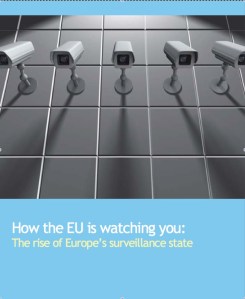
I have just got hold of a new report by UK-eurosceptic think-tank, Open Europe, called How the EU is Watching You: the Rise of Europe’s Surveillance State, which whilst it isn’t as startling as the NeoConPanopticon report from the Trilateral Institute and Statewatch, does some to collect some useful information together in one place. Crucially the report points out the same thing as Will Webster and I did in our paper in JCER a couple of months ago, that this isn’t just a case of ‘European’ bad practice being imposed on the UK, but just as much UK bad practice being exported and generalised throughout Europe.

One interesting footnote is how the discourse of opposition and analysis is changing. A few years ago, and still in academia, the idea of the ‘surveillance society’ was the dominant way of describing the situation, but now there is once again an increasing focus on the ‘surveillance state’ or the ‘database state’.  This is partly, I think because there are an increasing number of right-libertarian and anti-state or small-state groupings openly opposing increasing surveillance – for example, the new Big Brother Watch in the UK, and they tend to emphasise the state’s role (or in this case, the role of an organisation they regard as an unaccountable superstate). This also reflects the growing opposition from the UK in particular. This is particularly interesting because in the past, the idea of the ‘surveillance state’ was mainly a historical term to do with the development of repressive political policing, especially that involved in colonial counter-insurgency – see, for example, Alfred McCoy’s new book, Policing America’s Empire, on the role of the US occupation of the Philippines in the co-evolution of US and Filipino state surveillance practices – or in the totalitarian regimes of the former Eastern Bloc.

The landscape today is much less obviously one of state control. Indeed one could see these developments as a result of the retreat of the power of the individual state and an attempted reconfiguration of state-power of a new kind at a supranational level. And, this power is crucially dependent, as it has been since the end of WW2 on the private sector. The military-industrial complex is now a security-industrial complex and security is no longer anywhere near being simply state business.

Would Canadians be “safer with a camera on every corner”?

I haven’t got very involved with Canadian debates on surveillance yet (but don’t worry, I will!). However a comment piece in Thursday’s Globe and Mail, which demanded that Canadian cities install ubiquitous video surveillance, prompted me to pen an immediate letter, which was signed by both Professor David Lyon and myself. It was published today, slightly edited – the full version is below. (They also decided to edit out our respective titles, which makes me look senior to Professor Lyon. Oops.)

“Marcus Gee writes that “We’d be safer with a camera on every corner” (Comment, May 22nd, p.15). If only this were true. However it simply is not the case.

Mr Gee quotes the UK as an example of where video surveillance is effective, but this is not supported by the crime figures in the UK or by academic research. The most comprehensive evaluation of all studies done of the effects of CCTV on crime (by the Campbell Collaboration, 2009) concluded that it had little or not effect on the occurrence of violent crimes like the disgraceful murder of Christopher Skinner, which prompted Mr Gee to write. Even the limited British police assessment of CCTV conducted by the Association of Chief Police Officers (ACPO) in 2008, admitted this was the case.

It is easy to demand that ‘something must be done’ as a response to any particular incident of violent crime, and CCTV is the currently fashionable ‘something.’ But let us get beyond the superficial and look at the evidence. Then we could have a proper debate about CCTV.”

Lies, Damned Lies and CCTV Statistics…

Earlier today, I reported on reports that claimed that 96% of US citizens support video surveillance. Now, thanks to Vicki Contavespi, and the people at BRS Labs who commissioned the survey from Harris Interactive, I have the raw figures. And, unsurprisingly enough, whilst they aren’t ‘lies’, they don’t quite show what the headlines suggested – just as my headline, a quote often attributed of course to Disraeli, is also an overstatement of the case at hand. This is a very interesting survey. There were quite a few questions asked, and I don’t have time to go through all of them here now, but I will just deal with the question of ‘support’ for video surveillance and break it down just a little more.

First of all, the main questions on the acceptability of video surveillance (and other surveillance techniques) are couched in an particular way that is common in market research. The lead question is “How strongly do you agree or disagree with each of the following statements?” There is then a list of statements, which each have four options: strongly agree, somewhat agree, somewhat disagree, and strongly disagree. There is no ‘neutral / don’t care / no opinion’ option, which might have taken out many of those in the ‘somewhat’ categories on either side. The headline figures used then, of course, elide the ‘strongly’ and ‘somewhat’ figures.

For video surveillance, there are two main statements, firstly, “The federal government should be able to utilize video surveillance as long as my personal privacy is not invaded”, and secondly, “Local law enforcement should be able to use surveillance cameras to monitor public places.” The first question already contains a bias, in that is specifies a situation of no privacy invasion. This effectively nullifies the most common objection to video surveillance, and especially for those for whom the Federal Government is a intrinsically suspicious entity. The second, interestingly, doesn’t have this proviso, but then ‘local law enforcement’ isn’t ‘the Feds’ and generally does not attract the same antipathy. But the lack of a qualifying statement might provide a better clue to US public attitudes on video surveillance overall. For the first statement, the ‘headline’ figure of agreement is 82% and the second is 78%. However this disguises the fact that ‘strong agreement’ is much more limited, 36 and 35% respectively. And if you add up the ‘somewhat agree’ and ‘somehat disagree’ figures, you get 57% and 58%, which indicates to me that the majority of US people don’t have strong opinions for or against CCTV. See – statistics are all about what you are looking for in them!

What is even more interesting is that the question was then asked: “Which of the following aspects of video surveillance cameras, if any, concern you?” You would think that, given the headline and press release, that the survey showed no real concerns about CCTV. But that really isn’t the case at all. In fact, 88% of respondents said they were concerned by at least one of the listed aspects of video surveillance. Now remember, you’ve only got 18% or 22% who said that they disagreed with CCTV in terms of the question posed above, so this means that even most of the people who supported CCTV to whatever degree of strength, had concerns and most had more than one concern. This is quite striking. The main concerns were “not knowing what will be done with the information that is gathered ” (66%), “The fact that recorded footage can be used to mistakenly incriminate me” (61%), “Not knowing the background of whoever may be watching” (60%), “Not knowing how often and where I might be watched” (50%) and “The fact that photographs can be taken of me without permission” (48%). The only one on which there was significant difference between men and women seems (and I haven’t done any statistical analysis of the difference) to be over the concern about how often and where people might be watched, about which women were more likely to be concerned than men. In fact, in the whole survey, there appear to be no real overt differences in response based on gender.

So where, you might well be asking, does this 96% support figure come from? I searched through the tables some distance for the 96% figure before I found it. It certainly doesn’t refer to generalised support, but comes in response to the following question: “Which of the following areas, if any, do you think should be monitored by video surveillance in an effort to help protect U.S. citizens?” A-ha! So we have a question that implies the use of video surveillance somewhere, and that it will be used specifically to help protect US citizens (none of those foreigners!). The question is clearly pushing the respondents towards a positive answer. But here too things are not quite what the headlines claimed. Certainly, 96% of respondents said that video surveillance should be used in some areas. However, it is only in “Airports” (92%), “Public transportation” (85%) and “Seaports” (82%) that there is an overwhelming vote of confidence (though quite why seaports are considered to be less at risk or would benefit less from video surveillance than airports, I am not quite sure – the ghosts of 9/11 hover, I suppose).

“Public schools/Universities” barely scrape a majority (53%), and one wonders what the figures would be if they split universities and schools (and indeed different levels of school). “Playgrounds” only hit 39% – not so much of the common British ‘think of the kiddies’ paranoia here perhaps – “Businesses” – where of course surveillance is actually more likely to be found than anywhere else! – doesn’t manage a third (32%) and “Local neighborhoods”, which is the only unequivocal ‘public space’ category is only on 22%. Why not parks? Why not city centre streets? It is of course these places where the real controversy and the real fire and debate over CCTV lies. And the indications from this survey are that the more personal, the more intimate, the more there is a sense of ‘community’, the less likely US citizens are to accept video surveillance, even if it is couched in the overly positive way it is here.

And there is a question whose answers demonstrate further the complexity here. And, ironically, the percentage of respondents who replied to the question “Which of the following, if any, do you think are currently the biggest threats to your personal privacy?” with one of more concerns was – you guessed it – 96%! The major concerns were actually mostly from private or criminal surveillance: “identity theft” (74%), “Internet security threats” (70%) and “Unknown individuals who handle my personal information” (60%). Only 33% were concerned about federal or local government, but this isn’t surprising when this category is headed, as it is in the survey, “Big Brother”! Who is going to admit to being scared of ‘Big Brother’? And if you are going to give a silly popular stereotype as a potential answer, then the other categories should be similarly labelled… And why wasn’t this 96% the lead-in for the media?

As I said, there is a lot more in here too, and despite its flaws, this is an interesting survey which has much to it than meets the eye if you just read the media reports.

Poll claims 96% of US citizens support video surveillance

A Harris online poll of 2416 adult US citizens, conducted between May 28th and June 1st, 2009, has found a 96% rate of support for federal government video surveillance in ‘specific public places’, according to Reuters.

Further statistics from the survey include an 80% rate of support for ‘any available measures’ to protect citizens in a terrorist attack, and 54% supporting the US of federal stimulus funding for video surveillance. As the press release notes, public support appears to be totally detached from the evidence we have about the limited effectiveness of video surveillance – something is (quite literally) being seen to be done, and this is what appears to matter. Video surveillance is culturally engrained, even expected, as a result of two decades of movies and TV shows which use surveillance as a  theme (from programs like Cops to ‘realityTV’). So in many ways such a result is not altogether surprising.

The poll appears to have been commissioned as part of a PR campaign by an advanced ‘intelligent video surveillance’ company, which has a clearly stated commercial interest, which makes one wonder exactly how the questions were phrased, and how they were asked. The word ‘terrorism’ is mentioned a lot, and I expect there would be a great deal of difference in responses to a similar question that did not mention terrorism (or indeed did not mention the supposed purpose at all), and indeed a survey of people who had read a summary of available research on CCTV would probably once again, result in a different percentage (as economic experiments with ‘willingness to pay’ methods of valuing policy decisions have shown, informed participants make different judgements). I will try to get hold of the raw figures to take a deeper look…

Even video surveillance hit by global recession?

According to a new market-research report produced by Arizona firm, In-Stat, the market for video surveillance equipment has seen a slow-down in unit grow in 2009, and even a decline in overall revenue (and this may be the first time this has happened for many years). This is interesting as it is conventional wisdom that the security sector is generally unaffected or even benefits from recession (but see some previous posts here and here for other aspects of surveillance in a global recession). However the report also states that whereas sales of cameras are relatively flat, sales of data-recording equipment, especially hybrid recorders that can handle both analogue and digital images, are increasing and this is partly due to the US government’s stimulus package. This suggests that those operating exisiting video surveillance systems that may have older analogue cameras are chosing not to upgrade their cameras now but are making sure that they can retain the images more efficiently. The report predicts that, after the recovery, the overall market for video surveillance equipment in 2011 will be $19Bn US.

Mind you, I haven’t read the report in full, only this summary, because it retails at $3,495 US! Someone is clearly expecting to make plenty of money out of the recession…

Surveillance cameras in the favelas (2)

A couple of weeks ago, I found out that the military police had installed surveillance cameras in the favela of Santa Marta, in Rio de Janeiro, Brazil, which I visited back in April. This is the first time such police cameras have been put into such informal settlements in Rio. My friend and colleague, Paola Barreto Leblanc, sent me this link to these youtube broadcasts from a local favela TV company, in which residents discuss their (largely negative) views of the cameras.

There is also a poster that has been put up around the area produced by the Community Association and other local activist and civil society groups – see here – which reads as follows in English:

SANTA MARTA , THE MOST WATCHED PLACE IN RIO

At the end of August, the inhabitants of Santa Marta were surprised to learn from newspapers and TV that nine surveillance cameras would be installed in different areas of the favela. A fear of being misinterpreted paralysed the community.

Many of the people of the city, and some in the Moro itself support this initiative.  However, we are a pacified favela, so why do they keep treating us as dangerous?

Walls, three kinds of police, 120 soldiers, cameras – this is no exaggeration.  When will we be treated as ordinary citizens instead of being seen as suspects?

Wall: 2 million Reais, Cameras, half a million Reais. How many houses could this amount of money build? How many repairs to the water and sewage system?

The last apartments built in Santa Marta are 32 square metres. The Popular Movement for Housing [an NGO] says that the minimum size should be 42 square metres. Other initiatives have gone with 37 square metres. So why don’t we stand up and demand this minimum standard? This should be our priority!

When will the voice of the inhabitants of this community be heard?

We need collective discussion and debate.

Fear is paralysing this community and preventing criticism. But the exercise of our rights is the only guarantee of freedom.

“Peace without a voice is fear”

We want to discuss our priorities. We want to know about and be involved in the urban development project in Santa Marta.

We will only be heard and respected if we unite.

Think, talk, reflect, debate, get involved…

Project Indect and the NeoConOpticon

Following the release of the NeoConOpticon report, Ben Hayes of Statewatch has set up an interesting blog monitoring EU security policy, called (ahem…) Notes on the European Security Research Program. One the first post (and a follow-up) concerned one particular EU 7th Framework Program-funded project called Indect, which seems to think that it is a great idea to have an Enemy of the State-style comprehensive surveillance system across Europe. It appears to be filmed in Poland – you think the Poles at least would have learned from almost half a century of totalitarian rule…

There are of course, hundreds of these security projects being funded by the EU that Ben’s report detailed (with a tiny, tiny number of alternative or critical ones, and of course some token nods to simple ethical concerns like privacy within some of the projects). One that finished in 2007 was the SAFEE project that proposed (amongst other things) to put cameras in the back of every aircraft seat so that passengers’ facial expressions could be monitored automatically for signs off threat… it’s unclear how many of these ever get beyond the research stage – and I hope most don’t – but if they do, the future of the EU is one of a tightly controlled society of people constantly monitored even at the most personal level in case they step out of line. The great thing about the NeoConOpticon report is that it puts all of these things together rather than treating them in isolation. I wonder if the individual researchers involved would think differently if they actually considered their work in this context and in the context of the political architecture of security that is being built in the EU.

Anyway, here’s the PR video for Indect, for those who are interested in such things. It’s typical of the genre: a dumbed-down, hyped-up, over-macho, TV-detective series pastiche with a ridiculous voice-over and music. No doubt it goes down a storm at sales events.

Anyway, keep an eye on Ben’s blog. I will be.

Call for Papers: 4th Surveillance & Society Conference, 2010

A GLOBAL SURVEILLANCE SOCIETY?

THE FOURTH BIANNUAL SURVEILLANCE & SOCIETY CONFERENCE

Supported by the LIVING IN SURVEILLANCE SOCIETIES (LISS) COST Action, and the SURVEILLANCE STUDIES NETWORK

City University London, UK

April 13 – 15, 2010

CALL FOR PAPERS

OVERVIEW

Surveillance has become a ubiquitous feature of living in the global north, with citizens routinely monitored by a range of sophisticated technologies. Increasing levels of surveillance are typically justified and legitimated by threats of terrorism, fear of crime and disorder, as info/entertainment tools for the curious and through discourses emphasizing public and private service improvement. In spite of this, little is known about the effect of surveillance on individuals, society, the democratic polity, nation states in the developed and developing world, and the evolving nature of humanity.

THEMES

This conference calls for papers which examine the many facets of surveillance and globality. In particular, we welcome papers which address:

  • Living in the surveillance age
  • Surveillance, difference and discrimination
  • Attitudes and experiences of the watcher and watched
  • The development and diffusion of surveillance technologies
  • Surveillance technology in practice
  • The political economy of surveillance
  • The business of surveillance
  • The surveillance of consumers and workers
  • Public policy, regulation and surveillance
  • The philosophy of surveillance and philosophical perspectives on surveillance
  • Surveillance, intelligence and war
  • Surveillance, sovereignty and the nation state
  • Surveillance and the production of space

FEES AND GENERAL INFORMATION

This is a non-residential conference and participants will need to make their own arrangements for accommodation (we will provide advice for this in due course). The Conference will be held in and around the Oliver Thompson Lecture Theatre and Foyer, City University London, UK. London is a powerful, global city at the sharp end of surveillance processes, protocols and debates and thus provides delegates with an apt cultural context for the exploration of the above themes.

The conference web site will be up and running from early October 2009 providing full details of the emerging conference programme (i.e. schedule, plenary speakers etc.), maps, accommodation advice, evening dinner information, payment details and an electronic registration form.

The Conference Fee is £200 per person, which includes attendance, refreshments, lunch and an optional £25 two year membership of the Surveillance Studies Network. The membership fee will be used to promote the charitable activities of the Surveillance Studies Network, support the continued publication of the Journal of Surveillance and Society and give other benefits to members.

There will be a formal conference dinner on the evening of April 14th at an additional charge of £50.

SUBMISSION OF ABSTRACTS AND NOTIFICATION OF ATTENDANCE

If you wish to present a paper, please submit your 300-word abstract and an accompanying set of three keywords to Lisa, the conference administrator, by November 7th 2009 (email: surveillance_conference@live.co.uk) and please also include the following information so that we can contact you:

• Name

• Country of residence

• Institutional affiliation

• Institutional address

• Telephone number

• Email address

• 300-word abstract and list of three keywords

If you are thinking of attending but do not wish to give a paper, please send us the above information clearly stating that you do not wish to present a paper.

There will be two special issues of Surveillance and Society following this conference. The issues will be spaced to allow time for papers in different states of completion at the conference itself, to be submitted – please see the ‘Event Timetable’ section below. When you submit your abstract, please specify whether you intend to submit your paper to one of these issues.

POSTGRADUATE INFO

We are hoping to offer ten reduced fee places for postgraduate students wishing to give a paper or present a poster display of their research. If you wish to apply for this, please register our interest as soon a possible and send a 300 word abstract to Lisa (or indicate that you wish to present a poster), the conference administrator by 7th November 2009 (email: surveillance_conference@live.co.uk). Allocation of these strictly limited places will be based on the quality of the abstract/research description submitted and not on a first-come-first-served basis.

If you wish to attend, but do not wish to deliver a paper, please indicate this by the November 7th 2009.

EVENT TIMETABLE

2009

September 3rd – Statement of intent issued

September 28th – Full call for papers issued

October 7th – Website goes live

November 7th – Deadline for the submission of abstracts

November 23rd – Second Call issued – with list of key speakers. Electronic booking form available and formal registration and payment begins

December 18th – Final deadline for the submission of abstracts

2010

March 15th – Deadline for the electronic submission of full papers

March 15th – Final deadline for registration and payment for all conference attendees without late booking surcharge

March 24th – Papers published on Web available to all registered conference delegates

April 13th – 15th – Conference

June 30th – Deadline for submission to Surveillance and Society Conference Special Issue 1

Sept 30th – Deadline for submission to Surveillance and Society Conference Special Issue 2

Dec – Publication of Surveillance and Society Conference Special Issue 1

2011

Feb/March 2011 – Publication of Surveillance and Society Conference Special Issue 2

Please register your interest NOW!

We look forward to hearing from you.

Thanks,

Dr Gavin Smith

Professor Clive Norris

Dr Kirstie Ball

Dr David Murakami Wood

Dr Will Webster

Racial profiling hits a new low

Just when you think that state surveillance in supposedly free countries could not sink any lower, it has been revealed that UK Border Agency is finding a pilot project into using DNA and isotope analysis to determine the origin of asylum-seekers. This is not a joke or a scare-story. It is a real project. Science Insider has the details here. The Agency is refusing to say who is doing this research for them, nor has it provided any references to studies that show that what they are proposing will work. It appears that most scientists working in the area think it is based on entirely faulty premises and there is no reason to believe it will work. That’s only a minor objection compared to the political and ethical ones of course. As the story in Science Insider points out the Border Agency seem to be making a fundamental (and totally racist) error in assuming that ethnicity and nationality are synonymous. And this research would probably not got past any university ethics committee, which makes one wonder what kind of screening or ethical procedures the Border Agency used, and indeed who would carry out such an obviously unsound piece of research. It’s another example of increasingly unaccountable arms-length agencies (which have proliferated in recent years) using the ‘technical’ as an excuse to bypass what should be a matter of high-level policy, and indeed something that so obviously harks back to the bad days of Europe’s racist and genocidal past that it beggars belief that any sane official would have let this get further than a suggestion in a meeting.

(thanks to Andy Gates for pointing me to the story)

New Issue of S&S out now…

Surveillance & Society
The international, interdisciplinary, open access, peer-reviewed journal of Surveillance Studies.

Vol 6, No 4 (2009): Gender, Sexuality and Surveillance
Edited by Kirstie S Ball, David J Phillips, Nicola Green, and Hille Koskela

Featuring articles by…

Toby Beauchamp – Artful Concealment and Strategic Visibility: Transgender Bodies and U.S. State Surveillance After 9/11
Kevin Walby – Ottawa’s National Capital Commission Conservation Officers and the Policing of Public Park Sex
Kathryn Conrad – Surveillance, Gender, and the Virtual Body in the Information Age
Anthony Corones & Susan Hardy – En-Gendered Surveillance: Women on the Edge of a Watched Cervix

a piece of experimental writing by Brian Beaton – Random Digit Darling: The Telephone Turn in the American Social and Behavioral Sciences

a response to the review section in issue 6(3) on the UK House of Lords surveillance report by Charles D. Raab, Benjamin J. Goold – Putting Surveillance on the Political Agenda: A Short Defence of Surveillance, Citizens and the State

and our usual reviews of all the books that matter in surveillance studies.

Coming soon: New calls for papers: Surveillance & Empowerment; Consumer Surveillance; and the first call for our 2010 Conference in London.