New ICO Surveillance Report

The UK Information Commissioner is reporting to Parliament on the state of surveillance, based on an update report on developments since 2006 authored by Surveillance Studies Network members (including me).

On Thursday 11th November, Christopher Graham, the UK Information Commissioner, sent his report on the state of surveillance and recommendations for action to the House of Commons Home Affairs Committee. His report includes the SSN-authored ‘An Update to a Report on the Surveillance Society’, on which it is based.

The update report, co-authored by Charles Raab, Kirstie Ball, Stephen Graham, David Lyon, David Murakami Wood and Clive Norris, was written in the first half of 2010. It features a review of UK surveillance since they wrote the 2006 ‘Report on the Surveillance Society’ for the Information Commissioner’s Office. The new report focuses on developments in information collection, processing and dissemination, and on the regulatory challenges posed by these surveillance developments.

The Commissioner’s overview and recommendations, and the SSN update report, can be viewed here. I’ll put something up about what I think about his recommendations later after I have had a chance to read them…

UofT Researchers uncover Chinese Internet espionage system

The Globe and Mail is reporting today that researchers based at the University of Toronto’s Munk Centre for International Studies, along with two private internet security consultancies, SecDev and the Shadowserver Foundation, have uncovered a worldwide network of automated intrusion programs (or botnet) based in China. The report called Shadows in the Cloud describes how over 1300 infected computers containing information related to all kinds of material from the Dalai Lama, the Indian government and US security were linked back to Chinese sources. The authors include Greg Walton who wrote the excellent early report on China’s ‘Golden Shield’ Internet surveillance and censorship system a few years ago. It can’t be said for certain that this was a Chinese state operation: as with the attacks on Estonia from Russian sources back in 2007, suspicions just as much centre on ‘patriotic hackers’, who are just doing this out of a sense of outrage at opposition to their country’s leadership. And no doubt, this is far from the only nationally-oriented botnet system.

SHADOWS IN THE CLOUD: Investigating Cyber Espionage 2.0

SSN to do new Surveillance Society report for ICO

The same team that did the influential Report on the Surveillance Society for the UK Information Commissioner’s Office (ICO) back in 2006 will be doing a follow-up report on the state of surveillance in the UK for the ICO and the national Parliament this year. Many of the things discussed in that report, which I coordinated, have been accelerating and intensifying, most obviously things like airport body-scanning and the use of drone surveillance cameras, but other things have stalled or slowed, for example the implementation of the ID card regime and more widespread use of RFID tags outside of inventory systems. We’ll be assessing the state of play and making some recommendations as a result. The project this time will be led by Professor Charles Raab in Political Science at Edinburgh University, and one of the world’s leading experts on privacy regulation, and will also include Dr Kirstie Ball of the Open University Business School, Professor Clive Norris of the Centre for Criminological Research at Sheffield, Professor Steve Graham from the Global Urban Research Unit (my old place) at Newcastle University – all in the UK – as well as myself and Professor David Lyon here at the Surveillance Studies Centre at Queen’s University, in Ontario. It will be great to be back working with the whole team again, and I hope we can contribute to a more focused debate and some real changes to UK policy and practice. We shall see…

Canadians should be concerned about camera surveillance

A new report by the Surveillance Camera Awareness Network (SCAN) at Queen’s University shows that Canadians believe surveillance cameras promote safety, but their perceptions don’t match the actual evidence. The first of its kind in Canada, A Report on Camera Surveillance in Canada will be used as background to help structure new federal surveillance legislation.

“There is little or no evidence that surveillance deters crime,” says David Lyon, coordinator of the report and director of the school’s new Surveillance Studies Centre. “Media such as TV police shows and crime stoppers promote the perception that cameras are more important than they really are.”

The report looks at the rapid growth of surveillance in Canadian society based on studies about:

  • The lack of Canadian legislation addressing public camera surveillance
  • Camera surveillance as big business
  • An exploration of camera operators
  • Research on public opinions about camera surveillance
  • Camera surveillance as one of the legacies of hosting the Olympic Games
  • Camera surveillance in Ottawa taxicabs
  • Camera surveillance in shopping malls

“The public should be concerned,” adds Professor Lyon. “Surveillance technology is constantly changing. Closed-circuit television does not accurately describe it anymore; now surveillance footage is increasingly digitized and free to flow online. What stops are in place to prevent it from falling into the wrong hands? We need to question the social ethics of surveillance footage as well as establish legal limits on how the footage can be used.”

(The Surveillance Camera Awareness Network at the Queen’s Surveillance Centre completed the report with funding from the Office of the Privacy Commissioner and the Social Sciences and Humanities Research Council of Canada. The report is the topic of a surveillance workshop on January 15 and 16, 2010 at Queen’s University).

Press Release from Queen’s University.

Contact: Jeff Drake
jeff.drake@queensu.ca
613-533-2877
Queen’s University

UK DNA Database Criticised by Report

The UK’s DNA database, already under fire by the European Court of Human Right for retaining samples and data from innocent people, has now been lambasted in a report by the government’s own genetics watchdog. The Human Genetics Commission.

The report, called Nothing to Hide, Nothing to Fear? contains a numbers of serious criticisms, most notably the finding that police forces around Britain are routinely arresting people simply in order to obtain their DNA. Almost a million innocent people, including many children, are now on the database, and the ECHR ruling has finally prompted the government to make some minor concessions, such as keeping the DNA of innocent people for 6 years as opposed to 12, but there appears to have been no fundamental change in police practice, nor any change in the instructions given to local forces on best practice.

It’s main recommendations are:

  1. that there should be a parliamentary debate about the recording of what it calls ‘unconvicted’ people;
  2. that because the purpose of the database has shifted over time, there should be constraints set out in new primary legislation;
  3. that “robust evidence of the ‘forensic utility’ of the database should be produced to justify the resource cost and interference with individual privacy it represents”; and,
  4. that there should be an independent oversight board and appeals board to consider removal of profiles; and transparency over data and other issues.

These are all laudable,  but I really start to question their judgement in using the term ‘unconvicted people’. British law has always worked on the principle of ‘innocent until proven guilty’. People are therefore ‘innocent’ until they have a conviction. The term ‘unconvicted’ seems to imply that innocence is no longer an assumption, and that the working hypothesis is that everyone is either guilty or not yet (therefore, potentially) guilty. This is what results from the normalisation of surveillance in everyday life, and it’s one thing we warned most strongly against in our own Report on the Surveillance Society back in 2006. When even critical reports start using language that reflects the worldview of the people they are criticising, you have to be concerned.

Calling people ‘unconvicted’ and not ‘innocent’ matters.

Europe’s Surveillance State

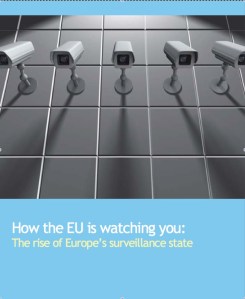
EU_surveillance
The Open Europe report

I have just got hold of a new report by UK-eurosceptic think-tank, Open Europe, called How the EU is Watching You: the Rise of Europe’s Surveillance State, which whilst it isn’t as startling as the NeoConPanopticon report from the Trilateral Institute and Statewatch, does some to collect some useful information together in one place. Crucially the report points out the same thing as Will Webster and I did in our paper in JCER a couple of months ago, that this isn’t just a case of ‘European’ bad practice being imposed on the UK, but just as much UK bad practice being exported and generalised throughout Europe.

One interesting footnote is how the discourse of opposition and analysis is changing. A few years ago, and still in academia, the idea of the ‘surveillance society’ was the dominant way of describing the situation, but now there is once again an increasing focus on the ‘surveillance state’ or the ‘database state’.  This is partly, I think because there are an increasing number of right-libertarian and anti-state or small-state groupings openly opposing increasing surveillance – for example, the new Big Brother Watch in the UK, and they tend to emphasise the state’s role (or in this case, the role of an organisation they regard as an unaccountable superstate). This also reflects the growing opposition from the UK in particular. This is particularly interesting because in the past, the idea of the ‘surveillance state’ was mainly a historical term to do with the development of repressive political policing, especially that involved in colonial counter-insurgency – see, for example, Alfred McCoy’s new book, Policing America’s Empire, on the role of the US occupation of the Philippines in the co-evolution of US and Filipino state surveillance practices – or in the totalitarian regimes of the former Eastern Bloc.

The landscape today is much less obviously one of state control. Indeed one could see these developments as a result of the retreat of the power of the individual state and an attempted reconfiguration of state-power of a new kind at a supranational level. And, this power is crucially dependent, as it has been since the end of WW2 on the private sector. The military-industrial complex is now a security-industrial complex and security is no longer anywhere near being simply state business.

Even video surveillance hit by global recession?

According to a new market-research report produced by Arizona firm, In-Stat, the market for video surveillance equipment has seen a slow-down in unit grow in 2009, and even a decline in overall revenue (and this may be the first time this has happened for many years). This is interesting as it is conventional wisdom that the security sector is generally unaffected or even benefits from recession (but see some previous posts here and here for other aspects of surveillance in a global recession). However the report also states that whereas sales of cameras are relatively flat, sales of data-recording equipment, especially hybrid recorders that can handle both analogue and digital images, are increasing and this is partly due to the US government’s stimulus package. This suggests that those operating exisiting video surveillance systems that may have older analogue cameras are chosing not to upgrade their cameras now but are making sure that they can retain the images more efficiently. The report predicts that, after the recovery, the overall market for video surveillance equipment in 2011 will be $19Bn US.

Mind you, I haven’t read the report in full, only this summary, because it retails at $3,495 US! Someone is clearly expecting to make plenty of money out of the recession…

Europe’s new security-industrial complex

neoconopticonThere is a superb and chilling new report out today that utterly demolishes the European Union’s claims to be in any way an  ethical or progressive leader on issues of security and surveillance. The report written by Ben Hayes for the Transantional Institute and Statewatch, documents in some detail the new vision for security in the EU, which the authors describe as a ‘neo-con-opticon.’ The report confirms a lot of things that have been concerning me about the direction and emphasis of EU security research and the increasingly unnacountable and behind closed-doors ways in which security policy is being developed. I asked back in January in an editorial in Surveillance & Society whether surveillance was becoming the new ‘baroque arsenal’, Mary Kaldor’s famous phrase to describe the huge, intricate and complex technocentric security structures of the second Cold War. This report answers that question with a resounding ‘yes’.

The press release quotes from the introduction:

“Despite the often benign intent behind collaborative European research into integrated land, air, maritime, space and cyber-surveillance systems, the EU’s security and R&D policy is coalescing around a high-tech blueprint for a new kind of security. It envisages a future world of red zones and green zones; external borders controlled by military force and internally by a sprawling network of physical and virtual security checkpoints; public spaces, micro-states and mega events policed by high-tech surveillance systems and rapid reaction forces; peacekeeping and crisis management missions that make no operational distinction between the suburbs of Basra or the Banlieue; and the increasing integration of defence and national security functions at home and abroad.

It is not just a case of sleepwalking into or waking up to a surveillance society, as the UK’s Information Commissioner famously warned, it feels more like turning a blind eye to the start of a new kind of arms race, one in which all the weapons are pointing inwards. Welcome to the NeoConOpticon.”

But don’t stop there. You can (well, you must) read the full report here: NeoConOpticon – The EU Security-Industrial Complex

And whilst you are at it, download Tony Bunyan’s equally superb report, The Shape of Things to Come – the EU Future Group, on the EU’s thoroughly undemocratic attempt to bypass public debate and hand internal security and surveillance policy over to the transnational security companies and the police and intelligence services.

(thanks to Rosamunde van Brakel for passing this on)

Locational Privacy

PDF file

The Electronic Frontier Foundation has a very good little report on locational privacy, “the ability of an individual to move in public space with the expectation that under normal circumstances their location will not be systematically and secretly recorded for later use.”

As usual for EFF, it is written in clear, understandable language and is free-to-access and download.

* I’m going to be away up to the mountains for a couple of days, so there won’t be any more posts here until Sunday at the earliest… next week is a slow one here in Japan as it is O-bon, the Buddhist festival of the dead, and many people go back to their family home and offices are generally closed for some or all of the week. I won’t be doing much in the way of interviewing, but I still have quite a few interviews and visits from the last two weeks to write up.

CCTV: expensive and limited says Home Office study

Back in 2002, David Farrington and Brandon Welsh published a study for the UK Home Office which showed that CCTV had only small effects on crime, except in car parks. Now they are back with a study that confirms all that, plus which shows that despite the evidence, more money is spent on CCTV in Britain than on any other single form of crime prevention. So much we knew, but what is a slightly unexpected finding is that CCTV apparently works better in Britain than in other countries. This is not a plus for the UK, rather it shows that in other nations it is even worse value-for-money – and it is clearly not an efficient use of public funds here as currently used. Instead the authors recommend that CCTV should be more narrowly focussed – in other words, we don’t need mass surveillance, we need targeted surveillance At the same time however, more and more money is going into CCTV in the USA in particular, where all the same ‘silver bullet’ arguments are being made as were made in the UK in the 1990s, and have now been shown to be largely unwarranted. The government has now fallen back on populism to justify the continued expansion of CCTV: ‘people want it.’ Well, on that basis, they would bring back public flogging and hanging… it would make rather more sense if they listened to the evidence from the reports they themselves are commissioning.

The full report is available from The Campbell Collaboration library, but there’s a summary in The Guardian today.