Brazil: Surveillance Society or Security Society?

although there are many forms of surveillance in evidence, Brazil is not fundamentally a ´surveillance society´

What I am doing here is a broad survey of issues around surveillance. I am trying to get to grips with as wide a range of indicators as possible. One impression I have already – which as an impression may be partly or entirely wrong – is that although there are many forms of surveillance in evidence, Brazil is not fundamentally a ´surveillance society´ in the way that the UK is, or in the rather different way that Japan is: Brazil is much more a ´security society´. This is not to say, for example, that there are not many CCTV cameras in the country: Marta Kanashiro´s article in Surveillance & Society last year indicated that there are well over a million cameras (the total is hard to estimate because of the number of illegal installations).

However, surveillance here is very much tied into security. It´s not a ´security state´ – although it still retains reminders of its more authoritarian past – the concentration on security is largely private. Industry reports I have found, for example, this one from the Massachussets South America Office, indicate that the security industry is growing at rates of betwen 10 and 15% regardless of wider economic trends. Foreign companies are poised like vultures over the thousands of SME security companies that make up the huge private security sector, and positively salivate over the high crime figures.

If one talks in abstracts and absolutes, investment in security at a national level seems to make a difference to these figures. The Fórum Brasileiro de Segurança Pública (or Fórum Segurança, the Brazilian Forum on Public Safety), an independent network of local groups, experts and members of state and private secuirty organisations, has started to publish an annual report. The second report, available late last year, indicates a strong correlation between increased spending ($35 Billion US in 2007) and the decline in homicides. For example, in Rio there was an increase in spending of 4.4% and a decline in homicides of 4.7%. A summary in English is available here.

The big thing is not so much public space surveillance (although the industry report mentioned above estimates a $1Bn US market for electronic surveillance technology mainly for the private sector), but both fortification (especially the upsurge in the building of secure condominiums) and the increasing numbers of human security operatives. These may be private security, the new Municipal Guards – basically private security now employed by more than 750 local mayors – or even more worryingly, the urban militias, particularly in Rio. Despite the massive investment in public safety highlighted by Fórum Segurança, official police and other state agents of security and safety are still poorly paid, demotivated and not trusted. To remedy their perceived weakness, in particular in dealing with drug trafficking gangs, so-called Autodefesas Comunitárias (ADC, or Community Self-Defence) groups have emerged. These are paramilitaries made up of current and former police, soldiers, firemen and private security, who basically invade favelas to drive out traffickers in the name of safety, but which soon come to dominate the area and create a new kind of violent order. Now a report by the Parliamentary Hearing Commission into the Militias of Rio de Janeiro, has named names (including several local representatives), and various measures are promised.

Identity and Identification in Brazil (continued)

…the Brazilian driving licence is a goldmine of personal information…

I spent a little while over the last couple of days examining the actual material identity documents currently required in Brazil. Here are some pictures with a little explanation. There will be a lot more in the final article!

The first is the simplest but in many ways the most important to life-chances. This is the Cadastro de Pessoas Físicas (CPF) (Register of Physical (or Natural) Persons) card (or Taxpayer’s Card).

CPF

‘Pessoas Físicas’ is a a piece of legalese that is draws a distinction between humans and other ‘legal persons’, like corporations or governments. The CPF number is issued to all those who pay tax and is essential if one wants any formal work. The actual document is a blue plastic card like old-style credit cards, which also has a machine readable magnetic strip on the back.

The number is also required for many other government transactions, and it is, apparently a major disaster if you lose the card, or if for some reason, your CPF number is rescinded (which can happen if you don’t pay tax in Brazil for more than a year, for example if you are abroad, without explanation). Many people who live in the favelas, and who are involved in the shadow economy do not have a CPF, which is a severe obstacle to social inclusion.

The second document is the Registro Geral (General Registry) (ID) card, a double-sided piece of thick paper, just larger than a credit card. It is oriented vertically at the front and horizontally at the back.

RG card

As I noted in the first post I made on this subject, the RG card cross-references the CPF and also birth certification (it lists the full names of both mother and father and city and state of origin). This card is the one that is being replaced by the new RIC smartcard ID system.

Finally, we have the Carteira Nacional de Habilitação, the driving licence which, despite its name, is issued at state rather than national-level. The colour and format differs from state-to-state, however they all have pretty much the same level of information (a lot!) and cross-identification with other forms of ID. This one is from Paraná, which is a paper usually folded in half horizontally. It is specifically forbidden to laminate it.

RNDH

The Brazilian driving licence is a goldmine of personal information. Partly this is because the licence had been intended to be a unifying piece of identification (a practice typical of ‘autocentric’ cultures!), containing all the information on both the CPF card and the RG card, and more. This will now not be the case following the issuing of the new RIC cards, so it will be interesting to see if the quantity of information on these licences will be reduced or, if not, what the justification will be for having this much visible personal information on one paper document.

Violent Crime in Brazil

Murder rates in Brazil and Sao Paulo (The Economist)
Murder rates in Brazil and São Paulo (The Economist, 2008)

Most people tend to think of Brazilian cities as divided and violent, with especially high rates of gang-related gun deaths in and around the favelas. Certainly that was the impression I was starting to get. However, there was an excellent piece last year in The Economist on falling murder rates in Brazilian cities. Yes, that´s right, I said falling murder rates. And not just falling, plummeting.

However, as the article points out, the decline is largely due to a halving of the murder rate in Brazil´s second city, São Paulo. The Economist put this down to a combination of: tighter gun control; better policing (including community policing initiatives and a large new Murder Squad, which ¨uses computer profiling to spot patterns and to act preventively¨); and, a relative decline in the youth demographic as the baby-boom cohort of children born after the mass immigration from the 1970s ages – the gangsters are getting older and getting out of crime, and there are slightly fewer young recruits to replace them. But one note of caution is that this may all be the temporary result of one particular gang gaining a dominant and unchallengable position. My view (not The Economist´s) is that if this latter development is a genuinely long-term trend, it could either result in a move to more legal community development activities by the gang (as has happened in some US cities) or a more stable but persistant pattern of criminality such as that in exhibited by the endemic gang-cultures of Southern Italy or in Japan…

Of course, I should also note that these figures are official ones from the Ministry of Health and I have no idea yet how reliable are the collection or categorisation methods for crime statistics used by the Brazilian authorities.

(thanks to Rodrigo Firmino for this one)

The new Brazilian ID system

The new Brazilian ID-card
The new Brazilian ID-card (from Renato Siqueira's Conversa Digital)

There are more details of the new Brazilian ID card and system on Renato Siqueira’s Conversa Digital blog, including some informative images and photos. It seems that far from eliminating the various different numbers currently used, this new system will merely create a kind of overlay. And, not only that, but the CPF, RG and electoral number will be printed on the back. Unless every single transaction will actually require the taking of fingerprints or the verification of photos, this card will be even more of a convenient source of personal information to thieves and fraudsters than ever before. Plus the chip technology is the same standard format that has proved to easy to clone and access illicitly elsewhere…

Identity and Identification in Brazil

My host and colleague here at PUCPR, Rodrigo Firmino, and I are working on a small bit of research and a paper for The Second Multidisciplinary Workshop on Identity in the Information Society (IDIS 09), at the the London School of Economics, on June 9th this year.

Our paper is based around a case of identity theft, which is endemic in Brazil, which we use to open up the laws, practices and technologies of identification here. One thing that is already clear is that Brazil is a highly bureaucratic state – for example, the forms you need to fill in just to get a mobile phone are incredible in their detail – yet the forms of identification which one needs for every transaction with the state and many private organisations too, are highly insecure.

One example is that every personal cheque has printed on it not only the usual information (bank name and address, bank sort code, account holder name and account number), but also has the 11-digit Cadastro de Pessoas Fisicas (CPF) (a taxpayer’s card) number and the 9-digit Registro Geral (RG) (the national ID card) number. This must be a utter joy to fraudsters and identity thieves!

What’s more, all these are not just numbers in a database somewhere but physical documents in their own right, and on each there is a lot of this cross-identification: the CPF card also has the name and date of birth, the CPF number is ubiquitous, appearing also on the RG card and the driving licence. The latter has its own 11-digit registration number, but also has the RG number, name, and place and date of birth. What is even more interesting is that the RG card not only contains a photo and a thumbprint (the state database contains prints of all 10 fingers and thumbs), but also the names of both parents. This means it can be related more easily to the birth certificate. It reminds me a little of the Japanese system which still prioritises the family above the individual in some ways, but there is no actual equivalent of the koseki, the Japanese family register.

Now, in the name of security and “para integrar os bancos de dados de diversos órgãos dos sistemas de identificação do Brasil” (to inegrate the databases of the diverse organisations of identification systems in Brazil), the Ministry of Justice is proposing to merge some of these – the RG, CPF, Driving Licence and Electoria Regisirtation, into a new, smart, Registro de Identidade Civil (RIC) card based on a unique number. Whilst this will have many of the same problems as new smart ID systems everywhere else, at the very least it might stop Brazilian citizens carrying around multiple documents that list almost everything thieves and fraudsters need and can access without any sophisticated equipment. The process is due to start now, and run until 2017, so we will be taking a look at this as it proceeds.

I’ll put some pictures up with explanations later today…

First impressions of Brazil

“whilst Curitiba may not be as divided as its bigger northern neighbour, the pervasiveness of defensive urban architecture is clear”

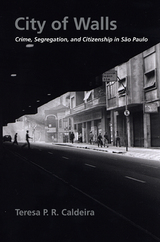
City of Walls by Teresa Caldeira

I have only been here a few days, but some things are already pretty clear. Brazil does not (yet) seem to be as obsessed by surveillance as the UK, but there is a noticeable concern with physical security. The Brazilian urbanist, Teresa Caldeira, called Sao Paulo the ¨City of Walls¨ in her excellent book of the same name, and whilst Curitiba may not be as divided as its bigger northern neighbour, the pervasiveness of defensive urban architecture is clear. Even fairly ordinary suburban houses have high walls, fences and gates,  and some boast razor wire or even electric fences on top. Shopping malls and banks have large numbers of private security guards who are not just hanging around doing nothing as they do in the UK, but seem alert and active. When I went to change some traveller´s cheques, the agency could only be accessed one person at a time, via two locked doors with intercoms and an intervening antechamber with a metal detector.

What is the source of the fear? Of course it is the poor, and in particular the favelados (the people who live in the favelas, the informal settlements that line the riverbanks). Even though in Curitiba, there are not so many favelas and they are not so extensive as in the larger cities of Brazil, the favelas are still no-go areas for non-favelados and I have been warned not even to think about entering. Of course I will be later in Rio, but I will have local help (I hope). Whether one thinks that these are people driven to desperation and crime, or as one contact here said, it is because the drug-runners chose to live amongst the favelados because the police will not follow them there, the division between the favelados and the rest of society is obvious. It is also blatantly racial. The favelados are generally darker, although in Curitiba, which is generally a more European and less African part of Brazil, there are also a significant number of favelados of eastern European descent, the families of immigrants who came to work in construction and were later left without work.

The engineering faculty of the Pontifical Catholic University of Parana, home to the Postgraduate School of Urban Management, where I am based for now, is right up against one of the favelas of Curitiba. The large windows at the back have had to have concrete shields fixed across them as some young guys from the favela had started to enjoy testing their guns out on the panes. There are still a few bullet holes visible in the walls! But don’t let me give you the impression that this is a war zone, or that everyone is paranoid and afraid of each other. It doesn’t seem that way either, and I don’t feel any less safe than I did in Washington DC in the early 90s…