Today there probably won´t be that much new here as I am concentrating on preparing for interviews for the next two weeks in Saõ Paulo and Brasília. I will be talking to various NGOs (mainly concerned with urban violence and security), academics, parliamentarians and representatives for the federal police and government ministers. I am also meeting Danilo Doneda later today, who is the leading Brazilian legal expert on privacy and data protection, and a member of the Habeus Data network, which campaigns for information rights in Latin American.
(My netbook has also decided not to work today, so if I can´t get that fixed there might not be much here at all for the next two weeks! Why do these things always happen just when it is least convenient?)
One of the purposes of my project here is to differentiate what is the product of globalising forces (or indeed generator of such forces), and what is more specific and particular to each of the countries and cities that I am examining. If you skim Mike Davis and Daniel Bertrand Monk´s 2007 collection, Evil Paradises, you can certainly come away with the overall impression that everything bad in the world is down to neoliberal capitalism. But actually, many of the contributors to that book, particularly Tim Mitchell on the reasons why the state and private capital are so entangled in Egypt and Mike Davis himself on Dubai, are quite careful about describing the particular historical roots and contemporary developments that have led to the situations they observe. I am trying to do the same.
As I wrote last week, the private security industry here in Brazil is obvious and ubiquitous. It is easy to see this simply as part of a trend towards privatisation, and the growth of personal, community and class-based responses to risk and fear that is pretty much the same, or is at least in evidence, all over the world. However, there are several factors here that point internally and backwards in time. The first was made clear to me reading James Holston´s superb 2008 book Insurgent Citizenship, which is both an excellent ethnographic study of contemporary conflicts over housing and land in Saõ Paulo and an illuminating historical account of the roots of such conflicts in the development of citizenship, property rights and order in Brazil from its foundation.
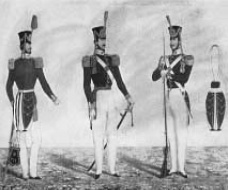
Brazilian National Guard troops in the C19th
Holston makes a comparison between the foundation of Brazil and the other, and in many ways superficially similar, federal state in the Americas, the USA. He argues that whilst the USA consolidated itself within a smaller territory before expanding west, Brazil arrived as a massive fully-formed state. In consequence, the USA developed a form of governance that expanded with the territory, and this included centrally-determined land surveying and an emphasis on small townships to control territory and organise development. Brazil on the other hand, being basically divided between highly administered colonial towns and practically no administration at all elsewhere, had ´an incapacity to consolidate itself´ (65). The state therefore depended on large landowners, and in particular after the creation of the National Guard (1831), which was delegated to these property owners, these landowners also acquired a military-police power. Effectively, this conflation of private interest and the law, or coronelismo, was built into the governing structure and culture of Brazil.
One of the thousands of private security firms...
It is a masterly analysis but Holston´s one slight error, I think, is to call this ´a nationwide privatisation of the public´ (66). It is hard to argue this when the public had never really yet existed in anything like the idealised sense in which it is used by political scientists – in other words the nature of the ´public´ in Brazil was always pre-defined by the private, and by the power of the private, rather than the other way around. In other words, what has happened since, off and on, has been a struggle by the more democratic and progressive interests in Brazil to bring the private into the public. You can see this right up to the present day with the struggles by the state to prohibit and eradicate the so-called Autodefesas Comunitárias, the authoritarian paramilitary groups that have emerged in Rio and other cities in recent years. The struggle is essentially one of creating the ´public´.
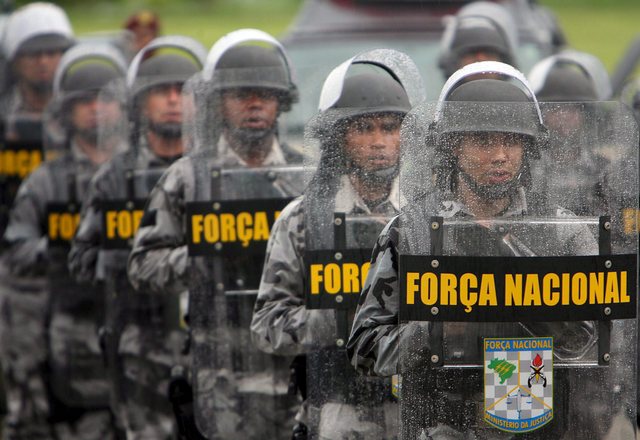
Members of the elite Brazilian National Public Security Force in training, 2007 (EPA/Antônio Lacerda)
The ADC issue highlights another historical reason for the dependence on and trust in, private security in Brazil. The reason is simply that the law is not trusted. Judges and courts have long been perceived as essentially tools of privilege and the official police in their various forms are not trusted by many people of all social classes. The former, as with coronelismo, goes way back into the post-colonial period, but the latter is also a particular legacy of the dictatorships (which can also be seen as the ultimate private control of the public), the last of which only ended in 1985. This leaves Lula´s government, the first that can really claim to be at all progressive, with several major problems: making an untrusted police more trustworthy whilst at the same time increasing their effectiveness and equipment; regulating the thousands of private security firms and, if possible, reducing the dependence of property-owning Brazilians upon them; and finally, and most importantly, dealing with the massive underlying inequalities, that are also a product of what Holston calls the the inclusive but inegalitarian nature of Brazil´s constitution and subsequent socio-economic development. The latter subject is outside the scope of my project, but I will be continuing to delve into the differentiations and intersections between segurança pública and segurança privada whilst I am here.
I can’t say I am remotely surprised, but in the journal, Homeland Security Affairs, Marcus Holmes has written a comprehensive demolition of the claim that the US federal government’s No-Fly List is an efficient security policy. He isn’t concerned with civil liberties – ACLU has done that elsewhere – nor with effectiveness – Bruce Schneier nailed that one a while back. He simply demonstrates, using elementary Cost-Benefit Analysis that the policy is a big fat waste of money. The article isn’t complicated to understand, so the best thing I can suggest is that you just go read it… (and thanks to Bruce Schneier and Boingboing.net for posting on this one).
CCTV cameras are seen as the answer to anything and everything. It’s not much more than a form of magical thinking.
Two contrasting CCTV stories today.
On the one hand, we have a seemingly typical story of civic authorities wanting to install cameras, right down to the lazy, cliched, headline: ‘Smile, you’re on surveillance camera’ – how many times have we seen variations on that one? The cameras are proposed to arrest a decline in custom at a busy city market except… that the city is Jerusalem, and the market is the Mahane Yehuda market, a favoured target for suicide bombers. Now, I am not entirely sure how cameras will stop a determined suicide bomber, who by definition isn’t really that bothered about being seen committing a crime, but this is just an extreme case of underlying causes being missed. There are the usual civil rights concerns raised, and the effectiveness of cameras questioned. But suicide bombing isn’t just some unavoidable fact of life, it’s directly related to the ongoing repression by Israel of the Palestinian territories… a clear case of sticking plaster for a mortal wound if ever I saw one.
Here as in many cases, CCTV cameras are seen as the answer to anything and everything. It’s not much more than a form of magical thinking.
On the other hand, we see the town of Cambridge, Massachusetts, voting against allowing Homeland Security cameras to be used. It’s another extreme case of course. You could hardy find a more comfortable and safe middle-class town with a higher concentration of liberal intellectuals – they even had a former head of ACLU speaking at the meeting. It must be positively terrifying to be a city councilor in the face of informed opposition like that. Of course the story is replete with all kinds of ironies, not least the city representative who argues that the city voted against it only because there hasn’t been enough public participation!
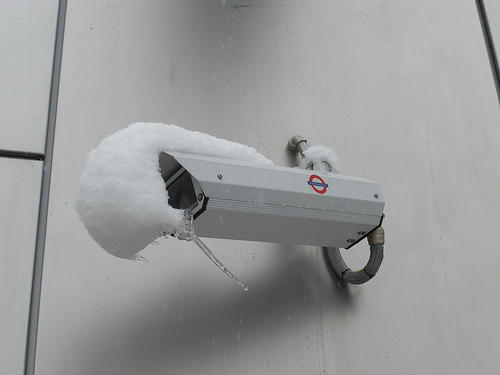
However, as the article also notes, the cameras are already installed, they just aren’t switched on. Perhaps, like this snowbound camera photographed yesterday in London, their ‘magic’ will work anyway and everyone will be happy…
They can see through snow, you know. London CCTV camera (by Almost Witty on boingboing.net)
One of the items reported on in Privacy International´s assessment of privacy in Brazil was that ¨in November 2006, the Brazilian National Road Traffic Council approved a Resolution adopting a Radio Frequency Identification (RFID) tags in all licensed vehicles across the country.¨ The Conselho Nacional de Trânsito (CONTRAN) is part of the Departemento Nacional de Trânsito (DENATRAN), itself part of the massive new Ministério das Cidades (Ministry of Cities), the product of Lula´s major ministerial reforms designed to shift emphasis and power away from the large rural landowners to the growing numbers of increasingly populous cities.
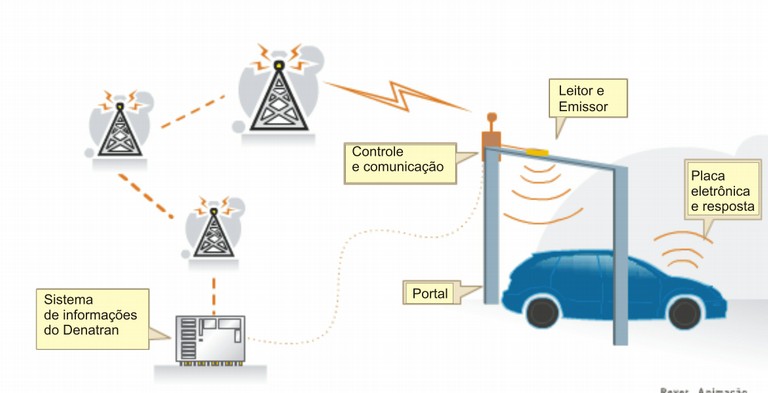
The new scheme is called the Sistema Nacional de Identificação Automática de Veículos (SINIAV, or National System for the Automatic Identification of Vehicles). Basically it will put an RFID-tag in every vehicle license plate, in a gradual process. Much like the new ID scheme for people, SINIAV is based on a unique number. In Annex II, Paragraph 3, the resolution provides a breakdown of exactly what will be contained in the tiny 1024-bit chip as follows. The unique serial number (64), and a manufacturer´s code (32), will be programmed in at the factory, leaving a total of 928 programmable bits. The programmable area contains two main sections. The first contains all the personal and vehicular information: place of registration (32), registration number of seller (32) application ate (16), license plate number (88), chassis number (128), vehicle tax number (RENAVAM) (36), vehicle make and model code (16) and finally 164 bits for ´governmental applications´. The remaining 384 bits are split into 6 blocks for unamed ´private initiatives.´
SINIAV system diagram (DENATRAN)
Privacy International note that there is no more than a mention of conformity to constitutional rules on privacy (of which more later). However there is much more that is of concern here. The resolution claims that the data will be encrypted between plate and reader, but the technical specifications are not given to any level of detail (*though there is more information from the Interministerial Working Group on SINIAV, which I haven´t examined in any detail yet). We all know already how easy it is to clone RFID chips. This scheme is supposed to be about security for drivers, but it could easily result in the same kind of identity fraud and consequent necessity of disproving the assumption of guilt created by automated detection systems for car-drivers as for credit cardholders. Could you always prove that it wasn´t your car which was the gettaway vehicle in a robbery in Saõ Paulo, or you driving it, when your actual car was in a car park in Curitiba? Widespread cloning of chips would also render the whole system valueless to government.
RFID chip
Then there is the question of function creep. The chip has spare capacity, and assigned space for unamed functions, state and private. Brazil already has a system of state toll roads (pay-for-use highways), and these chips could certainly be used as part of an automated charging system. That might be very convenient. However what other functions could be thought up, and how might safeguards be built in? As I have already noted, Brazil has no body for protecting privacy or data/information rights so it would be very easy for new more intrusive functionality to be added.
Combining the problems of a movement towards automated fines or changes, and criminality, another major issue would be the one recently revealed in Italy, where a automated red-light camera system was found to have been fixed in order to generate income from fines for corrupt police and a multitude of others.
The final question of course is whether this will all happen as planned or at all. The system would supposedly be complete by 2011. I know of a trial scheme in Saõ Paulo, but on a quick (and very unscientific) straw poll of people who I encountered today at the university here in Curitiba, there is to be no-one who has an RFID license plate or knows someone who does, and there is practically zero awareness even amongst educated professionals. Like the National ID-card scheme, people just don´t think it will go to plan or timetable. That may however, just reflect a (middle-class) Brazilian view of the abilities of the state.
Still, as the Frost and Sullivan market assessment states, all of this turns Brazil into a ‘highly attractive market for RFID suppliers’ which was probably the main motivation and will be the only real outcome.
This time they are talking to Dan Trottier and Val Steeves about the way that social networking technologies, and in particular Facebook, track individuals and groups.
News from Queen’s University’s Surveillance Project that the Surveillance Camera Awareness Network (SCAN), a stellar group of Canadian Surveillance Studies scholars, has released the first phase of its report on Camera Surveillance in Canada.
The report shows that public space CCTV is still relatively rare in Canada, with only 14 cities having implemented it. It argues that despite the lack of evidence for any effectiveness, and the absence of proper informed consent to schemes, the vast majority of the public support cameras largely on the basis of an ill-defined hope that they ‘work’.
My view is that the conditions for a British-style expansion would seem to be in place, were it not for the very different and much more activist role of Privacy Commissioners, informed by research like this, in questioning the need for CCTV. Let’s hope Britain’s role as an experimental surveillance guinea pig for the world will at least teach people elsewhere something…
The authors also mentioned that there is a surveillance series in the Ottawa Citizen that began Wednesday January 29. It features many surveillance studies academics from SCAN and more, and the first piece is really very good.
As another part of the series, the Citizen has adapted the 2016 scenarios that Kirstie Ball and I wrote for the Report on the Surveillance Society for the ICO back in 2006. They have pushed a load of things together so that it doesn’t quite makes sense, but never mind…
Every year, Privacy International publishes a kind of index of privacy. The methodology is qualitative and has a strong element of subjectivity based on PI´s campaigning objectives (for example my colleague, Minas Samatas, finds their assessment of Greece as the best country in Europe in this regard, ludicrous). There are also problems with the equivalence of the all the different categories, both in terms of whether all the surveillance identified is even ethically ´bad´ anyway, and in the adding up of categories to conclude that you can lump together the USA, UK, Russia and China. However, it remains a good focus for discussion and no-one else does anything similar.
Let´s see what they concluded about Brazil. Brazil ends up in the 3rd worst category overall, with a ´systematic failure to uphold safeguards´. In particular, PI condemned:
the role of the courts in weakening constitutional rights of data protection (something I will be coming back to next week);
the lack of a privacy law;
the lack of habeus data provisions;
the lack of a regulatory of personal data and privacy;
an overly simplistic test for the legailty of communications interception;
the new ID law;
recent Youtube censorship;
increasing workplace surveillance, which has only been partially addressed by the courts;
widepsread private interception of intenet and e-mail traffic;
that fact that ISPs are required to keep and hand over traffic data to police;
the extensive road transport surveillance using RFID.
However they also noted:
the protection of the right to privacy of children under a 1990 law; and
the fact that bank records are protected under the constitution, and warrants are required to seize them
I will be going through their country in report in more detail next week and using this as one of the bases for the questions I will ask NGO representatives and parliamentarians in the weeks after wards.
The American Civil Liberties Union (ACLU) is calling for President Obama´s administration to release secret files that would shed light on the previous US government´s security and surveillance policies, including the now use of torture and warrantless surveillance. It´s a good move of course, but as I´ve previously remarked, the NSA and others have been doing this for almost 50 years, either directly or indirectly through UKUSA allies, warrants or no warrants, so what makes anyone think that they only started doing this under Bush or will stop if such information is released? As intelligence researcher, Loch K. Johnson, remarked about the Church Committee hearings in the 1970s, one thing they showed was that, when it came to illegal intelligence activities, the office of the President was an irrelevancy. Bush was probably even more irrelevant than most. Still, sunlight is the best disinfectant… but if Obama can change the internal culture of US intelligence, he will truly have performed a miracle.





 ubisurv