Anti-surveillance clothing

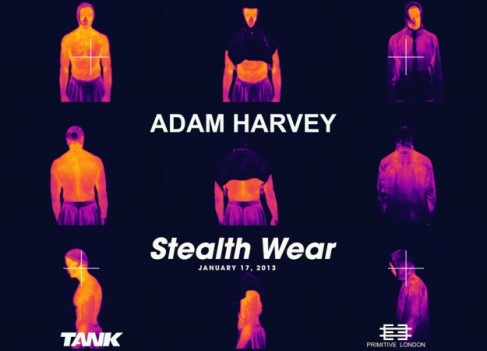
I just received notice of a fashion show: not the kind of thing I used to blog here back when I was blogging regularly – hello again BTW, this will be the first post in a revival of this blog, apart from anything else I miss the combination of disciplined regularity and almost random new directions that blogging brings – anyway, the fashion show is by a New York artist, Adam Harvey, who will present various items designed to counter surveillance of different kinds.

stealth-wear-487x351

There has been a growth in both surveillance and anti-surveillance clothing over the past few years. Back in the 2000s, we saw items like the Bladerunner GPS-enabled jacket – supposedly to enable parents to keep track of their kids but which would probably be more likely to tell them which bus they’d left it on or which friend they’d lent it to – and even earlier, Steve Mann‘s lab had been creating artifacts that combined engineering and art to subvert or reflect surveillance in ways both serious and humorous. More recently we’ve seen anti-surveillance make-up – another art project. But while artists have explored anti-surveillance and sousveillance, the general trend does seem to be towards clothing enabled for surveillance or at least connection into systems which require surveillance of the item or its wearer as part of some augmented reality / ubiquitous computing scenario.

Surveillance Image of the Week: Global Satellites…

A great graphic from Michael Paukner on Flickr of all the world’s satellites, working and defunct, plus debris, by country. Interestingly, China and France appear to the worst litterers of space as a proportion of the amount of stuff they have up there. Russia have the most out of commission satellites and the USA (not surprisingly) have the most working devices. Of course, this graphic doesn’t distinguish civil from military, nor say what are their functions, but the sheer amount of stuff in orbit indicates why there will be serious conflict over the use of orbital space soon enough…

Sorting Daemons

Kathleen Ritter (2006) 'Hidden Camera'

After the excellent opening seminar over the weekend, the exhibition, Sorting Daemons: Art, Surveillance Regimes and Social Control is on at the Agnes Etherington Art Centre in Kingston, Ontario, from 16 January – 18 April. The exhibition features works in a range of media-including painting, photography, video, installation and responsive electronic art-by artists Brenda Goldstein, Antonia Hirsch, David Kemp, Tran T. Kim-Trang, Germaine Koh and Ian Verchere, Arnold Koroshegyi, Ruthann Lee, Michael Lewis, Jill Magid, Walid Ra’ad; Kathleen Ritter, David Rokeby, Tom Sherman, Cheryl Sourkes and John Watt.  There is also a special video program, which draws on artists’ tapes produced over the past two decades. This exhibition extends off-site with presentation of Kathleen Ritter’s Hidden Camera at the Union Gallery in Queen’s University’s Stauffer Library until March 9.

The curators, Jan Allen and Sarah E.K. Smith, are also interested in having the exhibition go on tour in future, and would like to hear from galleries who might want to host the show. I’ll pass on any such inquiries…

Surveillance Image of the Week No.4: Being Invisible

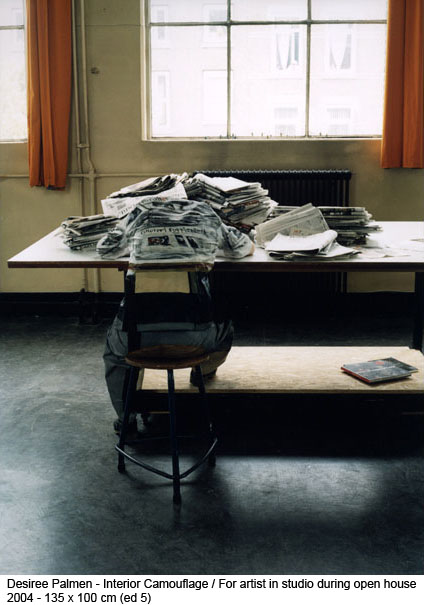
David Lyon sent me a reference to this wonderful Dutch artist, Desiree Palmen, who makes painstakingly painted or modelled invisibility disguises to comment on the ubiquity of video surveillance. They are somehow more beautiful for their hand-crafted (as opposed to high-tech) nature. For the picture below, her technique was to take a photograph of the interior and then paint it onto a canvass designed to be worn by the subject, who was then photographed again wearing the painted canvass in place.

Manu Luksch

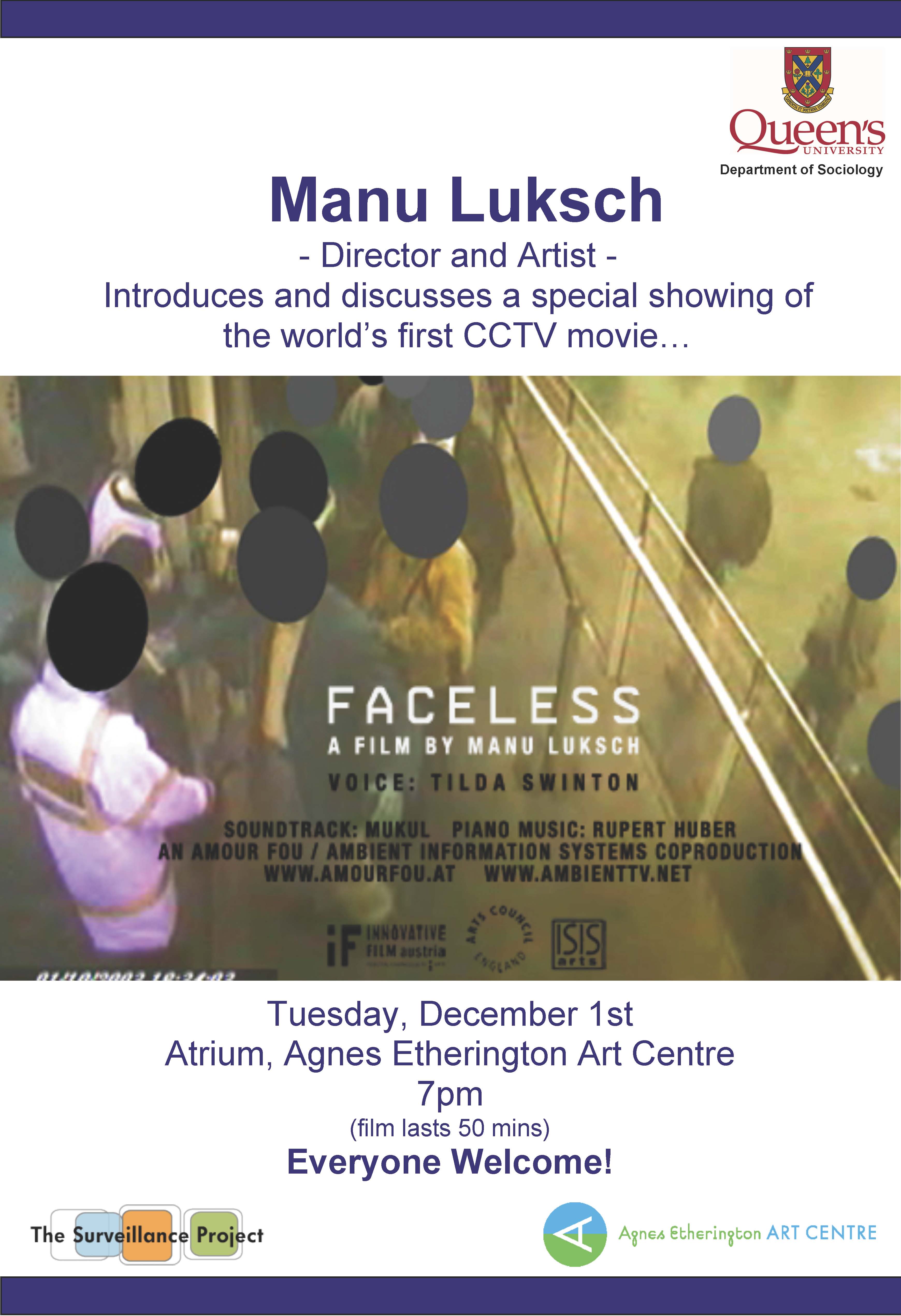
I am hosting the London-based Austrian new media artist and film director, Manu Luksch, here at Queen’s for a couple of days. On Tuesday 1st December, she is giving a presentation on her work on censorship in Iran and then in the evening, she is introducing and discussing her film, Faceless, a movie composed entirely of ‘found’ video surveillance footage (see the poster, below). You can find out more about her work on her website. She’ll be going on from here to Montreal…

Surveillance image of the week 3: remembering One and Other

One and Other, Anthony Gormley’s remarkable populist and popular participatory artwork, which enabled 2400 ordinary people to spend an hour each on the vacant fourth plinth in London’s Trafalgar Square, ended recently. Not surprisingly, given London’s reputation as a the surveillance capital of the world, there were some pointed reminders. This ‘plinther’ spent her hour dressed as a CCTV camera looking at the watchers and the watched…

CCTV plinth protest
CCTV plinth protest

(thanks to Eric Stoddart for this)

Surveillance picture of the week…

Surveillance light designed by Per Emanuelsson and Bastian Bischoff, Humans since 1982 (Victor Hunt Gallery).

My picture of the week comes from a fascinating-looking exhibtion at the Arts Centre, Washington (in the north of England) from October to November 2009.

(Thanks to Roy Boyne for sending this.)

Philippines: military targets writers and artists

There have been a couple of interesting stories that have caught my eye from the Philippines concerning the surveillance of writers and artists by the military. First, soldiers were discovered to have been watching the house of Bienvenido Lumbera, a major artist. More recently, prize-winning writer, Pedro “Jun” Cruz Reyes Jr. has complained of surveillance of his house by unidentified men in a white van – and this isn’t the first time.

The first incident was dismissed as a ‘training exercise’ by the Philippines Armed Forces (AFP) – which, even if it were true, hardly excuses the actions, although it does attempt to remove the suspicion of a concerted program or illicit policy. Now, with this second complaint, that first excuse starts to sound a little more hollow. But, there are some other facts here that make me more suspicious, in particular the status of both these artists as critical figures in Filipino cultural life, and secondly, a recent controversy over the attempt by the military- and US-backed President Arroyo to award special prizes to some of her favourite popular filmmakers and comics artists, an act which was prevented by the courts after complaints by, amongst others, Lumbera.

Of course, this kind of surveillance as personal harassment (because it is so obvious that it must be designed to be seen by the person being watched) is typically thought to produce a ‘chilling effect’ on democratic debate and criticism. The culture of fear and repression is often the result of the military being over-prominent in everyday life. In the Philippines, with its history of US military-colonial dominance, dictatorship, political killings, and the longstanding conflict between the AFP and Islamic separatist groups (which is also a conflict between landowners and peasants) in Mindanao, such an atmosphere is pervasive.

The treatment of these two artists pales in comparison with the treatment of others. Back in 2007 the United Nations Special Rapporteur, Philip Alston, condemned the use of violence, arbitrary imprisonment and intimidation by both army and police under the cover of ‘anti-terrorism. The worldwide writers support group, PEN, estimates that since 2001, 60 journalists have been murdered in the Philippines, and in total 903 killings and hundreds more ‘disappearances’ of people from all walks of life have been reported. In August, the writer Alex Pinpin, and four friends who made up the s0-called ‘Tagaytay 5’ were finally released after a popular campaign. They had been held for 859 days without access to a lawyer and had been threatened, beaten and tortured in the name of the ‘War on Terror’. They were alleged without foundation, to have been members of a paramilitary group, the New People’s Army.

Read more from PEN here – it’s certainly eye-opening.