Watching Downtown Tokyo

So, I’m back in Tokyo until next April, revisiting the areas which I examined in 2005-6, where surveillance cameras have been installed by the Tokyo Metropolitan Police, and the wards where I did case-study research on community safety development in 2009 (see my posts in this blog from July to September 2009).

One initial impression is that the progress of video surveillance has not perhaps been as rapid as I would have thought, but it may be that this impression is mistaken. Certainly, the numbers of cameras deployed by the TMP have not increased rapidly. While I looked initially at Shinjuku’s Kabukicho district, where cameras were first introduced in 2002 and Shibuya and Ikebukuro (2004), they were also introduced in Ueno (2006) and Roppongi (2007). The numbers of cameras in these areas and the technologies in use have not changed greatly since their introduction: Kabukicho has 55; Shibuya, 20;  Ikebukuro, 49; Ueno, 12; and Roppongi, 44. The cameras are all in areas associated with the night economy – pink or ‘red line areas’, or what in the UK would be called ‘red light districts’ or places strongly associated with gang-related nightlife activities.

From then there was a gap and nothing happened until this year, when the TMP introduced a small number of cameras into an area they seem to have previously overlooked: the so-called ‘Kabukicho of the East’ – it’s even referred to in this way by tourist guides – Kinshicho in Sumida ward, still very much a rough, working class area. Kinshicho is apparently known for two things: gambling (on horse-racing – it’s not coincidentally the HQ of  the Japan Racing Association) and ‘gaijin bars’ (or hostess bars staffed by foreign hostesses). But, if one examines the crime maps produced by the TMP, Kinshicho is not a particularly high crime area especially compared to its western counterpart, Kabukicho, and there are other areas of dubious repute in Tokyo, so what’s behind this particular move at this time?

AJ201205130014M
CCTV cameras at the Tokyo Sky Tree Tower (Hirotaka Kawakami)

This is simply speculation on my part, and I will be talking to police and others about this in the next few months, but Sumida ward is gentrifying. In 2006, the massive new Olinas shopping complex was built in the Kinshicho area, and then in 2012, the Tokyo Sky Tree Tower, the new communications tower for Tokyo, complete with associated shopping and entertainment complex, landed in Oshiage, just to the north. Shitamachi (literally ‘low city’ – or downtown) areas have become fashionable now and not just among tourists. But this nostalgic search for an older, ‘authentic’ Tokyo, usually that of the post-WW2 period, is limited to safe images of craftsmen, small shops, stand-up bars, street food, hard-work and propriety. Frankly, Kinshicho seems to be seen as an embarrassing throwback to a shadow image of the ‘bad old days’ of the shitamachi of gangs, gambling and the sex trade, that the authorities at least do not want associated with the new and more pleasant presentation they are seeking to create.

But the TMP cameras are only a small part of the story of public space video surveillance in Tokyo, and if one sticks to the police numbers, one would get a very misleading impression. For example, the Sky Tree Tower has been the focus of a major introduction of video surveillance through the main mechanism for public space surveillance in Tokyo, the 2003 Anzen Anshin Machizukuri Jourei (Community Safety Ordinance). This empowers neighbourhood and shopkeepers’ associations to introduce camera systems with support from ward governments and the Tokyo Metropolitan Government. In Oshiage, a very large and locally controversial 77 camera-system was introduced from 2012, with most of the cameras (66) directly around the Sky Tree. Kinshicho also has its TMP cameras supplemented by an even larger number of non-TMP cameras – the Asahi article above claims 47 but it’s unclear whether that includes the TMP cameras or not.

The progress of community safety development is the main focus of my research here this time, so I’ll be visiting Oshiage and Kinshicho in the near future. And I’ll be writing much more about this method of crime control through development planning, as it will no doubt be a key feature of how preparations for the 2020 Olympics are made.

Research News

This is just a quick personal update to say that my long-time collaborator, Kiyoshi Abe of Kwansei Gakuin University, and I, have been successful in winning a Japan Society for the Promotion of Science (JSPS) Fellowship, for my project, Public Safety and Surveillance in the Global City: The Case of Tokyo. I’ll be heading to Japan for ten months from mid-June this year, where I will be based in Tokyo, and working with Kiyoshi (who is down in Kobe) and hopefully also with some great people from Meiji University. That’s when this blog will return to being much more of a research diary for my fieldwork again – it’s been a while!

East Asia Drone Wars

Northrop-Grumman Global Hawk (USAF)

In one of my only posts last year, around this time, I argued that 2012 would be in the ‘year of the drone’ – and it certainly lived up to that. But we’re still only just beginning. This is already the decade of the drone. Unmanned Aerial Vehicles (UAVs) are going to be everywhere in the coming few years (and of course not just in international disputes – I am writing about the spread of domestic surveillance drones for a major report on Surveillance in Canada that we’re producing right now).

Media outlets are reporting that the dispute over maritime territory between China and Japan is ramping up through the use of UAVs.  At the moment both countries rely heavily on conventional naval or fisheries surveillance vessels, which are limited in terms of speed of deployment and numbers. However, surveillance drones could enable a more consistent presence over the disputed islands (and more importantly the sea around them, whose fisheries and below seabed mineral resources are the real underlying issue here).

However, there are big differences in the politics and the political economy of each state’s strategic trajectory here. Japan is relying on its longstanding ‘alliance’ with the USA, and is likely to purchase US-made Northrop-Grumman Global Hawks, further emphasizing the military dependency Japan still has on the USA. China, on the other hand, is speeding up development of its own UAVs, in multiple different models. US industry sources seem more worried by alleged breaches of intellectual property rights in the drones’ design than by strategic issues – but of course, China has almost certainly had access to both hardware and software from downed US drones, which is all part of what some analysts are terming a ‘drone race’ with the USA.

and the Chinese version (Chengdu Aircraft Co.)

But this isn’t just about surveillance. Like the USA’s models, many of China’s UAVs are armed or can be weaponized very easily, and again like the USA, China has also been looking to export markets – most recently, Pakistan has been discussing the purchase of several armed drones from China, following the distinct lack of success in its own UAV development program.

The Global Hawks that Japan is buying are not armed, but this doesn’t mean that Japan is acting less aggressively here or will not in future used armed drones. Despite the post-WW2 US-imposed but popular ‘pacifist’ constitution of the country, the recent return to power of rightist PM Shinzo Abe might will mean both more heated rhetoric over territorial claims and attempts to increase the of the country’s self-defence forces: a review of Japanese military spending – with a view to increasing it – was announced just yesterday.

Drones would seem to be a politically popular choice in this regard as they do not involve putting Japanese lives at risk, or at least not directly; however the longer term outcomes any drone war in East Asia would not likely favour a Japan whose regional economic and political power is influence declining relative to China’s.

Will 2012 be the year of the drone?

My first post of 2012 – and, yes, my New’s Year’s Resolution is to blog regularly again – is not about a new subject. Unmanned Aerial Vehicles (UAVs) or drones, are already on their way to being a standard tool of national security and increasingly of policing too. However, given decreasing price of small Micro-Unmanned Aerial Vehicles (MAVs), it was also inevitable that NGOs, activist and citizen groups and even individuals, would soon start to operate them as a form of sousveillance or counter-surveillance, or simply as surveillance.

Some Occupy protestors in Europe and the USA had already made use of commercially available MAVs to broadcast footage of protest. And, the BBC reports today that the Sea Shepherd Conservation Society, the radical direct action anti-whaling group, will this year use an Osprey drone aircraft to monitor Japanese whaling fleets operating in the southern oceans. Sea Shepherd has always been technically adventurous (and PR savvy), operating radar-invisible speedboats and even a submarine in the past.

But it all suggests that drones have made the leap from military to policing to civil use with remarkable speed, and I suggest that in 2012 we will see the proliferation of MAVs operated by non-government users. Let’s just see how fast governments now try to outlaw drones in response…

Sea Shepherd activists test their drone


Guess who likes the UK’s proposals to control the Internet?

In the wake of the riots, several British Conservative MPs, and indeed PM David Cameron himself, have suggested a harsher regime of state control of both messenger services and social networks. Their suggestions have attracted widespread derision from almost everybody who either knows something about the Internet and communications more broadly, or who places any value on freedom of speech, assembly and communication and regards these things as foundational to any democratic society.

However, the a yet vague proposals have gained support from one quarter: China. The Chinese state-controlled media have suggested that the Conservative Party’s undemocratic suggestions prove that the Chinese state was right all along about controlling the Internet and that now these events are causing liberal democracies to support the Chinese model of highly regulated provision (via Boing Boing).

This is pretty much what I have been suggesting is happening for the last 2 or 3 years – see here, here, here and here. It is just that now, the pretense of democratic communication is being dropped by western governments. And just in case David Cameron doesn’t get it – and he really does not appear to right now, no, it is not a good thing that the Chinese government likes your ideas: it makes you look undemocratic and authoritarian.

Helping robots find their way in the city

Many approaches to developing cities as automated environments, whether this be for robotics, for augmented reality or ubiquitous computing tend to take as their premise the addition of items, generally computing devices, to the environment. Thus, for example, RFID chips can be embedded in buildings and objects which could (and indeed in some cases, already do) communicate with each other and with mobile devices to form networks to enable all kinds of location-based services, mobile commerce and of course, surveillance.

But for robots in the city, such a complex network of communication is not strictly necessary. Cities already contain many relatively stable points by which such artificial entities can orient themselves, however not all of them are obvious. One recent Japanese paper, mentioned in Boing Boing, advocates the use of manhole covers, which tend to be static, metallic, quite distinctive and relatively long-lasting – all useful qualities in establishing location. The shape of manhole covers could be recorded and used as location-finding data with no need for embedded chips and the like.

It isn’t mentioned in the article, but I wonder whether such data could also be used for other inhabitants of the city with limited sensory capabilities: impaired humans? Could one equip people with devices that read the same data and use this to help sensorially-impaired people to navigate the city more effectively? On the less positive side, I also wonder whether such data would prove to be highly desirable information for use in urban warfare…

The Expansion of Video Surveillance in India

A recent market analysis (which contained many predictions, more of which tomorrow) identified India as one of the world’s fastest expanding video surveillance or Closed-Circuit Television (CCTV) markets, and the coverage of policing plans in the Indian media over the past couple of years would seem to confirm this. In particular, in the wake of the terrorist attack on Mumbai, authorities in all major cities have been pushing ahead with the intensification of security and surveillance measures. This is part of a more general expansion of surveillance in all areas of Indian governance, some of which, like the new biometric census and high-tech border surveillance and UAVs, I’ve mentioned here before.

Cities such as Chennai have announced plan for 10,000 cameras across a range of settings (interestingly in this case, ‘marriage halls’ were one of the first locations to get CCTV – perhaps someone can enlighten me as to why this would be – along with state banks and major malls) and the police chief is quoted as saying he wants “the whole city covered by CCTV.” Delhi is combining a massive expansion of CCTV with increasing numbers of police officers on the streets, so this is not a case of an inhuman technological gaze replacing the neighbourhood police officer. And here, as in the state of Gujarat, in cities like Ahmedabad, the road network is a particular priority with Automatic License (or Number) Plate Recognition (ALPR/ANPR) systems and cameras being installed on all major roads. This ‘Intelligent Traffic Management System’ (ITMS) is designed to be multipurpose and address security, traffic and emergency requirements.

The diffusion of CCTV to more remote and peripheral areas has also been remarkably quick. Just recently, the northern Haryana region has also announced a huge CCTV installation of around 5000 cameras in eight cities, which will be targeted at “shopping malls, main market, major traffic points and escape routes in these cities” – an interesting turn of phrase, which almost seems to portray the city as a prison. Just as in the major urban centres of the country, here too the new systems will employ analytics including movement recognition.

This expansion has not gone unchallenged – see this debate over some of the Chennai systems – but the debates seem rather lifeless and complaints seem to be limited to hoping that there will not be ‘abuse’ of the camera systems by police, and commenting on the lack of any regulatory body for video surveillance. Nor has it all been smooth in technological terms. The Delhi expansion of CCTV builds, as in many cases, from the security upgrades for a ‘mega-event’, in this case the Commonwealth Games in 2010. However, as with much of the infrastructure for these games, there were reports of systemic failure, if not a total lack of functionality from day one. The cameras for the event were apparently poorly calibrated and made watchers dizzy an in some cases, installed where no view could be obtained. It is also not the case that what many nation’s security authorities would consider to be priorities for video surveillance have actually already been covered, even where there has been a demonstrable threat: for example, it is only now that CCTV is being installed at Mumbai’s Chhatrapati Shivaji International Airport, which apparently had no CCTV at all prior to this.

Overall, there appears to be strong media backing for a combined state and private sector discourse that emphasises CCTV not so much as a protection against terrorism (though that is clearly present) but as an unquestionably ‘necessary’ or even simply ‘natural’ component of progress, economic development and modernisation. Consider, for example, this description of the new “shining steel” Metro system in the high-tech and global information economy service-centre region of Bangalore, where “automatic fare collecting gates, metal detectors, CCTV cameras and voice announcement systems” were all of a piece along with the announcement of the new ‘signature tune’ for the public transit network. And see also this rather peculiarly de-politicised description of the history (and future) of policing technology in India, written by a former senior officer from Kerala state, in which the British colonial imposition of fingerprinting in India is portrayed as a collaborative advance and in which, of course, CCTV is pictured as part of a similar and apparently totally necessary new series of technological advances designed to drag Indian policing out of a ‘medieval’ period.  At the same time, however the historic (and largely colonial) legacy of a slow-moving, fragmented and conflict-ridden bureaucracy is still resulting in a very uneven diffusion of video surveillance across this enormous country.

The Total Surveillance Society?

Advanced visual surveillance has become prevalent in most developed nations but, being restricted by inconvenient things like democracy and accountability (even if they are not as strong as some would like) and police and local authority funding, such surveillance remains patchy even where it is widespread.

The Chinese state, however, suffers from none of these inconvenient restrictions. Free from democracy, accountability, and with a buoyant economy still largely connected to the Communist Party, it is able to put in place surveillance systems beyond the wildest dreams of the most paranoid western administrators. The target of the new wave of surveillance is internal political unrest, particularly in separatist Tibetan Buddhist and Muslim areas of the massive nation.

Associated Press is reporting official internal announcements about how Urumqi, capital of the Uighur Muslim area of Xinjiang, which saw extensive anti-government protests last year, will be blanketed by surveillance systems. According to the report:

  • 40,000 high-definition surveillance cameras with riot-proof protective shells have already been installed in the region, with 17,000 in Urumqi itself
  • 3,400 buses, 4,400 streets, 270 schools and 100 shopping malls are already covered
  • the aim is for surveillance to be “seamless”, with no blind spots in sensitive areas of the city (and this includes in particular, religious sites)
  • 5,000 new police officers have been recruited

This is part of a wider ‘Safe City’ strategy – in this context, even more of a euphemistic description that the same words would be in the west – that will see 10 million cameras being installed across the country. Ths numbers keep growing all the time: the last time that I reported on this, the estimate was less than 3 million ! IMS Consultants last year estimated that the Chinese video surveillance market was $1.4 billion in 2009, and that this will grow to over $3.5 billion by 2014. China is now the single largest market for video surveillance in the world.

Japanese data losses expose surveillance of foreign residents

A scandal over leaked security documents has exposed the Japanese security service’s monitoring of foreigners, amongst other ‘anti-terrorist’ operations. The documents were posted on the web in November, and according to a report in the Yomiuri Shimbun last month, include “a list of foreigners being monitored by the division, and files related to secret police strategies – for example, guidelines for nurturing informants”.

Not only does this expose the concentration of the Japanese security services on foreigners, many included on the list simply by virtue of being ‘foreign’, rather than being any actually determined threat, but it is also a reminder that the Japanese laws on information sharing, leaking and so on, are archaic. As the newspaper says:

“At present, there is no law to punish those leaking confidential information. Even worse, stealing electronic data is not included in the list of offenses punishable under the Penal Code. In many cases, this makes it impossible for suspects to be held criminally responsible.”

I am not quite sure that the theft of electronic data is actually unpunishable, at least from conversations I have had with specialists in Japan, however I should add that there is, I am told, no law against selling stolen electronic data, which means that even if the theft could be punished, it would not reduce the economic incentives to steal data (which I have mentioned before is not uncommon).

Then of course there is the wider issue of whether it serves a higher purpose that this information is released anyway. No doubt it does embarrass the government, but there is not reason to think that this actively compromises real security in Japan as the NPA are quoted as claiming. If anything this does us a favour in reminding just how prejudiced much of the Japanese state’s relationship with its foreign residents, especially those who are non-white, is, and how much state surveillance is directed at them.

(thanks to Ikuko Inoue for sending me this story)

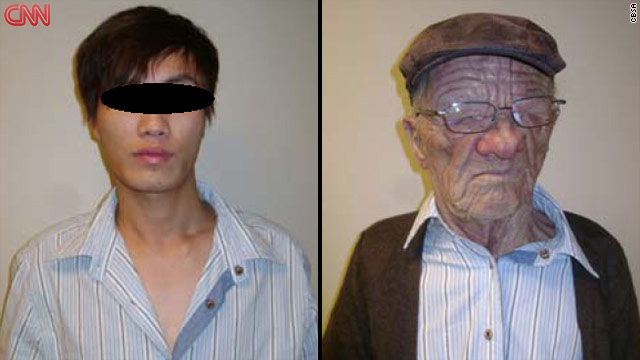
Disguised man allowed to board flight to Canada

An effective disguise (CNN)

CNN has an exclusive today on a young Chinese man who boarded an Air Canada flight from Hong Kong disguised as an old white man. During the flight he removed the mask and then claimed asylum on landing in Canada.

No-one outside of the man concerned and the Canadian Border Security Agency knows much more about this right now. The disguise looks pretty impressive. And he had a boarding pass for a man of the correct age and origins. Of course some people will try to spin this as a ‘security threat’ story, or make it about terrorism. But really this says far more about the desperation of those trying to claim asylum faced with the rather kafkaesque logic of such systems, which tend to assume that claimants can use legal means to escape from situations where their life might be in danger…

Not everything is about the (still relatively small) risk of terrorism and nor should we overreact or organise or always try to reorganise our societies on the basis of that risk. Canada has a historically-deserved reputation as a humane refuge for those in need. This should be defended.