
East Asia Drone Wars

Northrop-Grumman Global Hawk (USAF)

In one of my only posts last year, around this time, I argued that 2012 would be in the ‘year of the drone’ – and it certainly lived up to that. But we’re still only just beginning. This is already the decade of the drone. Unmanned Aerial Vehicles (UAVs) are going to be everywhere in the coming few years (and of course not just in international disputes – I am writing about the spread of domestic surveillance drones for a major report on Surveillance in Canada that we’re producing right now).

Media outlets are reporting that the dispute over maritime territory between China and Japan is ramping up through the use of UAVs.  At the moment both countries rely heavily on conventional naval or fisheries surveillance vessels, which are limited in terms of speed of deployment and numbers. However, surveillance drones could enable a more consistent presence over the disputed islands (and more importantly the sea around them, whose fisheries and below seabed mineral resources are the real underlying issue here).

However, there are big differences in the politics and the political economy of each state’s strategic trajectory here. Japan is relying on its longstanding ‘alliance’ with the USA, and is likely to purchase US-made Northrop-Grumman Global Hawks, further emphasizing the military dependency Japan still has on the USA. China, on the other hand, is speeding up development of its own UAVs, in multiple different models. US industry sources seem more worried by alleged breaches of intellectual property rights in the drones’ design than by strategic issues – but of course, China has almost certainly had access to both hardware and software from downed US drones, which is all part of what some analysts are terming a ‘drone race’ with the USA.

and the Chinese version (Chengdu Aircraft Co.)

But this isn’t just about surveillance. Like the USA’s models, many of China’s UAVs are armed or can be weaponized very easily, and again like the USA, China has also been looking to export markets – most recently, Pakistan has been discussing the purchase of several armed drones from China, following the distinct lack of success in its own UAV development program.

The Global Hawks that Japan is buying are not armed, but this doesn’t mean that Japan is acting less aggressively here or will not in future used armed drones. Despite the post-WW2 US-imposed but popular ‘pacifist’ constitution of the country, the recent return to power of rightist PM Shinzo Abe might will mean both more heated rhetoric over territorial claims and attempts to increase the of the country’s self-defence forces: a review of Japanese military spending – with a view to increasing it – was announced just yesterday.

Drones would seem to be a politically popular choice in this regard as they do not involve putting Japanese lives at risk, or at least not directly; however the longer term outcomes any drone war in East Asia would not likely favour a Japan whose regional economic and political power is influence declining relative to China’s.
Guess who likes the UK’s proposals to control the Internet?

In the wake of the riots, several British Conservative MPs, and indeed PM David Cameron himself, have suggested a harsher regime of state control of both messenger services and social networks. Their suggestions have attracted widespread derision from almost everybody who either knows something about the Internet and communications more broadly, or who places any value on freedom of speech, assembly and communication and regards these things as foundational to any democratic society.

However, the a yet vague proposals have gained support from one quarter: China. The Chinese state-controlled media have suggested that the Conservative Party’s undemocratic suggestions prove that the Chinese state was right all along about controlling the Internet and that now these events are causing liberal democracies to support the Chinese model of highly regulated provision (via Boing Boing).

This is pretty much what I have been suggesting is happening for the last 2 or 3 years – see here, here, here and here. It is just that now, the pretense of democratic communication is being dropped by western governments. And just in case David Cameron doesn’t get it – and he really does not appear to right now, no, it is not a good thing that the Chinese government likes your ideas: it makes you look undemocratic and authoritarian.

The Total Surveillance Society?

Advanced visual surveillance has become prevalent in most developed nations but, being restricted by inconvenient things like democracy and accountability (even if they are not as strong as some would like) and police and local authority funding, such surveillance remains patchy even where it is widespread.

The Chinese state, however, suffers from none of these inconvenient restrictions. Free from democracy, accountability, and with a buoyant economy still largely connected to the Communist Party, it is able to put in place surveillance systems beyond the wildest dreams of the most paranoid western administrators. The target of the new wave of surveillance is internal political unrest, particularly in separatist Tibetan Buddhist and Muslim areas of the massive nation.

Associated Press is reporting official internal announcements about how Urumqi, capital of the Uighur Muslim area of Xinjiang, which saw extensive anti-government protests last year, will be blanketed by surveillance systems. According to the report:

  • 40,000 high-definition surveillance cameras with riot-proof protective shells have already been installed in the region, with 17,000 in Urumqi itself
  • 3,400 buses, 4,400 streets, 270 schools and 100 shopping malls are already covered
  • the aim is for surveillance to be “seamless”, with no blind spots in sensitive areas of the city (and this includes in particular, religious sites)
  • 5,000 new police officers have been recruited

This is part of a wider ‘Safe City’ strategy – in this context, even more of a euphemistic description that the same words would be in the west – that will see 10 million cameras being installed across the country. Ths numbers keep growing all the time: the last time that I reported on this, the estimate was less than 3 million ! IMS Consultants last year estimated that the Chinese video surveillance market was $1.4 billion in 2009, and that this will grow to over $3.5 billion by 2014. China is now the single largest market for video surveillance in the world.

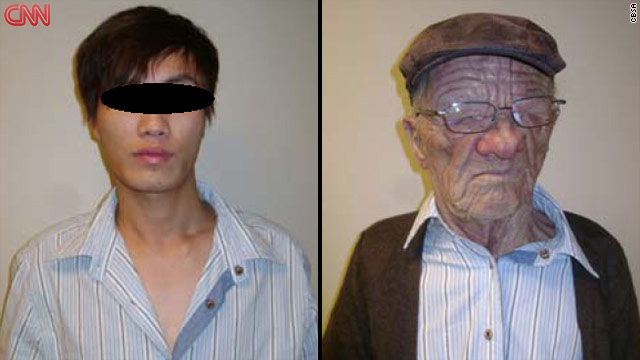
Disguised man allowed to board flight to Canada

An effective disguise (CNN)

CNN has an exclusive today on a young Chinese man who boarded an Air Canada flight from Hong Kong disguised as an old white man. During the flight he removed the mask and then claimed asylum on landing in Canada.

No-one outside of the man concerned and the Canadian Border Security Agency knows much more about this right now. The disguise looks pretty impressive. And he had a boarding pass for a man of the correct age and origins. Of course some people will try to spin this as a ‘security threat’ story, or make it about terrorism. But really this says far more about the desperation of those trying to claim asylum faced with the rather kafkaesque logic of such systems, which tend to assume that claimants can use legal means to escape from situations where their life might be in danger…

Not everything is about the (still relatively small) risk of terrorism and nor should we overreact or organise or always try to reorganise our societies on the basis of that risk. Canada has a historically-deserved reputation as a humane refuge for those in need. This should be defended.

UofT Researchers uncover Chinese Internet espionage system

The Globe and Mail is reporting today that researchers based at the University of Toronto’s Munk Centre for International Studies, along with two private internet security consultancies, SecDev and the Shadowserver Foundation, have uncovered a worldwide network of automated intrusion programs (or botnet) based in China. The report called Shadows in the Cloud describes how over 1300 infected computers containing information related to all kinds of material from the Dalai Lama, the Indian government and US security were linked back to Chinese sources. The authors include Greg Walton who wrote the excellent early report on China’s ‘Golden Shield’ Internet surveillance and censorship system a few years ago. It can’t be said for certain that this was a Chinese state operation: as with the attacks on Estonia from Russian sources back in 2007, suspicions just as much centre on ‘patriotic hackers’, who are just doing this out of a sense of outrage at opposition to their country’s leadership. And no doubt, this is far from the only nationally-oriented botnet system.

SHADOWS IN THE CLOUD: Investigating Cyber Espionage 2.0

Google does the right thing, but…

Google is, as I type this, closing down its Chinese site as the first stage of its withdrawal of service from mainland China, in response to numerous attacks on the company’s computers from hackers allegedly connected to the Chinese state and ongoing demands to provide a censored service with which they felt they could not comply. The company claims that Chinese users will still be able to use Google, only through the special Hong Kong website, http://www.google.com.hk, which for historical reasons falls outside the Chinese state’s Internet control regime. Whether this will mean that the site will actually be accessible to Chinese Net users is debateable. Some say they cannot access it already. There are also numerous ‘fake Google’ sites that have sprung up to try to make some fast cash out of the situation.

But there’s more to this of course. Google has been widely reported to have opened its doors to the US National Security Agency (NSA) in order, they say, to solve the hacking issue, but the NSA only get involved in matters of US national security – if Google is essentially saying it is effectively beholden to US intelligence policy and interests, I am not sure that this is a whole lot better than bowing to China. You can be sure as well, that once invited in, the NSA will insinuate themselves into the company. Having a proper official backdoor into Google would make things a lot easier for the NSA, especially in populating its shiny new data warehouse in Utah

China – the ultimate surveillance state?

Most societies are surveillance societies of one kind or another and to a greater or lesser extent, but there are very few comprehensive surveillance states, i.e: nations where the government is really interested in what you are doing and thinking and has the will and the resources to find out. Iran has a pretty serious network of petty officials, informers and spies who enforce both moral and legal norms; Burma has a regime of fear and military rule; and several states, usually those with less comprehensive control, have vicious and arbitrary systems of punishment (like Sudan). However few have the combination of wealth, technological resources, a complete lack of concern for outside opinion, and state will to keep control on any moves to greater political diversity as that possessed by China.

According to a report in Xinhua today, China’s police have in the last few years installed more than 2.75 million cameras in public space, largely in urban areas, and are now moving to install cameras in rural locations too, “linked to police stations, community police service posts and farmer security guards in rural areas to establish a comprehensive security network”.

As Naomi Klein’s report last year showed, helped by willing western companies and law enforcement agencies, China is becoming a vast laboratory for surveillance and social control. The aim is a fully integrated system that can police real world and online behaviour. The ruling Communist Party, whilst opening up the economy is determined to prove, contrary to US assertions, that you can indeed have a free market system and still have complete one-party authoritarian control. And as anyone who has ever tried to have a discussion on Chinese politics with Chinese students or visiting academics, the control extends deep into the education system, with ‘normal’ patriotism preventing the development of all but the most banal of views counter to the approved picture.

It is probably sometimes worth remembering that however bad the UK or Japan or the USA or any other democratic state seems to have become in this regard, China still takes the prize for the world’s most comprehensive surveillance society.

Mega-events, Security and Surveillance

The connection between what are often called ‘mega-events’ (international summits, major sporting competitions etc.), securitization, and he intensification of surveillance is becoming a very interesting area and one which we wrote about in our recent book on urban resilience. I am writing some further stuff on this with Kiyoshi Abe on how mega-events have been managed in Japan.

It seems that in general, such events are either used as ‘test-beds’ for new technologies and procedures which are then either continued afterwards (as with The Olympic Games and CCTV in Greece in 2004 and The FIFA World Cup and video surveillance in Japan/Korea in 2002), or become ‘islands’ of temporary exemption where normal legal human rights protections are reduced or removed and whole areas of public space are often literally, fenced off (as in Rio de Janeiro for the Pan-American Games of 2007, whose model will apparently be extended to include walling off the poor favelas in time for the 2014 FIFA World Cup). There’s going to be a very interesting conference on The Surveillance Games later this year to tie in with the Vancouver Winter Olympics.

Now The Guardian newspaper is reporting that the London Olympics 2012 may make use of a proposal originally designed to stop the proliferation of unofficial commercial advertising near games venues in order to prevent protest. The legislation even allows police to enter private houses to seize material.

Of course the government say that they have no plans to use it in this way, but it’s interesting to see the way in which the ‘standards’ being imposed by such travelling cicuses of globalization tend to end up looking more like the authoritarian regime in Beijing (host of the highly securitized 2008 Olympics) than the supposedly liberal west, whilst at the same time promoting a very controlled but highly commercialized environment. Even the original purposes of the 2006 law (necessary for London to host the Games) are an interesting reflection of the massive corporate interests involved in the Olympics, for which they apparently need a captive and docile audience.

They want us to trust them…

Maybe what Jacqui Smith needs is a dose of ‘Chinese democracy’ to go with her Chinese-style attitude to security and surveillance…

In the last fortnight there have been interesting developments that have reminded us, as if we needed reminding, that those who want to infringe on the liberty of others need to be absolutely squeaky-clean themselves or risk severe censure, and that those who introduce systems which encourage suspicion and spying should not be surprised if people no longer trust them and start to investigate their activities.

The first of course was the saga of Jacqui Smith’s apartment. The basic facts are that the UK Home Secretary has been claiming £24,000 (around $35,000 US) per year in allowances for an apartment that she does not actually live in. The particular irony (and we love a bit of irony in Britain!) was that she has been reported by a neighbour – in other words she was a victim of the kind of suspicious, back-stabbing, trust-no-one society that she has been encouraging. Of course she should resign if she had any intelligence or integrity, but we already know to the cost of our civil liberties that she does not.

Funnily enough, it is to China we go to another example and one with, it seems, a rather more accountable outcome. This is almost the second time in a row that I have unfavourably compared a western country to China – this is getting rather disturbing particularly as I am no friend of the Chinese state, being a long-term Free Tibet supporter. However, Variety (of all places) is reporting that Yu Bing, who is director of the internet monitoring department of Beijing’s Public Security Bureau, and therefore a major figure in the infamous Golden Shield, and surveillance of journalists, bloggers and net democracy activists (as well as those just trying to access unapproved content), has been arrested for taking bribes from a contractor.

Admittedly it is a lot more than the sums in the Jacqui Smith case (40M Yuan, or about $5.8M US), and corruption is endemic within the Chinese state at all levels, but it does show a rather different attitude to the establishment towards top officials who fail to live up to the standards we expect of them. Maybe what Jacqui Smith needs is a dose of ‘Chinese democracy’ to go with her Chinese-style attitude to security and surveillance?

China calls for better international regulation of space

…it is the USA that effectively controls earth orbit. However many other emerging economies see no reason why this should be the case….

Following last week’s collision between an obsolete Russian military satellite and an US Iridium communications satellite, there has been a lot of discussion about the management of orbital space (or, more accurately, the lack of it). Orbital positions are managed by the International Telecommunications Union (ITU), but the effective control of orbital space is a matter of power projection – i.e.: which country can maintain a stronger and more pervasive presence in space. With the Russian program almost defunct, and European satellites limited in number, it is the USA that effectively controls earth orbit. However many other emerging economies see no reason why this should be the case. India now has a regular launch program and in particular China is massively expanding its space presence, even making noises about its ability to destroy satellites if necessary.

China seems now to be using this incident to sound out other countries and the international scientific community about a more coherent and comprehensive international management of orbital space. In an article published on the official English-language news site, Chinadaily, various senior Chinese scientists and People’s Daily journalists are quoted in favour of “establishing a system for the promotion of space safety is an important method of space traffic management”, through “long-term cooperation from the international community”, and perhaps even a “space traffic law”, although it is acknowledged that this is “still a very remote concept”.

The one organisation that is not going to like this at all is the US military. USSTRATCOM has absorbed the space power doctrine developed in the 1990s by USSPACECOM, which argued effectively that orbital space should be part of US military plans for ‘Full-Spectrum Dominance’ (FSD) and that international projects like the International Space Station would be tolerated only insofar as they could be ‘leveraged’ to US advantage. The US military wants to maintain the ‘ultimate high ground’ that dominance of earth orbit gives them, for communications, for surveillance, for weapons targeting. They are not even very keen on the EU Galileo project, the new and more technically-advanced rival to GPS (which is a US military system).

Just as with the discussion about internationalising management of the Internet and moving it beyond US government control, any suggestions of a more comprehensive international management of space are likely to be resisted even at the expense of logic and reason. The Chinese know this very well, and are being rather cleverly provocative. They are however, right.