
On the ‘Right to Be Forgotten’

While Viktor Mayer-Schönberger is arguing today both that there’s really not a lot new to the European Court of Justice decision to order Google to adjust its search results to accommodate the right to privacy for one individual and that it really won’t be a problem because Google already handles loads of copyright removal requests very quickly, the decision has also sparked some really rather silly comments all over the media, usually from the neoliberal and libertarian right, that this is a kind of censorship or that it will open the door to states being able to control search results.

I think it’s vital to remember that there’s really an obvious difference between personal privacy, corporate copyright and state secrecy. I really don’t think it’s helpful in discussion to conflate all these as somehow all giving potential precedent to the other (and I should be clear that Mayer-Schönberger is not doing this, he’s merely pointing out the ease with which Google already accommodates copyright takedown notices to show that it’s not hard or expensive for them to comply with this ruling). State attempts to remove things that it finds inconvenient are not the same as the protection of personal privacy, and neither are the same as copyright. This decision is not a precedent for censorship by governments or control by corporations and we should very strongly guard against any attempts to use it in this way.

Google algorithms already do a whole range of work that we don’t see and to suggest that they are (or were) open, free and neutral and will now be ‘biased’ or ‘censored’ after this decision is only testament to how much we rely on Google to a large extent, unthinkingly. This is where I start to part company with Mayer-Schönberger is in his dismissal of the importance of this case as just being the same as a records deletion request in any other media. It isn’t; it’s much more significant.

You are sill perfectly free to make the effort to consult public records about the successful complainant in the case (or anyone else) in the ways you always have. The case was not brought against those holding or even making the information public. What the case sought to argue, and what the court’s verdict does, is to imply that there are good social reasons to limit the kind of comprehensive and effortless search that Google and other search engines provide, when it comes to the personal history of private individuals – not to allow that one thing that is over and one to continue to define the public perception of a person anywhere in the world and potentially for the rest of their life (and beyond). Something being public is not the same as something being easily and instantaneously available to everyone forever. In essence it provides for a kind of analog of the right of privacy in public places for personal data. And it also recognizes that the existence and potentials of any information technology should not be what defines society, rather social priorities should set limits on how information technologies are used.

Personally, I believe that this is a good thing. However, as the politics of information play out over the next few years, I also have no doubt that it’s something that will be come up again and again in courts across the world…

PS: I first wrote about this back in 2011 here – I think I can still stand behind what I though then!
Transparent Lives: Surveillance in Canada

The New Transparency project is coming to an end, and we are launching our major final report, Transparent Lives: Surveillance in Canada / Vivre à nu: La surveillance au Canada, in Ottawa on Thursday 8th May (which is also my birthday!). The report is being published as a book by Athabasca University Press, so it is available in all formats including a free-t0-download PDF. We want as many people in Canada (and elsewhere) to read it as possible.

The launch will be covered by the Canadian press and was already blogged in the Ottawa Citizen a few days ago.

A website with resources and summaries will be here very soon, and there is also a promotional video / trailer here in Youtube.


Illegal UK blacklists now being shared with the USA?

I’ve written here in the past about British blacklisting organisations that compile lists of ‘troublemakers’ (mainly union activists) and sell them to building firms and share them with police. This has led to people being unable to get jobs and all kinds of hassle. In theory, the notorious Economic League which started this activity back in the 1920s is now disbanded but their mantle was taken up by a number of other private bodies, including the Consulting Association, which was the subject of an unusual raid by the Information Commissioner’s Office (ICO) back in 2009.

Now it seems that in the era of transnational information sharing for ‘security’, such lists have found their way to the US Homeland Security complex. According to a report in the London Evening Standard, his certainly seems to be the case for major British mainstream environmental campaigner, John Stewart, formerly of the anti-road building lobby, Alarm UK and now of the Heathrow Association for the Control of Aircraft Noise (HACAN).

If such private politically motivated lists are now circulating internationally and being treated as reasonable grounds for refusing entry to other countries, it makes a mockery of the fact that they have already been found to be in breach of British and European laws, and it is likely that such data will continue to circulate entirely decontextualized from the circumstances and motivation of their collection. So an illegal anti-democratic trawling operation to stop legitimate political activity becomes the basis for security decisions to err… safeguard democracy. It would be funny if it wasn’t already so common and will continue to be so as security relies increasingly on risk assessments derived from the indiscriminate mashing together of information into ‘big data’.

Mozilla stops ad-network cookies

Mozilla, the developer of the Firefox web-browser, has decided that voluntary compliance by advertisers with its ‘Do Not Track’ settings is not working. Advertisers have basically been ignoring what is essentially a request by users, so instead of giving up, Mozilla has taken the right step and will simply not allow ad networks to install cookies on user’s computers or phones. This will of course cut ad revenue to some sites that rely on it, but it will also be a major step to slowing the proliferation of online tracking.

Of course, it can also be seen as a new negotiating position in a long conflict, as the Centre for Democracy and Technology points out, it could be a negotiating position that is all about trying to force companies to implement Do Not Track requests as a compromise from wholesale cookie-blocking. But I’m fully on board with Mozilla here either way. I very much doubt that Microsoft will take a similarly ethical stance on user control – because that’s what this is really about, not privacy as such but who has the right to control information about themselves.

New Privacy Survey released

Simon Davies, AKA Privacy Surgeon, and the London School of Economics have a great new survey of privacy predictions for 2013 out now. Key quote from the press release:

“More aggressive action by companies to monetise personal information through advertising will inevitably fuel further controversy, while consolidation of markets such as social networking may induce emerging players to engage dangerous privacy practices.”

Whether 2013 is the tipping point in this regard that the survey suggests or not, it is certainly the case that various ‘lines in the sand’ are being crossed on a regular basis at the moment and if the public aren’t as concerned as the experts surveyed for this report, then privacy may even lose even its tactical utility as a way of opposing surveillance, let alone mean the same thing to most people as it used to.

The Unbearable Shallowness of Technology Articles… or, what Facebook Graph Search really means.

Wired has a feature article about Facebook’s new search tool. The big problem with it is that its vomit-inducing fawning over Facebook’s tech staff. In trying to make this some kind of human interest story – well, actually the piece starts off with Mark Zuckerberg’s dog, you see, he is human after all – of heroic tech folk battling with indomitable odds to create something amazing – what in science fiction criticism would be called an Edisonade – it almost completely muffles the impact of what a piece like this should be foregrounding, which is about what this system is, what is has been programmed to do and where it’s going.

And this is what Graph Search does, very simply: it is a search engine that will enable complex, natural language interrogation of data primarily but not limited to Facebook. So instead of trying to second-guess what Google might understand when you want to search for something, you would simply be able tell you what you ask. And because this is primarily ‘social’ – or about connection, and you should have already given up enough information to Facebook to enable it to ‘graph’ you so that it knows you, the results should supposedly be the kind if things you really wanted from your query. Supposedly. An FB developer in the article describes this as “a happiness-inducing experience” and further says, “We’re trying to facilitate good things.” However what this ‘happiness’ means, just like what ‘friendship’ means in the FB context, and what “good” means, just like the use of ‘evil’ in Google’s motto, is rather different than how we might understand such a term outside these contexts.

In the article, one example demonstrated by the developer is as follows:

[He] then tried a dating query — “single women who live near me.” A group of young women appeared onscreen, with snippets of personal information and a way to friend or message them. “You can then add whatever you want, let’s say those who like a certain type of music,” [he] said. The set of results were even age-appropriate for the person posing the query.

So when Mark Zuckerberg is quoted in the article saying that Graph Search is “taking Facebook back to its roots”, he seems to mean creeping on girls, as was, let us not forget, the main intention of the early Harvard version. Doesn’t this generate exactly the concern that the notorious ‘Girls Around Me’ app encountered? As the title of my favourite tumblr site has it, this isn’t happiness. Or it’s the happiness of the predator, the pervert and the psychopath.

But more fundamentally, this isn’t about privacy, or even online stalking. In fact, in many ways, both are side-issues here. This is about control and access: control over my information and how I access other information, not just on Facebook but in general. To me, the plans outlined for Graph Search look worrying, even outside of my idea of what would constitute happiness, because they have nothing to do with how I use Facebook or how I would want to use it. I don’t use Facebook as my gateway to the Web and I am never going to. As Eli Pariser pointed out in The Filter Bubble a couple of years back, that would both be limiting of my experience of the Web (and increasingly therefore of my communications more broadly) and give one organisation way too much power over both that experience and the future of the Web. But this does seem to be how Facebook wants it to be, and further, I suspect that, just like Bill Gates before him with his .NET initiative and other schemes, and just like the walled garden locked-in hardware that Apple produces, Zuckerberg is more interested in Facebook colonizing the entire online experience, or layering itself so entirely, tightly and intimately over the online world that the difference between that world and Facebook would seem all but invisible to the casual user.

These developments are dramatic enough in themselves. Never mind fluffy stories of heroic techies and their canine sidekicks.

Occupy the Internet!

I’ve been writing for several years now about the creeping attempts by nominally democratic governments to control or even close the Internet (see here for example). This week the biggest such step for some time occurs as the world’s most powerful democracy, the USA, begins a new process of introducing such controls. There are two bills before the House of Representatives (the Stop Online Piracy Bill, SOPA) and the Senate (the Protect IP act), which essentially do the same thing (although the House bill goes further): assert a wide-ranging heavy-handed jurisdiction on the Internet even beyond US borders.

Of course, the US bills do not do this as China does, in the name of political and social order, but in the name of commerce. The bills are supposedly about protecting American intellectual property, however their effect is likely to be severely chilling to free expression and the dissemination of ideas and to innovation, social and economic. The bills, amongst many other provisions, will allow corporation to sue website owners and ISPs for even unknowingly hosting or communicating copyrighted materials illicitly.

As Michael Geist has shown, SOPA in particular also asserts US jurisdiction over vast swathes of the Internet on the grounds that any site whose name is registered with a US registrar is considered a ‘US site’ regardless of the location of its server and given that name-registration of top-level (.com, .org, .net etc)  names is entirely controlled from within the USA, the provisions mean that every top-level domain is considered to be ‘US’. Further it claims that IP addresses (the numerical address of site) within the whole North American region (ARIN) which includes Canada, Mexico and the Caribbean, are also ‘domestic’ for the purposes of this law. Basically, the USA is asserting a kind of Munro-doctrine for the Internet.

I wrote, half-jokingly, some time ago that the US state invented the Internet, but they don’t like how it’s being used and now they want it back: this is the demand in writing. The big problem in opposing this is of course the fact that US citizens have already been thoroughly bombarded with propaganda that has told them that they are ‘under threat’ from pirates and hackers and even cyberwar – and that openness makes them insecure. They’ve been told that the Wikileaks model of accountability through openness and transparency is an attack on the USA. In an age of economic insecurity, no doubt the protection of American jobs will also be wheeled out as an excuse.

But this is quite simply another manifestation of immoral corporate greed. Intellectual Property is in itself a kind of information-age enclosure, a concept that, while it may have some use in limited forms, has become so far-reaching that it is ludicrous, and through which financial and legal strength can simply steamroller traditional or alternative visions of fairness, sharing and openness – even though these things have been shown to be vital in real innovation. If this is an infowar, I know which side I am on, and which side you should be on, and it is not the side of Protect IP and SOPA and the negative politics of closure, it is with Anonymous and the Pirate Party, with open flows, open source and open access. We have to tell them that they can’t have the Internet back, it’s ours now. We have to occupy the Internet, to build around these attempts to stifle innovation and sharing and we have to do it now.

In the meantime, you can express your displeasure here: http://americancensorship.org/

See also: The Internet Must Be Defended! Part 1, Part 2, Part 3, Part 4.

London Riots and Video Surveillance, Pt.2

My last post was about the lack of any apparent deterrence of rioting from CCTV. However that’s not to say that video surveillance is proving of no use to the authorities. However the way it is being used says a lot about both the limits of CCTV and the general problem of analysis of video images.

As part of ‘Operation Withern’, the investigation into the rioting, the Metropolitan Police have set up a special section of their website, London Disorder Images, as well as on Flickr, which is essentially crowdsourcing the identification of suspects. Despite being the most well-resourced police force in the UK, the Met lacks the resources, time and expertise to analyse and identify everyone it wishes to identify itself, and with widespread popular anger about the riots, they are banking on opening up the process of surveillance and identification as being more efficient and effective – and they may well be right.

Of course, with the problems of lighting, angle, distances, and image quality, the images vary in identifiability – and bear in mind that the few posted so far are probably amongst the best ones – and no doubt there will be many misidentifications. And, in addition, hundreds of people are already being processed through magistrates courts without much need to video evidence. But it is a tactic we are seeing more and more in many places (e.g. Toronto, following the G20 disturbances).

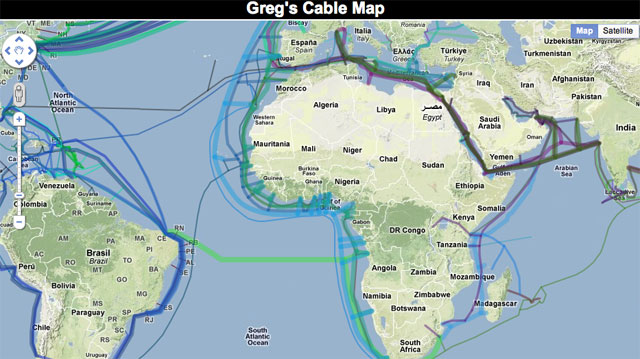
Greg’s Cable Map

Greg's Cable Map

There’s a fascinating interactive map of the world’s undersea communications cables here. It’s also a pretty good guesstimation guide as to where there are, or are likely to be, NSA or subordinate agencies’ (and other non-affiliated intelligence services’) field stations that funnel the data flowing through such cables through computer systems that analyse traffic and content data.

(via Gizmondo)

Will the Global South overtake the North in transparency?

At a time when liberal democracies in the Global North seem increasingly paranoid and cutting down both on personal freedoms and government accountability, could nations from the Global South seize the moment to become the new pace-setters on open government?

There are plenty of good examples from Latin American, but it’s in Africa that the real changes are occurring. Yes, that’s the same Africa often stereotyped as the home of endless war, corruption, military coups and dictators. Kenya, in fact, which the pessimists were portraying as being on the brink of collapse and authoritarianism after election violence a few years ago. But now, Kenya is pushing forward with massive changes in the way its government operates with an increasing tendency towards open information and other accountability initiatives, as a Guardian story is reporting.

Cynics will argue that this is just pandering to a new urban middle class, with only 26% of Kenyans having home Internet access. However, like many countries in Africa, the communications revolution us predominantly mobile and almost 65% of Kenyans have mobile telephones and will be able to access mobile versions of the new sites.