FBI data warehouse revealed by EFF

Tenacious FoI and ‘institutional discovery’ work both in and out of the US courts by the Electronic Frontier Foundation has resulted in the FBI releasing lots of information about its enormous dataveillance program, based around the Investigative Data Warehouse (IDW). 

The clear and comprehensible report is available from EFF here, but the basic messages are that:

  •  the FBI now has a data warehouse with over a billion unique documents or seven times as many as are contained in the Library of Congress;
  • it is using content management and datamining software to connect, cross-reference and analyse data from over fifty previously separate datasets included in the warehouse. These include, by the way, both the entire US-VISIT database, the No-Fly list and other controversial post-9/11 systems.
  • The IDW will be used for both link and pattern analysis using technology connected to the Foreign Terrorist Tracking Task Force (FTTTF) prgram, in other words Knowledge Disovery in Databases (KDD) software, which will through connecting people, groups and places, will generate entirely ‘new’ data and project links forward in time as predictions.

EFF conclude that datamining is the future for the IDW. This is true, but I would also say that it was the past and is the present too. Datamining is not new for the US intelligence services, indeed many of the techniques we now call datamining were developed by the National Security Agency (NSA). There would be no point in the FBI just warehousing vast numbers of documents without techniques for analysing and connecting them. KDD may well be more recent for the FBI and this phildickian ‘pre-crime’ is most certainly the future in more ways than one…

There is a lot that interests me here (and indeed, I am currently trying to write a piece about the socio-techncial history of these massive intelligence data analysis systems), but one issue is whether this complex operation will ‘work’ or whether it will throw up so many random and worthless ‘connections’ (the ‘six-degrees of Kevin Bacon’ syndrome) that it will actually slow-down or damage actual investigations into real criminal activities. That all depends on the architecture of the system, and that is something we know little about, although there are a few hints in the EFF report…

(thanks to Rosamunde van Brakel for the link)

SIVAM and Brazilian extremist nationalism

A Brazilian nationalist street stall in Rio

Whilst finishing up my work in Rio de Janeiro yesterday, I came across this interesting bunch of people, mv-brasil, who appear to be a Brazilian nationalist movement, with much in common with organisations like the British National Party or the various right-wing groups in the USA. Their website contains the usual odd mixture of anti-globalisation, evangelical Christian (they campaign against Halloween) and anti-United Nations / New World Order stuff with the added anti-Americanism. There of course is the usual rather uncomfortable fact of the ‘Brazilian Christian’ nationalist being a representative of a colonial power that invaded the country and took it from the indigenous people, but they roll over this one with some nods to Indian rights when it suits their cause, most notably when it comes to the Amazon.

A t-shirt with anti-internationalisation and privatisation of the Amazon slogan

One of the T-shirts for sale makes reference to this, being against ‘internationalisation and privatisation’ of the Amazon by the USA. It is a conspiracy theory I’ve come across before when I was doing some research on the SIVAM program – which provides some actual evidence for contentions that there is a secret American program to control the rainforest. I had someone tell me here in complete good faith that it was a ‘fact’ that several Amazonian tribes already thought that they were part of the USA and flew the US flag! This is combined with the fact the UN and international environmental organisations are very concerned about the destruction of the rainforest and the perceived lack of effort by successive Brazilian administrations to stop it. Put all this together and you have the ingredients for nationalist paranoia.

sivam_logoSo what is SIVAM? And why would I be interested in it anyway? The reason is that SIVAM is a surveillance system. Announced at the Earth Summit in 1992, and finally completed in 2002 and fully operationial from 2004, the Sistema de Vigilância da Amazônia (SIVAM) is a multipurpose, multi-agency network of satellite, aerial and ground surveillance and response that aims to monitor the illegal traffic of drugs and forest animals and plants, control national borders and those of indigenous peoples’ lands, and prevent the further destruction of protected areas of forest. A good technical account in English can be found in Aviation Today from 2002, and there is an interesting article on its construction here.

Donald Rumsefld visits the SIVAM control centre, 23 March 2005 (Wikimeda Commons)

The problem is that, although an initiative of various Brazilian government agencies including the environment and Indian affairs ministries, the federal police and the army, SIVAM is supported and funded by the USA – most of the initial $1.39Bn US cost came through a grant from the U.S. Export-Import Bank, and the consortium that supplies the equipment includes giant US military supplier, Raytheon – amongst many others from Brazil to Sweden. The visit of former President George W. Bush’s right-hand man and then Secretary of State for Defense, Donald Rumsfeld, to the SIVAM control centre in 2005, was widely reported in Bazil. It was of course interpreted by many as further evidence of Brazil’s ceding of control of the Amazon to the USA, or even presaging a US invasion of the Amazon, as Senator Norm Coleman discovered on a fact-finding mission later that year.

Latin American countries have every right to be suspicious of US motives: the Monroe Doctrine; George Kennan’s Cold War ‘grand area’ vision; the support for dictators like Augosto Pinochet; the invasions of Panama and Grenada; Plan Columbia and the widespread use of military ‘advisors’… the list goes on. And it is certainly the case that US strategic surveillance plans for ‘Full Spectrum Dominance’ and the like, have have long included ‘leveraging’ any system in which they are involved from the International Space Station to things like SIVAM. So of course they will have a strategic interest, and no doubt SIVAM data will find its way to US military C4ISR centres, but this does not amount to a plan to invade Brazil or take control of the Amazon.

Research as Espionage

There’s no doubt that academic research and military intelligence have a more tangled history than some would imagine, although in many countries in recent years ‘imperial disciplines’ like geography and anthropology have been through a long process of reevaluation and rejection the values that gave them birth. In the USA, however, geography remains intimately connected to the state and more particularly to current US military projects, indeed since 9/11 such ‘patriotic’ research has become more rather than less common.

z magazine has a very interesting article on a growing furore around first of a new US government cartography / geography program called the Bowman Expeditions. This half a million dollar project, México Indígena, has been mapping indigenous lands in Oaxaca, Mexico, where a popular insurgency has been growing in recent years. Local organisations under the umbrella of the Union of Organizations of the Sierra Juárez of Oaxaca (UNOSJO) have rejected the activities of the expedition and claim they were duped by researchers.

A slide from a Powerpoint from the project reveals ideological connections to US military goals, but the links are material too.

And it seems they were right to do so: the grant scheme is associated with the U.S. Army’s Foreign Military Studies Office (FMSO), which seems to be largely associated with so-called ‘open source intelligence’, in other words ‘leveraging’ academic mapping projects for military purposes, in particular the ‘cultural terrain’ for potential future counter-insurgency purposes, learning the lessons of failures in Afghanistan and Iraq. The academics involved, Jerome Dobson and Peter Herlihy from the University of Kansas, just down the road from FMSO, are now furiously backpedaling as previous denials are shown to be evasive and disingenuous…

Metropolitan Police Encouraging Stupidity and Suspicion

Rather than being a legitmate political response to an illiberal, repressive, undemocratic and unaccountable growth in surveillance, ‘interest’ in CCTV is now regarded as suspicious in itself…

Boing Boing has news of the latest London Metropolitan Police campaign which is supposedly encouraging people to report their suspicions on terrorist activity, but is in fact just another step on the illiberal, socially divisive and stupid road towards a McCarthyite Britain where British people are expected to spy on each other in the name of security.

Why not check your neighbours' waste bins?

Apart from encouraging people to rifle through their neighbours garbage, the most disturbing thing about this new campaign is the way in which it implies that any interest in CCTV cameras is a potentionally terrorist activity.

See that camera? No, you don't. It's not there.

From the late 1980s onwards, the British state in its usual bumbling, piecemeal and disorganised way, gradually created an increasingly comprehensive monitoring program of British city centres. There was never any strong evidence for the need for this technology, it was never approved by parliament, there was never a single CCTV Act that enabled it.

Now, just as it has become pretty clear that CCTV has very little effect on crime rates (its original justification, let us not forget), the state has started to close down criticism and even interest in or discussion of these surveillance measures. Effectively, we are being officially instructed to ignore the cameras and pretend we don’t see them. Rather than being a legitimate political response to an illiberal, repressive, undemocratic and unaccountable growth in surveillance, ‘interest’ in CCTV is now regarded as suspicious in itself.

At the same time, the British state is increasingly regulating the means of production of visual images by ordinary citizens. The state (and many private companies) can watch us while we have to pretend we don’ t notice, but for ordinary people to take picture or make video in public places, and in particular making images of state buildings or employees like the police (you know, the people who supposedly work for us), is being gradually and by stealth turned into a criminal act. In the past, I have been very careful not to shout about all acts of state surveillance being totalitarian (because very few of them actually are), but there is no other word for these trends. The police are attempting to make themselves the arbiters of how we see society and public places; they are telling us what can and cannot be legitimately the subject of interest and of visual representation.

They are also spending more time now ‘securing secturity’ – protecting the architecture of surveillance that has been built. You can see the private sector recognising this. At equipment fairs I have been to over the last few years, one of the big developments in camera technology has been methods of armouring and protecting the cameras themselves. There seems to be an effort, deliberate or unconscious, to forget the supposed original purpose of such surveillance in protecting us, and instead to concentrate on protecting the surveillance equipment.

This is particularly problematic for researchers like me. We’ll see what happens when I am back in London in May and June when I will be taking a lot of pictures of CCTV as part of my project, which is of course, ironically, sponsored by an official British state research council…

US plans surveillance drone airship

I am sure there will be arguments about the violation of airspace, which will not be trivial as the ongoing diplomatic and increasingly military row over US surveillance vessels off China is showing…

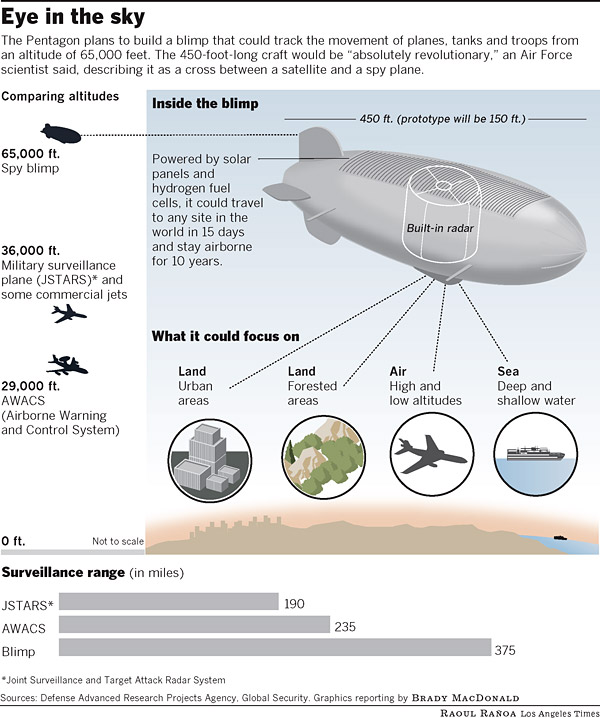
Unmanned aerial vehicles (UAVs) are one of the fastest-developing areas of surveillance technology. A new plan revealed by the US Department of Defense combines old and new tech with a plan, first revealed by the Los Angeles Times, for an pilotless surveillance airship called ISIS (Integrated Sensor Is the Structure) that will fly right at 65,000 feet (about 20km) high, right at the edge of ‘airspace’. The point of the airship is to provide the kind of constant watch that a geostationary satellite provides, but at a much lower level so that for more detailed pictures of the precise movements of vehicles, objects and people could be observed.

airship

Well, as usual, the reports only seem to to be concerned about how great this would be for US military tactics, and are not interested in the law, politics and ethics of such devices. For example, I am sure there will be arguments about the violation of airspace, which will not be trivial as the ongoing diplomatic and increasingly military row over US surveillance vessels off China is showing. And of course there are issues around the violation of human rights by such intrusive technology: international violations are very hard to deal with, however. And this will only be the beginning. The new Obama administration has promised more investment in intelligence and surveillance and less in warfighting. That sounds good in some ways, but of course just poses new problems and new issues for those of us concerned with ongoing US attempts to cover the whole world with surveillance for the benefit of its strategic aims.

The rise of personal surveillance

Personal surveillance is only going to get harder to regulate as things like ‘smart dust’ and micro-UAVs come down in price and are more easily available…

CBS News in the USA is reporting on the rise of stalking and in particular the use of more powerful, smaller and cheaper surveillance devices: embedded hidden cameras, GPS trackers and so on. They discuss in particular the case of Michael Strahan, a sportsman who seems to be obsessed with keeping watch on family and friends. But the bigger pictures is that stalking is something that apparently affects around 3.4 million US citizens. That’s more than one in a hundred, an astonishing figure if it’s anywhere near ‘right’.

Stalking and personal surveillance are an integral part of the culture of any state in which order in ensured through surveillance. We are creating unhealthy societies in which personal relationships between people are increasingly characterised by the same fear and distrust as states have of their people.

Smart Dust chips (Dust Networks)

ravenThis is only going to get harder to regulate as things like ‘smart dust’ and micro-UAVs come down in price and are more easily available. And already surveillance equipment like head-mounted cameras for cyclists, is marketed as ‘toys’… regulation is only half the answer. The other half has to be in working out how to shift away from this mistrustful, fearful, risk-obsessed culture. Part of this has to be down to government: the more that surveillance is part of every solution they come up with to any problem, the worse the social malaise will become.

Battle lines being drawn in UK surveillance debate

there appears to be a gathering of forces and a drawing of battle lines amongst the ‘big beasts’ of security policy in the UK…

securitystrategybannerThe UK’s Institute for Public Policy Research (IPPR), the influential think-tank that was behind the New Labour project, has released a report on intelligence and national security that argues that privacy and human rights will have to take second place in the War on Terror. The report, National Security Strategy, Implications for the UK Intelligence Community, is written by former civil service security and intelligence coordinator, David Omand, is part of the IPPR’s Commission on National Security in the 21st Century, whose rather unimpressive launch event I attended last year.

The Guardian newspaper’s story on this is trying to build this up into an ‘end of privacy’ / ‘end of civilisation as we know it’ story and Omand certainly comes down firmly on the side of security over liberty. He recognises that his arguments are contrary to ours and go “against current calls to curb the so-called surveillance society.” But he is not actually making a total ‘by any means necessary’ argument. Even the Guardian’s own report quotes his rather qualified statement that “in some respects [new intelligence methods] may have to be at the expense of some aspects of privacy rights.”

The report is simply not as strong or even as interesting as The Guardian‘s story suggests. Most of it is simply a description of how intelligence works (and not even a very comprehensive or insightful one at that). Much, as we predicted in our recent book (see My Publications), it tries to set the creation of ‘resilience’ as a key rationale for reducing civil liberties, as if resilience in itself was a good thing that needed no justification when in fact it is being used as a bland container for all sorts of questionable policies – from the use of torture and imprisonment without trial to the everyday use of intrusive high-tech surveillance. The references to the political controversies over surveillance are rather cursory and don’t really say much other than that people are worried and really they shouldn’t be. These are just the usual ‘trust us, we know what we are doing’ and ‘these are exceptional circumstances’ arguments that we have heard many times before, and they are as weak and old-fashioned coming from Omand as from anyone else.

It is worth noting that there appears to be a gathering of forces and a drawing of battle lines amongst the ‘big beasts’ of security policy in the UK. I reported yesterday on David Blunkett’s conversion to the cause of limiting surveillance society, and a few days ago, Stella Rimington, the former Head of the Security Service, MI5, condemned the current government’s approach to liberty and security in even stronger terms, arguing that the approach that Omand typifies would lead to ‘a police state’.

Surveillance has finally become an issue on which it is becoming less possible to be unengaged, apathetic or even neutral. That in itself is a good thing, however it does not guarantee a good outcome even if more major public figures suddenly discover their enthusiasm for liberty once they leave office. However, I hope this reflects a split which is growing within the current government too – normally when retired politicians and civil servants speak out, they are conscious of the way in which they speak on behalf of friends and colleagues who feel they cannot be so candid.

More details of illegal NSA wiretap program revealed

The Online Jounal has published a piece by ex-NSA operative and perennial thorn in the side of the organisation, Wayne Madsen, which gives far more detail of the system of illegal wiretapping of e-mails, in operation over recent years.

According to Madsen, two NSA programs for text interception are known to exist, one called PINWALE, which mainly targets Russian e-mails, and secondly the STELLAR WIND program, which “was initiated by the George W. Bush administration with the cooperation of major U.S. telecommunications carriers, including AT&T and Verizon.” and “was a major priority of the NSA program”.

Madesen gives details of how PINWALE and there’s little reason to suppose that STELLAR WIND is very different. Basically these programs search a range of ‘metadatabases’, repositories of captured text from millions of people around the world, outside and inside the USA. The search parameters include: “date-time, group, natural language, IP address, sender and recipients, operating system, and other information embedded in the header”.

Madesen claims that both STELLAR WIND and PINWALE “negated both USSID 18 and the Foreign Intelligence Surveillance Act of 1978 [which were introduced following the Church Committee report into illegal operations by the NSA in the 1960s and early 1970s] by permitting NSA analysts to read the e-mails, faxes, and text messages of U.S. persons”

The three metadatabases are called LION HEART, LION ROAR, and LION FUSION and were developed, as with many NSA systems in conjunction with an external contractor, in this case, Booz Allen Hamilton, which Madsen previously revealed was also responsible for FIRSTFRUITS, program used to track the articles, and communications of particular journalists.

There’s more detail in the article, and one other thing is certain. All these exotic codenames will now be history, as all intelligence agencies have a policy of changing them once they are revealed. Journalists still talk about ECHELON as if it exists as an active NSA operation, but that one hasn’t existed under that name for twenty years or more. There are a huge diversity of NSA programs for all kinds of communications interception and sorting. Each component will have its own terminology and many will be temporary parts of a greater whole, which may not even exist by the time they are revealed. At least former insiders like Madsen can keep some track of developments…

An aerial view of the NSA's station at Yakima in Washington State (Cryptome)

Privatising political policing in the UK?

Another good piece by Henry Porter on the Guardian’s Comment is Free website, against the influence of the Association of Chief Police Officers (ACPO), which despite being a private organisation with no public accountability, has a very large influence on policy. The particular concern is with reports that ACPO has set up a new Confidential Intelligence Unit (CIU), to monitor so-called ‘domestic extremists’ which will apparently be based at Scotland Yard. They are currently advertising for a Chief Executive.

According the Emergency Services News, the CIU will target environmental groups and those behind anti-Israel demonstrations and ” infiltrate neo-Nazi groups, animal liberation groups and organisations behind unlawful industrial action such as secondary picketing.” In other words we are back to the bad old days of defining everyone who doesn’t agree with the state as ‘subversives’ and putting them under surveillance. This is hardly new. I was one of a quite a large number of environmental protestors targeted by a private detective agency employed by the government back in the early 1990s, and in fact this kind of activity, far from being incidental to ordinary policing was at the heart of the ‘new police’ in Britain from their foundation in the Nineteenth Century. Statewatch founder, Tony Bunyan’s excellent history of The Political Police in Britain (Quartet, 1977) shows how the experience of colonial rule of India and Ireland was imported back to Britain. Targeting organised labour is hardly new either: immediately after the first world war, the British government introduced the Emergency Powers Act (1920) which was specifically targeted at strikes, and was used many times against striking workers. This was also always one of the major functions of MI5.

This isn’t the only recent story of this nature either. Last year The Guardian drew attention to the practice of ‘blacklisting’ workers, mainly those who are known as union activists or radicals. It was in reference to the new National Dismissal Register (NDR), which keeps a record of all workers who are dismissed from their jobs, supposedly for wrongdoing. The initiative was originally set up a joint venture between the Home Office and the British Retail Consortium through an organisation called Action Against Business Crime (AABC), although after revelations about its activities, the government rapidly withdrew leading to the announcement of its closure to new business on December 19th, 2008. However the website now seems to indicate its resurrection…

We have been here before too. Another product of the post-WW1 paranoia about organised labour was The Economic League, a right-wing anti-communist, anti-union organisation, that had attempted to prevent those it saw as dangerous subversives from gaining employment. (see: Arthur McIvor. 1988. ‘A Crusade for Capitalism’: The Economic League, 1919-39. Journal of Contemporary History 23(4): 631-655). The League was finally wound up in 1993, following the end of the Cold War, and more importantly the massive negative publicity it had endured. However, some of those involved went on to form CAPRiM, which continues to do much the same job of selling blacklists of workers to subscribing companies, and which may or may not be connected to the NDR.

The very significant point here though is that ACPO is an undemocratic, unaccountable, private organisation. Yet it is being allowed to operate a new private intelligence service from within New Scotland Yard, the headquarters of the Metropolitan Police, a publicly-funded and accountable body. This is effectively a kind of privatisation of MI5 functions. There are several questions here.

Firstly, what is the CIU’s relationship to the Metropolitan Police’s National Extremism Tactical Co-ordination Unit (NETCU), which sprung to prominence last year with much the same agenda and a disgraceful planted scare story in The Observer implying that environmental activists were terrorists? (the story has since been removed, but see my old blog for some details).

Secondly and more importantly, how can the Home Secretary possibly justify this outsourcing of anti-democratic internal security activities? It was unable to do so with the NDR, and it seems the only reasons for this new public-private initiative is to keep the CIU free from examination (and Freedom of Information requests) from the public and ‘off balance-sheet’ so not subject to National Audit Office or Parliamentary budgetary scrutiny. Yet in that case, how can its position within police headquarters be justified? If it is public, it should be subject to parliamentary and judicial oversight – as the Lords Constitution Committee on Surveillance recently demanded for all surveillance activities – and if it is private, it should not be allowed to benefit from public funds.

They can’t have it both ways.

ACLU calls for release of Bush security info

The American Civil Liberties Union (ACLU) is calling for President Obama´s administration to release secret files that would shed light on the previous US government´s security and surveillance policies, including the now use of torture and warrantless surveillance. It´s a good move of course, but as I´ve previously remarked, the NSA and others have been doing this for almost 50 years, either directly or indirectly through UKUSA allies, warrants or no warrants, so what makes anyone think that they only started doing this under Bush or will stop if such information is released? As intelligence researcher, Loch K. Johnson, remarked about the Church Committee hearings in the 1970s, one thing they showed was that, when it came to illegal intelligence activities, the office of the President was an irrelevancy. Bush was probably even more irrelevant than most. Still, sunlight is the best disinfectant… but if Obama can change the internal culture of US intelligence, he will truly have performed a miracle.