
RIPA to be limited

The UK Home Office is finally publishing plans to reform the Regulation of Investigatory Powers Act (RIPA) which defined in law the surveillance powers open to hundreds of government bodies. You can see what I have previously said about the consultation here. The consultation on RIPA actually had 7 major questions. The Home Office has now responded to all the opinions offered during the consultation. In more detail, this is what was said:

1.    Taking into account the reasons for requiring the use of covert investigatory techniques under RIPA set out for each public authority, should any of them nevertheless be removed from the RIPA framework?

Response: basically, none should be removed. Although the Home Office noted that many respondents had objections, they didn’t feel they added up. Indeed this section also seems to include extensions of the powers (or clarifications that act effectively as extensions) for example the ability of the Child Maintenance and Enforcement Commission (the replacement for the Child Support Agency), to have access to telecommunications data to investigate fathers required to pay child support. These extensions may be warranted or not, but they show the tendency for what Gary Marx long ago called ‘surveillance creep’ to occur – the saving of telecommunications data has increased since RIPA was proposed and now RIPA will be used to allow new agencies access to this data.

They also note that they will not be returning any of these investigatory functions to the police. This is interesting because later they use the reason of non-interference in law-enforcement for denying elected councillors detailed oversight. So this confirms a trend to less and less accountable law enforcement.

2. If any public authorities should be removed from the RIPA framework, what, if any, alternative tools should they be given to enable them to do their jobs?

Response: given the previous response, it is not surprising that no real change is proposed here. The Home Office in fact insists that more emphasis should be placed on overt surveillance by local authorities (like CCTV) in order to reduce the need to resort to RIPA’s covert surveillance!

3.    What more should we do to reduce bureaucracy for the police so they can use RIPA more easily to protect the public against criminals?

This wasn’t a question that I ever noticed critics of RIPA asking. Some agencies seem to have objected to the amount of paperwork around RIPA and The Home Office “agrees that it is in no-one’s interests for documentation to be unnecessarily time-consuming” and they, for once, insist on a proper auditable trail that can help protect privacy. They say in any case, applications are already down massively.

There is an interesting note that suggests the increasing use of RIPA for counter-terrorism activities which is left rather open – “the Government is facilitating the work of police collaborative units, such as the regional counter-terrorist units… This means officers seeking to use techniques under RIPA will be able to apply to authorising officers in different forces, where the Chief Officers have made a collaboration agreement that permits this”, in other words that RIPA might be used for massive, blanket undercover surveillance operations. Now that certain wasn’t what the government has recently claimed it was intended for – although of course, as anyone with any kind of memory will recall, it was exactly the justification used for passing it.

4.    Should the rank at which local authorities authorise the use of covert investigatory techniques be raised to senior executive?

Response: The media reports thus far have focused on the plan to limit the authorisation of such practices to council chief executives and directors – a recommendation made by the House of Lords Constitution Committee – what the Home Office actually recommends is to restrict the decision to a rather wider set: ‘Director, Head of Service, Service Manager or equivalent’. So, no junior officers any more, which is good, but not necessarily senior managers only. They also recommend having a compliance officer designated, which is good if they genuinely work on active and ethical compliance rather than thinking of excuses in retrospect.

5. Should elected councillors be given a role in overseeing the way local authorities use covert investigatory techniques?

Response: yes they should, but it should be ‘strategic’ and limited to once a year setting of policy and strategy with quarterly oversight meetings. They argue, as I mentioned earlier, that non-interference in law-enforcement is a good reason for keeping elected officials away from the details… Councillors in the UK have been increasingly hamstrung in the way that they can oversee their supposed bureaucracy, even to the point where they have been fined and suspended for criticising their own officers. Some real control would be welcome (after all, that is what the purpose of local democracy should be).

6. Are the Government’s other proposed changes in the Consolidating Orders appropriate?

Response: the Home Office basically rejected all the respondents’ comments on the proposals.

7.    Do the revised Codes of Practice provide sufficient clarity on when it is necessary and proportionate to use techniques regulated in RIPA?

Response: the codes of practice will be made clearer. No more guidance will be given. The Guardian says that the proposals will ‘ban’ the use of RIPA for ‘minor matters’ but I can’t really see that they do this, and the points of such codes is usually to avoid recourse to the law by encouraging a voluntary self-regulation; it is how CCTV is largely – and incredibly ineffectively – regulated in the UK too.
Europe’s Surveillance State

EU_surveillance
The Open Europe report

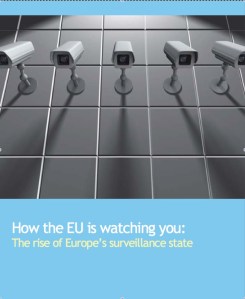
I have just got hold of a new report by UK-eurosceptic think-tank, Open Europe, called How the EU is Watching You: the Rise of Europe’s Surveillance State, which whilst it isn’t as startling as the NeoConPanopticon report from the Trilateral Institute and Statewatch, does some to collect some useful information together in one place. Crucially the report points out the same thing as Will Webster and I did in our paper in JCER a couple of months ago, that this isn’t just a case of ‘European’ bad practice being imposed on the UK, but just as much UK bad practice being exported and generalised throughout Europe.

One interesting footnote is how the discourse of opposition and analysis is changing. A few years ago, and still in academia, the idea of the ‘surveillance society’ was the dominant way of describing the situation, but now there is once again an increasing focus on the ‘surveillance state’ or the ‘database state’.  This is partly, I think because there are an increasing number of right-libertarian and anti-state or small-state groupings openly opposing increasing surveillance – for example, the new Big Brother Watch in the UK, and they tend to emphasise the state’s role (or in this case, the role of an organisation they regard as an unaccountable superstate). This also reflects the growing opposition from the UK in particular. This is particularly interesting because in the past, the idea of the ‘surveillance state’ was mainly a historical term to do with the development of repressive political policing, especially that involved in colonial counter-insurgency – see, for example, Alfred McCoy’s new book, Policing America’s Empire, on the role of the US occupation of the Philippines in the co-evolution of US and Filipino state surveillance practices – or in the totalitarian regimes of the former Eastern Bloc.

The landscape today is much less obviously one of state control. Indeed one could see these developments as a result of the retreat of the power of the individual state and an attempted reconfiguration of state-power of a new kind at a supranational level. And, this power is crucially dependent, as it has been since the end of WW2 on the private sector. The military-industrial complex is now a security-industrial complex and security is no longer anywhere near being simply state business.

UK police still adding innocent people’s DNA to database


Research in the UK has shown that police forces in Britain are continuing to add the DNA – and incidentally the fingerprints, although this is never mentioned – of innocent people to the DNA database despite the European Court of Human Rights ruling that it was illegal (and the government’s promise to accept the ruling). According to The Guardian newspaper today, 90,000 innocent people have been added to the National DNA database (NDNAD) since a the court ruling and the Association of Chief Police Officers (ACPO) – incidentally, a private organisation – is still telling chief constables to continue with this collection. On the other hand the process of removing individual profiles has been painfully slow: only 611 DNA profiles of innocent people have been removed, and all as a result of individual challenges in court. It seems that the police are determined to drag their feet as long as possible and, in fact, break the law quite openly. Hardly a good example…

Surveillance image of the week 3: remembering One and Other

One and Other, Anthony Gormley’s remarkable populist and popular participatory artwork, which enabled 2400 ordinary people to spend an hour each on the vacant fourth plinth in London’s Trafalgar Square, ended recently. Not surprisingly, given London’s reputation as a the surveillance capital of the world, there were some pointed reminders. This ‘plinther’ spent her hour dressed as a CCTV camera looking at the watchers and the watched…

CCTV plinth protest
CCTV plinth protest

(thanks to Eric Stoddart for this)

UK state spy program targets innocent

The headline may not come as any surprise but a damning report has been released on a key strand of the British government’s counterterrrorism strategy, Preventing Violent Extremism (or just ‘Prevent’). £140m (around $200m US) has been allocated to this program but much of it seems to have been devoted not to combatting nascent Islamic extremism (which is the stated aim) but MI5 simply collecting masses of information on entirely innocent British Muslims – information that will be kept until they are 100 years old! Part of this is because of the tenuous nature of the strategy in the first place: how would one define or identify those who are not terrorists but might become so? Will it be, as in cases reported by The Guardian, the student who attends a lecture on the conditions in Gaza or Muslim men with mental health problems? And much of this depends on teachers and lecturers reporting students. Therefore the program would seem inevitably to encourage suspicion and distrust, as Arun Kundnani writes and as the general tone of left and civil liberties critique has reinforced. But opposition has come from all sides: Pauline Neville-Jones, the Conservative shadow security minister, but also former chair of the Joint Intelligence Committee and political director of the Foreign Office, has also condemned the whole approach of New Labour, which she argues is rooted in the identification of discrete ‘communities’ who share similar characteristics. This can of course be the basis of a form of multiculturalism, but at times of increased security and suspicion it seems all to easy for it to morph into what is effectively racial profiling…

Manchester Airport trials virtual strip-search system

Rapiscan image (BBC)

You would think after 4 years of trials at Heathrow, that British airports would now be able to work out whether or not they could and more importantly, should, use the various varieties of body scanners that are now available. However Manchester Airport is holding another trial starting from now at its Terminal 2. At least it will give a chance for the public to say what they think. The scans are remote – i.e.: the officer observing the images is not on the airport floor, which prevents the kind of scenario we mentioned in our Report on the Surveillance Society of lewd remarks directed at passengers. Personally, I am rather less concerned about this rather abstract view of my body being seen briefly as I pass through an airport than I am about my financial details and personal life being traded between private companies, or about being under constant video surveillance in ordinary public space in the city. However, the images, although ghostly, are detailed enough that genitals, deformities, medical implants and so on can be seen, and if this story is to be believed it would seem that there is no provision for women’s images to be seen by a women alone and men’s only by a man. This will make it entirely unacceptable to some people, in particular members of certain religious groups. But the scans are – at least, for now – voluntary, in that passengers can refuse and have a traditional pat-down search instead.

However, this technology won’t be staying in the airports for long. I reported back in July on stories that terahertz wave scanning could soon be made to fit into portable cameras. That raises a whole different set of social, political and ethical questions…

(Thanks to Simon Reilly for sending me the link)

Project Indect and the NeoConOpticon

Following the release of the NeoConOpticon report, Ben Hayes of Statewatch has set up an interesting blog monitoring EU security policy, called (ahem…) Notes on the European Security Research Program. One the first post (and a follow-up) concerned one particular EU 7th Framework Program-funded project called Indect, which seems to think that it is a great idea to have an Enemy of the State-style comprehensive surveillance system across Europe. It appears to be filmed in Poland – you think the Poles at least would have learned from almost half a century of totalitarian rule…

There are of course, hundreds of these security projects being funded by the EU that Ben’s report detailed (with a tiny, tiny number of alternative or critical ones, and of course some token nods to simple ethical concerns like privacy within some of the projects). One that finished in 2007 was the SAFEE project that proposed (amongst other things) to put cameras in the back of every aircraft seat so that passengers’ facial expressions could be monitored automatically for signs off threat… it’s unclear how many of these ever get beyond the research stage – and I hope most don’t – but if they do, the future of the EU is one of a tightly controlled society of people constantly monitored even at the most personal level in case they step out of line. The great thing about the NeoConOpticon report is that it puts all of these things together rather than treating them in isolation. I wonder if the individual researchers involved would think differently if they actually considered their work in this context and in the context of the political architecture of security that is being built in the EU.

Anyway, here’s the PR video for Indect, for those who are interested in such things. It’s typical of the genre: a dumbed-down, hyped-up, over-macho, TV-detective series pastiche with a ridiculous voice-over and music. No doubt it goes down a storm at sales events.

Anyway, keep an eye on Ben’s blog. I will be.

Towards Open-Circuit Television

The era of Closed-Circuit Television (CCTV) surveillance may be coming to an end. Surprised? Unfortunately, this does not mean that we are likely to see less surveillance, and cameras being torn down any time soon – quite the contrary. Instead a number of developments are pointing the way to the emergence of more Open-Circuit Television (OCTV) surveillance. These developments include technological ones, like wireless networking, the move to store data via ‘cloud’ computing, participatory locative computing technologies like CityWare, and the increasing affordability and availability of personal surveillance devices (for example, these plug and play mini-cameras unveiled at DemoFall 09). However they also include changes in the way that video surveillance is monitored and by whom.

Back in 2007, a pilot scheme in Shoreditch in London, which enabled residents to watch CCTV cameras on a special TV channel, was canned. However the project had proved to be incredibly popular amongst residents. Now The Daily Telegraph reports that an entrepreneur in Devon, Tony Morgan has set up a company, Internet Eyes, which is marketing what is calls an ‘event notification system’. They plan to broadcast surveillance footage from paying customers on the Internet, with the idea that the public will work as monitors. They won’t just be doing this for nothing however: the whole thing is set up like a game, where ‘players’ gain points for spotting suspected crimes (three if it is an actual crime) and lost points for false alarms. To back this up, there are monthly prizes (paid for out of the subscriptions of the organisations whose cameras are being monitored) of up to 1000 GBP (about $1600 US). Their website claims that a provisional launch is scheduled for November.

Mark Andrejevic has been arguing, most recently in iSpy, that those who watch Reality TV are engaging in a form of labour, now we see the idea transferred directly to video surveillance in ‘real reality’ (a phrase which will make Bill Bogard laugh, at least – he’s been arguing that simulation and surveillance are increasingly interconnected, for years). This idea might seem absurd, indeed ‘unreal’ but it is an unsurprising outcome of the culture of voyeurism that has been engendered by that combination of ever-present CCTV on the streets and Reality TV shows that came together so neatly in Britain from the early 1990s. It certainly raises a shudder too, at the thought of idiots and racists with time on their hands using this kind of things to reinforce prejudices and create trouble.

But is it really so bad? At the moment, UK residents are asked to trust in the ‘professionalism’ of an almost entirely self-regulating private security industry or the police. Neither have a particularly good record on race-relations for a start. Why is it intrinsically worse, if there are to be cameras at all (which I am certainly not arguing that there should be) to have cameras that are entirely open to public scrutiny? Is this any different from watching public webcams? Wouldn’t it actually be an improvement if this went further? If say, the CCTV cameras in police stations were open to public view? Would it make others, including the powerful, more accountable like a kind of institutionalised sousveillance?

In Ken Macleod‘s recent novel, The Execution Channel, the title refers to an anonymous but pervasive broadcast that shows the insides of torture chambers and prison cells, which functions as a device of moral conscience (at least for literary purposes) but also a Ballardian commentary on the pervasive blandness of what used to be the most outrageous atrocity. Accountability is in the end as far from this project as it is from Internet Eyes. Set up like a game, it will be treated like a game. It strips out any consequence or content from reality and leaves just the surfaces. What is ‘seen’ is simply the most superficial – and seen by the most suspicious. Participatory internet surveillance is Unreality TV. In any case, I don’t think it will either be successful in terms of crime-control (other such participatory surveillance schemes, like that on the Texas-Mexico border, have so-far proved to be failures) or useful in social terms, and may also be illegal without significant safeguards and controls anyway.

And there is nothing to stop multiple people signing up with multiple aliases and just messing the system up… not that I’d suggest anything like that, of course.

(Thank-you to Aaron Martin for badgering me with multiple posts pointing in this direction! Sometimes it just takes a little time to think about what is going on here…)

Racial profiling hits a new low

Just when you think that state surveillance in supposedly free countries could not sink any lower, it has been revealed that UK Border Agency is finding a pilot project into using DNA and isotope analysis to determine the origin of asylum-seekers. This is not a joke or a scare-story. It is a real project. Science Insider has the details here. The Agency is refusing to say who is doing this research for them, nor has it provided any references to studies that show that what they are proposing will work. It appears that most scientists working in the area think it is based on entirely faulty premises and there is no reason to believe it will work. That’s only a minor objection compared to the political and ethical ones of course. As the story in Science Insider points out the Border Agency seem to be making a fundamental (and totally racist) error in assuming that ethnicity and nationality are synonymous. And this research would probably not got past any university ethics committee, which makes one wonder what kind of screening or ethical procedures the Border Agency used, and indeed who would carry out such an obviously unsound piece of research. It’s another example of increasingly unaccountable arms-length agencies (which have proliferated in recent years) using the ‘technical’ as an excuse to bypass what should be a matter of high-level policy, and indeed something that so obviously harks back to the bad days of Europe’s racist and genocidal past that it beggars belief that any sane official would have let this get further than a suggestion in a meeting.

(thanks to Andy Gates for pointing me to the story)

Gordon Brown stalls on UK ID cards issue

Despite the news stories saying that he had made a significant announcement on ID cards, the British Prime Minister, Gordon Brown, said absolutely nothing new interesting on the subject in his speech on future Labour policy yesterday. As Henry Porter comments on The Guardian website, whilst his announcement that ID cards would not be compulsory in the (increasingly unlikely) event of another Labour term was greeted with enthusiasm by the party faithful, this is not any kind of change in policy and nothing concrete was said about the National Identity Register (i.e.: the database, the important bit!). While the Conservative Party may be limited and rather disingenuous in their apparent opposition to the ‘surveillance state’, Labour appears to be merely self-congratulatory and complacent.