
Travel cards: Tokyo vs. London

NB: this post is largely incorrect… at least in the fact that actually the systems are much more similar and becoming even more so. I am not going to change the post (because being wrong is part of research and learning), but will direct you to a more recent post here.

Tokyo and London both have pre-paid smart card systems for travel on public transport. They look superficially similar but also have crucial differences.
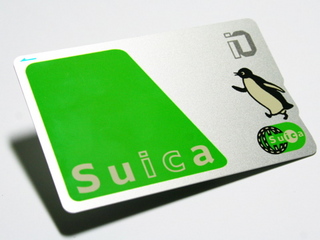
JR East's Suica card

In fact, first of all, there are several smart cards from different railway companies in Japan. Each of main privatised regional railway companies has one: the most common in Tokyo are the Suica card operated by JR Higashi (East Japan Railways) and the Pasmo card issued by a collection of smaller private railway companies as well as the TOEI subway, bus and Tokyo Metro systems. JR NIshi (JR West) and JR Toukai (JR Central) also have their own cards, ICOCA and TOICA respectively. They are all now pretty much interchangeable and Suica, which is the oldest system in operation since 2001, in particular can now be used for other kinds of payments in station shops and the ubiquitous Lawson chain of konbini (convenience stores) elsewhere in the city. It also now has a keitai denwa (mobile phone) enabled version in which the card is virtually present as a piece of phone software.

Great! It’s convenient, costs no more than buying tickets separately and if you forgot to bring any cash for your morning paper, you can use Suica for that too.

So, just like London’s Oyster card then?

Well, no.

TfL's Oyster card
TfL's Oyster card

The Oyster card, issued by Transport for London, looks pretty much the same and operates along similar technological lines, but because it also requires the user to register using a verifiable name, address and telephone number, with which the card is then associated, it is effectively also a tracking system, which is gradually producing an enormous database of movement surveillance. And of course this has not gone unnoticed to the UK’s police and security services who have reserved the right to mine this database for reasons of ‘national security’ and detection of crime. If you lose your card or have it stolen, then not only do you lose your £3 deposit, you’d better tell the authorities too or you might end up having some criminal activity associated with your name on the database.

Suica cards, on the other hand, can be bought from any ticket machine, require no deposit and no registration, and it doesn’t matter if you lose them, or leave the country, even for several years.

Tokyo and London’s transport systems have both experienced terrorist attacks so there’s no particular reason why Japan’s authorities shouldn’t have demanded a similar database (if you accept the UK’s reasoning). Tokyo also has a far more extensive, complex and multiply-owned transport infrastructure. Surely this must inevitably lead to an insecure and out-of-control system where disaster is inevitable.

So in which of the two cities does the transport system work far more efficiently? And where is that you are actually less likely to be a victim of crime, and feel safer?

I’ll give you a clue – it isn’t London.

Met Police finally admit photography is not a crime

After protest and parliamentary questions, The Register reports this week that the London Metropolitan Police have finally got round to reminding their officers that it is not in fact a criminal offence for ordinary people to take photographs or video in public places, nor even to take pictures of police officers. The way that many Met officers had been acting over the past couple of years with harassment of photographers, even tourists in some cases, and arrests under the Terrorism Act,  there appeared to be a deliberate attempt to change or extend the meaning of the law by police policy. This was at the same time that the Met had been running campaigns stating that it was suspicious for anyone to be interested in CCTV. Part of this is also the fault of the Act (and others like it, including the recent Counter-Terrorism Act), which are very broadly drawn and easily subject to extreme interpretation by those who would want to abuse them to attack individual liberties.

This isn’t over yet however; there are many other police forces in the rest of the country and also quasi-police (community support officers, town centre managers etc.) as well as private security, who need to recognise that the public have a right to take photographs in public, and should not be harassed, assaulted or threatened with some non-existent sanction for a perfectly legal pastime.

UK newspaper phone-tapping scandal

Back in the UK, the Sunday newspaper, The News of the World, known largely for its obsession with minor celebrity scandal has been itself the subject of rather more serious investigations, following revelations that it has paid out over £1 Million (around $1.4 M US) to people whose phones it secretly tapped in its search for dirt. Proprietor, Aussie, Rupert Murdoch, is known to satirical magazine, Private Eye, as the ‘Dirty Digger’, and given this showing, he seems to be earning his nickname.

The Guardian editorial highlights this as another threat to privacy, but there’s much more here. Murdoch is one of the most powerful men in the world and his company, News International, covers far more than just Britain – they recently bought the Wall Street Journal, for example. His more ‘serious’ newspaper, The Times of London (for whom, I should declare, I have written a piece once) was very vocal in the past in attacking the recently-retired Information Commissioner, Richard Thomas, first over his comments on ‘sleepwalking into a surveillance society’ and then later on his attempts to bring newspapers under the same regulatory regime over privacy as other organisations.

At the time, it was hard to know what the agenda was; but clearly it was more than the supposedly ‘honourable’ position of acting to protect journalistic independence and the rights of their sources. Now, I think, we can start to understand a little more about the view The Times advocated – perhaps it was simply trying to deflect public investigation into the illegal, underhand and privacy-invasive surveillance practices of other parts of the News International empire.

We should indeed be worried by this, not just because of the activities themselves, but because of the attempts to manipulate public policy and undermine the authority of one of the few people who was interested in, and capable of, attacking abuses of surveillance by the media by an increasingly powerful global private company.

So, does News International own newspapers in your country? Do you know what they get up to? Someone needs to dig the dirt…

MI5 in all kinds of trouble…

The British internal security service, MI5, has found itself in all kinds of trouble this week. First there was the report of the inquiry into the intelligence aspects of the 7/7 bombings in London. Although the report ‘cleared’ MI5 of wrongdoing (which was hardly unexpected!), it is clear that there was a catalogue of intelligence failures resulting from aspects as varied as a lack of funding, poor communication between MI5 and police, and simple mistake in judging the seriousness of the activities of those who came to the notice of MI5, particularly the two eventual bombers, Mohammed Sidique Khan and Shehzad Tanweer.

Then today, there have been serious allegations made in The Independent of the MI5 trying recruitment by blackmail on young British Muslims. Basically the modus operandi was to approach the potential informant and tell them that they were suspected of terrorist activities or terrorist sympathies, but that if they cooperated with MI5 then this would be overlooked. However if they refused then their ‘terrorist connections’ would be made more widely known.

All of this, as if it needed pointing out again, leads to the the clear conclusion that the security services need better and more transparent oversight, as well as clearer direction, and yes, perhaps more money (if they can behave themselves). The point is that properly controlled and justified targeted surveillance of genuine suspects (like Khan and Tanweer) is exactly what a security service should do, whereas mass preemptive surveillance (a la Met Police) or random blackmail is not. In fact the latter would tend to be counterproductive as in general, they will increase distrust in government and in particular, drive more young Muslims towards extremism.

Court rules against police precautionary surveillance

In another chapter in the current struggle over the means of visual representation, the UK Court of Appeal has made an important ruling that could affect the future of police surveillance tactics. In a case brought by anti-arms trade protestor, Andrew Wood (no relation!), the judges ruled that the Metropolitan Police should destroy photographs taken of Mr Wood at the AGM of giant dataveillance conglomerate, Reed Elsevier ( the BBC calls them a ‘publisher’ but that’s a rather archaic and inaccurate term for what Reed Elsevier does, which is to collect, analyse, organise and trade in personal and business data of all kinds).  Reed Elsevier had been involved with running arms trade exhibitions through a subsidiary at the time.

The ruling argued that the police should not take and retain pictures of people who were not suspected of any current wrongdoing, but whom the police considered might do so in the future. According to the BBC, the Met had argued that its actions “were reasonable in helping officers to detect crimes that may have occurred in the past or may do so in the future.” But that is exactly the kind of blanket risk-management-based way of thinking that allows almost any preemptive or precautionary mass surveillance to be justified, and it is quite right that the Court should have ruled that it should be controlled. It is about time that a ruling like this was made.

The one cautionary note here is that the Met will be appealing this to the House of Lords, and no doubt beyond if that fails, so watch this space…

Contact Point goes live

The controversial new central database of all children in the UK has gone live today for the North-west of England, and will gradually be rolled out across the UK. The £224M ‘Contact Point’, one of the main planks of the ‘Every Child Matters’ initiative, will be accessible to around 390, 000 police, social workers and other relevant professionals. It is mainly being promoted as a time-saving initiative, allowing quicker and more informed intervention in the case of vulnerable children, which we all hope it does, although this of course depends on the correct information being on the database in the first place. In addition, as the Joseph Rowntree Reform Trust review, Database State, rated the system as ‘red’ for danger in terms of privacy:

“because of the privacy concerns and the legal issues with maintaining sensitive data with no effective opt-out, and because the security is inadequate (having been designed as an afterthought), and because it provides a mechanism for registering all children that complements the National Identity Register.”

CCTV: expensive and limited says Home Office study

Back in 2002, David Farrington and Brandon Welsh published a study for the UK Home Office which showed that CCTV had only small effects on crime, except in car parks. Now they are back with a study that confirms all that, plus which shows that despite the evidence, more money is spent on CCTV in Britain than on any other single form of crime prevention. So much we knew, but what is a slightly unexpected finding is that CCTV apparently works better in Britain than in other countries. This is not a plus for the UK, rather it shows that in other nations it is even worse value-for-money – and it is clearly not an efficient use of public funds here as currently used. Instead the authors recommend that CCTV should be more narrowly focussed – in other words, we don’t need mass surveillance, we need targeted surveillance At the same time however, more and more money is going into CCTV in the USA in particular, where all the same ‘silver bullet’ arguments are being made as were made in the UK in the 1990s, and have now been shown to be largely unwarranted. The government has now fallen back on populism to justify the continued expansion of CCTV: ‘people want it.’ Well, on that basis, they would bring back public flogging and hanging… it would make rather more sense if they listened to the evidence from the reports they themselves are commissioning.

The full report is available from The Campbell Collaboration library, but there’s a summary in The Guardian today.

UK Ministry of Justice sounding old, tired and defeated

I was at a meeting organised by the Information Commissioner’s Office (ICO) today (Wednesday) in London where both Jack Straw and Michael Wills from the Ministry of Justice spoke. In the wake of the expenses revelations it was not surprising that both sounded somewhat conciliatory, but the degree of both overt and tacit admission of mistakes and changes needed was quite surprising. I had a bit of a set-to with Michael Wills on the apparent lack of knowledge amongst government ministers of the results of their own research on the (in)effectiveness of CCTV, to which he responded with the Melanie Phillips defence – i.e.: come and talk to ordinary people and they will tell you they want CCTV. This is a diversion for many reasons, not least of which is that unlike both the Daily Mail’s moral minority and the minister, I actually live in places where they only visit on official business and I also understand that what people mean when they demand CCTV is not the technology itself but a solution to the real and perceived problems of crime and anti-social behaviour that they face. They only demand CCTV because they see the programs on TV and are convinced that CCTV ‘works’ – however if you talk to senior police officers or anyone who has done research on this, they will tell you, yes, targeted mobile CCTV surveillance to deal with specific problems can be very effective (in terms of both cost and results) but mass camera surveillance is not the same thing. It is rather disappointing that a Justice Minister did not appear to understand the difference.

Jack Staw gave a weird speech. It was both full of matey bonhomie and characterised by stuttering hesitancy and vagueness. He made a number of historical errors, for example in claiming that the culture of secrecy was a product of the Cold War, when the first Official Secrets Act was a product of WW1. He also claimed that CCTV was all about ‘low-level disorder’ and ‘reassurance’, which will be news to all those (like his ministerial colleague) who still think it prevents crime. But he did rightly take some credit for Freedom of Information, including allowing parliamentary expenses to be included, even as it turned out, to his latter-day embarrassment.

Where it got very interesting was in his comments on the government’s consultation on the future of the DNA database following the damning verdict of the European Court. Contrary to Jacqui Smith, Straw indicated that he would be quite happy with the proposed 12 year retention period being reduced to 9 or even 6 years. He also claimed that there was a behind-the-scenes review of The Terrorism Act and other post-9/11 measures going on, which I don’t think many people in the room even appreciated. He admitted that the Labour government got many things wrong after 9/11 and that the environment had now also changed.

It was all very interesting, but you really got the feeling that this was a government on the way out anyway. The Tories will no doubt scrap the ID cards and register, but listening to the Shadow Justice Minister, Dominic Grieve, I got the impression that they don’t have much to offer apart from caution. That might be welcome for a while, but as a speaker from Google remarked, the debate is so far behind the reality of technological change that none of this will really matter very much unless there is a real culture shift. The ICO under the massively influential Richard Thomas, for whom this was very much a valedictory event before he steps down, has made great strides in this direction, but the government and opposition parties are still a long way away from understanding the need to establish a new basis for informational relationships between people, state and private companies that we desperately need.

USA, EU and UK all investing in advanced biometrics

News from various sources has revealed that the United State, the European Union and the United Kingdom are all preparing to invest further large sums in advanced biometrics and surveillance research.

According to an anonymous message to Slashdot, in the USA, Department of Justice requisitions for the coming year show “$233.9 million in funding for an ‘Advanced Electronic Surveillance’ project, and $97.6 million to establish the ‘Biometric Technology Center.'”  The former is largely to deal with the problems of intercepting Voice-over-Internet Protocol (VoIP) communications – like Skype. The latter is what Slashdot  calls a “vast database of personal data including fingerprints, iris scans and DNA which the FBI calls the Next Generation Identification” for the FBI. In other words, the architecture of the proposed ‘Server in the Sky’ system, which The Guardian revealed last year – for some notes on this and other systems under development, see here.

Meanwhile Owen Bowcott in The Guardian today has a story which puts together various bits and pieces from the EU’s FP7 Security theme research budget and UK security investment. In the UK, there is to be £15 million spent on updating UK biometric security for embassies, and more interestingly other unspecified ‘surveillance’ purposes, and in addition, rolling out of facial recognition systems to more UK airports. As we know, the controlled environments of airports where people are required to look at cameras, are one of the few place where this technology works properly.

This provides a rather tenuous link to the headline of the Guardian story which is an EU-funded study into brain-scanning (yet again) called Humabio (Human Monitoring and Authentication using Biodynamic Indicators and Behaviourial Analysis). There are lots of these about, and one of them may work sooner or later, but it is worth pointing out that people have been putting out ‘we will soon have brain scanning’ stories since the 1980s and like, nuclear fusion, it always seems to be 5 or 10 years in the future. Brain-scanning seems to be the technology of the future… always has been, always will be?

Surveillance: controlling people for the market

Larry Elliot, the Guardian’s main economics reporter, has written a great piece today which pretty much sums up what I and other surveillance studies scholars, as well as people writers like Hardt and Negri, Zygmunt  Bauman and Naomi Klein, have been saying about the direction of global policy, but particularly in the UK, in recent years. In short, it argues that the current government has completely abandoned the main principles of a liberal democracy, which were to control the market for the common good, and instead has reversed the equation, and now, largely through surveillance, seeks to control people for the benefit of the market. Although this is hardly a new argument, Elliot’s piece is particularly succinct and clear. Worth a read…