India has launched its first major military surveillance satellite, RISAT-2, a platform for high-resolution Synthetic Aperture Radar (SAR), which puts it up there with the kind of things that the USA were launching over 10 years ago. Of course although, as The Times of India comment shows, being part of the club of orbital space powers is a consideration, the main motivations are most immediately, dealing with the threat of Pakistani Islamic extremists, and in the long term, regional competition with China, which has its own active satellite launch (and satellite-killing) program. One thing which about which the paper is entirely correct is that Indian high tech is more advanced than China’s and this home-grown satellite marks a small but significant shift in global surveillance power towards India. Whether, for a country still struggling with massive poverty and inequality, it is what anyone ‘needs’ or is any more than an expensive strategic symbol is another question.
Whilst finishing up my work in Rio de Janeiro yesterday, I came across this interesting bunch of people, mv-brasil, who appear to be a Brazilian nationalist movement, with much in common with organisations like the British National Party or the various right-wing groups in the USA. Their website contains the usual odd mixture of anti-globalisation, evangelical Christian (they campaign against Halloween) and anti-United Nations / New World Order stuff with the added anti-Americanism. There of course is the usual rather uncomfortable fact of the ‘Brazilian Christian’ nationalist being a representative of a colonial power that invaded the country and took it from the indigenous people, but they roll over this one with some nods to Indian rights when it suits their cause, most notably when it comes to the Amazon.
A t-shirt with anti-internationalisation and privatisation of the Amazon slogan
One of the T-shirts for sale makes reference to this, being against ‘internationalisation and privatisation’ of the Amazon by the USA. It is a conspiracy theory I’ve come across before when I was doing some research on the SIVAM program – which provides some actual evidence for contentions that there is a secret American program to control the rainforest. I had someone tell me here in complete good faith that it was a ‘fact’ that several Amazonian tribes already thought that they were part of the USA and flew the US flag! This is combined with the fact the UN and international environmental organisations are very concerned about the destruction of the rainforest and the perceived lack of effort by successive Brazilian administrations to stop it. Put all this together and you have the ingredients for nationalist paranoia.
So what is SIVAM? And why would I be interested in it anyway? The reason is that SIVAM is a surveillance system. Announced at the Earth Summit in 1992, and finally completed in 2002 and fully operationial from 2004, the Sistema de Vigilância da Amazônia (SIVAM) is a multipurpose, multi-agency network of satellite, aerial and ground surveillance and response that aims to monitor the illegal traffic of drugs and forest animals and plants, control national borders and those of indigenous peoples’ lands, and prevent the further destruction of protected areas of forest. A good technical account in English can be found in Aviation Today from 2002, and there is an interesting article on its construction here.
Donald Rumsefld visits the SIVAM control centre, 23 March 2005 (Wikimeda Commons)
The problem is that, although an initiative of various Brazilian government agencies including the environment and Indian affairs ministries, the federal police and the army, SIVAM is supported and funded by the USA – most of the initial $1.39Bn US cost came through a grant from the U.S. Export-Import Bank, and the consortium that supplies the equipment includes giant US military supplier, Raytheon – amongst many others from Brazil to Sweden. The visit of former President George W. Bush’s right-hand man and then Secretary of State for Defense, Donald Rumsfeld, to the SIVAM control centre in 2005, was widely reported in Bazil. It was of course interpreted by many as further evidence of Brazil’s ceding of control of the Amazon to the USA, or even presaging a US invasion of the Amazon, as Senator Norm Coleman discovered on a fact-finding mission later that year.
Latin American countries have every right to be suspicious of US motives: the Monroe Doctrine; George Kennan’s Cold War ‘grand area’ vision; the support for dictators like Augosto Pinochet; the invasions of Panama and Grenada; Plan Columbia and the widespread use of military ‘advisors’… the list goes on. And it is certainly the case that US strategic surveillance plans for ‘Full Spectrum Dominance’ and the like, have have long included ‘leveraging’ any system in which they are involved from the International Space Station to things like SIVAM. So of course they will have a strategic interest, and no doubt SIVAM data will find its way to US military C4ISR centres, but this does not amount to a plan to invade Brazil or take control of the Amazon.
Over the last two weeks, we’ve talked to all kinds of police. We’ve talked to officers, both senior and junior from the Policia Militar (PM), the state-level equivalent of the French ‘gendarmerie’ or Italian ‘carabinieri’, including some who have been rebranded as ‘Policia Communitaria’; we’ve met guys from BOPE (the Rio-specific special operations group within the PM here) – and hopefully we will meet their Commander today; we’ve interviewed the Subchefe of the Policia Civil (PC), the detectives, again based at state-level; and we’ve visited the headquarters of the Guarda Municipal (GM), the relatively recently-formed city police. I haven’t talked to the firefighters, another military-state legacy, who are still an armed force, although a report from the State parliament in January recommended that they be disarmed. Back when I was in Brasilia, I also had a meeting with the Policia Federal (PF), the Brazilian ‘FBI’, another post-dictatorship development, who operate at federal level.
It is a confusing organisational landscape, and not just for me. Throughout the interviews with all the different representatives, very different perspectives emerged on what is important in policing, which force is more important and for what purpose, to what extent the current system works, and what would be the best way forward. Corruption was also something that came up time and time again, with everyone arguing that their force was improving and dealing with this, but hinting that there was still a problem with other kinds of police. There was lots of talk of ‘new generations’ of officers free from the taint of the past. But at the same time it was quite clear on the ground that people from all social classes still do not trust any of the police in general, even when they have established quite positive personal working relationships with officers in their own community.
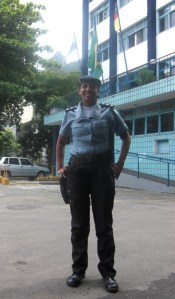
Cesar Couto Lima, Diretor de Operacoes of the Guarda Municipal
The GM are less than twenty years old and they ‘know their place’ in the hierarchy of police: at the bottom. They are not true ‘professional police’ in the sense that they have only three months basic training, followed by some specialist extra work. They are really somewhere between police and a private security force that just happens to be employed by the city – their commanders at the top level are however, ex-PM. They do, however, have a growing field of responsibility, acting both as a kind of protective and preventative force on the ground in the city centre and as a street-level agency of the ‘eyes on the street’ form of surveillance.
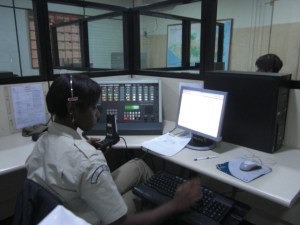
Operator in the Guarda Municpal emergency control room
They also act as the emergency services co-ordination, and this role will increase and be better integrated and funded in future. They are largely disarmed, though not because as many believe, the law prevents them from being armed. This is a strategic decision based on keeping a clear line between them and the PM. This is also the reason why they have a different uniform (in Rio a kind of unflattering beige) from the PM (blue). In our interview with the Director of Operations, Cesar Couto Lima, we were told that in the past, the uniforms had been the same colour but that this had been changed under the last mayor, Cesar Maia, to prevent GM officers from being shot by criminals in the mistaken belief that they were PM. They now have a very low rate of injury and death. The Dir Ops also wants to increase the numbers and in the very long term for the GM to be the be the main police force of a disarmed and less violent city.
It is a fine aspiration, however the new Mayor Eduardo Paes, has apparently suggested that the uniform is changed back to blue and that there should be more arming of the GM. The Dir Ops is utterly opposed to both, and I think he sees it as a deliberate ploy to give the impression of more PM around – the State Secretary for Security has already announced a plan to increase the numbers of PM in Rio by thousands, as we found out when we visited his office. The officers we met at the GM were generally pleasant, relaxed people, however the GM is not immune from corruption. I have heard allegations of extortion from street traders, the poor and criminals, in much the same way as gets reported of the two main forces, and indeed of death threats to officers who refuse to get involved with such practices. Any generalised or regular arming of the GM would only increase the temptation to act on the new power in an irregular way, and also, with so many weapons in the hands of relatively poorly paid and untrained officers lead to greater numbers of killings and a further channel for criminals to obtain weapons.
Ricardo Martins, the Subchefe of the Policia Civil would also like to see a demilitarisation of the police in the long-term. He argued that basically, the PM should be gradually abolished and absorbed into a purely civil police. He was also strongly in favour of more ‘intelligence-led’ and surveillance-based solutions, rather than force of arms or numbers. According to him, the expansion of the video surveillance system in the city was essential and absolutely necessary if the city was to be ready for the 2012 soccer World Cup (to be held across Brazil) and more particularly for the 2016 Olympics, for which the city is a frontrunner. All the senior officers an officials with whom we talked agreed that currently it was nowhere near ready. The GM also agreed with the expansion of CCTV, although they seemed to think that they would have a greater role in operating the systems in future, talking of plans for neighbourhood control rooms integrated with the emergency services control system. Neither the PC, nor more importantly, the Superintendente de Commando e Controle of the State, Claudio de Almeida Neto, gave any indication that this was the direction in which things were proceeding. Indeed the Superintendente was quite clear that there was a greater centralisation, co-ordination and professionalisation of video surveillance operations taking place through his office and his control room, which is in the old ‘Centro do Brasil’ railway station. The office of the Secretary of State for Security seemed not to be that interested in surveillance at all, and commented that it was very expensive, which suggests that the funds for the expansion of the video surveillance system that all expect, whoever they think will be running it, may not be quite as lavish as they believe or would want. I will write more about this later. The PC, however has the reputation of being the most corrupt of all the forces. Subchefe Martins pointed to the internal investigations branch as evidence of the effectiveness of their fight against corruption. Other interviewees were not as easily impressed!
Capitao Pricilla, Head of Santa Marta Community Police initiative
So where should policing in Rio go? One way forward was obvious when we interviewed Capitao Pricilla, the current ‘star’ of the PM, who heads up the Community Policing initiative in Morro Santa Marta. Capitao Pricilla is a PR-dream: attractive, articulate, intelligent, convincing in her arguments, and clearly dedicated to her work with the community. She is everything you would hope a new generation of younger PM officers would be, and she clearly stated that she is part of a new generation. And she is popular too. As we talked with her, officers would constantly come over just to say ‘hello’ and older women in particular, would treat her like a TV celebrity. Now, of course I am wary of the way in which such charisma would make her an obvious choice to head such an operation, which is much promoted as ‘the way forward’ in the media. However there have been many ‘ways forward’ before which have come to nothing and Rio is constantly making and destroying innovative initiatives before they even have a chance to have a real effect. The Santa Marta initiative probably cannot be replicated in many favelas, like Prazeres, where there is a more intimate relationship with the ‘parallel power’ of the traffickers. But Capitao Pricilla seems like the real deal. Let’s hope that she and officers like her get the support they need and are not undermined by the violence and corrupt practices of so many of their colleagues. It’s a utopian hope perhaps, and Rio is still going to need the other far more aggressive hand of the other attempt to get around corrupt practice in the PM, the BOPE – about whom I will write more after our visit today – as much as it needs the helping hand of Community Policing initiatives for a while. It is that large and less articulate mass of PM and PC officers who have no interest in doing anything different, and the equally corrupt politicians who prevent change for their own selfish reasons, that are the main barrier to any organisational change.
There’s no doubt that academic research and military intelligence have a more tangled history than some would imagine, although in many countries in recent years ‘imperial disciplines’ like geography and anthropology have been through a long process of reevaluation and rejection the values that gave them birth. In the USA, however, geography remains intimately connected to the state and more particularly to current US military projects, indeed since 9/11 such ‘patriotic’ research has become more rather than less common.
z magazine has a very interesting article on a growing furore around first of a new US government cartography / geography program called the Bowman Expeditions. This half a million dollar project, México Indígena, has been mapping indigenous lands in Oaxaca, Mexico, where a popular insurgency has been growing in recent years. Local organisations under the umbrella of the Union of Organizations of the Sierra Juárez of Oaxaca (UNOSJO) have rejected the activities of the expedition and claim they were duped by researchers.
A slide from a Powerpoint from the project reveals ideological connections to US military goals, but the links are material too.
And it seems they were right to do so: the grant scheme is associated with the U.S. Army’s Foreign Military Studies Office (FMSO), which seems to be largely associated with so-called ‘open source intelligence’, in other words ‘leveraging’ academic mapping projects for military purposes, in particular the ‘cultural terrain’ for potential future counter-insurgency purposes, learning the lessons of failures in Afghanistan and Iraq. The academics involved, Jerome Dobson and Peter Herlihy from the University of Kansas, just down the road from FMSO, are now furiously backpedaling as previous denials are shown to be evasive and disingenuous…
Paola and I had a very productive interview with Colonel Mario Sergio de Brito Duarte, the Director President of the Institute for Public Security (ISP) in Rio de Janeiro. The ISP is a state-level organisation with multiple functions including research on public security and the compilation of crime statistics; professional development for the police services (and also more broadly to encourage greater cooperation and coordination between military and civil police); and community involvement and participation in the development of security policy. The Colonel gave us an hour and a half of his time to explain his view on a wide range of issues around crime, security, the problems of the favelas, and the potential for surveillance, social interventions and policing in solving these problems.
As with many senior police (and military) officers with whom I have talked over the years, the Colonel is an educated, thoughtful man who has strong views based in his experiences as a front-line officer with the Policia Militar in Rio (including some years in BOPE, the special operations section) – as detailed in his book, Incursionanda no Inferno (Incursions into the Inferno). Despite how the title may sound, he was far from being gung-ho or authoritarian in his views, emphasising throughout, as with almost everyone I have talked to, that socio-economic solutions will be the only long-term guarantee of public security in Rio. And he certainly had no sympathy for the illegal actions of militias, despite understanding why they emerged and continued to be supported by some sections of the community.
However, it was also clear to him that current policies like Mayor Eduardo Paes’ ‘choque de ordem’ strategy which involves demolitions of illegally-built houses in the favelas, was absolutely necessary as well. He spent some time outlining his view of the history of how drug gangs infiltrated and gained control of many favelas, an in particular the importance of their obtaining high quality small arms – though he was vague on exactly where these arms came from – I have, of course, heard allegations from other interviewees that corrupt soldiers and policemen were one common source of such weapons.
From the point of view of surveillance studies, it was notable how profoundly indifferent the Colonel appeared to be towards he growth of surveillance, and in particular CCTV cameras. He argued that they might be a useful supplement to real policing, but he certainly did not appear to favour a UK-style ‘surveillance society’ – of which, at least in Rio, there seems little sign as yet. He was similarly indifferent towards other central state social interventions like the Programa Bolsa Familia (PBF), and initiatives like ID cards – of course they might help in some way, but he certainly made no attempt to ague, as the UK government has done, that such technology will make a big difference to fighting crime and terrorism (indeed it was interesting that ‘terrorism’ was not mentioned at all – I guess that, when you have to deal with the constant reality of poverty, drugs and fighting between police and gangs, there is no need to conjure phantasms of terror). Even so, the Colonel recognised that the media in Rio did create fantasies of fear to shock the middle classes, and that this sensationalism did harm real efforts to create safer communities.
There was a lot more… but that will have to wait until I have had the whole interview transcribed and translated. In the meantime, my thanks to Colonel Mario Sergio Duarte and to the very nice and helpful ISP researcher Vanessa Campagnac, one of the authors of the analysis of the Rio de Janeiro Victimisation Survey, who talked to us about more technical issues around crime statistics.
Governments will find it harder and harder to stand up to this kind of pressure from the growing security economy – all the companies grown fat on the War on Terror
Two recent stories of the cancellation of airborne surveillance programs should remind us that the route to a surveillance society is not an inevitable technological trajectory.
You don't see that very often! An airborne DEA surveillance plane (Photo by Schweizer Aircraft/MCT).
One is a classic tale of secret budgets disguising incompetence and disorganisation rather than efficient espionage. The US Drugs Enforcement Agency (DEA) has ended an experimental air surveillance program, following almost total equipment failure. The planes, in short, didn’t fly, or didn’t fly much. Almost $15 million US down the drain, and no accountability because this was an ultra-secret, need-to-know, maximum deniability, ‘black earmark’ project…
The other is a more courageous story of a government finally standing up to the pressure or its larger ‘allies’, and the fear-mongering PR of arms companies. In this case, the Australian government has withdrawn from the BAMS Global Hawk Unmanned Aerial Vehicle (UAV) program. It has cost the country $15 Million AUS, but this will save almost $1 Billion AUS. It also puts a small dent in the massive expansion of UAVs, now being used everywhere from the skies of Afghanistan to the streets of Liverpool. This decision did not make the military-industrial complex very happy and the story in The Australian shows clear evidence of corporate PR spin at work – the emotional blackmail of claiming that this decision could cost Australian lives in the event of more bushfires (or in other stories, it would leave Australia open to terrorism).
Global Hawk (USAF)
Even in a recession, governments will find it harder and harder to stand up to this kind of public pressure from the growing security economy – all the companies grown fat on the War on Terror that have the ear of the military and are backed by US-led consortia. It is to their credit that the Australian government has not given in – as for the US DEA, well, that is the opposite lesson – secrecy and the assumption of necessity can lead to massively wasteful state procurement and an absence of real security. The question is whether either lesson will prompt wider leaning…
I am sure there will be arguments about the violation of airspace, which will not be trivial as the ongoing diplomatic and increasingly military row over US surveillance vessels off China is showing…
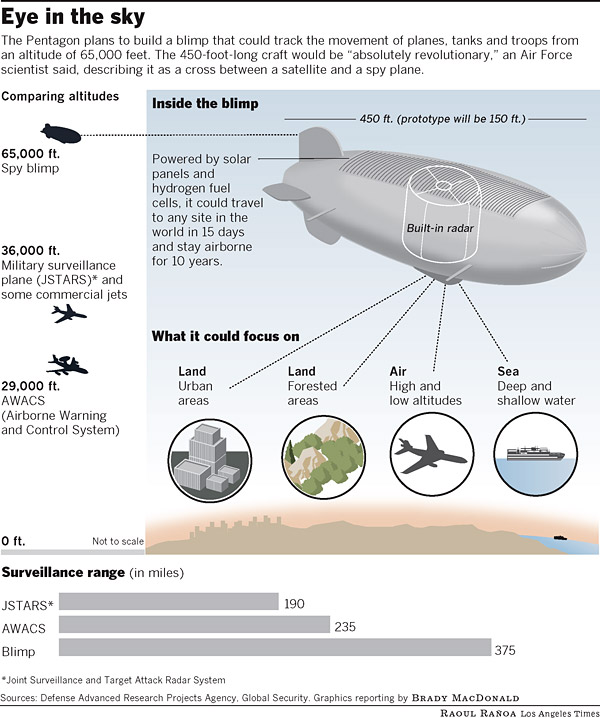
Unmanned aerial vehicles (UAVs) are one of the fastest-developing areas of surveillance technology. A new plan revealed by the US Department of Defense combines old and new tech with a plan, first revealed by the Los Angeles Times, for an pilotless surveillance airship called ISIS (Integrated Sensor Is the Structure) that will fly right at 65,000 feet (about 20km) high, right at the edge of ‘airspace’. The point of the airship is to provide the kind of constant watch that a geostationary satellite provides, but at a much lower level so that for more detailed pictures of the precise movements of vehicles, objects and people could be observed.
Well, as usual, the reports only seem to to be concerned about how great this would be for US military tactics, and are not interested in the law, politics and ethics of such devices. For example, I am sure there will be arguments about the violation of airspace, which will not be trivial as the ongoing diplomatic and increasingly military row over US surveillance vessels off China is showing. And of course there are issues around the violation of human rights by such intrusive technology: international violations are very hard to deal with, however. And this will only be the beginning. The new Obama administration has promised more investment in intelligence and surveillance and less in warfighting. That sounds good in some ways, but of course just poses new problems and new issues for those of us concerned with ongoing US attempts to cover the whole world with surveillance for the benefit of its strategic aims.
As a result of an annual report on datamining sent to the US Congress by the Office of the Director of National Intelligence, a research project, Video Analysis and Content Extraction (VACE), has been revealed. The program is aiming to produce an computer system that will be able to search and analyse video images, especially “surveillance-camera data from countries other than the United States” to identify “well-established patterns of clearly suspicious behavior.”
Conducted by the Office of Incisive Analysis, part of the Intelligence Advanced Research Projects Activity (IARPA), the program has apparently been running since 2001,and is merely one of several post-9/11 research projects aiming to create advanced dataveillance systems to analyse data from global sources. How the USA would obtain the information is not specified…
One could spend a long time listing all the DARPA and IARPA projects that are running, many of which are speculative and come to nothing. The report also mentions the curious Project Reynard that I have mentioned before, which aims to analyse the behaviours of avatars in online gaming environments with the aim of detecting ‘suspicious behaviours’. Reynard is apparently achieving some successful results, but we have no real idea at what stage VACE is, and the report only states that some elements are being tested with real world data. This implies that there is nowhere near a complete system. Nevertheless the mentality behind these projects is worrying. It is hardly the first time that the USA has tried to create what Paul Edwards called a ‘closed world’ and these utopian projects which effectively try to know the whole world in some way (like ECHELON, or the FBI’s proposed Server in the Sky) are an ongoing US state obsession.
It is the particular idea that ‘suspicious patterns of behaviour’ can be identified through constant surveillance and automated analysis, that our behaviour and indeed thoughts are no longer our own business. Because it is thoughts and anticipating action that is the ultimate goal. One can see this, at a finer grain, of programs like Project Hostile Intent, a Department of Homeland Security initiative to analyse ‘microexpressions’, supposedly preconscious facial movements. The EU is not immune from such incredibly intrusive proposals: so-called ‘spy in the cabin’ cameras and microphones in the back of every seat have been proposed by the EU-funded SAFEE project, which is supported by a large consortium of security corporations. The European Commission has already hinted that it might try to ‘require’ airlines to use the system when developed.
No doubt too, because of the close (and largely secret and unaccountable) co-operation of the EU and USA on security issues, all the images and recordings would find their way into these proposes databases and their inhuman agents would check them over to make sure we are all passive, good humans with correct behaviours, expressions and thoughts, whether we are in the real or the virtual world…
The Met are unlikely to care. They are not generally known for their respect for the political rights of British citizens…
The Guardian has posted another worrying story (and an interesting video) on the routine police surveillance of environmental activists, most of whom have no connection to any criminal behaviour. The Metropolitan police, who have always been in the forefront of efforts to try to portray political activists as actual or potential criminals, is collecting storing and sharing information, including many private personal details, on activists using Crimint, the national criminal intelligence system. The data includes activists “seen on a regular basis” as well as less frequent activists, regardless of arrests or convictions, their names, political associations and photographs. This information is being shared between police forces to build up more complete portraits of political activity nationwide.
The human rights group, Liberty, is challenging this data collection and sharing on the grounds that it breaches Article 8 of the European Convention on Human Rights. My view is that it almost certainly does, and that the Met are unlikely to care. They are not generally known for their respect for the political rights of British citizens indeed one of their original purposes was to crack down on political dissent back in the Nineteenth Century and they have always maintained this role. They operate the National Extremism Tactical Coordination Unit (NETCU) which is also involve in spreading disinformation on political activists and their HQ at New Scotland Yard will apparently host the new privately-run ACPO Confidential Intelligence Unit (CIU).
I have had my own personal experience of the Met’s way of dealing with activists and it is certainly not in any way respectful of anyone’s rights. It urgently needs to be brought under some proper control and accountability, and hopefully being found guilty of breaching Article 8 of the ECHR, if it happens, will be a good start.
In one of those fortuitous instances of synchronicity, there are two stories today that illustrate some of both the commonalities and the differences between state surveillance practices and regulation in the UK and the USA.
In the UK, The Guardian has revealed that the Surveillance Commissioner (a separate office to the Information Commissioner) has been very critical behind the scenes, as the Lords Committee was in public, of the uses to which the Regulation of Investigatory Powers Act (2000) (RIPA) has been put, not this time by local government, but by national ministries like the Department for Environment, Food and Rural Affairs (DEFRA) and agencies, including Ofcom (the broaadcast and communications regulator) and the Charities Commission. DEFRA came in for a particular telling-off over its spying on fishermen. The chief commissioner, Sir Christopher Rose found generalised lax practice, a lack of proper justification for and proportionality in the used of RIPA, and little training or accountability. In short, RIPA is being used because the powers exist not because there is any pressing justification to use surveillance in this manner – the used of surveillance has expanded because it is available.
It is very interesting that The Guardian had to discover all this through Freedom of Information Act (FOIA) requests, and that the Surveillance Commissioner had not put all of this in the public domain as a matter of course. It highlights for me, once again, the clear difference in attitude and regulatory practice between him and the open, accountable, and active Information Commissioner’s Office (ICO). It confirms my view that we would be much better off if the Surveillance Commissioner’s work was absorbed into the ICO.
In the USA, it is to lawyers that people immediately turn if some bad practice is suspected on behalf of the government. The Los Angeles Times reports that on Friday, the US government lost the case it had been bringing to try to stop an Islamic charity based in Oregon from suing them over what they claim were illegal wiretapping operations targeted at them. The case stems from the Bush administration’s attempts to bypass what were already very weak regulations governing the surveillance of American citizens which were introduced in the Foreign Intelligence Surveillance Act (1978) (FISA) and recently amended in the Protect America Act (2007). Requests are supposed to go to the Foreign Intelligence Surveillance Court (FISC) which meets in secret and does not have to publish its rulings and so far as we know, has never turned down a request – so it is somewhat mystifying except as a matter of speed and convenience that the Bush administration did bypass the court.
Now the Obama administration is (shamefully) defending the actions of his predecessor. This is not entirely surprising. Intelligence is one area of continuity between governments: it is what Peter Gill called the ‘secret state’, a core that remains constant regardless of changes of administration. Nixon and Bush were both stupid enough to get caught, but the NSA, CIA and FBI are continually looking for different ways to get around domestic regulations on surveillance. Political devices like the UKUSA agreement served this purpose for many years – whereby Canadian and British intelligence services would collect SIGINT on Americans and supply it to the NSA and vice-versa. But GCHQ and others just don’t have the capabilities to carry out the amount of monitoring that now goes on. It’s been the reality for many years now that the NSA in particular does spy on Americans. Again, they have the capabilities so those capabilities are used.
Of course, unlike in the UK, we are talking about the threat of terrorism not anglers catching one-too-many fish; that really does say something about the petty bureaucracy that characterises the UK! However RIPA was also justified originally with reference to terrorism and serious and organised crime. Anyway, the ruling in the Oregon case clearly states that state secrets privilege was not enough to justify warrantless surveillance of suspects, whatever they had allegedly done. It seems that at least is one point of hope that the USA and the UK have in common. Let’s see where these situations now lead in each country…




 So what is SIVAM? And why would I be interested in it anyway? The reason is that SIVAM is a surveillance system. Announced at the Earth Summit in 1992, and finally completed in 2002 and fully operationial from 2004, the




 ubisurv