
Guardian article

The Guardian‘s Comment is Free site published a short version of my critiques of RIPA today… you can read it here.


Or the full version prior to editing is here:

A little-known tribunal is meeting this week to consider a case a case of wrongful surveillance. The case brought by Jenny Paton and Tim Joyce against Poole District Council in the Regulation of Investigatory Powers Tribunal concerns the local authority’s targeted surveillance measures against the couple and their children in an investigation of their application for school places. Among other activities, council employees trailed the family and interrogated neighbours.

The case comes in the same week that the government issued its response to a consultation process on the reform of the law which the tribunal oversees: the Regulation of Investigatory Powers Act (RIPA) (2000). RIPA has proved controversial as it seems to give many different public bodies new powers of surveillance, but that isn’t entirely true: as many local council officials admit, much of this was going on before 2000, but RIPA regulates and restricts it – in fact, it restricts it too much to some of the published responses to the consultation process. It is, however, almost impossible to determine whether RIPA has increased or decreased surveillance of this kind as no consistent records were kept prior to RIPA’s introduction. What is certainly the case is that the public is now more aware of the use of surveillance powers by agencies they had never realized were allowed to do such things.

Surveys have found that only 9% of RIPA authorizations resulted in either prosecution of enforcement action. In Australia, earlier this year, when only 28% of the use of targeted surveillance (in that case by police) resulted in prosecutions, their law was denounced as an excuse for ‘fishing expeditions.’ So what does a 9% rate indicate for Britain? Desperation perhaps? Or at least that RIPA was being massively overused for trivial issues. The House of Lords Constitution Committee report, Surveillance: Citizens and the State, certainly thought so, arguing not only that the inadequate administrative procedures should be reviewed but also that the government should think again about the whole business of allowing Local Authorities police powers, and that in any case, these powers “should only be available for the investigation of serious criminal offences which would attract a custodial sentence of at least two years.”

The government has failed to take heed of these recommendations. Ok, so they have agreed to restrict the authorization of covert surveillance under RIPA to ‘Director, Head of Service, Service Manager or equivalent’, and that Local Authorities should designate compliance officers so there will be no more junior officers deciding to play James Bond, as in the Poole case. However, by going to a ‘consultation’ whose respondents were dominated by Local Authorities and other RIPA-enabled agencies, they have managed to avoid doing anything particularly radical. This started from limiting the scope of the review through the questions they asked in the consultation.

For example, by asking which covert investigatory techniques specifically should be removed (and discounting any views that said ‘all of them’) they managed to get a mixed set of answers that failed to produced a clear vote against any one technique. Result: no techniques get removed and in fact some of the existing allowed techniques get extended to yet more agencies, for example the new Child Maintenance and Enforcement Commission (the replacement for the Child Support Agency). In particular, this extension of powers covers telecommunications data, whose keeping by the state has of course increased since RIPA was proposed. Now RIPA will be used to allow new bodies access to this data.

A curious note throughout the response by the government is the insistence on using an idea of non-interference with law-enforcement as a reason for not allowing elected officials any more than strategic scrutiny over the actions their own officials take under RIPA. This matters because RIPA is just one of many ways in which law-enforcement is not spreading as a function to increasing numbers of agencies beyond the police and judiciary. This seems to be general position that New Labour has taken – although it hasn’t always got its way – does anyone remember the dropped proposals to allow any ‘responsible people’ to levy on the spot fines?

And the government response seems to take a bullish delight in attacking those who have criticized the surveillance society. They insist, for example – and despite all the evidence to suggest that such interventions have limited effectiveness – that Local Authorities should make more use of overt, mass surveillance, like CCTV, instead of using RIPA. They are creating a binary choice, which seems to say assume that some kind of surveillance should be used: which do you choose, overt or covert? But, of course, that shouldn’t be the choice at all. They are also trying to have their cake and eat it on CCTV: the response to the consultation dismisses those consultees who brought up the subject of CCTV – which is not covered by RIPA – but feel quite able themselves to recommend its extended use in their own response. This of course also ignores the perfectly legitimate feeling amongst many that it is about CCTV was brought under proper control and a reformed RIPA might well be the place to do it.

Then there are things missing: notably, the concentration on Local Authorities, which for the most part has completely obscured the use of covert surveillance by central government departments and arms-length agencies including the Department for Environment, Food and Rural Affairs (Defra), the NHS and the Environment Agency, all of which have been criticized in the past by the Surveillance Commissioner.  Nothing seems to be proposed to increase the visibility of the RIPA Tribunal which is, just for now, in the news. The Lords described it as all but invisible and weak. Nor do the government propose to do anything to strengthen training or the Code of Practice, and in any case, there has been a huge over reliance on such self-regulation for matters which should have more formal control; this is also how CCTV and the security industry is largely – and incredibly ineffectively – regulated in the UK.

Pretty much anyone could have predicted this limp response from the Home Office to some rather serious problems. They don’t read their own research, they don’t do consultation in a meaningful manner, and then, surprise, surprise, they conclude that there really isn’t very much wrong after all. Jenny Paton and Tim Joyce may well disagree, and let us hope that the RIPA Tribunal do too.
Bizarre happenings in Rio de Janeiro

My collaborator, Paola Barreto Leblanc writes to me “Something really bizarre happened this week. In a public street in Rio’s center CCTVs from some buildings and a Bank – private circuits – caught a criminal action led by police officers [Policia Militar – PM, or Military Police, in fact]. Instead of helping a victim of an attack they rob the robbers!” The news story is available on youtube:

The thing that adds an extra layer of particularly bleak humour to this nasty event is that the name of the PM officer involved is capitão Bizarro (Captain Bizarre)… however, the really sad fact about the whole incident is that the victim was prominent social justice activist and founder of the internationally-renowned favela music group AfroReggae, Evandro João da Silva. He did a lot more good for the city and for the improvement of the lives of the urban poor than any gang-members or police officers ever did and he will be sorely missed. The PM chief, Mário Sérgio Duarte, who we interviewed back in April, is once again in the papers and on TV, apologizing. I noted at the time that Colonel Duarte seemed ‘profoundly indifferent’ to CCTV – I wonder if he will change his mind now and in what direction…

As Paola also writes to me, the nexus of CCTV in Rio is an intensely confusing one, mixing drug-gangs, corrupt police, the media, who like anywhere else seem to be living off the images from CCTV cameras without much in the way of respect for the victims. We are now starting to work together on a paper on these developments.

Would Canadians be “safer with a camera on every corner”?

I haven’t got very involved with Canadian debates on surveillance yet (but don’t worry, I will!). However a comment piece in Thursday’s Globe and Mail, which demanded that Canadian cities install ubiquitous video surveillance, prompted me to pen an immediate letter, which was signed by both Professor David Lyon and myself. It was published today, slightly edited – the full version is below. (They also decided to edit out our respective titles, which makes me look senior to Professor Lyon. Oops.)

“Marcus Gee writes that “We’d be safer with a camera on every corner” (Comment, May 22nd, p.15). If only this were true. However it simply is not the case.

Mr Gee quotes the UK as an example of where video surveillance is effective, but this is not supported by the crime figures in the UK or by academic research. The most comprehensive evaluation of all studies done of the effects of CCTV on crime (by the Campbell Collaboration, 2009) concluded that it had little or not effect on the occurrence of violent crimes like the disgraceful murder of Christopher Skinner, which prompted Mr Gee to write. Even the limited British police assessment of CCTV conducted by the Association of Chief Police Officers (ACPO) in 2008, admitted this was the case.

It is easy to demand that ‘something must be done’ as a response to any particular incident of violent crime, and CCTV is the currently fashionable ‘something.’ But let us get beyond the superficial and look at the evidence. Then we could have a proper debate about CCTV.”

Lies, Damned Lies and CCTV Statistics…

Earlier today, I reported on reports that claimed that 96% of US citizens support video surveillance. Now, thanks to Vicki Contavespi, and the people at BRS Labs who commissioned the survey from Harris Interactive, I have the raw figures. And, unsurprisingly enough, whilst they aren’t ‘lies’, they don’t quite show what the headlines suggested – just as my headline, a quote often attributed of course to Disraeli, is also an overstatement of the case at hand. This is a very interesting survey. There were quite a few questions asked, and I don’t have time to go through all of them here now, but I will just deal with the question of ‘support’ for video surveillance and break it down just a little more.

First of all, the main questions on the acceptability of video surveillance (and other surveillance techniques) are couched in an particular way that is common in market research. The lead question is “How strongly do you agree or disagree with each of the following statements?” There is then a list of statements, which each have four options: strongly agree, somewhat agree, somewhat disagree, and strongly disagree. There is no ‘neutral / don’t care / no opinion’ option, which might have taken out many of those in the ‘somewhat’ categories on either side. The headline figures used then, of course, elide the ‘strongly’ and ‘somewhat’ figures.

For video surveillance, there are two main statements, firstly, “The federal government should be able to utilize video surveillance as long as my personal privacy is not invaded”, and secondly, “Local law enforcement should be able to use surveillance cameras to monitor public places.” The first question already contains a bias, in that is specifies a situation of no privacy invasion. This effectively nullifies the most common objection to video surveillance, and especially for those for whom the Federal Government is a intrinsically suspicious entity. The second, interestingly, doesn’t have this proviso, but then ‘local law enforcement’ isn’t ‘the Feds’ and generally does not attract the same antipathy. But the lack of a qualifying statement might provide a better clue to US public attitudes on video surveillance overall. For the first statement, the ‘headline’ figure of agreement is 82% and the second is 78%. However this disguises the fact that ‘strong agreement’ is much more limited, 36 and 35% respectively. And if you add up the ‘somewhat agree’ and ‘somehat disagree’ figures, you get 57% and 58%, which indicates to me that the majority of US people don’t have strong opinions for or against CCTV. See – statistics are all about what you are looking for in them!

What is even more interesting is that the question was then asked: “Which of the following aspects of video surveillance cameras, if any, concern you?” You would think that, given the headline and press release, that the survey showed no real concerns about CCTV. But that really isn’t the case at all. In fact, 88% of respondents said they were concerned by at least one of the listed aspects of video surveillance. Now remember, you’ve only got 18% or 22% who said that they disagreed with CCTV in terms of the question posed above, so this means that even most of the people who supported CCTV to whatever degree of strength, had concerns and most had more than one concern. This is quite striking. The main concerns were “not knowing what will be done with the information that is gathered ” (66%), “The fact that recorded footage can be used to mistakenly incriminate me” (61%), “Not knowing the background of whoever may be watching” (60%), “Not knowing how often and where I might be watched” (50%) and “The fact that photographs can be taken of me without permission” (48%). The only one on which there was significant difference between men and women seems (and I haven’t done any statistical analysis of the difference) to be over the concern about how often and where people might be watched, about which women were more likely to be concerned than men. In fact, in the whole survey, there appear to be no real overt differences in response based on gender.

So where, you might well be asking, does this 96% support figure come from? I searched through the tables some distance for the 96% figure before I found it. It certainly doesn’t refer to generalised support, but comes in response to the following question: “Which of the following areas, if any, do you think should be monitored by video surveillance in an effort to help protect U.S. citizens?” A-ha! So we have a question that implies the use of video surveillance somewhere, and that it will be used specifically to help protect US citizens (none of those foreigners!). The question is clearly pushing the respondents towards a positive answer. But here too things are not quite what the headlines claimed. Certainly, 96% of respondents said that video surveillance should be used in some areas. However, it is only in “Airports” (92%), “Public transportation” (85%) and “Seaports” (82%) that there is an overwhelming vote of confidence (though quite why seaports are considered to be less at risk or would benefit less from video surveillance than airports, I am not quite sure – the ghosts of 9/11 hover, I suppose).

“Public schools/Universities” barely scrape a majority (53%), and one wonders what the figures would be if they split universities and schools (and indeed different levels of school). “Playgrounds” only hit 39% – not so much of the common British ‘think of the kiddies’ paranoia here perhaps – “Businesses” – where of course surveillance is actually more likely to be found than anywhere else! – doesn’t manage a third (32%) and “Local neighborhoods”, which is the only unequivocal ‘public space’ category is only on 22%. Why not parks? Why not city centre streets? It is of course these places where the real controversy and the real fire and debate over CCTV lies. And the indications from this survey are that the more personal, the more intimate, the more there is a sense of ‘community’, the less likely US citizens are to accept video surveillance, even if it is couched in the overly positive way it is here.

And there is a question whose answers demonstrate further the complexity here. And, ironically, the percentage of respondents who replied to the question “Which of the following, if any, do you think are currently the biggest threats to your personal privacy?” with one of more concerns was – you guessed it – 96%! The major concerns were actually mostly from private or criminal surveillance: “identity theft” (74%), “Internet security threats” (70%) and “Unknown individuals who handle my personal information” (60%). Only 33% were concerned about federal or local government, but this isn’t surprising when this category is headed, as it is in the survey, “Big Brother”! Who is going to admit to being scared of ‘Big Brother’? And if you are going to give a silly popular stereotype as a potential answer, then the other categories should be similarly labelled… And why wasn’t this 96% the lead-in for the media?

As I said, there is a lot more in here too, and despite its flaws, this is an interesting survey which has much to it than meets the eye if you just read the media reports.

Oh, look…

I’m in the local paper here in Kingston today because the Canada Research Chairs program released the official news of the new appointments yesterday. They clearly don’t do proof-reading at The Whig-Standard (what a wonderfully historically and politically-redolent name that is!) and the photo makes me look like I am wearing a hair-piece(!), but apart from that… it’s all fine. And both the reporter, Peter Hendra, and the photogrpaher, Michael Lea, were a pleasure to deal with. Thanks, guys.

UK newspaper phone-tapping scandal

Back in the UK, the Sunday newspaper, The News of the World, known largely for its obsession with minor celebrity scandal has been itself the subject of rather more serious investigations, following revelations that it has paid out over £1 Million (around $1.4 M US) to people whose phones it secretly tapped in its search for dirt. Proprietor, Aussie, Rupert Murdoch, is known to satirical magazine, Private Eye, as the ‘Dirty Digger’, and given this showing, he seems to be earning his nickname.

The Guardian editorial highlights this as another threat to privacy, but there’s much more here. Murdoch is one of the most powerful men in the world and his company, News International, covers far more than just Britain – they recently bought the Wall Street Journal, for example. His more ‘serious’ newspaper, The Times of London (for whom, I should declare, I have written a piece once) was very vocal in the past in attacking the recently-retired Information Commissioner, Richard Thomas, first over his comments on ‘sleepwalking into a surveillance society’ and then later on his attempts to bring newspapers under the same regulatory regime over privacy as other organisations.

At the time, it was hard to know what the agenda was; but clearly it was more than the supposedly ‘honourable’ position of acting to protect journalistic independence and the rights of their sources. Now, I think, we can start to understand a little more about the view The Times advocated – perhaps it was simply trying to deflect public investigation into the illegal, underhand and privacy-invasive surveillance practices of other parts of the News International empire.

We should indeed be worried by this, not just because of the activities themselves, but because of the attempts to manipulate public policy and undermine the authority of one of the few people who was interested in, and capable of, attacking abuses of surveillance by the media by an increasingly powerful global private company.

So, does News International own newspapers in your country? Do you know what they get up to? Someone needs to dig the dirt…

More on CCTV in Japan

The slightly left-leaning Asahi Shimbun newspaper had a pretty balanced if uninspiring editorial this week on the spread of CCTV cameras in Japan. The English translation is available here.

The most important thing in the editorial is the recommendation of national laws for CCTV. This would be better than in the UK for example, where there still isn’t any national regulation of CCTV except for the Data Protection Act. The paper’s suggestions are:

  • transparent operational procedures with ‘rigorous conditions’ for the sharing of images
  • third party oversight for police cameras and a ‘help desk where people can complain about being caught on tape’

This is a start, but only a start, and the second one would probably prove completely unworkable especially if cameras become more widespread. It would be rather better for some kind of permission system to operate, where cameras were seen as an exceptional response to a proven need. The paper is already accepting the normality of CCTV cameras in public spaces regardless of the evidence of their effectiveness- which it acknowledges is equivocal (in fact it’s generally much worse than that in the UK) or indeed the wider social impacts.

RIPA Reform

I’ve been looking over the government’s proposals for consultation on the reform on the Regulation of Investigatory Powers Act 2000 (RIPA), officially published on Friday. There’s actually very little that they suggest, apart from some minor and largely voluntary controls on the use of RIPA for trivial purposes by Local Authorities. The Times rang me up and asked me to knock off 500 words (in about an hour!) for a comment on the proposals… which I did… and here it is, unedited*:

Reforming RIPA

Back in the year 2000, opposition was developing to a new piece of legislation, the Regulation of Investigatory Powers Bill. But the controversy over the Bill which became the Regulation of Investigatory Powers Act 2000 (RIPA) was all about provisions to bring electronic communications (e-mail) under the same regulatory regime as telephone and telex, and to demand encryption keys.

What was relatively uncontroversial then were the provision for the regulation of covert surveillance by Local Authorities. Now, councils are accused of abusing the RIPA for trivial purposes, such as dog fouling or littering, or using oppressive or intrusive methods that are not proportional or appropriate to the alleged offences, such as covert monitoring of children to establish where parents involved in an application for school places lived. And much seems to have been inefficient too: a survey of Britain’s 182 Local Authorities found that they have used RIPA surveillance on over 10,000 occasions, yet only 9% resulted in prosecution or enforcement action. But it is not just local government. The Surveillance Commissioner has criticized national ministries like DEFRA and agencies including Ofcom and the Charities Commission over their misuse of RIPA**.

Officials respond that RIPA merely restricts and records what organisations were already doing. Most of the surveillance, they argue, is of the level of two men in a car watching a known fly-tipping site, and that even this requires onerous form-filling – four pages for each request. And even the statistics mislead, because there simply were no statistics on surveillance by these organisations before RIPA.

If RIPA has enabled us to see both the levels and abuse of surveillance powers, it has done us this favour at least. But the Surveillance Commissioner found generalized lax practice, a lack of proper justifications and proportionality, and little training or accountability: RIPA is being used because the powers exist, not because there is any pressing justification to use surveillance in this manner.

RIPA was always expansionary in that it allowed more than was intended. It was also a rag-bag; even the original e-mail surveillance provisions were cut and pasted from another bill. Like so much of the legislation from this government, it was poorly drafted and justified in parliament at the time by reference to issues (like national security) which little relevance to what most of the Act was about. And its appeals body, the Investigatory Powers Tribunal, is practically invisible, as the House of Lords Constitution Committee report on surveillance argued recently.

The Constitution Committee went a lot further than the government in this consultation document, arguing that surveillance powers should be reserved for the investigation of serious criminal offences and that should judicial oversight for all surveillance carried out by public authorities. Instead here, the government merely suggests moving sign-off powers higher up within the organizations. The Lords also suggested that there should have been proper provision for public accountability and post-legislative scrutiny in RIPA. Instead, this review is taking place due largely to government embarrassment over the constant stream of revelations.

Yet the government seems intent on extending surveillance and other powers still further; there has been a proliferation of databases, agencies, laws, and quasi-police. The new Communications Bill will extend surveillance powers over the Internet still further. The consultation document also reminds us in one section that there is still no meaningful regulation of the now ubiquitous CCTV cameras: they are outside of RIPA and, it seems, out of control. RIPA is merely one aspect of a very British tendency to manage things through surveillance before other means – which is a good working definition of a ‘surveillance society’. This has to be controlled, and in a rather more thoughtful and systematic way than these knee-jerk reviews in response to media concern.

*The edited version has now been published by The Times as ‘A very British tendency…’ They have just trimmed the attempt to broaden the argument at the end!

**This is what you get for writing something very quickly – in the editing, I compressed stuff that had originally said that Ofcom and the Charities Commission were using RIPA and that various organisations had been criticised into one sentence that implied that they were the organisations being criticised. Neither have been so criticised by the Surveillance Commissioner and I apologise to both for suggesting that they were.

The last progressive government of Rio?

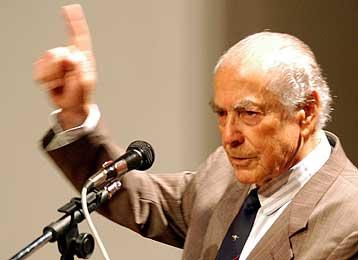
Leonel Brizola, 1922-2004

One question that has been preoccupying my thoughts recently has been the question of why the simple things are not being done in Rio to address the problems of the favelas: sanitation, education, healthcare etc… many of the people we have talked to look back to the regime of Leonel Brizola, the Governor of the State of Rio de Janeiro from 1983 to 1987 and then again from 1991 to 1994. Brizola was a left-progressive populist, a social democrat and a former opponent of the dictatorship who had had to live in exile for much of the 1970s. Sadly he died in 2004, but we had the opportunity this week to talk to his former Secretary of State for Public Security, and also briefly Governor himself from 1994-5, Nilo Batista.

We met Professor Batista in the Instituto Carioca de Crimonologia (ICC), an independent research organisation, which he runs (and funds from his legal work), along with his wife, sociologist, Vera Malaguti Batista. The Institute is housed in a sleek modern building up in the hills of Santa Teresa, from whose picture windows the city below is all but invisible and the bay appears almost as it was when Europeans first arrived. However, the concerns of the Institute are very much with the reality of the city today.

We had a long and wide-ranging conversation, which would be impossible to recount in detail here, but the basis of it was an understanding of Brazilian society, and in particular that of Rio, based on the ongoing legacies of the past, in particular slavery and authoritarianism. Vera Malaguti’s book, O Medo na Cidade do Rio de Janeiro: dois tempos de uma historia (Fear in the City of Rio de Janeiro: one story in two periods) examines previous periods of revolt by Africans in Brazil and argues that the often unspoken elite fear of the africanisation of Brazil. They argue that repressive public security strategies today are founded in this same fundamental fear, driven by the media that serves the powerful middle classes who aspire to elite values and lifestyles.

In opposition they place Brizola and that brief (and they argue, unrepeated) period at the end of the dictatorship when social justice and in particular, education, were priorities and favelas were provided with services in the same way as any other neighborhood. The security strategy of Brizola and Batista was effectively one of anti-stigmatisation. They argue that since then, media-driven fear and repression has been far more the norm and this had undermined the progress made under Brizola.The current public security-based strategy of the Governor Cabral and the ‘choque de ordem’ of Giuliani-wannabe Mayor Eduardo Paes, is one example. By concentrating on ‘pacifying’ one or two places as examples (Santa Marta and Cidade de Deus at present) without being able to afford the same strategy elsewhere, it constitutes simply a public relations exercise, and elsewhere repression without development continues as normal.

The Batistas are passionate and well-motivated, but there are many who argue that this picture of a progressive Brizola regime subsequently undermined by repressive policies is at the very least, a limited view. It was, after all, under Brizola that the traffickers grew in power and acquired weapons; the mid-eighties was the key period here as the cocaine trade grew from almost nothing to being the driving force of gang activity in Rio. This isn’t just a view held by political opponents: whilst he certainly does not (and could not with any justification) claim that the rise of the cocaine trade was anything to do with Brizola, Enrique Desmond Arias in Drugs and Democracy in Rio de Janeiro, argues that the personalist populism of Brizola undermined the leadership of the Community Associations in the favelas and left them open to co-option by drug gangs. When we visited the office of the current Secretary of State for Security, Jose Mariano Beltrami, and talked with his representative, it was quite strongly argued that Brizola neglected the issue of the growing arming and violence of drug traffickers, and also did nothing to solve the massive problem of police corruption (on which I will write more later). The current longer-term strategy is now to recruit a lot more Military Police, in the hope that numbers will do what force has not, and enable the gangs to be beaten.

We also visited the office of a leading critic of human rights abuses, Alessandro Mollon, a Deputy in the State parliament. He said that Beltrami is actually shifting, without ever having admitted to it, from a very macho and repressive approach when he first arrived from the southern state of Rio Grande do Sul, to a more considered (but hardly progressive) strategy now, of which the emphasis on police officers on the streets, rather than invasions, is one aspect.

Former Mayor of Rio, Cesar Maia

The claim that Brizola was the last real progressive figure to lead Rio also neglects some others, particularly those who have held the office of the Mayor. Under Cesar Maia (1993-7; 2001-2008), the ‘Favela Bairro’ program had much in common with what Brizola did in social terms. Indeed when we asked the leader of the Morro dos Prazeres Community Association what would be the one thing she wanted above all else, it was ‘more Favela Bairro’. In Dona Marta they also had some time for the former governor, Anthony Garotinho (1999-2002) a frankly quite foolish evangelical populist, currently under investigation for corruption, as is his wife, Rosinha, who was Governor from 2003-7. However, we heard from others that the things that they attribute to Garotinho were actually planned or initiated under previous administrations and just did not see the light until his.

What is certainly the case is that Brizola had a better attitude to the favelados as people, than other administrations, regardless of his mistakes. The current regime certainly seems to be more driven far more by middle-class fears than by social progress, but it is also the constant undermining of the progress of previous administrations like Brizola’s and then later Maia’s terms as Mayor by new waves of media-courting repression that is so depressing in Rio. It happens in every democratic country, but here in Brazil there is the most blatant inequality of any wealthy country still crying out to be addressed. If it was, then most of the issues of ‘crime’ and ‘insecurity’ would start to disappear. It would, as Deputado Mollon also pointed out, be a lot cheaper than the massive amounts of money now going into the hands or private security companies – who, as Professor Batista noted are often run by the families of senior police officers, who therefore have no actual interest in reducing crime and every reason to want to see fear continue to grow.

(With thanks to Nilo Batista, Vera Malaguti Batista, Alessandro Mollon and the staff of the office of Jose Mariano Beltrami for their time and patience. In particular, I hope to return to the Instituto Carioca de Criminologia sometime in the future to talk about the findings of this project, and to submit something to their excellent journal, Discursos Sediciosos: crime, direito e sociedade)

At the Instituto de Segurança Pública

Paola and I had a very productive interview with Colonel Mario Sergio de Brito Duarte, the Director President of the Institute for Public Security (ISP) in Rio de Janeiro. The ISP is a state-level organisation with multiple functions including research on public security and the compilation of crime statistics; professional development for the police services (and also more broadly to encourage greater cooperation and coordination between military and civil police); and community involvement and participation in the development of security policy. The Colonel gave us an hour and a half of his time to explain his view on a wide range of issues around crime, security, the problems of the favelas, and the potential for surveillance, social interventions and policing in solving these problems.

As with many senior police (and military) officers with whom I have talked over the years, the Colonel is an educated, thoughtful man who has strong views based in his experiences as a front-line officer with the Policia Militar in Rio (including some years in BOPE, the special operations section) – as detailed in his book, Incursionanda no Inferno (Incursions into the Inferno). Despite how the title may sound, he was far from being gung-ho or authoritarian in his views, emphasising throughout, as with almost everyone I have talked to, that socio-economic solutions will be the only long-term guarantee of public security in Rio. And he certainly had no sympathy for the illegal actions of militias, despite understanding why they emerged and continued to be supported by some sections of the community.

However, it was also clear to him that current policies like Mayor Eduardo Paes’ ‘choque de ordem’ strategy which involves demolitions of illegally-built houses in the favelas, was absolutely necessary as well. He spent some time outlining his view of the history of how drug gangs infiltrated and gained control of many favelas, an in particular the importance of their obtaining high quality small arms – though he was vague on exactly where these arms came from – I have, of course, heard allegations from other interviewees that corrupt soldiers and policemen were one common source of such weapons.

From the point of view of surveillance studies, it was notable how profoundly indifferent the Colonel appeared to be towards he growth of surveillance, and in particular CCTV cameras. He argued that they might be a useful supplement to real policing, but he certainly did not appear to favour a UK-style ‘surveillance society’ – of which, at least in Rio, there seems little sign as yet. He was similarly indifferent towards other central state social interventions like the Programa Bolsa Familia (PBF), and initiatives like ID cards – of course they might help in some way, but he certainly made no attempt to ague, as the UK government has done, that such technology will make a big difference to fighting crime and terrorism (indeed it was interesting that ‘terrorism’ was not mentioned at all – I guess that, when you have to deal with the constant reality of poverty, drugs and fighting between police and gangs, there is no need to conjure phantasms of terror). Even so, the Colonel recognised that the media in Rio did create fantasies of fear to shock the middle classes, and that this sensationalism did harm real efforts to create safer communities.

There was a lot more… but that will have to wait until I have had the whole interview transcribed and translated. In the meantime, my thanks to Colonel Mario Sergio Duarte and to the very nice and helpful ISP researcher Vanessa Campagnac, one of the authors of the analysis of the Rio de Janeiro Victimisation Survey, who talked to us about more technical issues around crime statistics.